




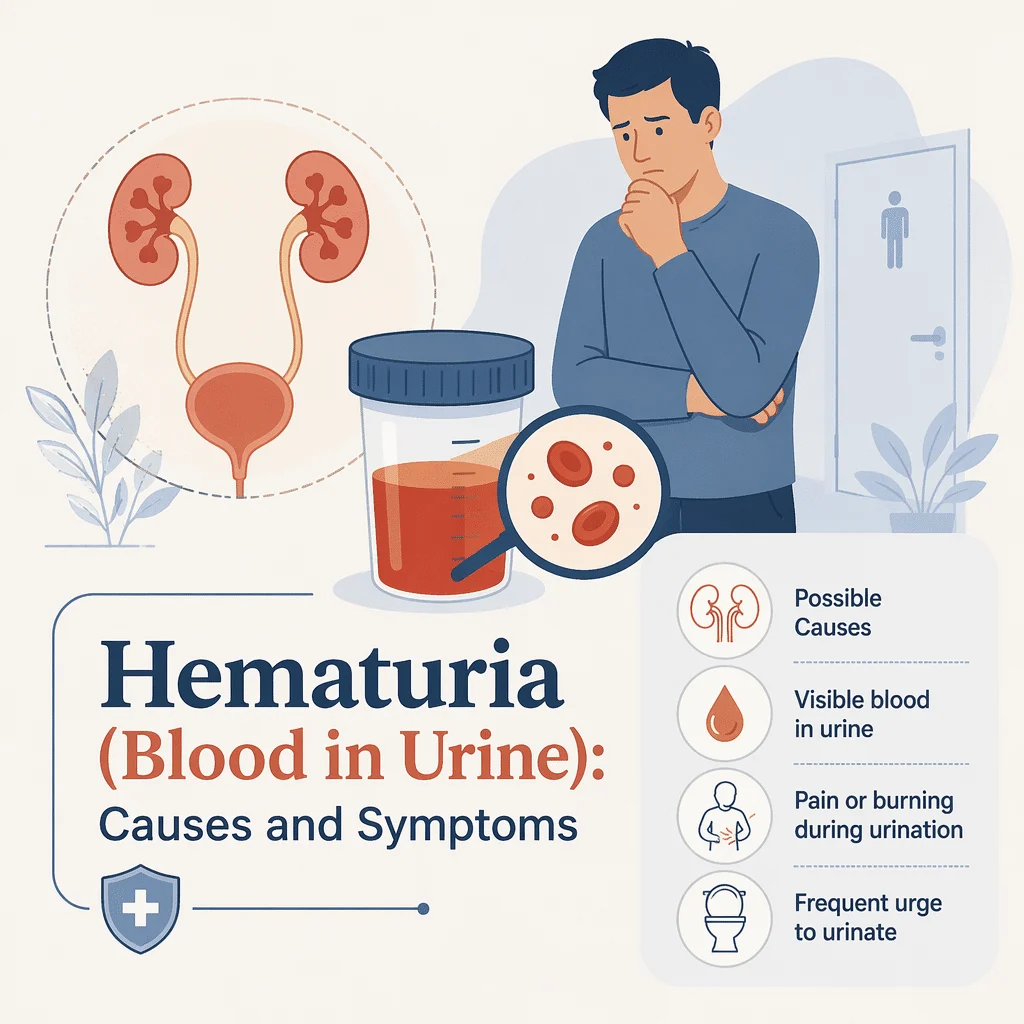
Finding blood in urine is frightening, and the instinct to wait and see is a very human one — especially when everything looks normal again the next morning. That instinct is the problem. In an adult, urine that looks red, pink, or like tea or cola needs to be assessed by a doctor, even if it happened once and stopped on its own.
In this article you’ll learn how visible and microscopic hematuria differ, what causes each, which findings point to the kidneys, why a blood thinner never explains bleeding away, what turns urine red without any blood being present, and how doctors work it out. The red-flag box below sets out what should not wait. For the wider picture of what a urine test measures, start with our urinalysis results interpretation guide.
Visible blood in urine versus microscopic hematuria
Hematuria means red blood cells in the urine. It comes in two forms, and they are not interchangeable.
Visible hematuria — also called gross or macroscopic hematuria — is blood you can see: urine that looks pink, red, rusty, or brown like tea or cola. It takes remarkably little blood to color a full bladder, so the shade tells you very little about how much you are losing. Concentration shifts it too, since the same trace looks darker in a small, strong first-morning sample — one of the things urine specific gravity describes.
Microscopic hematuria is invisible. It is picked up only when a sample is tested: the dipstick pad turns positive, or a laboratory sees red cells under the microscope. Most people who have it feel entirely well.
The distinction matters because the two are investigated differently. Visible blood carries more weight in an adult and prompts a fuller work-up. Microscopic blood is now approached with risk stratification: age, sex, smoking history and how many red cells were seen all feed into how intensively it is followed up, so two people with the same result may be offered different next steps.
Why visible blood in the urine always needs checking, even once
Here is the pattern that costs people the most. Someone passes red urine, it alarms them, and within a day or a week it has cleared. The bleeding stopping feels like the problem resolving. It is not. Bleeding from the urinary tract very often stops by itself whatever the cause, and a bladder tumor that bleeds once and then goes quiet is behaving exactly as bladder tumors typically behave.
Painless visible hematuria is the classic presenting feature of bladder cancer. The risk rises with age, with a smoking history, in men, and with certain occupational exposures — dyes, rubber, paints, leather and some industrial solvents. Smoking is the single biggest modifiable risk factor for bladder cancer, and the raised risk lingers for many years after quitting, which is why a former smoker’s history still counts. Most causes of blood in the urine are not cancer — and that is precisely why the minority that are must not be missed.
None of this means assuming the worst. It means the decision to be checked should not depend on whether the bleeding is still happening when you pick up the phone. Contact a doctor promptly about visible blood in the urine at any age, even if your urine has gone back to normal, and note the date, the color and anything you noticed alongside it.
Red flags: do not wait these out
- Visible blood in the urine at any age — contact a doctor promptly, even if it has already stopped.
- Blood with clots in the urine.
- Being unable to pass urine at all — this is an emergency.
- Fever together with pain in the flank or side.
- Heavy bleeding with dizziness, faintness or a racing heart — this is an emergency.
- Blood in the urine alongside unexplained weight loss or bone pain.
- Blood in the urine with swelling of the legs, face or hands, or with breathlessness.
The common causes of blood in urine
Most episodes have an explanation that has nothing to do with cancer.
- Urinary tract infection. An inflamed bladder lining bleeds, usually with burning, urgency and going more often. When blood appears alongside white cells on a test, infection moves up the list — our guide to leukocyte esterase on a urine test covers that combination and what it means when white cells appear without infection.
- Kidney and bladder stones. A stone scraping along the ureter causes severe, gripping loin-to-groin pain and often visible blood; see kidney stones for how they form and are treated.
- Prostate conditions. Benign prostatic enlargement is a frequent source of bleeding in older men, as is prostatitis, inflammation of the prostate gland.
- Vigorous exercise. Runner’s hematuria follows long or intense efforts and usually settles within a couple of days — but it is a conclusion reached after other causes are ruled out, not an assumption.
- Recent instrumentation or injury. A urinary catheter, a recent bladder or prostate procedure, or a blow to the back or abdomen can all cause bleeding.
Menstruation is the commonest source of contamination rather than a cause, so mention where you are in your cycle when you hand in a sample.
When the kidneys are the source
Some bleeding starts in the glomeruli, the kidney’s tiny filtering units, rather than in the plumbing below. The pattern looks different, and spotting it changes who you are referred to.
The first clue is color: glomerular bleeding tends to turn urine brown, smoky or cola-colored rather than bright red, and clots are unusual. The second is company. Blood together with protein points toward a kidney cause and usually prompts blood tests and a kidney specialist’s opinion — our article on protein in urine explains what proteinuria means and how it is measured.
Three patterns come up repeatedly:
- IgA nephropathy, also called Berger disease, classically causes visible blood during or within a day or two of a sore throat or other upper respiratory infection — a much shorter interval than in other kidney conditions.
- Thin basement membrane nephropathy, in which the filtering membrane is thinner than usual, often runs in families and shows up as persistent microscopic blood with normal kidney function.
- Post-infectious glomerulonephritis, which follows a streptococcal throat or skin infection by one to several weeks and can bring swelling and raised blood pressure.
Under the microscope, red cells from the kidney often look misshapen, and clumps called red cell casts may appear. Blood tests for kidney function usually follow — see high BUN and creatinine levels for what those numbers describe.
Blood thinners do not explain blood in the urine away
This runs against most people’s intuition. If you take warfarin, a direct oral anticoagulant, aspirin or another antiplatelet drug and you notice blood in your urine, the medicine is not the answer. At most it is part of it.
Anticoagulation does not conjure bleeding out of healthy tissue. It unmasks a lesion that was already there — a tumor, a stone, an inflamed prostate — by turning something that would have bled invisibly into something you can see. Research on people admitted to hospital with visible bleeding while taking these drugs finds a sizeable share have a urinary tract cancer that predates it. Guidelines are unambiguous: a person on a blood thinner with blood in the urine needs the same evaluation as anyone else, on the same timescale. Putting it down to the medication and stopping there is how diagnoses get missed, and patients and clinicians both do it.
Two practical points. Never stop, skip or adjust an anticoagulant or antiplatelet medicine yourself, and do not pause it before an appointment — these drugs are usually preventing something serious, and any change is a decision for the doctor who prescribed them. And bring an up-to-date list of everything you take, since interactions between these drugs can influence how bleeding behaves.
What looks like blood in the urine but is not
Red urine is not always blood, and a positive dipstick is not always red cells.
Foods and medicines that change urine color
Beetroot is the famous one: beeturia turns urine anything from pink to deep magenta and fades within a day or so. Blackberries, rhubarb and food colorings can do something similar. Among medicines, rifampin (an antibiotic) turns urine and other body fluids orange-red, phenazopyridine (a bladder painkiller) produces a vivid orange, nitrofurantoin can turn urine brown, and senna-based laxatives may give it a reddish tint. If you started something new in the days beforehand, say so — it is the quickest thing to rule in or out.
When the strip says blood but there are no red cells
The dipstick blood pad does not detect red cells directly. It detects haem, the iron-containing pigment carried inside them, so two other substances also turn it positive. Free hemoglobin, released when red cells break apart in the bloodstream, is one. Myoglobin is the other — a muscle protein released when muscle breaks down, as in rhabdomyolysis after extreme exertion, a crush injury, a long period lying immobile, or certain drug reactions. The urine can look brown, the strip reads positive, and there are no red cells to be found.
This is precisely why a positive dipstick is confirmed with microscopy: a strip that says blood while the microscope shows no red cells means something else is going on, and the next step is usually a blood creatine phosphokinase (CPK) measurement to look for muscle breakdown. Menstrual blood, finally, remains the commonest contaminant of a urine sample — not hematuria, but enough to make a result unreadable, so testing is often repeated once bleeding has finished.
How blood in the urine is investigated
The sequence is fairly consistent, and knowing it in advance helps.
It starts with confirmation. A dipstick result is checked with microscopy on a properly collected sample, because the strip alone cannot tell red cells from haem pigments. The same strip reports several pads at once, so your report may also flag glucose in the urine or ketones, which rarely relate to bleeding. If infection is suspected, a urine culture is sent. Blood tests check kidney function and blood count, and urine creatinine is often measured alongside protein so the protein figure can be read in context.
Imaging comes next when the picture calls for it. For visible bleeding in an adult, the kidneys and ureters are usually imaged with CT urography, a CT scan with contrast timed to outline the collecting system. Ultrasound is used where contrast or radiation is best avoided, for example in pregnancy or in younger people at low risk.
What a cystoscopy actually involves
Fear of this test is a genuine cause of delay, so it is worth describing plainly. Cystoscopy is a look inside the bladder using a thin telescope passed along the urethra. Most are done with a flexible instrument in an outpatient clinic, take a few minutes, and use a local anesthetic gel that numbs and lubricates while sterile fluid gently fills the bladder. For most people it is uncomfortable rather than painful — a stinging sensation and an urge to pass urine — and it is normal to sting a little when passing urine for a day afterwards. It remains the only test that sees the bladder lining directly.
For microscopic blood, how far this goes depends on risk. Low-risk people may be offered a repeat urine test or an ultrasound rather than the full work-up, while those at intermediate or high risk go on to cystoscopy and imaging — a deliberate change designed to spare low-risk people invasive tests without loosening the net around those who need them.
What you noticed, what it usually means, and what to do
This table is a guide to next steps, not a diagnosis, and nothing in it should be used to decide that visible blood is safe to ignore.
| What you noticed | What it usually points to | What to do |
|---|---|---|
| Pink or red urine once, then back to normal | Bleeding somewhere in the urinary tract; the fact that it stopped says nothing about the cause | Contact a doctor promptly, precisely because it has stopped |
| Cola-colored or smoky urine a day or two after a sore throat | A kidney (glomerular) pattern such as IgA nephropathy | Contact a doctor within a few days; expect urine and blood tests |
| Blood with burning, urgency and going very often | Urinary tract infection or bladder inflammation | See a doctor soon; a sample and a culture are usually needed |
| Blood found only on a test, with no symptoms at all | Microscopic hematuria, which may be persistent or a one-off | Follow the plan your doctor sets; repeat testing or risk-based assessment |
| Severe one-sided loin pain with visible blood | A stone moving down the ureter | Seek medical care the same day; pain relief and imaging |
| Red or orange urine after beetroot or a new medicine | Pigment rather than blood | Mention it to your doctor; a urine test settles it quickly |
| Brown urine after extreme exertion, with aching muscles | Possible muscle breakdown, releasing myoglobin rather than red cells | Seek medical care promptly; blood tests are needed |
Bleeding that recurs over months can quietly drain iron stores, which is one reason a blood count and iron studies are often checked; our guide to low ferritin explains what those results describe. If you are unsure how urgently to act, err toward being seen.
Latest scientific advances in evaluating blood in urine
Research over the past three years has concentrated on two things: matching the intensity of investigation to a person’s actual risk, and working out who most needs a camera test.
Risk-stratified evaluation of microscopic blood
What was found: in 2025 the American Urological Association and its partner society published an update to their microhematuria guideline. It revised the system that sorts people into low, intermediate and high risk, and added guidance on urine-based tumor markers and cytology (examining urine for cancer cells shed from the lining).
What this means for you: if blood was found only on a test, the plan you are offered should be tailored rather than one-size-fits-all, and it is reasonable to ask which risk group you fall into.
Bleeding while taking anticoagulants
What was found: a German hospital study of people admitted with visible bleeding recorded how many were taking anticoagulants or antiplatelet drugs, and what was uncovered when they were investigated. A substantial proportion had a pre-existing cancer of the urinary tract, and interactions between their medicines were common.
What this means for you: taking a blood thinner is a reason to be investigated properly, not a reason to stop looking for a cause.
Smoking history matters long after quitting
What was found: using a large US national health survey, researchers compared how long before diagnosis people with bladder cancer and with lung cancer had quit smoking. Bladder cancer appeared much further from the quit date, and the authors argued smoking history deserves more weight in hematuria risk models.
What this means for you: tell whoever assesses you that you used to smoke, even if you stopped decades ago. It is relevant information, not old news.
Urine biomarker tests alongside cystoscopy
What was found: a multicenter US study in Veterans Affairs clinics tested a urine biomarker panel — measuring cancer-associated gene activity and DNA changes in a urine sample — against cystoscopy in adults with visible or microscopic blood. It missed very few cancers and classified a large share of people as unlikely to have one, and a companion laboratory study confirmed the test performs consistently between sites.
What this means for you: tests like this are emerging as a way of sorting out who most needs a camera test. They work alongside cystoscopy rather than instead of it, so a reassuring urine result is not a reason to decline a test your doctor recommends.
What happens at the first appointment
What was found: a 2025 review of the literature and international guidance on handling blood in the urine in emergency and outpatient settings concluded that delayed recognition at first contact leads to missed cancers. It listed the features that should trigger prompt referral: visible bleeding, anemia, persistent symptoms and impaired kidney function.
What this means for you: the first appointment carries a lot of weight. Go with the dates, the color, any pain, your medication list and your smoking history.
Frequently asked questions
The blood stopped on its own — do I still need to see someone?
Yes. This is the single most important answer on this page. Bleeding from the urinary tract stops by itself in most cases, whatever caused it, so the bleeding settling tells you nothing reassuring about the cause. Painless visible bleeding that appears once and then disappears is a recognized way for serious conditions to announce themselves, and the reassurance people take from it is the main reason diagnoses get delayed. Contact a doctor promptly and describe what you saw, when, and how long it lasted, even if your urine has looked completely normal since.
Does blood in urine mean cancer?
Usually not. Infection, stones, prostate enlargement, strenuous exercise and kidney conditions account for far more cases than cancer does. But cancer is a real possibility, particularly with painless visible bleeding, in older adults, in men, and in current or former smokers, and it is the possibility that carries the highest cost if it is missed. Both halves of that sentence matter: most people will get a benign explanation, and the way everyone gets one is by being checked rather than by guessing.
Can my blood thinner cause blood in my urine?
Anticoagulants and antiplatelet drugs make bleeding more visible, but they do not create it out of nothing. The usual situation is that something in the urinary tract was already bleeding in a small way, and the medication turned it into something you can see. Guidelines are clear that people taking these drugs need the same evaluation as everyone else. Report it to your doctor and keep taking your medication exactly as prescribed — never stop, skip or adjust an anticoagulant on your own, because it is almost certainly preventing something serious.
What causes blood in urine in women?
The commonest causes are urinary tract infections, which are far more frequent in women, followed by stones and, less often, kidney conditions. Menstrual blood contaminating a sample is a frequent explanation for an unexpected result rather than a cause of true hematuria, so timing the test outside your period usually clarifies things. Visible blood in a woman’s urine still deserves the same prompt assessment as in anyone else — being younger or female lowers the odds of a serious cause but does not remove them.
What do blood clots in urine mean?
Clots indicate that enough blood entered the urinary tract for it to coagulate, which generally points to a source in the bladder, prostate or kidney rather than to a glomerular kidney problem. Clots also matter practically, because they can block the flow of urine. Blood with clots warrants urgent medical attention, and being unable to pass urine at all is an emergency that needs same-day care.
Can exercise cause blood in urine, and how long should it last?
Yes. Long-distance running, rowing and other prolonged or high-impact efforts can produce temporary bleeding, usually microscopic and occasionally visible, and it typically clears within a couple of days of rest. The catch is that exercise is a diagnosis of exclusion. If you have visible blood, tell your doctor about the training rather than deciding it explains everything, and if blood is still present on a repeat test after rest, it needs investigating like any other episode.
Glossary
| Term | Definition |
|---|---|
| Hematuria | The presence of red blood cells in the urine, whether or not you can see them. |
| Gross (visible) hematuria | Blood present in enough quantity to change the color of the urine to pink, red, rusty or brown. |
| Microscopic hematuria | Red cells detected only by testing a sample, with urine that looks completely normal. |
| Haem | The iron-containing pigment inside red blood cells that the dipstick blood pad reacts to. |
| Myoglobin | A muscle protein released when muscle breaks down; it turns the blood pad positive without any red cells being present. |
| Rhabdomyolysis | Breakdown of muscle tissue that releases myoglobin into the blood and urine. |
| Glomerulus | One of the kidney’s microscopic filtering units; bleeding from here is called glomerular. |
| Red cell cast | A small tube-shaped clump of red cells formed inside a kidney tubule, pointing to a kidney source. |
| Cystoscopy | An examination of the inside of the bladder using a thin telescope passed along the urethra. |
| CT urography | A CT scan with contrast, timed to outline the kidneys, ureters and bladder. |
Sources
- National Institute of Diabetes and Digestive and Kidney Diseases (NIDDK). Hematuria (Blood in the Urine). niddk.nih.gov
- National Cancer Institute (NCI). What Is Bladder Cancer? cancer.gov
- MedlinePlus Medical Encyclopedia, US National Library of Medicine. Urine – bloody. medlineplus.gov
- Gross and Microscopic Hematuria. StatPearls, NCBI Bookshelf, US National Library of Medicine. ncbi.nlm.nih.gov
- Barocas DA, Lotan Y, Matulewicz RS, Raman JD, Westerman ME, Kirkby E, Pak LJ, Souter L. Updates to Microhematuria: AUA/SUFU Guideline (2025). The Journal of Urology, 2025. doi.org/10.1097/JU.0000000000004490
- Lawaczeck L, Slomma R, Stenzl A, Aufderklamm S, Norz V, Hammes J, Lipp HP, Rausch S. Gross Hematuria Associated with Anticoagulants and Antiplatelet Drugs: Analysis of Current Treatment Standards and Relevance of Co-medication and Pharmacological Interactions. European Urology Focus, 2023. doi.org/10.1016/j.euf.2023.09.004
- Beatrici E, Labban M, Filipas DK, Stone BV, Reis LO, Dagnino F, Lughezzani G, Buffi NM, Lipsitz SR, Clinton TN, Matulewicz RS, Trinh QD, Cole AP. Smoking characteristics and years since quitting smoking of US adults diagnosed with lung and bladder cancer: A national health and nutrition examination survey analysis. International Brazilian Journal of Urology, 2024. doi.org/10.1590/S1677-5538.IBJU.2023.0625
- Savage SJ, Ercole CE, Hemstreet G, Leone A, Masterson T, McWilliams G, Risk M, Schroeck FR, Stratton K, Lough T, de Lange M, Sakamoto K. Diagnostic performance of Cxbladder Triage Plus for the identification and stratification of patients at risk for urothelial carcinoma: The multicenter, prospective, observational DRIVE study. Urologic Oncology, 2025. doi.org/10.1016/j.urolonc.2025.10.008
- Harvey JC, Fletcher D, Ellen CW, Colonval M, Hazlett JA, Zhou X, Newell JM. Analytical Validation of the Cxbladder Triage Plus Assay for Risk Stratification of Hematuria Patients for Urothelial Carcinoma. Diagnostics, 2025. doi.org/10.3390/diagnostics15141739
- Szymkiewicz S. Clinical Significance, Differential Diagnosis and Initial Management of Hematuria in Emergency and Outpatient Settings. Cureus, 2025. doi.org/10.7759/cureus.91639
Further reading
- Urinalysis results: how to read the full report
- Bladder cancer: symptoms and warning signs
- Urine crystals: causes and risks
- Foamy urine explained: causes and risks
- PSA (prostate-specific antigen): what the test shows
Understand your lab results with AI DiagMe
A urinalysis report is hard to read on your own: red blood cells, protein, creatinine and, on a separate blood panel, PSA all arrive as numbers with very little explanation attached. AI DiagMe turns those results into plain language so you can walk into your appointment knowing what to ask. It helps you understand your results; it does not diagnose, and it does not replace your doctor. It is also not a substitute for being seen about visible blood in your urine, which always needs assessment by a clinician.
Get your results interpreted in minutes