If you have been making yourself sick, or you have just found out that someone you love has been, this page is written for both of you. Self-induced vomiting is not a character flaw and not something anyone chooses lightly. It is a symptom, most often of an illness, and illnesses can be treated. There is a support box directly below this paragraph with people you can speak to today, before you read another word.
What follows explains what self-induced vomiting is, why it happens, why it is genuinely hard to stop, what it does to the body, and what treatment and recovery actually look like. It is written to be read wherever you happen to be right now, including if you are not ready to change anything yet.
Talk to someone today
You do not have to be sure you have an eating disorder, and you do not have to be ready to stop, to use any of these.
- National Alliance for Eating Disorders helpline: call 1-866-662-1235, Monday to Friday, 9 am to 7 pm ET. The line is answered by licensed therapists who specialize in eating disorders, and they can help you find care near you. More on their Find Treatment page.
- If you are in crisis or having thoughts of suicide: call or text 988, the 988 Suicide & Crisis Lifeline. It is free, confidential and open every hour of every day.
- If someone is in immediate physical danger, call 911.
If calling feels like too much right now, telling one person you trust also counts.
What self-induced vomiting is, and who it affects
Self-induced vomiting is when a person deliberately makes themselves sick. Clinicians group it under the broader term purging, and it is a recognized symptom rather than a diagnosis in its own right.
It occurs in bulimia nervosa, where it typically follows episodes of eating that felt out of control. It occurs in the binge-purge subtype of anorexia nervosa. It occurs in other eating disorders, including those that do not fit neatly into a named category. And it sometimes happens for reasons that have little to do with an eating disorder at all, such as trying to relieve painful fullness. All of it deserves the same response: curiosity and care, not judgement.
Here is the thing that keeps far too many people away from help. You cannot tell whether someone has an eating disorder by looking at them, and most people who live with one are not underweight. Eating disorders occur across every body size, every gender, every age and every background. Someone can be desperately unwell and look entirely unremarkable to everyone around them.
This matters because a great many people quietly conclude that they are not sick enough to take up a professional’s time. That belief is a symptom of the illness talking, not an accurate reading of your situation. There is no threshold you have to cross first.
Why it happens, and why it is so hard to stop
People arrive here by very different routes. Sometimes it starts after a period of restricting food, when the body’s hunger becomes overwhelming and eating slips into something that feels uncontrollable. Sometimes it follows a comment about a body, or bullying, or a diet that was praised. Sometimes it grows out of anxiety, depression, trauma or a need to feel that at least one thing is manageable when everything else is not.
Genetics, brain chemistry, temperament and life events all contribute. No one causes their own eating disorder, and no parent causes their child’s.
What makes it so difficult to stop is that the behavior becomes self-reinforcing. There is distress. Then there is a short, real sense of relief or emptying. Then, very often, shame arrives, and shame is itself distressing, which brings the whole loop back round to the beginning. Each turn makes the next one a little more automatic.
That cycle is a recognized clinical feature of eating disorders. It is described in every serious textbook on the subject. If you have tried to stop on your own and not managed it, you have run into the actual mechanics of an illness. That is information about the illness, not about you.
What it does to the body
These consequences are worth knowing plainly, because they are the reason a doctor should be involved. They are not listed to frighten anyone.
Electrolytes and the heart
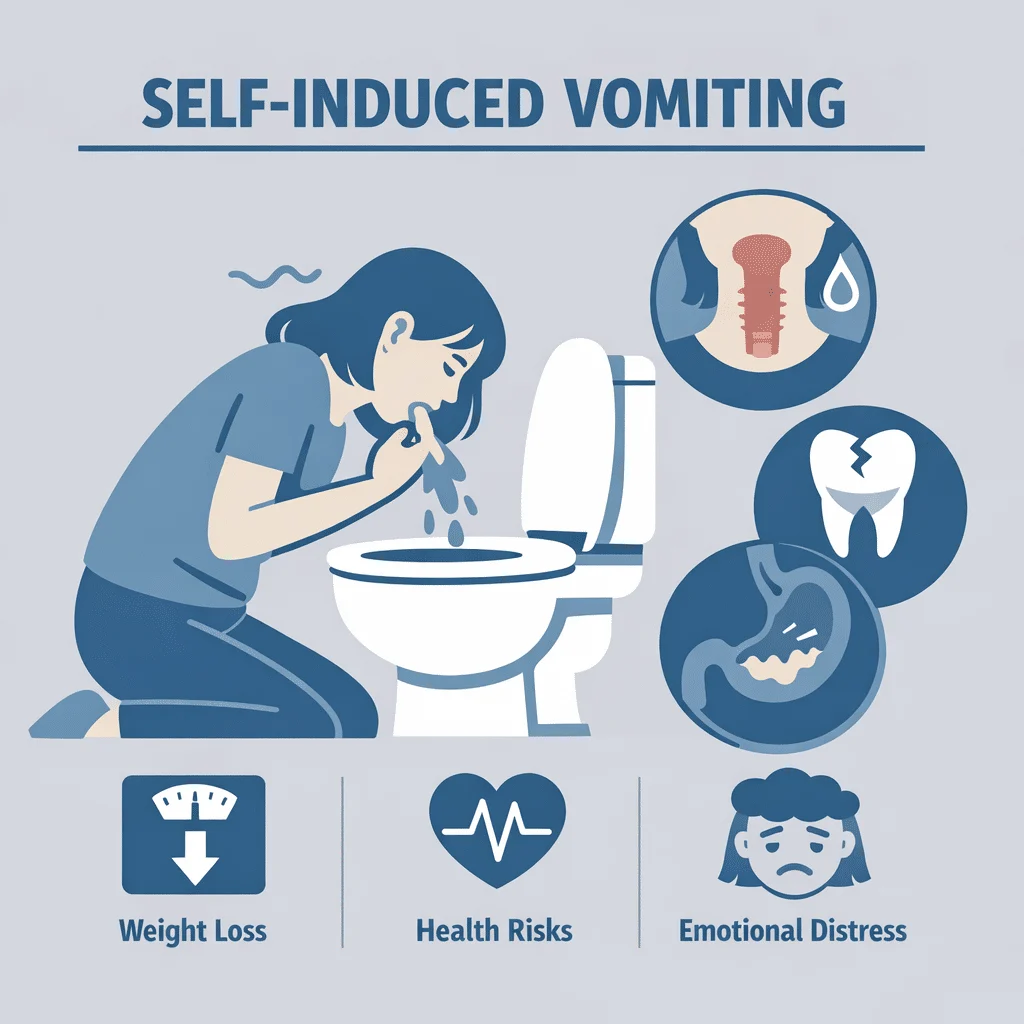
This is the most important paragraph on the page. The greatest immediate danger from repeated vomiting is electrolyte disturbance. Vomiting depletes potassium, and low potassium, called hypokalemia, can disturb the heart’s electrical rhythm. Severe disturbances of heart rhythm can be fatal, and this is the mechanism behind most sudden deaths associated with purging.
Sodium, chloride and magnesium can also fall, and the blood can become too alkaline, a state called metabolic alkalosis. A doctor can pick all of this up with a simple blood test such as an electrolyte panel, usually alongside a tracing of the heart. This is a reason to be seen, not a reason to panic.
Teeth, mouth and throat
Stomach acid softens and wears away tooth enamel, which does not grow back, and the teeth become more sensitive and more prone to decay. The salivary glands near the jaw can swell. The throat becomes sore and inflamed, and reflux is common enough that some people first seek help for a persistent cough caused by acid reflux.
One genuinely useful thing to know: brushing your teeth straight after vomiting makes enamel damage worse, because the enamel is temporarily softened and brushing scrubs it away. Rinsing your mouth with plain water is kinder to your teeth. That is damage limitation, not encouragement, and it is not a substitute for seeing a dentist, who can protect what is there and who will have seen this many times before.
The rest of the body
Repeated vomiting can tear the lining of the esophagus, which causes bleeding. It causes dehydration, which in turn strains the kidneys, something a doctor may see as raised BUN and creatinine on a kidney function panel. Periods can become irregular or stop altogether, and a late or missing period is sometimes what first brings someone to a doctor.
Clinicians sometimes notice calluses on the knuckles, known as Russell’s sign. It is named here only because you may encounter the term, not as something to look for in another person.
What it does not do
This is worth saying once, plainly. Purging does not deliver what the illness promises it will. The relief is brief, the body does not end up where the illness says it will, and what it reliably produces instead is physical harm and a tighter grip.
That is not an argument for doing it differently or more carefully. It is one of the clearest arguments for getting treatment, because treatment addresses the thing that is actually driving it.
Treatment, and what recovery actually looks like
Recovery is possible, and treatment works. That is not a slogan; it is the consistent finding of decades of follow-up research, and it includes people who have been unwell for many years.
Treatment is usually built from a few components, described here so they are less unfamiliar, not prescribed:
- Psychological therapy, which does most of the work. Enhanced cognitive behavioral therapy, known as CBT-E, has the strongest evidence base for adults and adolescents. For younger people, family-based treatment, which brings parents in as allies rather than supervisors, is the other well-evidenced option.
- Medical monitoring, which usually means periodic checks of electrolytes, kidney function and the heart, so that nothing dangerous goes unnoticed while the rest of the work happens.
- Dietetic support, to rebuild a pattern of eating that makes the cycle less likely to fire. Regular eating is one of the most effective things there is against binge-purge cycles.
- Medication in some cases, decided with a doctor, often where depression or anxiety sits alongside the eating disorder.
Recovery is rarely a straight line. Most people have setbacks, and a setback is a normal part of the process rather than evidence that treatment has failed. Many of the physical effects, including the cardiovascular ones, improve substantially once eating stabilizes and purging stops. Teeth are the main exception, which is why seeing a dentist early is worth it.
Taking a first step
The step does not have to be large. In practice, most people start with one of these:
- Booking with a GP or primary care doctor and saying one honest sentence. You do not need a speech prepared. “I have been making myself sick and I need help” is enough, and it is a sentence they have heard before.
- Speaking to a school or university counselor, who can usually see you quickly and without a referral.
- Calling the helpline in the box above, where the person answering is a therapist who does this specific work.
- Telling one trusted person, and letting them make the first call with you or for you.
Getting help earlier makes treatment easier, which is a reason to move now rather than a reason to feel behind. If you have already lost years to this, treatment still works, and services are used to meeting people at that point.
If you are worried about someone
Being the person who notices is hard, and it is easy to do the loving thing in a way that backfires. Broadly: connection helps, control does not.
Starting the conversation
Pick a private, unhurried moment, away from a meal.
Things that tend to help:
- “I have noticed you seem to be having a hard time, and I care about you. How are you really doing?”
- “You do not have to tell me anything. I just want you to know I am here and I am not going anywhere.”
- “Would it help if I found some options, or came with you to see someone?”
- Then listening, without fixing, and without needing them to agree with you today.
Things that tend to make it worse: policing meals or bathrooms, monitoring what they eat, issuing ultimatums, expressing shock or disgust, and commenting on their appearance or their body in any direction at all, including compliments. Praise about how someone looks lands very differently inside an eating disorder than it does outside one.
You may be met with denial, anger or a flat no. That is common and it is not a failure. Keep the door open, say it again another day, and get support for yourself too. The helpline above takes calls from families and friends as well as from people who are unwell.
When it is a medical emergency
Most of the time this is not an emergency, and the right route is a doctor’s appointment. Occasionally it is urgent.
Seek emergency care now
Call 911 or go to an emergency department if you or someone else has:
- chest pain, palpitations, or a heart that is racing or beating irregularly
- fainting, a seizure, confusion, or severe muscle weakness
- vomit containing blood, or severe pain in the chest, throat or abdomen
- difficulty breathing after being sick
- thoughts of ending your life, or of seriously harming yourself
If you are having thoughts of suicide, call or text 988 at any hour. Emergency staff treat this as a medical problem, which is exactly what it is.
Latest scientific advances in treatment and recovery
Research published since 2023 has been reassuring in several directions at once, and most of it points the same way: towards treatment being worth starting.
A review of cardiovascular complications in eating disorders concluded that most of the heart-related abnormalities seen in these illnesses, including those driven by electrolyte disturbance, are fully reversible once nutrition is restored and purging stops. That is one of the most hopeful findings in this field, and it is a direct argument for getting medical care rather than avoiding it.
A comprehensive review of renal and electrolyte complications set out why clinicians pay such close attention to potassium, sodium and acid-base balance in people who purge, and why chronic depletion can affect the kidneys over time. The practical message is that these are things a doctor should check and manage, not things anyone should try to interpret alone.
On treatment, a 2024 review of CBT-E for adolescents described it as achieving outcomes comparable to family-based treatment, giving young people and families a genuine choice between two well-evidenced approaches, which matters when one of them is not a good fit.
A systematic review of dental erosion in eating disorders confirmed the strong link with self-induced vomiting and argued for dental involvement early, both to protect teeth and because dentists are often the first professionals in a position to notice.
Perhaps most useful of all, a 2024 qualitative study of young people who developed an eating disorder while living in a larger body found that feeling “not sick enough” was among the most commonly reported barriers to their own recovery, alongside experiences of weight stigma. It is research that says, in effect, what this page has already said: the sense that you do not qualify for help is one of the illness’s most effective defences, and it is wrong.
Glossary
| Term | Definition |
|---|---|
| Purging | The clinical umbrella term for behaviors intended to compensate for eating. Self-induced vomiting is one of them. |
| Electrolytes | Minerals in the blood, such as potassium, sodium, chloride and magnesium, that carry the electrical signals nerves and muscles run on. |
| Hypokalemia | A lower than normal level of potassium in the blood. It is the disturbance most likely to affect heart rhythm. |
| Metabolic alkalosis | A state in which the blood becomes too alkaline. Repeated vomiting is one recognized cause. |
| Bulimia nervosa | An eating disorder involving episodes of eating that feel out of control, followed by compensatory behaviors. |
| Anorexia nervosa, binge-purge subtype | A form of anorexia nervosa in which restriction is accompanied by episodes of bingeing and purging. |
| CBT-E | Enhanced cognitive behavioral therapy, a talking therapy designed specifically for eating disorders and used across diagnoses. |
| Family-based treatment | An approach for children and adolescents in which parents are supported to take an active part in their child’s recovery. |
| Dental erosion | Loss of tooth enamel caused by acid. Enamel does not regenerate, so dental care is preventive as much as restorative. |
| Russell’s sign | Calluses on the knuckles that clinicians sometimes observe. It is a clinical observation, not a diagnostic test. |
Frequently asked questions
Can you actually recover from this?
Yes. Clearly and genuinely yes. Eating disorders are treatable, and long-term follow-up studies show that people recover fully, including people who were unwell for many years before they got help. Recovery usually is not tidy, and setbacks along the way are normal rather than disqualifying. What makes the difference is getting into treatment and staying connected to it, not getting it right first time. If you take nothing else from this page, take that.
Is it still a problem if I am not underweight?
Yes, and this question stops more people from getting help than almost anything else. Most people with eating disorders are not underweight, and the medical risks of purging, particularly to electrolytes and the heart, do not depend on body size at all. Research on this specific point has found that feeling “not sick enough” is one of the biggest barriers people face to their own recovery. You qualify for help because you are struggling. That is the whole criterion.
How do I tell someone?
Shorter is easier than you think. One sentence will do it: “I have been making myself sick and I need some help.” You can send it as a message rather than say it out loud, and you can send it to a doctor, a school counselor, a helpline or one person you trust. You do not have to explain, justify or answer questions you are not ready for. If it helps, write the sentence down first and read it out.
Do I have to have a diagnosis before I can get help?
No. You do not need a label, a referral or a certainty about what is going on. Clinicians and helplines are used to people arriving with “something is wrong and I do not know what to call it.” The assessment is part of the help, not a gate you have to pass through to reach it.
Why do I feel so ashamed about this?
Because shame is part of how the illness works, not a verdict on you. It thrives on secrecy, and it is very good at convincing people that they are uniquely disgusting. In reality this is a common symptom of a common illness, and the professionals who treat it are not shocked by it. The first time you say it out loud is nearly always the worst it feels.
What will a doctor actually do?
Usually they will ask some questions, examine you, and arrange blood tests to check things like electrolytes and kidney function, often with a tracing of the heart. They may check your teeth or suggest a dentist. Then they will talk to you about therapy options and referral. They are not there to weigh your character.
Where to find support
- National Alliance for Eating Disorders helpline: 1-866-662-1235, Monday to Friday, 9 am to 7 pm ET, answered by licensed eating disorder therapists, with referrals to treatment. See their Find Treatment page.
- 988 Suicide & Crisis Lifeline: call or text 988, or chat online through 988lifeline.org, free and confidential, 24 hours a day.
- In an emergency, call 911 or go to your nearest emergency department.
Recovery is possible, and people find their way to it from every possible starting point.
Sources
- Eating Disorders — National Institute of Mental Health (NIMH)
- Eating Disorders — MedlinePlus, U.S. National Library of Medicine
- Bulimia nervosa — Office on Women’s Health, U.S. Department of Health and Human Services
- Friars D, Walsh O, McNicholas F. Assessment and management of cardiovascular complications in eating disorders. Journal of Eating Disorders. 2023;11(1):13. https://doi.org/10.1186/s40337-022-00724-5
- Puckett L. Renal and electrolyte complications in eating disorders: a comprehensive review. Journal of Eating Disorders. 2023;11(1):26. https://doi.org/10.1186/s40337-023-00751-w
- Dalle Grave R, Calugi S. Enhanced cognitive behaviour therapy for adolescents with eating disorders: development, effectiveness, and future challenges. BioPsychoSocial Medicine. 2024;18(1):18. https://doi.org/10.1186/s13030-024-00315-7
- Nijakowski K, Jankowski J, Gruszczyński D, Surdacka A. Eating Disorders and Dental Erosion: A Systematic Review. Journal of Clinical Medicine. 2023;12(19):6161. https://doi.org/10.3390/jcm12196161
- Jhe GB, Recto M, Vitagliano JA, Rose KL, Richmond T, Freizinger M, Lin J. Growing up in a larger body: youth- and parent-reported triggers for illness and barriers to recovery from anorexia nervosa. Journal of Eating Disorders. 2024;12(1):192. https://doi.org/10.1186/s40337-024-01156-z
Further reading
- Vomiting bile: causes, symptoms and treatments
- Nighttime nausea: causes, symptoms and treatments
- Urinalysis results: an interpretation guide
- Black spot on the tongue: causes, symptoms and treatments
- Low ferritin: causes, symptoms and treatment
Understand your lab results with AI DiagMe
If a doctor is looking after you, they may check things like potassium, sodium and kidney function, and those results can be hard to read on your own. AI DiagMe can help you understand what the numbers mean so you can ask better questions at your next appointment.
It does not diagnose anything, it does not monitor an eating disorder, and it is not a substitute for care from your doctor or therapist. It is not for emergencies.
Get your results interpreted in minutes