Se você tem se provocado vômitos, ou acabou de descobrir que alguém que você ama está fazendo isso, esta página foi escrita para vocês dois. O vômito autoinduzido não é um defeito de caráter, nem algo que alguém escolhe de forma leviana. É um sintoma — na maioria das vezes, de uma doença — e doenças têm tratamento. Logo abaixo deste parágrafo há uma caixa de apoio com pessoas com quem você pode conversar hoje, antes mesmo de continuar lendo.
O que vem a seguir explica o que é o vômito autoinduzido, por que ele acontece, por que é genuinamente difícil parar, o que ele faz ao corpo e como são o tratamento e a recuperação na prática. O texto foi escrito para ser lido onde quer que você esteja agora — inclusive se você ainda não está pronto para mudar nada.
Fale com alguém hoje
Você não precisa ter certeza de que tem um transtorno alimentar, nem estar pronto para parar, para usar qualquer um desses recursos.
- Central de ajuda da National Alliance for Eating Disorders: ligue para 1-866-662-1235, de segunda a sexta-feira, das 9h às 19h (horário de Brasília). A linha é atendida por terapeutas especializados em transtornos alimentares, que podem ajudar você a encontrar atendimento perto de você. Saiba mais no site deles página Encontre Tratamento.
- Se você está em crise ou tendo pensamentos de suicídio: no Brasil, ligue para o 188 (CVV), gratuito e 24 horas. Nos Estados Unidos, 988 Suicide & Crisis Lifeline. É gratuito, confidencial e funciona 24 horas por dia, todos os dias.
- Se alguém estiver em perigo físico imediato, ligue para o 192 (SAMU) ou 193 (Bombeiros).
Se ligar parece demais agora, contar para uma pessoa de confiança também é um passo válido.
O que é o vômito autoinduzido e quem ele afeta
O vômito autoinduzido ocorre quando uma pessoa deliberadamente provoca o próprio vômito. Os profissionais de saúde o classificam dentro do termo mais amplo de purgação, e ele é reconhecido como um sintoma — não como um diagnóstico em si.
Ele ocorre na bulimia nervosa, onde geralmente vem após episódios de alimentação que pareceram fora de controle. Ocorre no subtipo compulsão-purgação da anorexia nervosa. Ocorre em outros transtornos alimentares, incluindo aqueles que não se encaixam perfeitamente em uma categoria definida. E às vezes acontece por razões que têm pouco a ver com um transtorno alimentar, como tentar aliviar uma sensação dolorosa de estômago cheio. Tudo isso merece a mesma resposta: curiosidade e cuidado, não julgamento.
Este é o fator que afasta pessoas demais de buscar ajuda. Não é possível saber se alguém tem um transtorno alimentar só de olhar, e a maioria das pessoas que convive com um não está abaixo do peso. Os transtornos alimentares afetam pessoas de todos os tipos de corpo, gêneros, idades e origens. Alguém pode estar gravemente mal e parecer completamente normal para todos ao redor.
Isso importa porque muitas pessoas concluem em silêncio que não estão doentes o suficiente para ocupar o tempo de um profissional. Essa crença é um sintoma da própria doença falando, não uma leitura precisa da sua situação. Não existe nenhum limite que você precise cruzar antes.
Por que acontece e por que é tão difícil parar
As pessoas chegam aqui por caminhos muito diferentes. Às vezes começa após um período de restrição alimentar, quando a fome do corpo se torna avassaladora e comer escorrega para algo que parece incontrolável. Às vezes surge após um comentário sobre o corpo, bullying ou uma dieta que foi elogiada. Às vezes cresce a partir de ansiedade, depressão, trauma ou da necessidade de sentir que pelo menos uma coisa está sob controle quando tudo o mais não está.
Genética, química cerebral, temperamento e experiências de vida contribuem para isso. Ninguém causa o próprio transtorno alimentar, e nenhum pai ou mãe causa o do filho.
O que torna tão difícil parar é que o comportamento se torna autorreforçador. Há sofrimento. Depois vem uma breve e real sensação de alívio ou esvaziamento. Então, com muita frequência, chega a vergonha — e a vergonha em si é angustiante, o que faz o ciclo inteiro voltar ao começo. Cada volta torna a próxima um pouco mais automática.
Esse ciclo é uma característica clínica reconhecida dos transtornos alimentares. Está descrito em todos os livros especializados sobre o assunto. Se você já tentou parar sozinho e não conseguiu, é porque esbarrou na mecânica real de uma doença. Isso é uma informação sobre a doença, não sobre você.
O que faz ao corpo
Vale conhecer essas consequências de forma clara, pois é por isso que um médico deve ser envolvido. Elas não estão listadas aqui para assustar ninguém.
Eletrólitos e o coração
Este é o parágrafo mais importante desta página. O maior risco imediato dos vômitos repetidos é o desequilíbrio de eletrólitos. Os vômitos reduzem potássio, e o potássio baixo, chamado hipocalemia, pode alterar o ritmo elétrico do coração. Distúrbios graves do ritmo cardíaco podem ser fatais, e esse é o mecanismo por trás da maioria das mortes súbitas associadas à purgação.
Sódio, cloreto e magnésio também pode cair, e o sangue pode ficar alcalino demais, um estado chamado alcalose metabólica. Um médico consegue identificar tudo isso com um simples exame de sangue, como um painel de eletrólitos, geralmente junto com um eletrocardiograma. Isso é um motivo para ser avaliado, não para entrar em pânico.
Dentes, boca e garganta
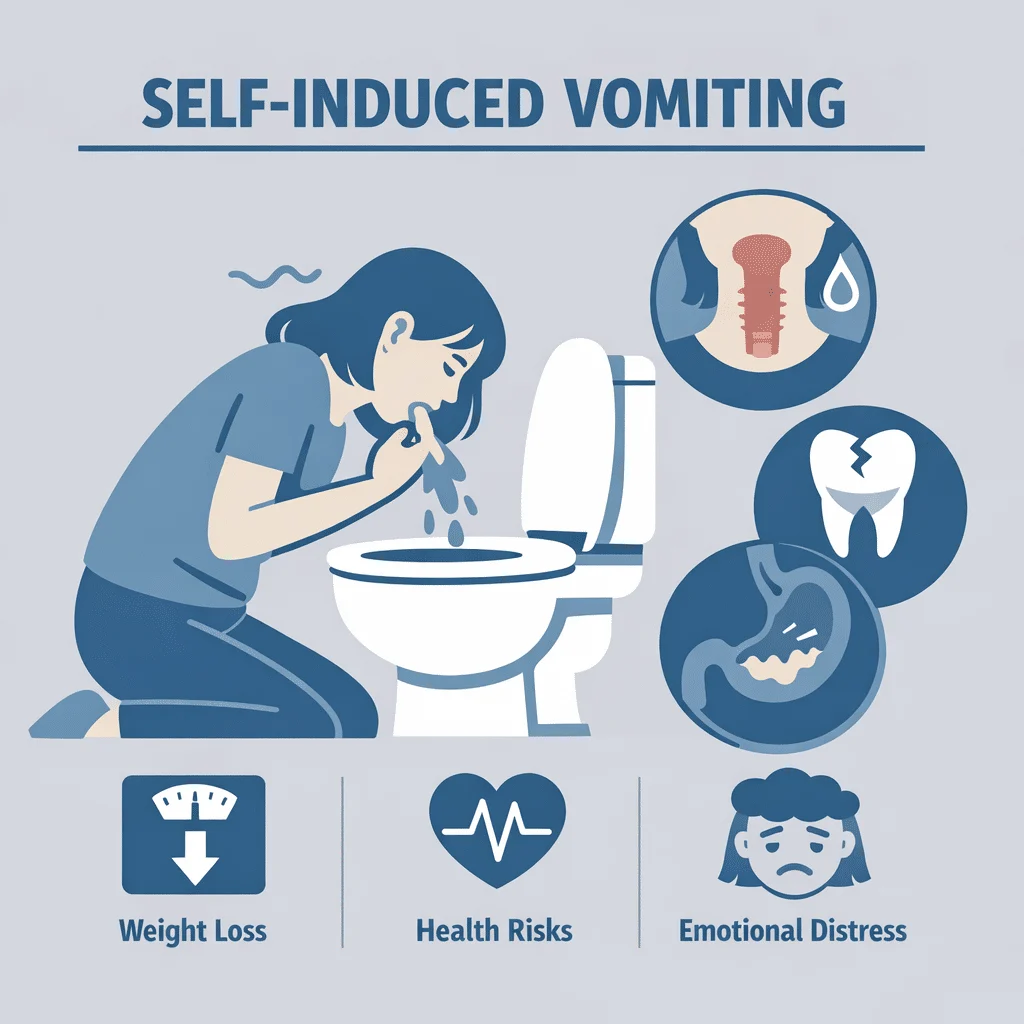
O ácido do estômago amolece e corrói o esmalte dos dentes, que não se regenera, tornando-os mais sensíveis e mais suscetíveis a cáries. As glândulas salivares próximas à mandíbula podem inchar. A garganta fica irritada e inflamada, e o refluxo é tão frequente que algumas pessoas procuram ajuda pela primeira vez por causa de uma tosse persistente causada pelo refluxo ácido.
Uma informação realmente útil: escovar os dentes logo após vomitar piora o dano ao esmalte, porque ele fica temporariamente amolecido e a escovação o desgasta ainda mais. Enxaguar a boca com água pura é mais gentil para os dentes. Isso é uma medida para limitar os danos, não um incentivo, e não substitui a consulta ao dentista, que pode proteger o que ainda está preservado e que já viu essa situação muitas vezes.
O restante do corpo
Vômitos repetidos podem lacerar o revestimento do esôfago, causando sangramento. Isso provoca desidratação, o que por sua vez sobrecarrega os rins — algo que o médico pode identificar como ureia (BUN) e creatinina elevadas em um painel de função renal. O ciclo menstrual pode se tornar irregular ou parar completamente, e atraso ou ausência de menstruação é o que às vezes leva alguém ao médico pela primeira vez.
Os profissionais de saúde às vezes observam calosidades nos nós dos dedos, conhecidas como sinal de Russell. O termo é mencionado aqui apenas porque você pode encontrá-lo, não como algo a procurar em outra pessoa.
O que isso não faz
Vale dizer isso uma vez, com clareza. A purgação não entrega o que a doença promete. O alívio é breve, o corpo não chega ao lugar que a doença diz que chegará, e o que ela produz de forma consistente são danos físicos e um controle cada vez mais forte.
Isso não é um argumento para fazer diferente ou com mais cuidado. É um dos argumentos mais claros para buscar tratamento, porque o tratamento aborda o que realmente está impulsionando esse comportamento.
Tratamento e como é a recuperação de verdade
A recuperação é possível, e o tratamento funciona. Isso não é um slogan; é o que décadas de pesquisas de acompanhamento mostram de forma consistente, incluindo pessoas que convivem com a doença há muitos anos.
O tratamento geralmente é composto por alguns elementos, descritos aqui para que sejam menos desconhecidos, não como prescrição:
- Terapia psicológica, que realiza a maior parte do trabalho. A terapia cognitivo-comportamental aprimorada, conhecida como TCC-E, tem a base de evidências mais sólida para adultos e adolescentes. Para pessoas mais jovens, o tratamento baseado na família, que envolve os pais como aliados e não como supervisores, é a outra opção bem fundamentada em evidências.
- Monitoramento médico, que geralmente consiste em exames periódicos de eletrólitos, função renal e do coração, para que nada perigoso passe despercebido enquanto o restante do trabalho acontece.
- Acompanhamento nutricional, para reconstruir um padrão alimentar que reduza a probabilidade de o ciclo se repetir. Comer de forma regular é uma das medidas mais eficazes contra os ciclos de compulsão e purgação.
- Medicação em alguns casos, decidida com um médico, frequentemente quando há depressão ou ansiedade junto com o transtorno alimentar.
A recuperação raramente é linear. A maioria das pessoas enfrenta recaídas, e uma recaída é uma parte normal do processo — não uma prova de que o tratamento falhou. Muitos dos efeitos físicos, incluindo os cardiovasculares, melhoram significativamente quando a alimentação se estabiliza e as purgações cessam. Os dentes são a principal exceção, por isso consultar um dentista cedo vale a pena.
Dando o primeiro passo
O passo não precisa ser grande. Na prática, a maioria das pessoas começa com uma destas opções:
- Marcar uma consulta com um clínico geral ou médico de atenção primária e dizer uma frase honesta. Você não precisa preparar um discurso. “Tenho me machucado e preciso de ajuda” é suficiente — e é uma frase que eles já ouviram antes.
- Conversar com um orientador escolar ou universitário, que geralmente consegue atender rapidamente e sem necessidade de encaminhamento.
- Ligar para o serviço de apoio indicado acima, onde quem atende é um terapeuta especializado nesse tipo de situação.
- Contar para uma pessoa de confiança e deixá-la fazer a primeira ligação junto com você ou por você.
Buscar ajuda mais cedo torna o tratamento mais fácil — esse é um motivo para agir agora, não para se sentir atrasado. Se você já perdeu anos com isso, o tratamento ainda funciona, e os serviços estão acostumados a receber pessoas nesse ponto.
Se você está preocupado com alguém
Ser a pessoa que percebe é difícil, e é fácil agir com amor de um jeito que acaba saindo pela culatra. De forma geral: conexão ajuda, controle não.
Iniciando a conversa
Escolha um momento tranquilo e reservado, longe das refeições.
O que costuma ajudar:
- “Percebi que você está passando por um momento difícil, e me importo com você. Como você está de verdade?”
- “Você não precisa me contar nada. Só quero que saiba que estou aqui e não vou a lugar nenhum.”
- “Seria útil se eu encontrasse algumas opções ou fosse com você consultar alguém?”
- Depois, ouvir sem tentar resolver, e sem precisar que a pessoa concorde com você naquele momento.
O que costuma piorar a situação: fiscalizar refeições ou banheiros, monitorar o que a pessoa come, dar ultimatos, demonstrar choque ou repulsa, e fazer comentários sobre a aparência ou o corpo da pessoa em qualquer sentido — inclusive elogios. Elogios sobre a aparência de alguém têm um impacto muito diferente dentro de um transtorno alimentar do que fora dele.
Você pode ser recebido com negação, raiva ou uma recusa direta. Isso é comum e não é uma falha. Mantenha a porta aberta, repita em outro dia e busque apoio para você também. A linha de apoio mencionada acima atende familiares e amigos, além das pessoas que estão passando por dificuldades.
Quando é uma emergência médica
Na maioria das vezes, não se trata de uma emergência, e o caminho certo é uma consulta médica. Ocasionalmente, é urgente.
Procure atendimento de emergência agora
Ligue para o 192 (SAMU) ou vá a uma emergência se você ou outra pessoa apresentar:
- dor no peito, palpitações ou coração acelerado ou com batimentos irregulares
- desmaio, convulsão, confusão mental ou fraqueza muscular intensa
- vômito com sangue ou dor intensa no peito, na garganta ou no abdômen
- dificuldade para respirar após vomitar
- pensamentos de acabar com a própria vida ou de se machucar gravemente
Se você está tendo pensamentos de suicídio, ligue para o 188 (CVV) a qualquer hora — é gratuito e funciona 24 horas. A equipe de emergência trata isso como um problema médico, que é exatamente o que é.
Últimos avanços científicos em tratamento e recuperação
As pesquisas publicadas desde 2023 têm sido tranquilizadoras em várias direções ao mesmo tempo, e a maioria aponta para o mesmo caminho: o tratamento vale a pena ser iniciado.
Uma revisão sobre complicações cardiovasculares em transtornos alimentares concluiu que a maioria das alterações cardíacas observadas nessas doenças, incluindo as causadas por desequilíbrio eletrolítico, é totalmente reversível após a restauração da nutrição adequada e a interrupção das purgações. Essa é uma das descobertas mais encorajadoras nessa área e um argumento direto para buscar atendimento médico em vez de evitá-lo.
Uma revisão abrangente sobre complicações renais e eletrolíticas explicou por que os médicos prestam tanta atenção ao potássio, ao sódio e ao equilíbrio ácido-base em pessoas que se purgam, e por que a depleção crônica pode afetar os rins ao longo do tempo. A mensagem prática é que essas são questões que um médico deve verificar e tratar — não algo que qualquer pessoa deva tentar interpretar sozinha.
Em relação ao tratamento, uma revisão de 2024 sobre a TCC-E para adolescentes descreveu resultados comparáveis ao tratamento baseado na família, oferecendo aos jovens e às famílias uma escolha real entre duas abordagens bem fundamentadas em evidências — o que é importante quando uma delas não se encaixa bem.
Uma revisão sistemática sobre erosão dentária em transtornos alimentares confirmou a forte associação com o vômito autoinduzido e defendeu o envolvimento do dentista desde cedo, tanto para proteger os dentes quanto porque os dentistas costumam ser os primeiros profissionais em posição de notar o problema.
Talvez o mais útil de tudo seja um estudo qualitativo de 2024 com jovens que desenvolveram um transtorno alimentar enquanto viviam em um corpo maior: sentir-se “não doente o suficiente” foi uma das barreiras mais relatadas para a própria recuperação, junto com experiências de estigma relacionado ao peso. É uma pesquisa que diz, na prática, o que esta página já disse: a sensação de que você não merece ajuda é uma das defesas mais eficazes da doença — e está errada.
Glossário
| Prazo | Definição |
|---|---|
| Purgação | O termo clínico abrangente para comportamentos destinados a compensar a alimentação. O vômito autoinduzido é um deles. |
| Eletrólitos | Minerais no sangue, como potássio, sódio, cloreto e magnésio, que conduzem os sinais elétricos dos quais nervos e músculos dependem. |
| Hipocalemia | Um nível de potássio no sangue abaixo do normal. É o desequilíbrio com maior probabilidade de afetar o ritmo cardíaco. |
| alcalose metabólica | Um estado em que o sangue se torna alcalino demais. Os vômitos repetidos são uma causa reconhecida. |
| Bulimia nervosa | Um transtorno alimentar que envolve episódios de ingestão alimentar que parecem fora de controle, seguidos de comportamentos compensatórios. |
| Anorexia nervosa, subtipo compulsão-purgação | Uma forma de anorexia nervosa em que a restrição alimentar é acompanhada de episódios de compulsão e purgação. |
| TCC-E | Terapia cognitivo-comportamental aprimorada, uma terapia de conversa desenvolvida especificamente para transtornos alimentares e utilizada em diferentes diagnósticos. |
| Tratamento baseado na família | Uma abordagem para crianças e adolescentes na qual os pais são apoiados a participar ativamente da recuperação do filho. |
| Erosão dentária | Perda do esmalte dentário causada por ácido. O esmalte não se regenera, por isso o cuidado odontológico é tanto preventivo quanto restaurador. |
| Sinal de Russell | Calosidades nos nós dos dedos que os clínicos às vezes observam. É uma observação clínica, não um teste diagnóstico. |
Perguntas frequentes
Dá para se recuperar de verdade?
Sim. Com toda a clareza e sinceridade: sim. Os transtornos alimentares têm tratamento, e estudos de acompanhamento de longo prazo mostram que as pessoas se recuperam completamente — inclusive aquelas que ficaram doentes por muitos anos antes de buscar ajuda. A recuperação geralmente não é linear, e recaídas ao longo do caminho são normais, não um sinal de fracasso. O que faz a diferença é entrar em tratamento e manter o vínculo com ele, não acertar de primeira. Se você não levar mais nada desta página, leve isso.
Ainda é um problema se eu não estou abaixo do peso?
Sim, e essa dúvida impede mais pessoas de buscar ajuda do que quase qualquer outra coisa. A maioria das pessoas com transtornos alimentares não está abaixo do peso, e os riscos médicos das purgações — especialmente para os eletrólitos e o coração — não dependem do tamanho do corpo. Pesquisas sobre esse ponto específico mostram que a sensação de "não estar doente o suficiente" é uma das maiores barreiras para a própria recuperação. Você merece ajuda porque está sofrendo. Esse é o único critério.
Como falo com alguém sobre isso?
É mais simples do que você imagina. Uma frase já basta: “Tenho me forçado a vomitar e preciso de ajuda.” Você pode enviar isso por mensagem em vez de falar em voz alta, e pode mandar para um médico, um orientador escolar, uma linha de apoio ou alguém de confiança. Não é preciso explicar, justificar nem responder perguntas para as quais você ainda não está pronto(a). Se ajudar, escreva a frase primeiro e leia em voz alta.
Preciso ter um diagnóstico antes de buscar ajuda?
Não. Você não precisa de um rótulo, encaminhamento ou certeza sobre o que está acontecendo. Profissionais de saúde e linhas de apoio estão acostumados a receber pessoas que chegam dizendo “algo está errado e não sei como chamar isso.” A avaliação faz parte da ajuda — não é uma barreira que você precisa superar para chegar até ela.
Por que sinto tanta vergonha disso?
Porque a vergonha faz parte do funcionamento da doença, não é um julgamento sobre você. Ela prospera no segredo e é muito boa em convencer as pessoas de que são as únicas a sentir isso. Na realidade, esse é um sintoma comum de uma doença comum, e os profissionais que a tratam não se chocam com isso. A primeira vez que você fala em voz alta é quase sempre a pior sensação.
O que um médico vai fazer na prática?
Geralmente, ele vai fazer algumas perguntas, examiná-lo(a) e solicitar exames de sangue para verificar coisas como eletrólitos e função renal, muitas vezes com um eletrocardiograma. Pode avaliar seus dentes ou indicar um dentista. Em seguida, vai conversar com você sobre opções de terapia e encaminhamento. Ele não está ali para julgar o seu caráter.
Onde encontrar apoio
- Linha de apoio da National Alliance for Eating Disorders: 1-866-662-1235, de segunda a sexta-feira, das 9h às 19h (horário do leste dos EUA), atendido por terapeutas especializados em transtornos alimentares com licença, com encaminhamentos para tratamento. Consulte o site deles página Encontre Tratamento.
- 988 Suicide & Crisis Lifeline (Estados Unidos): ligue ou envie uma mensagem de texto para 988, ou converse online por meio de 988lifeline.org, gratuito e confidencial, 24 horas por dia.
- Em caso de emergência, ligue para o 192 (SAMU) ou vá ao pronto-socorro mais próximo.
A recuperação é possível, e as pessoas encontram o caminho para ela a partir dos mais variados pontos de partida.
Fontes
- Transtornos Alimentares — National Institute of Mental Health (NIMH)
- Transtornos Alimentares — MedlinePlus, Biblioteca Nacional de Medicina dos EUA
- Bulimia nervosa — Escritório de Saúde da Mulher, Departamento de Saúde e Serviços Humanos dos EUA
- Friars D, Walsh O, McNicholas F. Assessment and management of cardiovascular complications in eating disorders. Journal of Eating Disorders. 2023;11(1):13. https://doi.org/10.1186/s40337-022-00724-5
- Puckett L. Renal and electrolyte complications in eating disorders: a comprehensive review. Journal of Eating Disorders. 2023;11(1):26. https://doi.org/10.1186/s40337-023-00751-w
- Dalle Grave R, Calugi S. Enhanced cognitive behaviour therapy for adolescents with eating disorders: development, effectiveness, and future challenges. BioPsychoSocial Medicine. 2024;18(1):18. https://doi.org/10.1186/s13030-024-00315-7
- Nijakowski K, Jankowski J, Gruszczyński D, Surdacka A. Eating Disorders and Dental Erosion: A Systematic Review. Journal of Clinical Medicine. 2023;12(19):6161. https://doi.org/10.3390/jcm12196161
- Jhe GB, Recto M, Vitagliano JA, Rose KL, Richmond T, Freizinger M, Lin J. Growing up in a larger body: youth- and parent-reported triggers for illness and barriers to recovery from anorexia nervosa. Journal of Eating Disorders. 2024;12(1):192. https://doi.org/10.1186/s40337-024-01156-z
Leitura complementar
- Vômito com bile: causas, sintomas e tratamentos
- Náusea noturna: causas, sintomas e tratamentos
- Resultado do exame de urina: guia para entender os valores
- Mancha preta na língua: causas, sintomas e tratamentos
- Ferritina baixa: causas, sintomas e tratamento
Entenda os resultados dos seus exames com o AI DiagMe.
Se você está sendo acompanhado por um médico, ele pode solicitar exames como potássio, sódio e função renal — e esses resultados podem ser difíceis de entender sozinho. O AI DiagMe pode ajudar você a compreender o que os números significam para que possa fazer perguntas melhores na sua próxima consulta.
Ele não faz diagnósticos, não monitora transtornos alimentares e não substitui o acompanhamento do seu médico ou terapeuta. Não deve ser usado em situações de emergência.
Obtenha a interpretação dos seus resultados em minutos.