










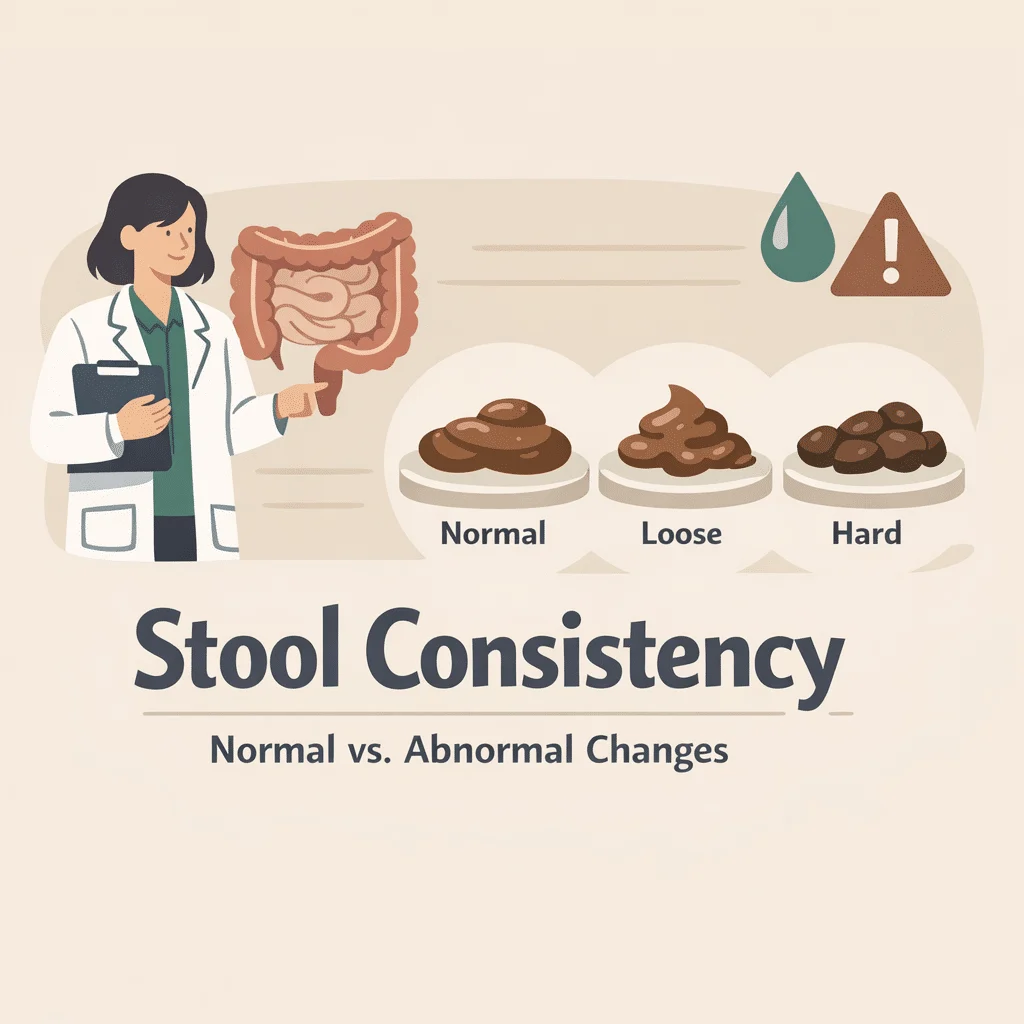
Stool consistency is one of the few health signals you can read without a laboratory, and it shifts far more often than most people expect. The texture of a bowel movement reflects how long waste stayed in your colon and how much water the colon pulled back out of it. Waste that moved through quickly stays loose; waste that lingered becomes firm and hard to pass. Both can be perfectly normal on a given day. In this article you’ll learn what the Bristol Stool Form Scale actually measures, what a normal range of frequency and form looks like, which foods, fluids, medicines and life events change the texture, how long a change should last before it deserves attention, and how to describe what you are seeing to a clinician.
What stool consistency really measures
By the time food residue reaches your colon it is liquid. The colon’s main job at that point is to reclaim water and electrolytes, compacting the residue into a formed stool. The National Institute of Diabetes and Digestive and Kidney Diseases puts it plainly: the large intestine absorbs water and changes the waste from liquid into stool.
That single mechanism explains almost everything about stool consistency. The longer the residue sits in contact with the colon wall, the more water is removed and the harder the result. Speed it up and less water comes out, so the stool arrives soft, mushy or watery. Consistency is therefore a rough readout of transit time, not a disease in itself.
How long normal transit takes
Mayo Clinic describes roughly six hours for food to move through the stomach and small intestine, after which passage through the large intestine may take up to 36 to 48 hours. That wide window is normal, and it is also why one late meal, one missed glass of water or one travel day can visibly change the next morning’s stool.
Why form beats frequency as a signal
Researchers have compared bowel habit against measured gut transit for decades. The original work behind the Bristol Stool Form Scale, published by Lewis and Heaton in 1997, showed that the form of the stool tracks intestinal transit time closely enough to be used as a practical stand-in for it. A later study by Saad and colleagues confirmed that stool form correlates with whole-gut and colonic transit, while how often you go correlates far less well. In practice, what your stool looks like tells a clinician more than how many times a week you pass one.
The Bristol Stool Form Scale, type by type
The Bristol Stool Form Scale sorts bowel movements into seven types, from hard pellets to fully liquid. It is the most widely used shorthand for stool consistency in clinics and in research, and it gives you a number to report instead of a vague description. Cleveland Clinic groups types 1 and 2 as constipation, types 3 and 4 as the ideal range, and types 5 to 7 as tending toward diarrhea.
| Type | What it looks like | What it usually says about transit |
|---|---|---|
| Type 1 | Separate hard lumps, like little pebbles, difficult to pass | Waste stayed in the colon a long time; markedly slow transit |
| Type 2 | Sausage-shaped but lumpy along its length | Slow transit; the usual picture in mild constipation |
| Type 3 | Sausage-shaped with cracks on the surface | Comfortably within the normal range |
| Type 4 | Smooth and soft, shaped like a sausage or a snake | Normal transit; the form most often described as ideal |
| Type 5 | Soft blobs with clear-cut edges, passed easily | Slightly fast transit; often seen when fiber intake is low |
| Type 6 | Fluffy pieces with ragged edges, mushy overall | Fast transit; the colon had little time to reabsorb water |
| Type 7 | Watery, entirely liquid, with no solid pieces | Very fast transit; classic diarrhea |
Using the scale without over-reading it
The scale is a description, not a diagnosis. A single type 6 morning after a heavy meal out means very little; a run of type 6 mornings across three weeks means something. The scale also compresses a lot of information into one number, and researchers have pointed out that consistency has physical properties, such as water content and stiffness, that a seven-point picture chart cannot fully capture. Treat your type number as a useful summary that starts a conversation, not as a verdict.
What normal bowel frequency and form look like
There is no single correct number of bowel movements. The commonly cited normal range runs from about three times a day to about three times a week, and most people settle into a stable personal rhythm. The National Institute of Diabetes and Digestive and Kidney Diseases defines constipation as having fewer than three bowel movements a week, while also stressing that people can have different bowel movement patterns and that only you know what is normal for you.
That last point matters more than the averages. A person who reliably passes a type 4 stool every second day is not constipated. A person who normally goes twice a day and suddenly drops to twice a week has changed, even though both figures sit inside the published range. Your own baseline is the reference value that counts.
A brief word on color
Brown is the expected color, produced by bile pigments broken down along the way. Green often simply means fast transit or a lot of leafy vegetables. Dark flecks are frequently food residue rather than anything worrying, and one guide covers black specks in stool and their possible meaning. Two color changes deserve prompt medical attention rather than watchful waiting: visible blood or a black tarry appearance, and persistently pale, greasy stool. A separate article details rectal bleeding causes, symptoms and when to seek help, and another guide describes fatty stool causes, symptoms and treatment options.
What changes stool consistency from day to day
Fiber and fluid
Fiber changes stool consistency in two opposite-looking ways, which is why generic advice to eat more fiber sometimes disappoints. Insoluble fiber, found in wheat bran, vegetable skins and nuts, adds bulk and speeds passage. Soluble and viscous fiber, found in oats, psyllium, barley and legumes, holds water in the stool and makes it softer and easier to pass. Someone with hard type 1 or type 2 stools usually benefits more from the viscous, water-holding kind.
Fluid works alongside fiber rather than instead of it. Fiber can only soften stool if there is water available for it to hold, which is why increasing fiber during a period of poor fluid intake can make stools harder rather than softer. Heavy fluid losses swing consistency the other way and can affect circulation as well; another article reviews dehydration and its effect on blood pressure.
Medications
Medicines are among the most common and most overlooked causes of a change in stool consistency. The effect usually begins within days of starting or stopping a drug, which makes the timing easy to check against a diary.
| Medication | Usual effect on stool consistency |
|---|---|
| Opioid painkillers | Slow the bowel markedly, producing hard type 1 to type 2 stools |
| Oral iron supplements | Firmer, darker stools; sometimes loose stools instead |
| Aluminum-containing antacids | Tend to firm the stool and slow passage |
| Magnesium-containing antacids | Draw water into the bowel and loosen the stool |
| Antibiotics | Commonly loosen stools by disturbing gut bacteria; constipation also occurs |
| Metformin | Frequently causes looser, more urgent stools, especially at first |
Antibiotics deserve a note of their own because they cut both ways. One article examines antibiotics and constipation causes and management. When loose stools during or after a course of antibiotics become severe or persistent, a specific infection needs excluding, and another page explains the C. diff toxin test and how to read its results.
Travel, routine and the menstrual cycle
Travel acts on the bowel through several routes at once: different food, different water, disrupted sleep, less movement on long journeys and a bathroom routine you cannot follow. Constipation on the outbound trip and looser stools a few days in are both common. Persistent loose stools after travel, especially after untreated water or a stay in a high-risk region, are the one pattern worth testing rather than waiting out, and our library explains the ova and parasites stool test and how to read its results.
The menstrual cycle produces a predictable, harmless swing for many people. Rising prostaglandins around the start of a period increase bowel contractions, so stools loosen for a day or two, while the progesterone-dominant phase before it tends to slow things down. We also cover period diarrhea causes, symptoms and treatments in detail.
Stress and the gut-brain axis
The gut has its own dense nervous system, connected to the brain by two-way signaling often called the gut-brain axis. Acute stress speeds colonic transit in many people, which is why exams, deadlines and bad news produce urgent, loose stools. Sustained stress can push the pattern either way. When alternating loose and hard stools come with abdominal pain that eases after passing a stool, the picture may fit a functional disorder, and our library explains irritable bowel syndrome and how to manage it.
How long a change should last before it matters
Most shifts in stool consistency settle within a few days once the trigger passes. A useful working rule is to look at duration and direction together. A change that lasts under a week, has an obvious explanation and resolves on its own rarely needs investigation. A change that persists beyond two to four weeks, has no clear trigger, or keeps getting more pronounced deserves a medical opinion even if nothing hurts.
Some findings should not wait for that window to close. Visible blood, black tarry stools, unexplained weight loss, fever, stools that wake you at night, a new and lasting change in bowel habit after the age of 45, or a family history of bowel disease all justify earlier contact. This is an overview rather than a workup: the detailed assessment of bleeding sits in its own guide.
Where inflammation is suspected behind weeks of loose stools, a stool test can help separate inflammatory bowel disease from a functional pattern, and another article covers fecal calprotectin test results and what the numbers mean. Where infection is suspected, another page describes the stool culture test and what it detects.
How to describe your stool to a clinician
Clinicians are used to vague answers, and vague answers slow diagnosis. Being specific about stool consistency costs you nothing and often shortens the path to an explanation. Five details do most of the work.
- The Bristol type number, or a short physical description if you would rather not use the scale.
- How often you go now, compared with your usual pattern before the change.
- When it started and whether it is constant or comes and goes.
- Associated features: urgency, straining, pain, bloating, waking at night, blood, mucus, greasiness.
- What changed around the same time: a new medicine, a trip, a diet change, an illness, a stressful period.
Keeping a short stool diary
A one-line-per-day record kept for two weeks is more informative than trying to remember four weeks of bowel habit in a consultation. Note the date, the Bristol type, the number of movements, anything visible in the bowl, and one word for anything unusual that day, such as a new tablet, a restaurant meal or a long flight. Patterns emerge quickly on paper that are invisible in memory, and a diary is the simplest way to show a clinician whether your stool consistency really changed or simply felt different.
Latest scientific advances
Research on stool consistency has moved quickly in the last three years, mostly in two directions: confirming that the Bristol scale measures what it claims to, and working out which dietary changes reliably shift stool form.
The Bristol scale has been re-validated with modern images
A 2025 validation study rebuilt the scale with new illustrations and tested whether people classify their stools consistently using them. The images performed well, supporting the continued use of the scale as a self-reported measure. What this means for you: the type number you report from a chart in a waiting room or an app is a reasonable description of what a clinician would record, so it is worth using.
Fiber softens stool, but the type of fiber decides how much
A 2026 systematic review pooling more than a hundred randomized trials in people with normal bowel function examined how fiber intake affects stool output and form. Alongside it, two 2026 network meta-analyses, a method that ranks several treatments against each other using the combined trial evidence, compared dietary interventions for chronic constipation. Viscous soluble fibers, the water-holding kind found in psyllium and oats, came out ahead for improving stool consistency specifically. What this means for you: if your stools are hard, switching toward viscous soluble fiber and keeping fluid intake up is a better-supported first step than simply adding bran.
Stool form can improve before frequency does
A 2023 review of trials using fibers and probiotics found that these interventions softened stool, raising the Bristol score toward the middle of the scale, without reliably changing how often people went. The same work reported that the make-up of a person’s gut bacteria before starting helped predict who responded. What this means for you: if you start a fiber supplement and your stools become easier to pass without the number of trips changing, that is a genuine improvement rather than a failure, and it is worth giving several weeks.
Stool consistency is one of the strongest signals in gut microbiome studies
Work published in 2015 and repeatedly confirmed since showed that stool consistency is strongly associated with the richness and composition of gut bacteria, and that it must be accounted for in any microbiome analysis. What this means for you: commercial gut microbiome reports that ignore your stool form are reading a sample whose bacterial profile is partly explained by transit time alone, so interpret them cautiously.
The scale has known limits
A 2019 analysis argued that stool consistency has measurable physical properties that a seven-point picture scale only partly captures, and called for more objective measures in research. What this means for you: the Bristol type is an excellent conversation starter and a poor precision instrument. Persistent symptoms still need a clinical assessment rather than a number.
Glossary
| Term | Definition |
|---|---|
| Bristol Stool Form Scale | A seven-point chart that classifies stool by shape and texture, from hard separate lumps to fully liquid. |
| Transit time | How long food residue takes to travel from the mouth to the toilet. Whole-gut transit covers the entire journey. |
| Colon | The large intestine, where water and electrolytes are reabsorbed and liquid residue is compacted into stool. |
| Soluble fiber | Fiber that dissolves in water and forms a gel, holding water in the stool. Found in oats, psyllium, barley and legumes. |
| Insoluble fiber | Fiber that does not dissolve and adds bulk, speeding passage through the bowel. Found in wheat bran, skins and nuts. |
| Gut microbiome | The community of bacteria and other microbes living in the intestine, which varies with diet, medication and transit time. |
| Gut-brain axis | The two-way communication between the digestive tract and the brain, through which stress can alter bowel activity. |
| Steatorrhea | Stool containing excess fat, typically pale, bulky, greasy and hard to flush. |
| Osmotic effect | The pull of water into the bowel by substances that are poorly absorbed, such as magnesium salts or some sweeteners. |
| Stool diary | A short daily record of bowel movements, form and possible triggers, kept to show a clinician an accurate pattern. |
Frequently asked questions
Is type 6 stool normal?
An occasional type 6 stool, mushy with ragged edges, is common and usually reflects nothing more than a fast transit day after a rich meal, a lot of coffee, a stressful morning or a new medicine. It becomes worth attention when it is the rule rather than the exception. If most of your stools have been type 6 for more than two to four weeks, or if the change comes with weight loss, blood, night-time symptoms or fever, ask a clinician rather than adjusting your diet on your own.
What does a type 4 stool mean?
Type 4 is the smooth, soft, sausage-shaped stool that passes without straining, and it is the form most often described as ideal because it sits in the middle of the transit range. It suggests the colon had roughly the right amount of time to reabsorb water. Type 3 is equally acceptable. Aiming for types 3 and 4 most of the time is a reasonable practical target, but nobody produces the same type every single day.
How often should I have a bowel movement?
Anywhere from about three times a day to about three times a week falls inside the usual range, and your personal baseline matters more than the average. The National Institute of Diabetes and Digestive and Kidney Diseases defines fewer than three bowel movements a week as constipation, while noting that patterns differ between people. A stable rhythm with comfortable, easy-to-pass stools is more reassuring than any particular number.
Can drinking more water change my stool consistency?
Water alone rarely transforms a hard stool if fiber intake is low, because the colon reabsorbs freely available water efficiently. Fluid works best in combination with soluble fiber, which holds water inside the stool where it is needed. If you are increasing fiber, increasing fluid at the same time is important, since fiber without enough water can make stools harder. Heavy sweating, fever or vomiting increase your fluid needs noticeably.
Why does my stool consistency change from one day to the next?
Day-to-day variation is normal and reflects how much fiber and fluid you took in, how much you moved, how well you slept, where you were in your menstrual cycle if you have one, your stress level, and any medicines you took. Each of these nudges transit time, and transit time sets the water content of the stool. Variation across a week is expected; a sustained drift in one direction over several weeks is the pattern that matters.
How long should I keep a stool diary before seeing a doctor?
Two weeks is usually enough to show a pattern without becoming a burden. Record the date, the Bristol type, the number of movements and anything unusual that day. If red flags appear at any point, such as visible blood, black tarry stools, unexplained weight loss or severe pain, do not wait for the two weeks to finish before seeking advice.
Sources
- Cleveland Clinic — Bristol Stool Chart: types and what they mean — my.clevelandclinic.org
- National Institute of Diabetes and Digestive and Kidney Diseases — Your digestive system and how it works — niddk.nih.gov
- National Institute of Diabetes and Digestive and Kidney Diseases — Definition and facts for constipation — niddk.nih.gov
- Mayo Clinic — Digestion: how long does it take? — mayoclinic.org
- Lewis SJ, Heaton KW — Stool form scale as a useful guide to intestinal transit time — Scandinavian Journal of Gastroenterology, 1997 — consensus.app
- Saad RJ, Rao SSC, Koch KL, et al. — Do stool form and frequency correlate with whole-gut and colonic transit? — American Journal of Gastroenterology, 2010 — consensus.app
- Vandeputte D, Falony G, Vieira-Silva S, et al. — Stool consistency is strongly associated with gut microbiota richness and composition, enterotypes and bacterial growth rates — Gut, 2015 — consensus.app
- Vork L, Wilms E, Penders J, Jonkers DMAE — Stool consistency: looking beyond the Bristol Stool Form Scale — Journal of Neurogastroenterology and Motility, 2019 — consensus.app
- Dekimeche O, et al. — Iconographic validation of the Bristol Stool Form Scale — French Journal of Urology, 2025 — consensus.app
- Balk EM, et al. — Fiber intake and laxation in people with normal bowel function: a systematic review — American Journal of Clinical Nutrition, 2026 — consensus.app
- Mou Y, et al. — Efficacy of dietary interventions for functional constipation: a network meta-analysis — American Journal of Clinical Nutrition, 2026 — consensus.app
- Mou Y, et al. — Efficacy of different dietary fibers for chronic idiopathic constipation: a network meta-analysis — Food and Function, 2026 — consensus.app
- Lai H, et al. — Effects of dietary fibers or probiotics on functional constipation symptoms and roles of gut microbiota — Gut Microbes, 2023 — pubmed.ncbi.nlm.nih.gov
Further reading
- Crohn’s disease: causes, symptoms and treatments
- Colorectal cancer: causes, symptoms and treatments
- Celiac disease and gluten intolerance, explained
- Diarrhea after fasting: causes and treatments
- Electrolyte panel: sodium, potassium, chloride and bicarbonate
Understand your lab results with AI DiagMe
A change in stool consistency is often the first thing you notice, and blood and stool tests are what turn that observation into an explanation. A complete blood count, ferritin, an inflammation marker such as C-reactive protein and an electrolyte panel are frequently ordered alongside stool testing when bowel habit changes persist. AI DiagMe reads those results and explains in plain language what each value means in context. It helps you understand your report and prepare better questions; it does not make a diagnosis and does not replace your doctor.
Get your results interpreted in minutes