
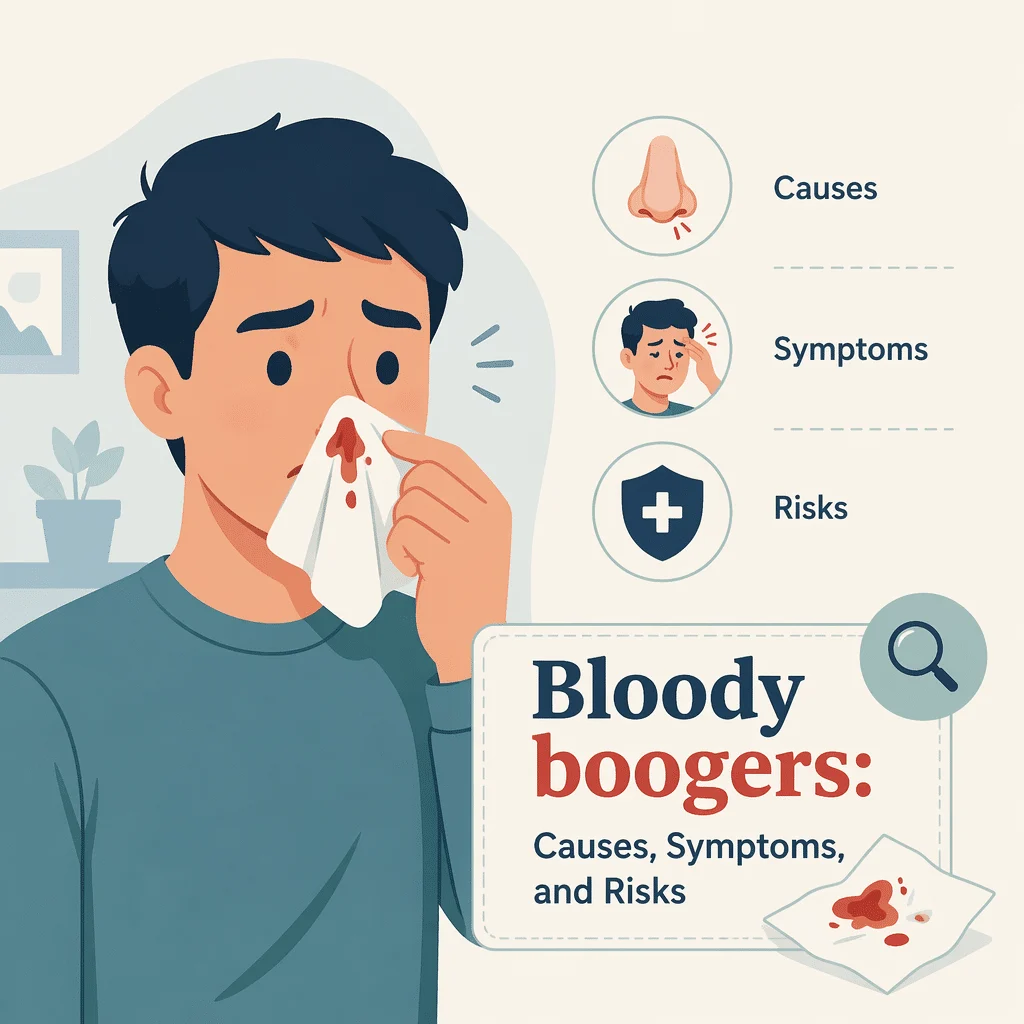
Bloody boogers — streaks or specks of blood in the mucus you blow or pick out of your nose — are extremely common, and in the vast majority of cases they are not a sign of disease. The lining inside your nose is thin, warm and packed with tiny blood vessels sitting just under the surface. Dry winter air, a heavy cold, a fingernail or one forceful blow is enough to nick one. The result looks alarming on a tissue but is usually trivial.
In this article you’ll learn why the nose bleeds so readily, which everyday situations explain almost all blood-streaked mucus, how nasal sprays and blood thinners fit in, what parents should know, and the patterns — one-sided, persistent, or joined by bleeding elsewhere — that genuinely deserve a doctor’s assessment.
Why blood shows up in nasal mucus so easily
Your nose warms and humidifies every breath before it reaches your lungs, and that job needs a rich blood supply running close to the surface of a very thin lining.
Most of that fragility sits in one small patch. On the front of the nasal septum — the wall dividing your two nostrils — several arteries meet in a network called Kiesselbach’s plexus, or Little’s area. According to the StatPearls review published by the National Library of Medicine, roughly nine out of ten front-of-nose bleeds start there. That patch faces cold air, hot air, dust and swings in humidity, and the lining over it is easily traumatized.
When it dries out, crusts form. Pull a crust away with a fingernail, a tissue or a hard blow, and the vessel underneath weeps blood into the surrounding mucus. This is why a bloody booger is often not a nosebleed at all: nothing drips, and you find a brown or red streak in what comes out.
Dry air, heating, altitude and CPAP masks
Dryness is the biggest everyday driver. MedlinePlus, from the National Library of Medicine, notes that nosebleeds happen more often in winter, when cold viruses circulate and indoor air is drier.
Central heating strips moisture from indoor air, and air conditioning does the same in hot climates. High altitude, long flights and desert environments reduce humidity further. A CPAP machine for sleep apnea, or oxygen through a nasal cannula, pushes air across the lining for hours and dries it reliably. The classic result is bloody boogers in the morning: the lining dehydrates overnight, crusts form, and the first blow of the day removes them.
MedlinePlus lists two general measures for frequent nosebleeds — keeping indoor air moist with a humidifier, and using saline spray or a water-soluble nasal gel so the lining does not dry out. These address the cause rather than the blood itself.
Picking, blowing and everyday nose trauma
The StatPearls review lists digital manipulation — nose picking — first among local causes of nosebleeds. It explains a huge share of blood-streaked mucus in healthy people.
The sequence is predictable. The lining dries, a crust forms, a finger or tissue removes it, and the raw spot bleeds slightly. The scab then itches, so it gets removed again a day later, and one dry patch can keep producing bloody boogers for weeks. Forceful blowing does the same without fingernails, as does vigorous rubbing in hay fever season. Tissue that tears after very light contact has a name of its own, and our guide explains what doctors mean by friable tissue.
Children pick their noses, and that is usually all it is
StatPearls reports that nosebleeds peak in two age groups: children between about two and ten, and adults between fifty and eighty. Young children have small nasal passages, catch many colds, and explore their noses with their fingers.
For a parent, the headline is simple: streaky mucus from both nostrils in a child who is otherwise well, eating and playing normally, is almost always dryness plus fingers. The one pattern that changes this is described below.
Allergies, colds and sinus infections
Anything that inflames the nasal lining makes it swell, produce more mucus and bleed more readily. Viral colds, allergic rhinitis and sinus infections all qualify. Inflammation widens the vessels near the surface and thins the barrier over them, while more mucus means more blowing. Blood-streaked mucus during a bad cold is expected, and it stops when the cold does.
Mucus color follows similar logic. Thick yellow or green discharge reflects immune cells rather than severity, and a red streak through it does not change that. Our article on white mucus covers what the colors indicate.
Facial pressure, a blocked nose and discharge lasting beyond ten days may point instead toward a sinus infection. If bloody boogers arrive every spring with sneezing and itchy eyes, a clinician may suggest an allergy blood test to identify the trigger.
Nasal sprays, decongestants and medicines that raise bleeding risk
Steroid sprays and why technique matters
Minor nosebleeds are a recognized side effect of steroid nasal sprays, and StatPearls lists them among medications that can provoke epistaxis. The mechanism is mechanical: a nozzle pointed straight up the middle of the nose fires repeatedly at the septum, exactly where the fragile vessels sit.
Standard technique reverses this. Aim the nozzle outward, toward the ear on the same side, rather than at the midline; using the opposite hand for each nostril makes that angle automatic. Avoid a hard sniff afterward. Do not stop a prescribed spray over a streak of blood — ask your pharmacist to check your technique.
MedlinePlus separately lists overuse of decongestant nasal sprays as a cause. Those constrict blood vessels, and prolonged use leaves the lining dry, irritated and prone to rebound congestion. Some oral antihistamines dry mucous membranes too, which can tip a borderline nose into crusting.
Blood thinners and supplements
Anticoagulant and antiplatelet medicines do not create bleeding points, but they make an existing one bleed longer and more visibly. StatPearls names warfarin, clopidogrel and anti-inflammatory drugs such as ibuprofen, naproxen and aspirin, plus supplements including vitamin E, ginkgo and ginseng.
People taking warfarin already have a monitoring routine, and clinicians follow the prothrombin time and INR to keep the dose in range. Frequent or hard-to-stop nosebleeds on these medicines are information the prescriber needs — but not a reason to stop treatment on your own, because the clot the medicine prevents is usually far more dangerous than the bleeding.
Cocaine and other substances taken through the nose
MedlinePlus names snorting cocaine or amphetamine among the causes of nosebleeds. Cocaine constricts the vessels supplying the septum, and repeated use starves that cartilage of blood, causing persistent crusting, ulceration and eventually a hole in the septum. Mention it plainly at a consultation, because it changes what a doctor looks for.
Reading the pattern: what your bloody boogers usually mean
The useful information comes from the pattern, not the amount of blood. A one-off streak after a hard blow needs nothing at all.
| What you are seeing | What it usually means | Reasonable next step |
|---|---|---|
| Streaks from both nostrils, worse in winter or with the heating on | A dry, crusting lining | Humidify the room; keep the lining moist |
| A little blood during a cold, sinusitis or hay fever | An inflamed, congested lining | Manage the congestion; review if it outlasts the cold |
| Blood after starting or changing a nasal spray | Spray repeatedly hitting the septum | Check your spray technique; do not stop it alone |
| Blood-stained discharge from one side only, week after week | Something local on that side that needs seeing | Book an examination of the nose |
| Recurrent bleeding while taking a blood thinner | A minor bleeding point amplified by the drug | Tell the prescriber; do not adjust the dose yourself |
| Nosebleeds plus easy bruising, bleeding gums or heavy periods | A possible underlying bleeding tendency | Ask your doctor about blood tests |
| Heavy recurrent nosebleeds, a family history, red spots on lips or fingertips | A possible inherited vascular condition | Request assessment; mention the family history |
When the pattern is wrong: one side, persistent, or bleeding elsewhere
Almost everything above is benign. Knowing the rare causes is not a reason to worry — it helps you spot the few patterns that do not fit.
Warning signs that justify a medical assessment
- Blood-stained discharge from one nostril only, lasting weeks
- Blockage of one side of the nose that does not clear
- Numbness of the face or cheek, double vision, or a neck lump
- Unexplained bruising, bleeding gums, or bleeding from other sites
- Bleeding on a blood thinner that will not settle
- Recurrent heavy nosebleeds plus a family history of the same
- Bleeding that continues after 10 to 15 minutes of correct, uninterrupted pressure
- Nosebleeds after a head injury, or a nose that looks crooked after a blow
One side only, in a child: think foreign body
This is the most useful and most commonly missed point in pediatrics. A young child with persistent one-sided nasal discharge — especially if it smells unpleasant and is streaked with blood — may have pushed something into that nostril days or weeks earlier. Beads, foam, paper and small toy parts are typical; button batteries are the urgent exception, as they damage tissue fast.
StatPearls lists a foreign body in the nose among the differential diagnoses for nosebleeds, and the child often does not remember or does not say. One-sided, smelly, blood-tinged discharge deserves an examination, not more cold remedies.
One side only, in an adult
Persistent one-sided bleeding or blockage in an adult also warrants a look inside the nose, because that is where structural causes concentrate: nasal polyps, an inverted papilloma or, far more rarely, a sinonasal or nasopharyngeal tumor.
The National Cancer Institute notes that nasopharyngeal cancer is uncommon in the United States, and that its signs include a neck lump, a blocked or bleeding nose, hearing trouble in one ear, and headaches. One-sided bloody mucus overwhelmingly does not mean cancer — but one-sided symptoms are worth showing to a clinician rather than waiting out.
Hereditary hemorrhagic telangiectasia and bleeding disorders
Hereditary hemorrhagic telangiectasia, or HHT, is an inherited condition in which small blood vessels form abnormally. Recurrent nosebleeds are usually the earliest symptom, and they run in families. The telling combination is repeated nosebleeds, a close relative with the same problem, and small red or purple spots — telangiectasias — on the lips, tongue, fingertips or inside the nose. Because the bleeding repeats, HHT often drains iron reserves and produces low ferritin or even iron-deficiency anemia.
Inherited conditions such as von Willebrand disease and hemophilia, and acquired platelet problems, can also cause nosebleeds alongside bruising and prolonged bleeding after dental work. Anyone with a clotting disorder planning a pregnancy should read our guide to von Willebrand disease in pregnancy. Where a doctor suspects a bleeding tendency, the first step is blood work: a clinician may order a complete blood count, which also reports your platelet count, and may request a coagulation panel.
What to do during a nosebleed, and when to see a doctor
A bloody booger rarely needs anything. An actual nosebleed does, and MedlinePlus sets out the standard first-aid sequence.
Sit down and lean forward, so blood drains out of the nose rather than down the throat. Gently squeeze the soft part of the nose — the fleshy section below the bony bridge — between thumb and finger so both nostrils are closed, and hold for a full ten minutes without releasing to check. MedlinePlus adds that a cold compress across the bridge may help, that lying down is not recommended, and that you should avoid sniffing or blowing your nose for several hours afterward. It is equally clear about one thing: do not pack the inside of the nose with gauze.
Seek emergency care, according to MedlinePlus, if bleeding does not stop after twenty minutes, if it follows a head injury, if the nose may be broken, if you take medicines that stop your blood clotting, or if you have needed specialist care for a nosebleed before.
Book a routine appointment for frequent nosebleeds, for bleeding unconnected to a cold, after sinus surgery, or for anything in the warning box above. Expect questions about how often, which side, what you take and what runs in the family, then an examination.
Latest scientific advances in understanding nasal bleeding
The studies below were identified through PubMed and are linked by DOI in the Sources section. None changes the message that most blood in nasal mucus is harmless, but together they sharpen where medical attention helps.
Most children improve with simple moisturizing alone
A 2024 study in Laryngoscope Investigative Otolaryngology followed 122 children treated for recurrent nosebleeds. About three quarters improved or stopped bleeding altogether using nasal lubricants alone, with no procedure. Those whose bleeding persisted shared three features: a family history of clotting problems, daily nosebleeds, and anemia.
What this means for you: moisturizing is not a weak substitute for real treatment — it is what works for most children, and the minority who keep bleeding are identifiable by those three features. As a retrospective review of one practice, it shows a pattern rather than proof.
Winter mattered more than allergy, and steroid sprays did not increase bleeding
A 2025 study in the International Journal of Pediatric Otorhinolaryngology compared 98 children attending a clinic for nosebleeds with 234 attending for other nasal problems. Those with nosebleeds were more likely to present in the cold season. Unexpectedly, children using a steroid nasal spray were less likely to be in the nosebleed group; allergy status, a deviated septum, age and sex made no measurable difference.
What this means for you: the assumption that a prescribed steroid spray causes your child’s bloody boogers was not supported here — cold, dry seasons mattered more. It compared two groups already attending one clinic, so it shows an association; a less inflamed lining may simply bleed less.
Scanning is not the default for nosebleeds
Practice recommendations published in 2026 in European Radiology by the European Society of Head and Neck Radiology set out when imaging helps in nasal blockage and nosebleeds. History and an endoscopic look inside the nose come first; imaging is not routinely indicated. Scans are reserved for bleeding that is recurrent, severe or from the back of the nose, to find a vascular abnormality or tumor.
What this means for you: if a doctor examines your nose and does not order a scan, that is guideline-consistent care, not an oversight. This is expert consensus guidance, not a new experiment.
Recurrent nosebleeds plus family history point toward HHT
A 2025 review in Nature Reviews Disease Primers summarized current understanding of HHT. In adults, the main problems are iron deficiency and anemia caused by repeated nosebleeds or bleeding from abnormal vessels in the gut, while children usually have nosebleeds alone. Management centers on controlling the bleeding, correcting iron deficiency, and evaluating relatives who may carry the same gene.
What this means for you: HHT is uncommon, but its clue is easy to spot at home — nosebleeds that keep returning and also affect a parent, sibling or child. This is an expert review rather than a single study, reflecting current consensus.
Glossary of key terms
| Term | Definition |
|---|---|
| Epistaxis | The medical word for a nosebleed. |
| Nasal mucosa | The moist lining covering the inside of the nose. |
| Nasal septum | The wall of cartilage and bone separating the two nostrils. |
| Kiesselbach’s plexus (Little’s area) | A small patch at the front of the septum where several arteries meet; the source of most nosebleeds. |
| Anterior nosebleed | Bleeding from the front of the nose: the common kind, usually easy to control. |
| Posterior nosebleed | Bleeding from further back in the nose: less common and more likely to need medical care. |
| Anticoagulant | A medicine that slows the formation of blood clots. |
| Antiplatelet | A medicine that makes platelets less likely to stick together. |
| Telangiectasia | A small cluster of widened blood vessels visible just under the skin or lining. |
| Hereditary hemorrhagic telangiectasia (HHT) | An inherited condition causing fragile small blood vessels, recurrent nosebleeds and abnormal vessel connections in organs. |
Frequently asked questions
Is bloody mucus a sign of something serious?
Almost never on its own. Blood in nasal mucus usually means a dry, crusted or inflamed lining with a fragile vessel just beneath it, and it settles once the dryness or the cold resolves. What raises the question of something more is the company it keeps: bleeding that comes only from one nostril for weeks, a nose blocked on one side, unexplained bruising or bleeding from other sites, or heavy nosebleeds that also run in your family. Those combinations deserve a medical opinion, not because they usually mean disease but because they are the ones that need looking at.
Should I worry if the blood is only on one side?
A single episode from one nostril is normal, because most nosebleeds start from one small patch on one side of the septum. What matters is persistence. Blood-stained discharge coming from the same nostril week after week, particularly with blockage on that side, a bad smell, facial numbness or a lump in the neck, should be examined. In children the usual explanation is something pushed into the nose; in adults a doctor will want to look inside to rule out a growth. Both are checked in the same simple way.
Are bloody boogers normal in babies and young children?
Yes. Children between about two and ten are one of the two peak age groups for nosebleeds. Small nasal passages, frequent colds, dry bedrooms and curious fingers add up to blood-streaked mucus in most children at some point, and it is not a sign of a blood disorder. In newborns and small babies, dryness and gentle suctioning of the nose are the usual culprits. See a doctor if the discharge is one-sided and persistent, if bleeding happens daily, or if there is bruising elsewhere.
Why do I get bloody boogers every morning?
Overnight is when the nose dries out most. Heating or air conditioning runs while you sleep, you breathe through your mouth and nose for hours without drinking, and crusts form along the septum. The first blow of the day pulls them off, and the raw spot beneath leaves a streak. CPAP users notice this particularly, because air is being driven across the lining all night. Raising bedroom humidity and keeping the lining moist usually breaks the cycle within a few days.
Can bloody boogers happen in pregnancy?
They are common in pregnancy. Blood volume rises and hormonal changes make the nasal lining swell and congest, which is why many pregnant women feel blocked and blow their noses more. A more fragile, more congested lining bleeds more easily. This is usually harmless, but mention repeated nosebleeds at an antenatal appointment, particularly if you feel unusually tired, since ongoing blood loss and pregnancy both draw on iron stores.
What does it mean if I have bloody boogers but no nosebleed?
It usually means the bleeding is minimal and old. A tiny vessel oozed a small amount of blood into mucus that then dried into a crust, so nothing ever ran from the nose. That pattern points strongly toward dryness and crusting rather than anything systemic, and it is the most common presentation of all. Apply the same rule as elsewhere: the amount of blood matters far less than whether it keeps coming from one side, or is joined by bleeding somewhere else.
Sources
- Tabassom A, Dahlstrom JJ. Epistaxis. StatPearls, NCBI Bookshelf, National Library of Medicine. https://www.ncbi.nlm.nih.gov/books/NBK435997/
- MedlinePlus Medical Encyclopedia, National Library of Medicine. Nosebleed. https://medlineplus.gov/ency/article/003106.htm
- National Cancer Institute. Nasopharyngeal Cancer Treatment (PDQ), Patient Version. https://www.cancer.gov/types/head-and-neck/patient/adult/nasopharyngeal-treatment-pdq
- Lee JA, Puchi C, Billings KR, et al. Outpatient management of pediatric epistaxis: a cost analysis and clinical model. Laryngoscope Investigative Otolaryngology, 2024. Identified via PubMed. https://doi.org/10.1002/lio2.1310
- Cummins M, Hunt C, Ramadan HH, Makary CA. Risk factors associated with epistaxis in children. International Journal of Pediatric Otorhinolaryngology, 2025. Identified via PubMed. https://doi.org/10.1016/j.ijporl.2025.112427
- Peporte ARJ, Vassallo E, Preda L, Beale T, Hirvonen J. ESR Essentials: imaging in nasal obstruction and epistaxis, practice recommendations by the European Society of Head and Neck Radiology. European Radiology, 2026. Identified via PubMed. https://doi.org/10.1007/s00330-025-12305-6
- Hermann R, Shovlin CL, Kasthuri RS, et al. Hereditary haemorrhagic telangiectasia. Nature Reviews Disease Primers, 2025. Identified via PubMed. https://doi.org/10.1038/s41572-024-00585-z
Further reading
- Complete blood count: read your results
- Coagulation panel: PT, PTT, INR and D-dimer
- Allergy blood test: IgE and panels explained
- Sinus infection: symptoms, causes and treatment
- Anemia: symptoms, causes and blood tests
Understand your lab results with AI DiagMe
If your nosebleeds keep coming back, a doctor may order a full blood count, a platelet count or clotting tests to check whether your blood clots normally. Those results arrive as numbers and reference ranges that are hard to interpret alone. AI DiagMe explains what each value means in plain language, so you can have a better conversation with your clinician. It does not diagnose anything, it cannot examine your nose, and it does not replace a medical consultation.
Get your results interpreted in minutes