




































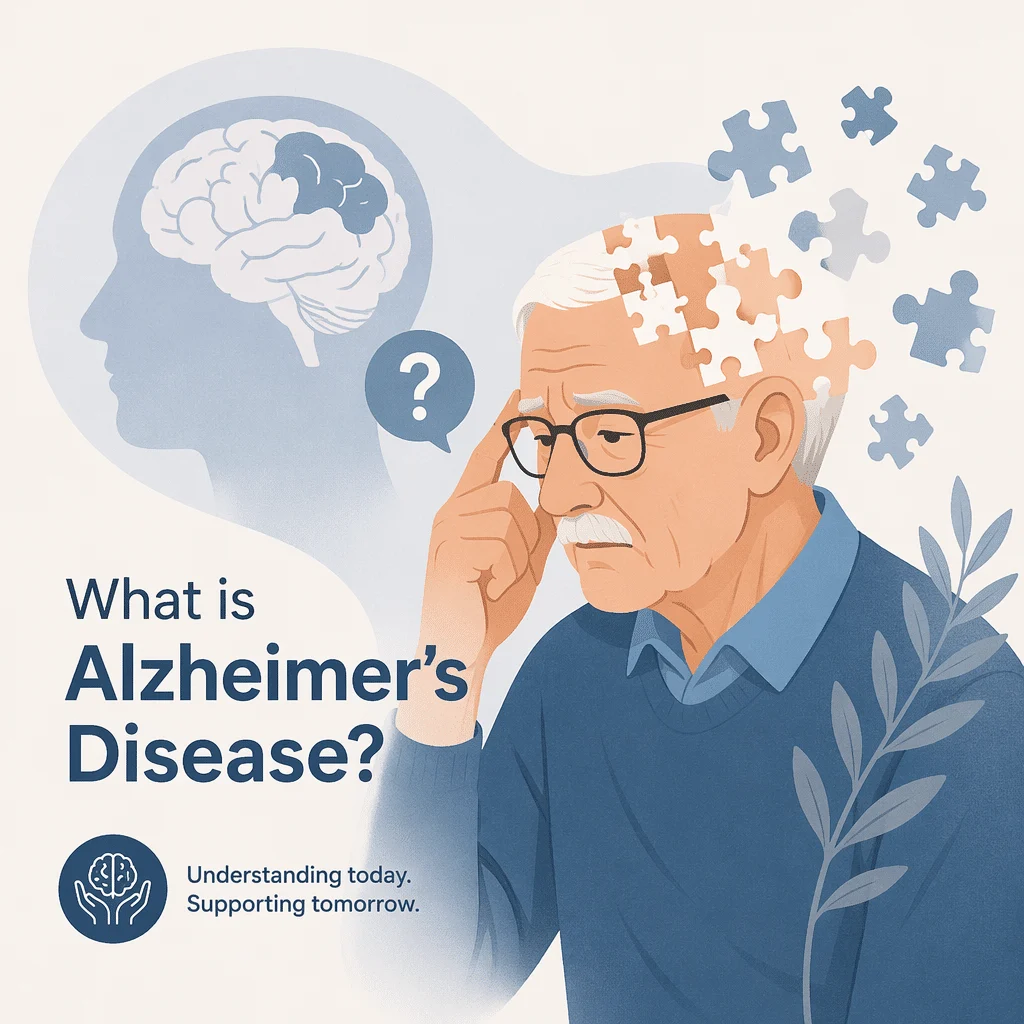
La enfermedad de Alzheimer es un trastorno cerebral progresivo y la causa más común de demencia; afecta gradualmente la memoria, el pensamiento y la capacidad de realizar las actividades del día a día. Se desarrolla lentamente, a menudo a lo largo de muchos años, y se manifiesta de forma diferente en cada etapa. Los médicos entienden esta condición mucho mejor que hace una década, y nuevos análisis de sangre están empezando a cambiar qué tan temprano puede identificarse. Este artículo explica qué es la enfermedad de Alzheimer, sus síntomas tempranos y tardíos, las etapas por las que avanza, las causas y factores de riesgo, cómo se diagnostica hoy en día, los tratamientos disponibles y cómo apoyar a alguien que vive con ella.
Un análisis de sangre ahora puede apoyar el diagnóstico: descubre qué cambia con la autorización de la FDA para PrecivityAD2.
Qué es la enfermedad de Alzheimer
La enfermedad de Alzheimer es una condición neurodegenerativa, lo que significa que daña y destruye lentamente las células cerebrales llamadas neuronas. A medida que estas células dejan de funcionar y mueren, el cerebro se encoge gradualmente y las redes que almacenan recuerdos y guían el razonamiento se deterioran. Dos proteínas anormales están en el centro de este proceso: la beta-amiloide, que forma placas pegajosas entre las neuronas, y la tau, que se enrolla formando ovillos dentro de ellas. Estos cambios silenciosos pueden comenzar entre diez y veinte años antes de que aparezcan los primeros síntomas notables.
Esta enfermedad es la principal causa de demencia y representa entre el 60 y el 80 por ciento de los casos, según los Centros para el Control y la Prevención de Enfermedades. La demencia en sí no es una sola enfermedad, sino un término amplio para describir el deterioro de la memoria y el pensamiento lo suficientemente grave como para interferir con la vida diaria. Como varias condiciones pueden causar ese deterioro, te recomendamos leer nuestra guía de síntomas y tipos de demencia. Ver esa categoría más amplia ayuda a entender mejor el lugar que ocupa el Alzheimer.
En qué se diferencia del envejecimiento normal
Olvidar cosas de vez en cuando es una parte normal del envejecimiento. Los cambios de memoria del Alzheimer son distintos: son persistentes, empeoran de forma constante y comienzan a interrumpir las rutinas cotidianas. La tabla a continuación compara los cambios que pueden ser señales de alerta tempranas con los olvidos comunes que muchas personas notan con el paso de los años.
| Posible señal temprana de Alzheimer | Más típico del envejecimiento normal |
|---|---|
| Olvidar hechos o fechas importantes que acaba de aprender, y preguntar lo mismo una y otra vez | Olvidar a veces un nombre o una cita, y recordarlo después |
| Tener dificultad para seguir una receta conocida o llevar el control de los gastos del mes | Necesitar ayuda de vez en cuando para usar una función del celular o un aparato nuevo |
| Perderse en un camino que conoce bien o no saber dónde está | Olvidar por un momento qué día es y luego recordarlo |
| Poner objetos en lugares inusuales repetidamente y no poder recordar dónde los dejó | Extraviar las llaves o los lentes de vez en cuando |
| Alejarse del trabajo, los pasatiempos o los amigos, junto con cambios notorios en el estado de ánimo | Sentirse cansado de las rutinas o las obligaciones de vez en cuando |
Síntomas: desde las primeras señales hasta los cambios más avanzados
Los síntomas del Alzheimer generalmente aparecen de forma gradual y se vuelven más evidentes conforme avanza la enfermedad. Identificar las primeras señales es importante, porque una evaluación temprana abre la puerta al apoyo, la planificación y, en algunos casos, a tratamientos que funcionan mejor cuando se inician a tiempo.
Primeras señales
El primer síntoma más frecuente es la pérdida de memoria que afecta la vida diaria, especialmente la dificultad para retener información recién aprendida. Otras señales tempranas son fáciles de ignorar al principio, pero suelen presentarse juntas:
- Repetir preguntas o conversaciones y depender cada vez más de notas y recordatorios
- Dificultad para encontrar la palabra correcta o seguir una conversación
- Perder la noción de fechas, estaciones del año o el paso del tiempo
- Problemas para planear, resolver situaciones sencillas o manejar el dinero
- Extraviar objetos y no poder recordar los pasos que se siguieron para encontrarlos
- Mayor indecisión, ansiedad o alejamiento de las actividades habituales
Conforme avanza la enfermedad
Con el tiempo, los lapsos de memoria se hacen más grandes y otras capacidades se ven afectadas. La persona puede confundirse sobre dónde está o en qué año vive, tener dificultad para reconocer a familiares y amigos, y necesitar ayuda para vestirse, bañarse y comer. El lenguaje se vuelve más difícil, el juicio disminuye y los patrones de sueño suelen cambiar. Los cambios en el estado de ánimo y el comportamiento, como la desconfianza, la agitación o la inquietud, son frecuentes y pueden ser muy difíciles para las familias. En la etapa más avanzada, las personas pierden la capacidad de mantener una conversación, moverse y cuidarse solas, y dependen de otros las 24 horas del día.
Las etapas del Alzheimer
Los médicos suelen describir el Alzheimer’ como una enfermedad que avanza en etapas amplias. El ritmo varía mucho de una persona a otra y los límites entre etapas no son precisos, pero este esquema ayuda a las familias a anticipar las necesidades y planificar el cuidado. La siguiente tabla resume cómo suele verse cada etapa.
| Etapa | Cómo se presenta habitualmente |
|---|---|
| Preclínica (sin síntomas) | Los cambios en el cerebro pueden comenzar años antes de que aparezca cualquier síntoma, y solo son detectables mediante pruebas de investigación o biomarcadores |
| Temprana (leve) | Olvidos, dificultad para encontrar palabras y pérdida de objetos; la persona generalmente sigue siendo en gran medida independiente |
| Intermedia (moderada) | Mayor confusión y dificultad para realizar actividades cotidianas; se necesita ayuda para vestirse y comer, y el comportamiento puede cambiar |
| Avanzada (grave) | Pérdida de la capacidad para conversar, caminar o cuidarse a sí mismo; se requiere apoyo de tiempo completo |
Muchos especialistas ahora incluyen una etapa previa llamada deterioro cognitivo leve, que describe cambios en el pensamiento mayores a los del envejecimiento normal, pero que aún no son lo suficientemente graves como para considerarse demencia. No todas las personas con deterioro cognitivo leve desarrollan Alzheimer’s, pero es una ventana importante para la evaluación.
Causas y factores de riesgo
La enfermedad de Alzheimer no tiene una sola causa. La mayoría de los casos surgen de una combinación de envejecimiento, factores genéticos, y factores de salud y estilo de vida que se acumulan a lo largo de décadas. Entender estos riesgos es útil porque varios de ellos pueden modificarse.
Edad y genética
La edad es, con mucho, el factor de riesgo más importante, y la mayoría de las personas con Alzheimer’s tienen 65 años o más. La genética también influye. Una variante genética común llamada APOE e4 aumenta el riesgo, aunque tenerla no garantiza que se desarrolle la enfermedad, y muchas personas que la desarrollan no la tienen. Un pequeño número de familias tiene mutaciones hereditarias poco frecuentes que causan Alzheimer’s de inicio temprano, que a veces se presenta en personas de cuarenta o cincuenta años. Los antecedentes familiares y, en las mujeres, un riesgo ligeramente mayor a lo largo de la vida también contribuyen.
Salud cardiovascular y estilo de vida
Lo que es bueno para el corazón tiende a ser bueno para el cerebro. La presión arterial alta, la diabetes, la obesidad, el tabaquismo, la inactividad física, la pérdida auditiva y el sueño deficiente están todos relacionados con un mayor riesgo. La inflamación crónica también puede jugar un papel, y los médicos a veces revisan el marcador de inflamación en sangre PCR. El equilibrio de vitaminas del complejo B también importa, un patrón que suele estar relacionado con niveles bajos de folato o vitamina B12, y nuestra biblioteca explica los niveles elevados de homocisteína y los riesgos cognitivos. Ninguno de estos factores actúa solo, pero en conjunto ayudan a explicar por qué la salud del cerebro y la salud del cuerpo están tan estrechamente relacionadas.
Cómo se diagnostica hoy la enfermedad de Alzheimer
No existe un solo estudio que confirme el Alzheimer’s en el consultorio. En cambio, los médicos construyen un panorama a partir de varias fuentes, y las herramientas disponibles han mejorado notablemente en los últimos años.
Evaluación clínica y pruebas cognitivas
El diagnóstico comienza con un historial clínico detallado, frecuentemente con la ayuda de un familiar, además de una exploración física y neurológica. Se aplican pruebas cognitivas breves que miden la memoria, la atención, el lenguaje y la capacidad para resolver problemas. Estas evaluaciones en papel no pueden diagnosticar la enfermedad por sí solas, pero muestran si el pensamiento ha cambiado y en qué medida.
Imágenes cerebrales y líquido cefalorraquídeo
Los estudios de imagen del cerebro ayudan a descartar otros problemas, como un derrame cerebral o un tumor, y pueden revelar pérdida de volumen en las regiones de la memoria. Los estudios PET especializados pueden mostrar directamente la acumulación de amiloide o tau, y una muestra de líquido cefalorraquídeo permite medir las mismas proteínas. Ambos métodos son precisos, pero costosos, invasivos o de acceso limitado.
Biomarcadores en sangre: un punto de inflexión
El cambio más importante de los últimos años es la llegada de análisis de sangre que detectan las alteraciones biológicas del Alzheimer. Estos miden un fragmento de tau llamado p-tau217, a veces combinado con la proporción de dos proteínas amiloides, e identifican los cambios característicos de la enfermedad con una precisión comparable a la del líquido cefalorraquídeo y los estudios PET. Para una explicación en lenguaje sencillo, nuestro equipo analizó el análisis de sangre p-tau217. En 2025, las autoridades regulatorias de Estados Unidos aprobaron el primer análisis de este tipo para uso clínico, y nuestra sección de noticias médicas explicó el nuevo análisis de sangre para Alzheimer aprobado por la FDA. Estos análisis están destinados a personas que ya presentan síntomas, no para detectar la enfermedad en adultos sanos, y complementan —sin reemplazar— una evaluación completa.
Descartar condiciones que se parecen al Alzheimer
Algunos problemas de memoria se deben a condiciones tratables y no al Alzheimer, por lo que una buena evaluación busca primero causas reversibles. La tiroides poco activa es un ejemplo clásico, y los médicos suelen solicitar el análisis de hormona tiroidea TSH. Las deficiencias nutricionales también importan, ya que ambas pueden afectar el pensamiento: nuestra biblioteca describe síntomas y causas de vitamina B12 baja, y también aborda síntomas y causas de deficiencia de folato. El estado de ánimo es otro aspecto clave, porque el ánimo bajo en adultos mayores puede parecerse a la pérdida de memoria, y nuestra guía repasa síntomas, causas y tratamientos de la depresión. Corregir estos problemas puede mejorar o incluso resolver los síntomas.
Tratamientos y manejo del día a día
Todavía no existe cura para el Alzheimer, pero hay varios tratamientos que pueden ayudar, y las opciones son más amplias que hace apenas unos años. La atención generalmente combina medicamentos con apoyo práctico para la persona y su familia.
Medicamentos para los síntomas
Dos familias de medicamentos bien establecidas, los inhibidores de la colinesterasa y la memantina, no detienen la enfermedad, pero pueden aliviar algunos síntomas y apoyar la función diaria por un tiempo. Los médicos también pueden tratar los problemas de sueño, la ansiedad o la depresión, que pueden empeorar notablemente el pensamiento y la calidad de vida si no se atienden.
Medicamentos con anticuerpos anti-amiloide
Una clase más nueva de tratamiento apunta a la enfermedad en sí misma. El lecanemab (comercializado como Leqembi) y el donanemab (comercializado como Kisunla) son anticuerpos fabricados en laboratorio que eliminan el amiloide del cerebro y desaceleran modestamente el deterioro en las etapas tempranas del Alzheimer’. Ambos cuentan con aprobación en Estados Unidos; en 2023 la agencia anunció la aprobación tradicional del lecanemab, y el donanemab la obtuvo en 2024. El beneficio es real pero limitado, los medicamentos se administran por infusión y conllevan riesgos, entre ellos inflamación cerebral temporal o pequeños sangrados visibles en estudios de imagen, por lo que solo son adecuados para pacientes cuidadosamente seleccionados bajo vigilancia estrecha.
Cuidados cotidianos y apoyo
Más allá de los medicamentos, la estructura y la rutina ayudan enormemente. Calendarios sencillos y recordatorios, un hogar seguro y familiar, actividad física regular, contacto social y apoyo para los cuidadores mejoran la vida diaria. Planificar con anticipación las decisiones legales, financieras y de cuidado mientras la persona todavía puede participar es uno de los pasos más valiosos que una familia puede dar.
Reducir tu riesgo y vivir bien con la enfermedad
No existe una forma garantizada de prevenir el Alzheimer’s, pero los mismos hábitos que protegen el corazón parecen proteger el cerebro. Controlar la presión arterial y el azúcar en sangre, mantenerse activo física y mentalmente, cuidar la audición y el sueño, no fumar y mantener vínculos sociales pueden ser de gran ayuda. Los Centros para el Control y la Prevención de Enfermedades señalan que una gran proporción de los casos de demencia, cercana a la mitad, podría prevenirse o retrasarse si se abordan los factores de riesgo modificables a lo largo de la vida. Para quienes ya viven con un diagnóstico, el sentido de vida y la conexión con los demás siguen siendo posibles, especialmente con apoyo temprano, conversaciones honestas y un plan que se adapte conforme cambian las necesidades.
Avances científicos recientes
La investigación sobre la enfermedad de Alzheimer avanza rápidamente y hay dos áreas que destacan. Estos hallazgos son recientes y aún están evolucionando, por lo que es mejor verlos como un avance importante y no como la última palabra.
El primer avance es el análisis de sangre. Los científicos han demostrado que medir la p-tau217 (un fragmento de la proteína tau) en una muestra de sangre sencilla, a veces junto con la proporción amiloide 42-40, puede identificar la biología subyacente de la enfermedad con una confiabilidad similar a la de una punción lumbar o un estudio PET cerebral, que es una imagen que revela la acumulación de proteínas. Un estudio amplio realizado en consultorios médicos comunes y clínicas de memoria encontró que el análisis de sangre coincidía con la biología real con mucha mayor frecuencia que la primera impresión del médico. En 2025, la Asociación de Alzheimer publicó su primera guía clínica que respalda estos análisis de sangre en entornos especializados. Lo que esto significa para ti: un simple análisis de sangre podría confirmar o descartar cada vez más el Alzheimer como causa de los síntomas de memoria, evitando estudios más invasivos; aunque por ahora estas pruebas están pensadas para personas que ya tienen síntomas, no para detectar la enfermedad en personas sanas.
El segundo avance es el tratamiento. Se han desarrollado dos anticuerpos de laboratorio (anticuerpos monoclonales, proteínas fabricadas para adherirse a un objetivo específico) con el fin de eliminar el amiloide del cerebro. En estudios clínicos de gran escala conocidos como CLARITY-AD para lecanemab y TRAILBLAZER-ALZ 2 para donanemab, ambos fármacos frenaron el deterioro del pensamiento y la memoria en etapas tempranas del Alzheimer, y ambos ya están aprobados en Estados Unidos. Lo que esto significa para ti: por primera vez, un tratamiento puede frenar un poco la enfermedad en lugar de solo aliviar los síntomas. El efecto es moderado, los medicamentos requieren infusiones y un seguimiento cuidadoso, y pueden causar efectos secundarios como inflamación cerebral o pequeños sangrados, por lo que los médicos evalúan los beneficios y riesgos caso por caso. En conjunto, la detección más temprana mediante análisis de sangre y los tratamientos que pueden actuar en etapas iniciales apuntan en la misma dirección alentadora, aunque la ciencia sigue avanzando.
Glosario
| Término | Definición |
|---|---|
| Alzheimer | La causa más común de demencia; una enfermedad cerebral progresiva que daña lentamente la memoria y el pensamiento. |
| Demencia | Un término general para referirse al deterioro de la memoria y el pensamiento lo suficientemente grave como para interferir con la vida diaria. |
| Beta-amiloide | Una proteína que se agrupa formando placas entre las células cerebrales y es una característica distintiva del Alzheimer. |
| Tau (p-tau217) | Una proteína que forma ovillos dentro de las células cerebrales; su forma p-tau217 ahora puede medirse en sangre. |
| Biomarcador | Una señal biológica medible, en sangre, líquido cefalorraquídeo o en un estudio de imagen, que refleja un proceso de enfermedad. |
| APOE e4 | Una variante genética común que aumenta el riesgo de desarrollar Alzheimer sin que esto sea una certeza. |
| Deterioro cognitivo leve | Cambios en el pensamiento mayores a los del envejecimiento normal, pero no lo suficientemente graves como para llamarse demencia. |
| Tomografía PET | Un estudio de imagen que puede mostrar directamente la acumulación de amiloide o tau en el cerebro. |
| Anticuerpo anti-amiloide | Un medicamento de anticuerpo fabricado en laboratorio, como lecanemab o donanemab, que elimina el amiloide del cerebro. |
| ARIA | Anomalías de imagen relacionadas con el amiloide: inflamación temporal del cerebro o pequeños sangrados que a veces se observan con los medicamentos anti-amiloide. |
Preguntas frecuentes
¿Olvidar nombres y citas siempre es señal de Alzheimer’s?
No. Olvidar de vez en cuando un nombre o una cita y recordarlo después es algo común en el envejecimiento normal. Los cambios de memoria del Alzheimer’s son persistentes, empeoran con el tiempo y comienzan a interferir con las actividades del día a día. Si los olvidos se vuelven más frecuentes o están afectando tu vida, vale la pena comentárselo a tu médico en lugar de asumir lo peor.
¿El Alzheimer’s es hereditario?
En la mayoría de los casos no se hereda directamente. Genes como el APOE e4 pueden aumentar el riesgo, pero muchas personas que lo tienen nunca desarrollan la enfermedad, y muchas de las que sí la desarrollan no tienen ningún gen de riesgo conocido. Algunas familias poco comunes tienen mutaciones que causan Alzheimer’s de inicio temprano, que puede aparecer cuando la persona tiene cuarenta o cincuenta años, pero estos casos representan solo una pequeña fracción del total.
¿Un análisis de sangre puede diagnosticar el Alzheimer?
Los análisis de sangre que miden p-tau217 son un avance importante y actualmente están respaldados en entornos especializados para personas que ya tienen síntomas de memoria. Todavía no son un diagnóstico por sí solos y no están pensados para hacerle estudios a personas sanas. El médico sigue combinando el resultado con el historial clínico, pruebas cognitivas y, en ocasiones, estudios de imagen antes de llegar a una conclusión.
¿Cuál es la diferencia entre el Alzheimer’s y la demencia?
La demencia es el término general para referirse a un deterioro grave de la memoria y el pensamiento que afecta la vida diaria, y puede tener varias causas. El Alzheimer’s es la causa más común de demencia. En otras palabras, la demencia es el conjunto de síntomas y el Alzheimer’s es la enfermedad de fondo que los provoca.
¿Se puede prevenir el Alzheimer’s?
No existe una forma garantizada de prevenirlo, pero sí se puede reducir el riesgo. Controlar la presión arterial, el azúcar en sangre y el peso, mantenerse activo, cuidar la audición y el sueño, no fumar, y seguir activo mental y socialmente son medidas que ayudan. Las autoridades de salud estiman que una parte importante de los casos de demencia podría prevenirse o retrasarse si se atienden estos factores a lo largo de la vida.
¿Cuánto tiempo de vida se espera después de un diagnóstico?
Varía mucho y depende de la edad, la salud general y la etapa en que se diagnostica. Muchas personas viven varios años, y algunas más de una década. El apoyo, el tratamiento de otras condiciones y un buen cuidado diario influyen tanto en la duración como en la calidad de vida, por lo que un solo número no puede reflejar el panorama de cada persona.
Fuentes
- National Institute on Aging (NIH) — Alzheimer’s Disease Fact Sheet, 2023 — nia.nih.gov
- Alzheimer’s Association — What Is Alzheimer’s Disease?, 2025 — alz.org
- Centers for Disease Control and Prevention — About Dementia, 2024 — cdc.gov
- MedlinePlus, National Library of Medicine — Alzheimer’s Disease, 2025 — medlineplus.gov
- U.S. Food and Drug Administration — FDA Converts Novel Alzheimer’s Disease Treatment to Traditional Approval (Leqembi), 2023 — fda.gov
- U.S. Food and Drug Administration — FDA Approves Treatment for Adults With Alzheimer’s Disease (Kisunla), 2024 — fda.gov
- Palmqvist S, et al. — Biomarcadores en sangre para detectar la enfermedad de Alzheimer en atención primaria y secundaria — JAMA, 2024 — doi.org/10.1001/jama.2024.13855
- Ashton NJ, et al. — Diagnostic Accuracy of a Plasma Phosphorylated Tau 217 Immunoassay for Alzheimer Disease Pathology — JAMA Neurology, 2024 — doi.org/10.1001/jamaneurol.2023.5319
- Palmqvist S, et al. — Plasma phospho-tau217 para el diagnóstico de la enfermedad de Alzheimer en atención primaria y secundaria mediante una plataforma totalmente automatizada — Nature Medicine, 2025 — doi.org/10.1038/s41591-025-03622-w
- Palmqvist S, et al. — Alzheimer’s Association clinical practice guideline on blood-based biomarkers in specialized care — Alzheimer’s & Dementia, 2025 — doi.org/10.1002/alz.70535
- ClinicalTrials.gov — Study to Confirm Safety and Efficacy of Lecanemab in Early Alzheimer’s Disease (Clarity AD), NCT03887455 — clinicaltrials.gov/study/NCT03887455
- ClinicalTrials.gov — A Study of Donanemab in Early Alzheimer’s Disease (TRAILBLAZER-ALZ 2), NCT04437511 — clinicaltrials.gov/study/NCT04437511
- ChEMBL, EMBL-EBI — Lecanemab (Leqembi), CHEMBL3833321 — ebi.ac.uk/chembl
- ChEMBL, EMBL-EBI — Donanemab (Kisunla), CHEMBL4297245 — ebi.ac.uk/chembl
Lecturas recomendadas
- Demencia: síntomas, causas y tipos
- La nueva prueba de sangre para el Alzheimer aprobada por la FDA
- Qué predice el análisis de sangre p-tau217
- El estudio de TSH para la hormona tiroidea
- Vitamina B12 baja: síntomas, causas y tratamientos
Entiende tus resultados de laboratorio con AI DiagMe
El Alzheimer no se puede confirmar con un solo valor en sangre, pero los estudios de laboratorio adecuados ayudan a tu médico a descartar condiciones tratables que imitan los problemas de memoria, como hipotiroidismo, deficiencia de vitamina B12 o folato, o niveles elevados de homocisteína. AI DiagMe interpreta resultados como tu TSH, vitamina B12, folato y marcadores de inflamación en un lenguaje claro, para que entiendas qué significa cada número antes de tu consulta. Está diseñado para ayudarte a entender tus resultados, no para darte un diagnóstico, y no reemplaza a tu médico.
Obtén la lectura de tus resultados en minutos