



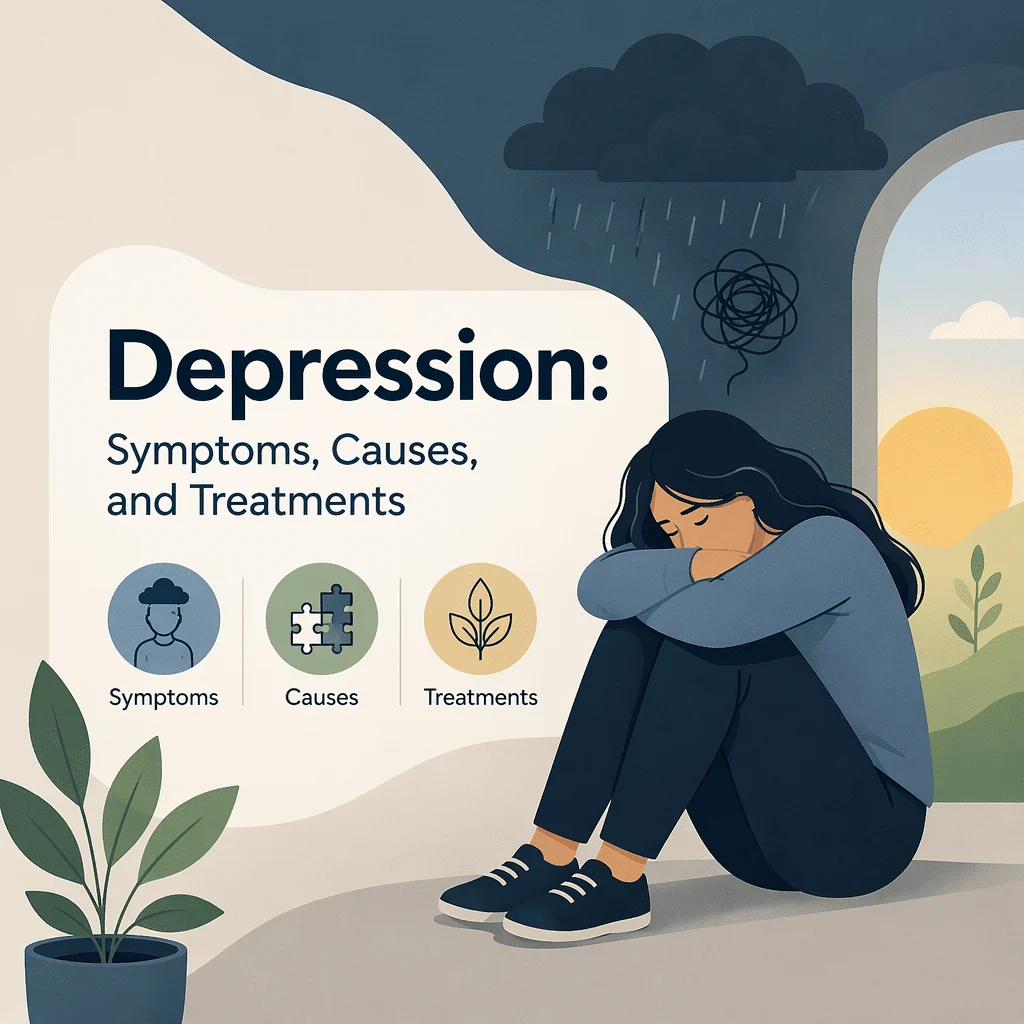
La depresión es una de las condiciones de salud más comunes en el mundo, aunque sigue siendo muy mal entendida. También llamada trastorno depresivo mayor, es una enfermedad médica real que afecta cómo te sientes, piensas, duermes y funcionas — no es un estado de ánimo pasajero ni una debilidad personal. Este artículo explica qué es la depresión, cómo reconocer sus síntomas, qué la causa y cómo la diagnostican los médicos. También aprenderás por qué no existe un solo análisis de sangre para detectarla, y cómo los estudios de laboratorio ayudan a descartar condiciones físicas que pueden imitarla, como problemas de tiroides o deficiencias de vitaminas. Por último, explicamos las opciones de tratamiento en términos sencillos y, lo más importante, cuándo buscar ayuda. El mensaje tranquilizador a lo largo de todo el artículo: la depresión tiene tratamiento y hay apoyo efectivo disponible.
Qué es realmente la depresión
La depresión, conocida médicamente como trastorno depresivo mayor, es mucho más que sentirse triste uno o dos días. Es un estado de ánimo bajo persistente o una pérdida de interés que dura al menos dos semanas e interfiere con la vida cotidiana — el trabajo, las relaciones, el sueño y el apetito. A diferencia de la tristeza común, que se va cuando cambian las circunstancias, la depresión tiende a prolongarse, y puede aparecer incluso cuando todo parece ir bien. También es muy frecuente: afecta a personas de todas las edades, géneros y contextos de vida.
Más que tristeza ordinaria
Todos nos sentimos mal en algún momento. Lo que distingue a la depresión es su intensidad, su duración y la forma en que afecta tanto al cuerpo como a la mente. Las personas suelen describir un cansancio profundo, una pérdida del placer por las cosas que antes disfrutaban y dificultad para concentrarse. Reconocer que la depresión es una condición de salud — no un defecto de carácter — es el primer paso para recibir ayuda efectiva.
Cómo reconocer los síntomas de la depresión
Los síntomas de la depresión varían de persona a persona, pero generalmente persisten la mayor parte del día, casi todos los días, durante al menos dos semanas. Se agrupan en síntomas emocionales, físicos y cognitivos, y con frecuencia se presentan juntos.
Señales emocionales y conductuales
- Estado de ánimo bajo, triste o vacío que no mejora
- Pérdida de interés o placer en actividades que antes se disfrutaban
- Sentimientos de inutilidad, culpa o desesperanza
- Alejamiento de amigos, familia y rutinas habituales
- Irritabilidad o inquietud, especialmente frecuentes en hombres y adolescentes
Señales físicas y cognitivas
- Fatiga o una caída notable en la energía
- Cambios en el sueño, ya sea durmiendo demasiado o muy poco
- Cambios en el apetito o el peso
- Dificultad para concentrarse, recordar o tomar decisiones
- Dolores, molestias o problemas digestivos sin explicación aparente
Dado que muchas de estas señales —fatiga, mal sueño, cambios de peso— también pueden deberse a enfermedades físicas, los médicos realizan un historial clínico detallado antes de llegar a cualquier conclusión. Esta superposición es precisamente la razón por la que los estudios de laboratorio pueden tener un papel de apoyo, como explicamos más adelante.
¿Qué causa la depresión?
Rara vez existe una sola causa. La depresión generalmente se desarrolla a partir de una combinación de factores biológicos, psicológicos y sociales que se acumulan con el tiempo. Entender estas causas puede reducir la autocrítica y orientar hacia el tipo de apoyo adecuado.
Factores biológicos
La química cerebral, la genética y las hormonas contribuyen al desarrollo de la depresión. Esta puede ser hereditaria, y se cree que los cambios en los neurotransmisores del cerebro, como la serotonina, juegan un papel importante. Las condiciones físicas —como los trastornos de tiroides, las enfermedades crónicas y la inflamación prolongada— también pueden desencadenar o profundizar el estado de ánimo bajo. El estrés crónico eleva la hormona cortisol y, con el tiempo, esto puede alterar el estado de ánimo y el sueño; si esto te preocupa, puedes explorar un análisis de sangre de cortisol.
Factores psicológicos y sociales
Los eventos estresantes en la vida —como la pérdida de un ser querido, la pérdida del empleo, problemas económicos, el aislamiento o el trauma, especialmente en la infancia— aumentan el riesgo. También lo hacen ciertos patrones de personalidad, como una fuerte tendencia a la autocrítica. Factores sociales como la soledad y la falta de apoyo pueden mantener la depresión una vez que comienza. Estos desencadenantes no significan que la persona sea débil; reflejan cómo interactúan la mente, el cuerpo y el entorno.
Cómo se diagnostica la depresión
No existe ningún estudio de imagen ni un análisis de sangre único que pueda confirmar la depresión. En cambio, el diagnóstico se basa en una evaluación clínica cuidadosa realizada por un médico o un profesional de salud mental, quien escucha tu experiencia y compara tus síntomas con criterios establecidos.
La evaluación clínica
En Estados Unidos, los médicos utilizan los criterios del DSM-5, el manual estándar de trastornos de salud mental. En términos sencillos, el diagnóstico de trastorno depresivo mayor generalmente requiere al menos cinco síntomas —como estado de ánimo bajo o pérdida de interés— presentes la mayor parte del día, casi todos los días, durante dos semanas o más, y que causen dificultades reales en la vida cotidiana. El médico también preguntará sobre tu historial médico, los medicamentos que tomas, el consumo de alcohol y los antecedentes familiares.
Cuestionarios de detección
Para medir qué tan graves son los síntomas, los médicos suelen usar un cuestionario breve. El más conocido es el PHQ-9, un formulario de nueve preguntas que pregunta con qué frecuencia te han molestado problemas como dormir mal, tener poca energía o sentir poco interés en las cosas durante las últimas dos semanas. No diagnostica depresión por sí solo, pero ayuda a dar seguimiento a los síntomas y a ver si el tratamiento está funcionando. La depresión y la ansiedad suelen presentarse juntas, por lo que tu médico también puede evaluar los síntomas que se comparten con los trastornos de ansiedad.
El papel de los análisis de sangre: descartar causas físicas
Aquí hay un punto importante y honesto: ningún análisis de sangre puede diagnosticar la depresión. No existe ningún marcador biológico que le indique a un laboratorio que “esto es depresión”. Lo que los análisis de sangre sí pueden hacer es descartar —o revelar— condiciones físicas que producen síntomas parecidos a los de la depresión, como cansancio, estado de ánimo bajo y dificultad para concentrarse. Como señala Mayo Clinic, un médico puede solicitar una biometría hemática (BH) o revisar la función tiroidea para asegurarse de que otra condición no sea la responsable.
Aquí es donde entender tus propios resultados resulta útil. Si se encuentra y se trata una causa física, el estado de ánimo suele mejorar. La tabla a continuación muestra los estudios que los médicos usan con más frecuencia para descartar causas físicas que imitan la depresión, y por qué cada uno es importante.
| Análisis de laboratorio | Qué ayuda a descartar o revelar |
|---|---|
| Función tiroidea (TSH) | Una tiroides poco activa o hiperactiva puede causar cansancio, cambios de peso y estado de ánimo bajo que se parecen a la depresión. |
| Biometría hemática (BH) | Puede revelar anemia, una falta de glóbulos rojos sanos que frecuentemente provoca cansancio y poca energía. |
| Vitamina B12 | Los niveles bajos pueden afectar el estado de ánimo, la memoria y la energía, y son fáciles de corregir una vez detectados. |
| Folato (vitamina B9) | Una deficiencia puede contribuir al cansancio y al estado de ánimo bajo, y suele presentarse junto con niveles bajos de B12. |
| Vitamina D (25-OH) | La deficiencia es común y se ha relacionado con el estado de ánimo bajo, especialmente durante los meses con menos luz solar. |
| Proteína C reactiva (PCR) | Un marcador general de inflamación, que cada vez más investigaciones vinculan con síntomas depresivos. |
Por ejemplo, una tiroides poco activa es una causa clásica que imita la depresión, por lo que tu médico puede revisar una Prueba de función tiroidea TSH, y puede ser útil entender niveles normales de tiroidesLa nutrición también importa: un médico puede solicitar un estudio que revele niveles bajos de vitamina B12, y los laboratorios también pueden detectar síntomas de deficiencia de folato, que a su vez afectan niveles de homocisteína.
Cuando el cansancio apunta a reservas bajas, tu médico puede pedir una prueba de vitamina D en sangreY como el estado de ánimo y la inflamación parecen estar relacionados, los médicos a veces solicitan una prueba de proteína C reactiva para medir inflamaciónNinguno de estos resultados diagnostica la depresión, pero en conjunto ayudan a construir un panorama más completo de tu salud.
Cómo se trata la depresión
La depresión tiene tratamiento y la mayoría de las personas mejora con el apoyo adecuado. El tratamiento generalmente se adapta a la gravedad de los síntomas y a las preferencias de cada persona, y suele abarcar tres áreas que con frecuencia se combinan. Esta información es educativa y no es una recomendación de ningún tratamiento específico — esas decisiones las tomas tú junto con tu médico.
Terapias psicológicas
La psicoterapia, o terapia de conversación, ayuda a muchas personas. La terapia cognitivo-conductual, que trabaja los patrones de pensamiento y conducta negativos, y la terapia interpersonal están entre las más estudiadas. La terapia puede usarse sola en casos de depresión leve, o junto con medicamentos en casos moderados a graves.
Medicamento
Los antidepresivos pueden ayudar a corregir los cambios en la química cerebral relacionados con la depresión. Existen varios tipos, y encontrar el más adecuado a veces requiere paciencia, ya que pueden tardar algunas semanas en hacer efecto. Los receta y supervisa un médico, quien también orienta cualquier ajuste en la dosis.
Estilo de vida y apoyo
La actividad física regular, el sueño estable, una alimentación equilibrada y el contacto social favorecen la recuperación y ayudan a prevenir recaídas. Reducir el consumo de alcohol, que en sí mismo es un depresor, también es de gran ayuda. Estos pasos no reemplazan la atención profesional, pero sí la fortalecen.
Cuándo consultar a un médico — y cuándo buscar ayuda urgente
Cuándo hacer una cita
Considera consultar a un médico si el ánimo bajo, la pérdida de interés o los síntomas mencionados duran más de dos semanas, siguen regresando o afectan tu trabajo, tus estudios o tus relaciones. También vale la pena una visita si el cansancio u otros síntomas físicos no tienen una explicación clara — una revisión puede descartar causas físicas al mismo tiempo. Buscar ayuda a tiempo suele hacer que el tratamiento sea más sencillo y rápido.
Cuándo buscar ayuda urgente
Si tú o alguien que conoces está pensando en hacerse daño o en el suicidio, hay ayuda disponible ahora mismo, y estos sentimientos pueden mejorar con apoyo. En México, puedes llamar a SAPTEL al 55 5259-8121, disponible las 24 horas, o comunicarte con los servicios de emergencias al 911. No tienes que enfrentar una crisis solo, y pedir ayuda es una señal de fortaleza, no de debilidad.
Avances científicos recientes
La investigación sobre la depresión avanza rápidamente. A continuación te presentamos tres avances de los últimos años, explicados en términos sencillos, junto con lo que cada uno puede significar para ti.
La conexión entre inflamación y estado de ánimo
Lo que encontraron los investigadores: en un estudio muy grande que siguió a cientos de miles de adultos durante muchos años (una cohorte — un grupo al que se le da seguimiento con el tiempo), las personas con niveles más altos de ciertos marcadores de inflamación en la sangre, incluida la proteína C reactiva, tuvieron una probabilidad algo mayor de desarrollar depresión más adelante. Un análisis de 2024 que reunió varios estudios encontró que esta señal de inflamación era más clara en mujeres que en hombres.
Lo que esto significa para ti: la inflamación no causa toda depresión, y todavía no existe ningún estudio que pueda diagnosticarla. Pero estos hallazgos ayudan a explicar por qué la salud física y la mental están tan estrechamente relacionadas, y por qué un médico puede investigar niveles altos de PCR. La relación es real, pero modesta, y los científicos aún están tratando de separar la causa del efecto.
Tratamientos de acción más rápida
Lo que encontraron los investigadores: un medicamento oral más nuevo llamado zuranolona funciona de manera diferente a los antidepresivos tradicionales. En un ensayo de fase 3 (un estudio amplio en etapa avanzada realizado en personas), los adultos con trastorno depresivo mayor que tomaron un ciclo corto de 14 días mejoraron más rápido que quienes recibieron un placebo, y algunos notaron una diferencia en aproximadamente tres días. La zuranolona está actualmente aprobada en Estados Unidos específicamente para la depresión después del parto, conocida como depresión posparto.
Lo que esto significa para ti: las opciones de acción rápida son un área de investigación activa y prometedora. Dicho esto, algunas revisiones advierten que el beneficio en la depresión en general parece más modesto, y cualquier medicamento es una decisión que debes tomar con tu médico. Esto apunta hacia un futuro con más opciones, no a una cura milagrosa única.
Terapia asistida con psilocibina en estudio
Lo que encontraron los investigadores: ensayos tempranos están evaluando la psilocibina — un compuesto administrado únicamente bajo supervisión médica estrecha junto con psicoterapia — para la depresión que no ha respondido a otros tratamientos. En un ensayo aleatorizado de 2024 (donde las personas se asignan al azar para que los grupos puedan compararse de manera justa), las sesiones cuidadosamente supervisadas se asociaron con reducciones significativas en las puntuaciones de depresión.
Lo que esto significa para ti: esto sigue siendo experimental. No es un tratamiento aprobado ni para usar en casa, y solo se estudia en entornos de investigación controlados; sin embargo, refuerza un mensaje alentador: la ciencia para tratar la depresión sigue avanzando.
Glosario
| Término | Definición |
|---|---|
| Trastorno depresivo mayor (TDM) | Una condición médica que implica un estado de ánimo bajo persistente o pérdida de interés que dura al menos dos semanas y afecta la vida diaria. |
| PHQ-9 | Un formulario breve de nueve preguntas, el Cuestionario de Salud del Paciente, que ayuda a medir qué tan graves son los síntomas de depresión. |
| DSM-5 | El Manual Diagnóstico y Estadístico de los Trastornos Mentales, quinta edición; los criterios estándar que utilizan los médicos en Estados Unidos para diagnosticar condiciones de salud mental. |
| Serotonina | Un químico cerebral, o neurotransmisor, que ayuda a regular el estado de ánimo, el sueño y el apetito. |
| Antidepresivo | Un tipo de medicamento que se usa para tratar la depresión actuando sobre la química del cerebro. |
| TSH (hormona estimulante de la tiroides) | Un marcador en sangre que indica qué tan bien está funcionando la glándula tiroides. |
| Proteína C reactiva (PCR) | Una proteína que libera el hígado cuando hay inflamación en alguna parte del cuerpo. |
| Anemia | Una condición en la que hay muy pocos glóbulos rojos sanos, lo que puede causar cansancio y falta de energía. |
| Terapia cognitivo-conductual (TCC) | Una terapia de conversación que ayuda a cambiar patrones de pensamiento y conducta que no son útiles. |
Preguntas frecuentes sobre la depresión
¿Existe un análisis de sangre que pueda diagnosticar la depresión?
No. No existe ningún análisis de sangre que pueda diagnosticar la depresión por sí solo. El diagnóstico se hace mediante una evaluación clínica de tus síntomas, tu historial médico y cómo te afectan en la vida diaria. Sin embargo, los análisis de laboratorio siguen siendo útiles, ya que ayudan a descartar condiciones físicas —como problemas de tiroides o deficiencias de vitaminas— que pueden causar síntomas similares. Entender esos resultados puede ayudarte a ti y a tu médico a tener un panorama más completo.
¿Una deficiencia de vitaminas puede causar depresión?
Niveles bajos de vitamina B12, ácido fólico o vitamina D pueden causar cansancio, bajo estado de ánimo y dificultad para concentrarse, síntomas que se parecen a la depresión o la empeoran. Corregir una deficiencia real a veces mejora estos síntomas, por eso los médicos suelen revisarlos. Sin embargo, la mayoría de los casos de depresión no se explican por una sola deficiencia, y los suplementos no sustituyen una evaluación y atención adecuadas.
¿En qué se diferencia la depresión de la tristeza del día a día?
La tristeza es una respuesta normal ante situaciones difíciles y generalmente se va con el tiempo. La depresión es más profunda y persistente: dura al menos dos semanas, afecta la mayor parte del día casi todos los días, e interfiere con el sueño, la energía, la concentración y la capacidad de disfrutar la vida. Cuando el bajo estado de ánimo se prolonga o sigue regresando, vale la pena hablar con un profesional.
¿La depresión es señal de debilidad?
No. La depresión es una condición médica que surge de una combinación de factores biológicos, psicológicos y sociales, no de una falla personal ni de falta de fuerza de voluntad. Personas muy fuertes y exitosas pueden tener depresión. Reconocerla y pedir ayuda es un paso constructivo y valiente, y existen tratamientos efectivos al alcance de todos.
¿Los antidepresivos crean adicción?
Los antidepresivos no generan adicción de la misma manera que sustancias como el alcohol o los opioides; no provocan antojos ni euforia. Algunas personas notan síntomas de discontinuación si los dejan de golpe, por eso los médicos suelen reducir la dosis de forma gradual. Cualquier decisión de iniciar, cambiar o suspender un medicamento debe tomarse junto con el médico que lo recetó.
¿Cuánto tiempo dura normalmente el tratamiento para la depresión?
Varía. Para un primer episodio, las guías clínicas suelen recomendar continuar el tratamiento varios meses después de que los síntomas mejoran, para reducir el riesgo de recaída. Las personas con depresión recurrente pueden beneficiarse de un apoyo a más largo plazo. La duración adecuada depende de tu historial y tu respuesta al tratamiento, y es algo que debes revisar regularmente con tu médico.
Fuentes
- National Institute of Mental Health — Depression — National Institutes of Health, 2024 — nimh.nih.gov
- MedlinePlus — Depression — U.S. National Library of Medicine, 2024 — medlineplus.gov
- Mayo Clinic — Depression (major depressive disorder): Diagnosis and treatment, 2024 — mayoclinic.org
- Zeng Y and colleagues — Inflammatory Biomarkers and Risk of Psychiatric Disorders — JAMA Psychiatry, 2024 — doi.org/10.1001/jamapsychiatry.2024.2185
- Jarkas DA and colleagues — Sex differences in the inflammation-depression link: a systematic review and meta-analysis — Brain, Behavior, and Immunity, 2024 — doi.org/10.1016/j.bbi.2024.07.037
- Clayton AH and colleagues — Zuranolone for the Treatment of Adults With Major Depressive Disorder: a randomized, placebo-controlled phase 3 trial — American Journal of Psychiatry, 2023 — doi.org/10.1176/appi.ajp.20220459
- Rosenblat JD and colleagues — Psilocybin-assisted psychotherapy for treatment-resistant depression: a randomized clinical trial — Med, 2024 — doi.org/10.1016/j.medj.2024.01.005
- Gao K and colleagues — Pharmacological Monotherapy for Depressive Disorders: Current and Future — a narrative review — Medicina, 2025 — doi.org/10.3390/medicina61040558
Lecturas recomendadas
- Para ver cómo la tiroides puede influir en la energía y el estado de ánimo, consulta el Prueba de función tiroidea TSH.
- Para revisar tus reservas después de meses largos y con poca luz solar, explora el prueba de vitamina D en sangre.
- Para entender una causa frecuente de cansancio, revisa niveles bajos de vitamina B12.
- Para saber cómo el cuerpo señala la inflamación, consulta el proteína C reactiva, marcador de inflamación.
- Para conocer un nutriente relacionado con el estado de ánimo y la anemia, revisa el análisis de sangre de ácido fólico.
Entiende tus resultados de laboratorio con AI DiagMe
La depresión la diagnostica un profesional, pero cuando el cansancio o el ánimo bajo te hacen preguntarte qué pasa, tus resultados de laboratorio pueden darte pistas útiles. AI DiagMe te ayuda a entender estudios de uso común —como tiroides (TSH), vitamina B12, vitamina D y proteína C reactiva— en un lenguaje claro, para que puedas tener una conversación más informada con tu médico. Te ayuda a entender tus resultados; no diagnostica depresión ni reemplaza la atención médica.
Obtén la lectura de tus resultados en minutos