




















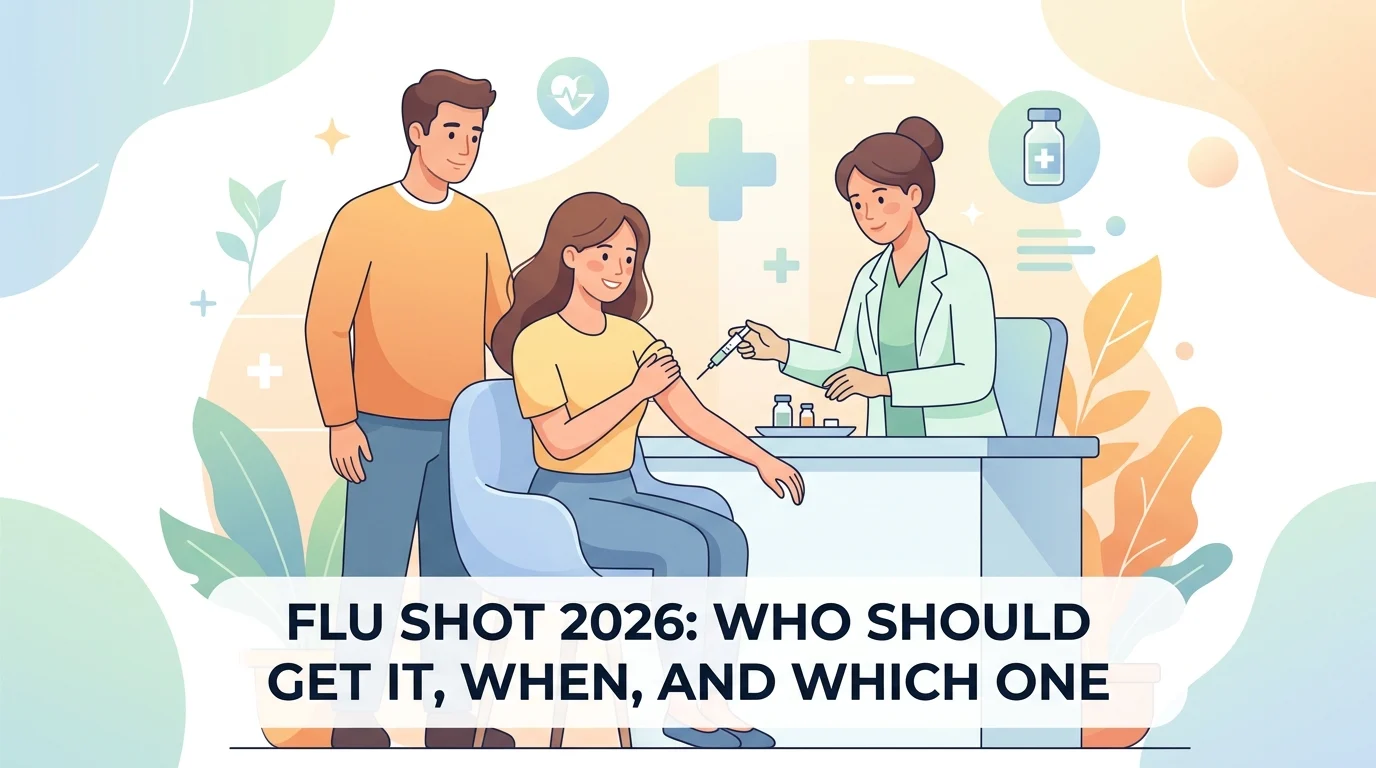
A flu shot 2026 plan starts with one question: who should get vaccinated, and when? This fall, the answer comes from two places. The CDC says its recommendations from the July 2025 immunization schedule remain in effect for the 2026-2027 season, while a group of medical societies has issued joint guidance to fill a gap left by a stalled federal advisory committee. The advice overlaps far more than it differs. This article explains who is recommended, the best timing, which vaccine adults 65 and older should ask for, and what the newest research says. It does not replace advice from your own clinician.
Flu shot 2026: who is recommended
The CDC’s interim guidance for 2026-2027 keeps routine annual flu vaccination for everyone 6 months and older, using an FDA-licensed vaccine approved for their age. Medical societies including the American Academy of Family Physicians, American Academy of Pediatrics, American College of Obstetricians and Gynecologists, American Medical Association and Infectious Diseases Society of America give the same message, and explicitly include pregnant people.
When supply is limited, the CDC lists priority groups: young children, adults 50 and older, pregnant women, people with certain chronic conditions, and health care workers and household contacts of people at high risk. People with an egg allergy can receive any age-appropriate flu vaccine, and egg allergy alone requires no extra precautions.
When to get your flu shot
For most people, the ideal window is September or October. The CDC advises against vaccinating in July or August for most adults, especially those 65 and older, because protection can fade over the season. Experts quoted by the Association of American Medical Colleges suggest October, ideally before Halloween, since immunity takes a couple of weeks to build.
If you miss that window, vaccination is still worthwhile while flu viruses circulate, and protection can extend into March or April. Children who need two doses, and women in the third trimester of pregnancy, are exceptions to the timing rule and may be vaccinated earlier.
Which vaccine if you are 65 or older
The CDC states that adults 65 and older should preferentially receive a high-dose, recombinant or adjuvanted vaccine when available. If none is available, any other age-appropriate vaccine should be given instead of going without. The medical societies’ guidance, as summarized by the AAMC, tells adults over 65 to ask for a high-dose or an mRNA vaccine.
| Vaccine type | A quién va dirigido | Qué debes saber |
|---|---|---|
| Standard-dose | Most people 6 months and older | Routine option for all ages when no preferred vaccine applies |
| High-dose | Adults 65 and older | Preferred option in CDC guidance |
| Adjuvanted | Adults 65 and older | Contains an ingredient that boosts the immune response |
| Recombinant | Adults 65 and older | Made without eggs |
COVID-19 and RSV: the other fall vaccines
Because the CDC has not issued updated 2026-2027 recommendations for every fall vaccine, the AAMC guide relies on joint society recommendations. They advise annual COVID-19 vaccination for adults 19 and older, including pregnant people, with adults over 65 receiving a dose every six months. For RSV, they recommend a one-time vaccine for adults 75 and older and for adults 50 to 74 at increased risk. People who recently had COVID-19 can usually wait about three months. Most insurers have said they will keep covering flu, COVID-19 and RSV vaccines, and Medicare is required to provide coverage.
Latest scientific advances: does a stronger vaccine help?
According to PubMed, a large randomized analysis published in The Lancet (DOI) pooled two trials in Denmark and Spain with nearly half a million older adults. The high-dose vaccine modestly reduced hospitalizations for flu or pneumonia compared with the standard dose, with a clearer benefit for laboratory-confirmed flu. Deaths from any cause were similar between groups. The analysis was funded by a vaccine manufacturer, which is worth keeping in mind.
A network meta-analysis in the Journal of the American Geriatrics Society (DOI) reached a similar conclusion: enhanced vaccines (high-dose, adjuvanted and recombinant) gave somewhat better protection against flu hospitalization than standard vaccines, with no clear winner among them. A heart failure subanalysis (DOI) pointed the same way, though its estimates were too imprecise to be conclusive.
What this means for you: if you are 65 or older, ask for a preferred vaccine, but do not delay vaccination just to wait for one. The extra benefit is real but modest, and no flu vaccine prevents every case.
Do you need a blood test around your vaccine?
In the guidance reviewed for this article, no blood test is listed as a prerequisite for a flu shot. What matters on the day is that you do not have a fever or an acute illness. Lab work still plays a supporting role for the conditions that make vaccination a priority, such as diabetes and kidney disease, which are tracked with tests like HbA1c and eGFR.
To see how lab results fit into flu season, read our guide to the first FDA-approved mRNA flu vaccine. For the basics of the illness itself, see our overview of influenza symptoms, treatment and prevention. If you want to understand an inflammation marker, review our explanation of C-reactive protein and inflammation.
Cuándo hablar con su médico
- You have a fever or an acute illness on the day of your appointment: ask whether to reschedule.
- You are pregnant, immunocompromised or managing a chronic condition and are unsure which vaccines and timing suit you.
- You have had a severe allergic reaction to a vaccine before.
- After a shot, you develop trouble breathing, swelling of the face or throat, or fainting: call 911.
Glosario
- High-dose vaccine: a flu vaccine with more antigen to stimulate a stronger response in older adults.
- Adjuvanted vaccine: a vaccine that includes an ingredient that boosts the immune response.
- Recombinant vaccine: a flu vaccine made without eggs using laboratory-produced proteins.
- Vacuna de ARNm: a vaccine that gives cells instructions to make a harmless viral protein.
- Relative vaccine effectiveness: how much better one vaccine performs compared with another.
Preguntas frecuentes
Is it too early or too late to get a flu shot in October?
No. September and October are the ideal window, and later vaccination still helps while flu viruses are circulating.
Can I get the flu and COVID-19 vaccines at the same visit?
The CDC notes that inactivated flu vaccines can be given at the same time as other inactivated vaccines at separate injection sites. Ask your clinician or pharmacist about your situation.
Do I need to avoid the flu shot if I have an egg allergy?
No. People 6 months and older with an egg allergy can receive any age-appropriate flu vaccine.
Will insurance cover my fall vaccines?
Most insurers have said they will keep covering flu, COVID-19 and RSV vaccines, and Medicare is required to provide coverage. Check with your plan.
Does the flu shot prevent every case of flu?
No. It lowers the risk of severe illness and hospitalization, but protection is never complete.
Fuentes
- CDC — Interim Clinical Considerations for the Use of Seasonal Influenza Vaccines in the United States
- AAMC — A guide to fall vaccines
- Johansen ND et al. — Effectiveness of high-dose influenza vaccine against hospitalisations in older adults (FLUNITY-HD), The Lancet, 2025
- Ferdinands JM et al. — Protection against influenza hospitalizations from enhanced influenza vaccines among older adults, J Am Geriatr Soc, 2024
- Skaarup KG et al. — High-dose versus standard-dose influenza vaccine in heart failure (DANFLU-2), Circ Heart Fail, 2025
Otros artículos
- Vacuna antigripal de ARNm: qué significa para ti la primera aprobada por la FDA
- Gripe (Influenza): Síntomas, Tratamiento y Prevención
- Complete blood count: what the results mean
Entiende tus propios resultados de análisis de sangre con AI DiagMe
Managing a chronic condition or waiting on lab results? Comprenda los resultados de su laboratorio con AI DiagMe..