




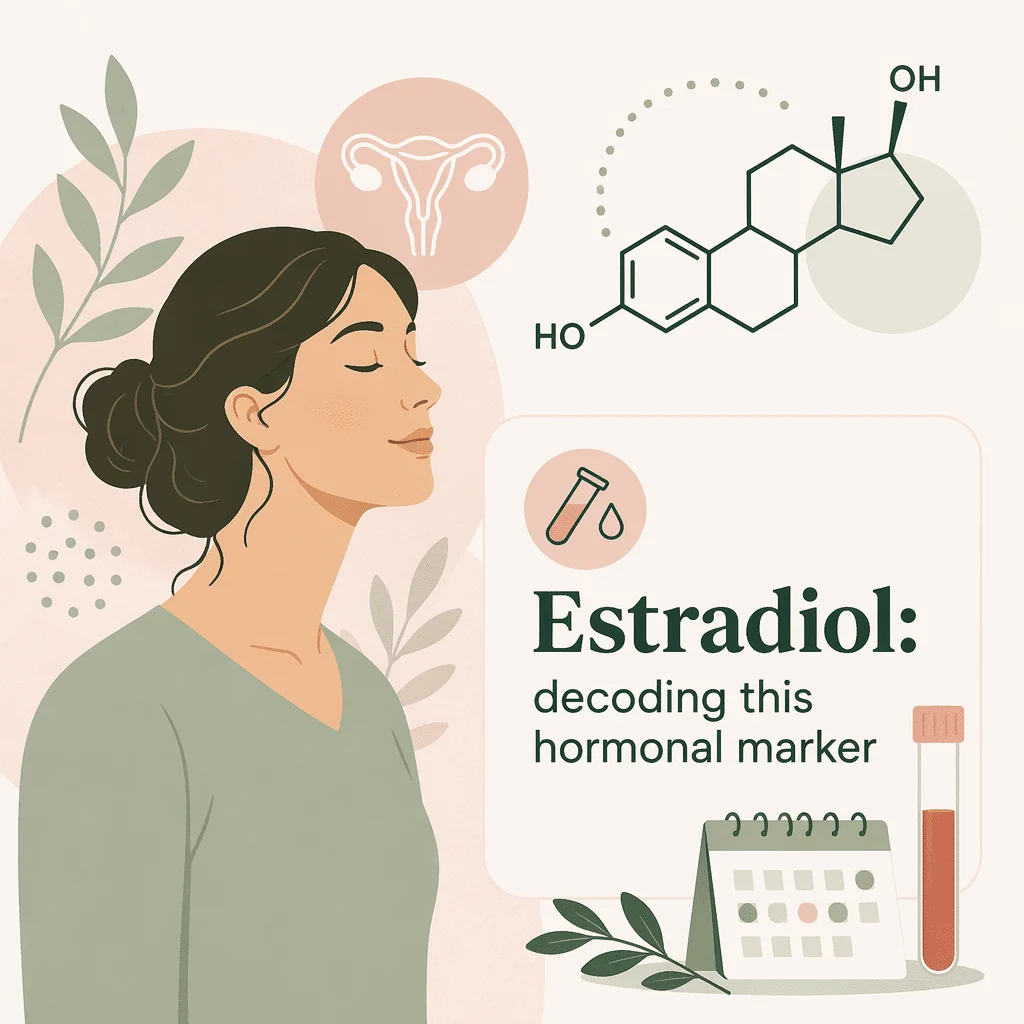
An estradiol blood test measures how much estradiol — often written as E2 — is circulating in your blood. Estradiol is the strongest and most abundant form of oestrogen, and it does far more than regulate the menstrual cycle: it supports fertility, bone strength, mood, and cardiovascular health in both women and men. Because the level rises and falls naturally across the day, the menstrual cycle, and a lifetime, a single figure can be hard to interpret on your own. This article explains what the test measures, what typical estradiol ranges look like by sex and life stage, what high and low results can mean, when a value is worth discussing with a clinician, and what recent research adds. You will also find a plain-language glossary and answers to the questions people ask most.
What an estradiol blood test measures
Estradiol (E2) is a steroid hormone in the oestrogen family. In women of reproductive age, the ovaries produce most of it, with smaller contributions from the adrenal glands and from fat tissue. In men, the testes and fat tissue make estradiol, much of it converted from testosterone by an enzyme called aromatase. A blood sample — usually drawn from a vein in the arm — captures the amount circulating at that moment.
Doctors order the test for many reasons: to look into irregular periods, assess fertility, monitor an in vitro fertilisation (IVF) cycle, confirm menopause, investigate early or delayed puberty, or check hormone balance in men. Because estradiol works with other hormones, clinicians usually order a follicle-stimulating hormone (FSH) test. To complete the hormonal picture, they often add a luteinising hormone (LH) test.
On its own, an estradiol number says little; its meaning comes from context. A low estradiol paired with a high FSH, for example, points towards ovaries that are winding down, as in menopause or primary ovarian insufficiency. A low estradiol alongside a low or normal FSH suggests instead a signalling problem higher up, in the brain’s pituitary gland. This is why clinicians rarely read estradiol in isolation.
The procedure itself is quick and low-risk — the same routine blood test used for most panels, and results are often available within a day or two. The value is usually read as part of a broader assessment of reproductive and hormonal health, and during fertility treatment the level is tracked repeatedly to follow how the ovaries respond. Some people go on to arrange a full fertility blood test panel.
Estradiol reference ranges by sex and life stage
There is no single “normal” estradiol value. Levels swing widely across the menstrual cycle, drop sharply after menopause, and sit in a lower, steadier band in men. The table below shows typical adult ranges in picograms per millilitre (pg/mL), with an approximate conversion to picomoles per litre (pmol/L), the unit some laboratories report.
| Group or menstrual cycle phase | Typical estradiol range (pg/mL) | Approximate range (pmol/L) |
|---|---|---|
| Follicular phase (early cycle) | 30–120 | 110–440 |
| Ovulatory phase (mid-cycle) | 130–370 | 480–1,360 |
| Luteal phase (late cycle) | 70–250 | 260–920 |
| After menopause | Below 30 | Below 110 |
| Adult men | 10–40 | 37–150 |
Treat these figures as a general guide rather than a verdict. Every laboratory sets its own reference range based on the population it serves and the method it uses, so always compare your number with the range printed on your own report. For a plain-language reference, comparable cycle-based ranges appear in Cleveland Clinic’s oestrogen overview. Values in children before puberty are normally very low and climb as puberty begins.
How estradiol shifts across the cycle
Early in the menstrual cycle, during the follicular phase, estradiol starts low and rises as an ovarian follicle matures. It peaks just before ovulation, driving the mid-cycle surge that releases an egg. In the luteal phase that follows, estradiol settles to an intermediate level that helps prepare the lining of the uterus. This rhythm is exactly why the timing of your test changes what counts as normal.
How to read your estradiol results
Units and conversion
Most UK laboratories report estradiol in pmol/L. If your result is in pg/mL, you can convert it roughly by multiplying by 3.67, so 27 pg/mL is about 100 pmol/L. Keeping the same units at every visit makes it far easier to compare results over months or years.
Timing and preparation
Strict fasting is generally not required for an estradiol blood test. Timing matters more. In a menstruating woman, the same number can be perfectly normal in one week and unexpected in another, so a clinician will often specify a cycle day — commonly day two to five for a baseline reading. Consistent conditions from one test to the next make the comparison meaningful.
A simple way to review your result
Start by finding your figure, its units, and the laboratory’s reference range on the report. Note where you are in your cycle or life stage, since that shapes what “expected” looks like. Then read the whole hormonal pattern rather than one isolated number. To understand how laboratories build these bands, see our explainer on normal blood test ranges. For the report layout itself, consult our guide to reading blood test results.
One more habit helps: try to stay with the same laboratory when you can. Because methods differ, a value from one lab is not always directly comparable to a value from another, even when both look normal.
Finally, weigh the number against how you feel. Estradiol exists to produce effects throughout the body, so symptoms such as hot flushes, irregular cycles, breast changes, or low mood can matter as much as the figure on the page. A value that sits inside the reference range but comes with clear symptoms is still worth raising with your clinician.
What high estradiol levels can mean
A high estradiol reading is not a diagnosis on its own; it is a clue that your care team interprets alongside your symptoms and other results.
In women
Common explanations include the natural mid-cycle surge, if the sample was taken near ovulation, as well as pregnancy and ovarian stimulation during fertility treatment. Persistent elevation outside these situations can point to polycystic ovary syndrome, an oestrogen-producing ovarian cyst or tumour (uncommon), liver disease, or excess body fat, since fat tissue converts other hormones into estradiol. To map the pattern, doctors may also investigate high prolactin levels. They often weigh your sex hormone-binding globulin levels, too.
In men
In men, a higher-than-expected estradiol can follow weight gain, liver disease, some medications, or an imbalance between testosterone and oestrogen. Possible signs include breast tenderness or enlargement (gynaecomastia), lower libido, or mood changes, although mild elevations often cause no symptoms at all.
When a man’s estradiol is genuinely high, doctors usually look at the balance between estradiol and testosterone rather than either hormone alone, and they may review body weight, alcohol intake, and any medications known to raise oestrogen.
What low estradiol levels can mean
In women
Before puberty and after the menopause, a low estradiol level is expected. During the reproductive years, it may reflect a problem in the brain-ovary signalling chain — for example, primary ovarian insufficiency, when the ovaries slow down before age 40, along with very low body weight, intense athletic training, an eating disorder, or high prolactin. Symptoms can include missed periods, hot flushes, vaginal dryness, and disrupted sleep, and many people in this stage also track their menopause symptoms. Because these levels naturally fluctuate, a single low reading is often repeated, sometimes with FSH and LH, before any firm conclusion is drawn.
In men
Men need a small, steady amount of estradiol for healthy bones and metabolism. Very low levels — sometimes caused by low testosterone, called hypogonadism, or by aromatase-inhibitor drugs — can contribute to bone loss, joint discomfort, and higher body fat. Because a man’s estradiol sits so low to begin with, the accuracy of the measurement method matters, a point we return to below.
Estradiol, bones, and heart health beyond fertility
Estradiol’s influence reaches well past reproduction. It helps slow the natural breakdown of bone, supports healthy cholesterol patterns, and plays a part in how blood vessels and body fat behave.
Bone strength
When estradiol falls at the menopause, bone loss speeds up, which is why fracture risk climbs in the years that follow. To weigh that risk, doctors sometimes order a calcium and bone mineral panel. Read alongside the hormone results, and alongside a bone density scan, it helps a clinician judge whether low estradiol is affecting the skeleton and whether treatment is worth considering.
Heart and metabolism
Oestrogen also shapes cholesterol and blood-vessel function, which is one reason cardiovascular risk shifts after the menopause. Estradiol is not used to predict heart disease on its own, but it forms part of the wider hormonal context that clinicians weigh.
Why men should not overlook estradiol
In men, much of the estradiol that protects bone is made locally from testosterone. That is why a man with low testosterone can also develop weaker bones — the shortfall of estradiol, not testosterone alone, is part of the story. Clinicians assessing male hormones often add a wider hormone panel and usually order a testosterone blood test.
When to see a doctor about your estradiol
Estradiol results are best understood over time and in context, so a single figure rarely calls for alarm. Even so, some patterns deserve a medical review rather than watchful waiting.
- Periods that stop, become very irregular, or disappear before the age of 40
- Hot flushes, night sweats, or vaginal dryness that disrupt daily life
- Difficulty conceiving after several months of trying
- In men, breast enlargement, low libido, or unexplained bone thinning
- Any value your report flags as markedly high or low, or a level that keeps drifting on repeat testing
As a rough guide, a result within about 10% of the range often just needs a repeat test — for women, on the same cycle day. A wider gap usually warrants a conversation with a clinician, who may order additional hormone tests or imaging. Never start, stop, or change hormone treatment on the strength of a single number.
Latest scientific advances on estradiol
Research keeps refining how estradiol is measured and how its levels shape long-term health. Here is what recent, high-quality studies add, in plain terms.
Hormone therapy helps protect bone after the menopause
A 2023 review concluded that oestrogen helps maintain bone density and lowers the risk of fractures throughout the skeleton, so menopausal hormone therapy can be an option for bone protection when there is no reason to avoid it. A 2025 review that pooled 20 studies went further: combining hormone therapy with regular strength and impact exercise preserved bone density better than either approach on its own. What this means for you: if your estradiol is low after the menopause, bone health is worth discussing — but hormone therapy suits some people and not others, so the choice is individual.
The measurement method matters, especially at low levels
Most routine laboratories use an immunoassay, a fast antibody-based test. Reviews from 2023 and 2025 point out that at very low estradiol levels — as in men, postmenopausal women, children, or patients taking breast-cancer drugs known as aromatase inhibitors — these assays can be less accurate. A more precise technique called LC-MS/MS, which separates and weighs molecules, gives more reliable low readings, and the US Centers for Disease Control and Prevention runs a programme to standardise estradiol testing between laboratories. What this means for you: if a low result seems surprising, it is reasonable to ask which method was used, because a different technique can change the picture.
Estradiol and bone strength in men
A 2025 systematic review and meta-analysis studied men with hypogonadotropic hypogonadism, a condition in which the brain does not signal the testes to make enough sex hormones. It found their bone density was low but improved with hormone treatment, and that men with higher testosterone and higher estradiol tended to have stronger bones. Even so, bone density did not always return fully to normal. What this means for you: estradiol supports bone health in men as well as women, though this evidence pools small studies and is still developing.
Glossary
| Term | Definition |
|---|---|
| Estradiol (E2) | The strongest and most abundant form of oestrogen, active in both women and men. |
| Oestrogen | A family of sex hormones that includes oestradiol, oestrone, and oestriol. |
| Aromatase | An enzyme that converts androgens such as testosterone into oestradiol. |
| Follicular phase | The first half of the menstrual cycle, before an egg is released. |
| Luteal phase | The second half of the cycle, after ovulation, when the uterine lining thickens. |
| Picogram per millilitre (pg/mL) | The usual US unit for reporting oestradiol in blood. |
| Picomole per litre (pmol/L) | A metric unit for oestradiol; about 3.67 pmol/L equals 1 pg/mL. |
| Reference range | The band of values found in most healthy people for a given test and method. |
| Immunoassay | A common, fast laboratory method that measures hormones using antibodies. |
| LC-MS/MS | Liquid chromatography–tandem mass spectrometry, a precise method for low hormone levels. |
Frequently asked questions about the oestradiol blood test
What is a normal oestradiol level?
There is no universal number. In menstruating women, oestradiol changes with the cycle — lower early on, highest around ovulation, and intermediate afterwards. It is very low after the menopause and before puberty, and sits between roughly 10 and 40 pg/mL in adult men. Because laboratories use different methods and populations, the most reliable comparison is the reference range printed on your own report.
Do you need to fast for an oestradiol blood test?
Fasting is generally not necessary. What matters more is timing and consistency: for a menstruating woman, the cycle day can change the result far more than a recent meal. If your clinician wants a baseline value, they will usually ask for a sample in the first few days of the cycle and may suggest testing under similar conditions each time.
When in the menstrual cycle should oestradiol be measured?
It depends on the reason for testing. For a baseline assessment, day two to five is common. To capture the pre-ovulation peak, testing happens mid-cycle. During fertility treatment, oestradiol is measured several times to monitor how follicles develop. Your clinician will tell you which day suits your situation, so mention the date of your last period when booking.
What can cause a falsely high or low oestradiol reading?
Laboratory methods differ, and at very low levels some antibody-based assays can over- or under-estimate the true value. Certain medications also shift results, including aromatase inhibitors, some antifungal and antiepileptic drugs, and hormonal contraception, which lowers natural ovarian estradiol. If a result does not fit the clinical picture, a repeat test — sometimes by a more precise method — often clarifies it.
Why would a man need an estradiol test?
Men make a small but important amount of estradiol, mostly converted from testosterone. A doctor may check it when investigating breast enlargement, low libido, fertility concerns, unexplained bone thinning, or treatment with aromatase-inhibitor drugs. Because male levels are low, an accurate laboratory method is especially important for a meaningful result.
Can lifestyle change estradiol levels?
Everyday factors do influence oestrogen. Body weight matters because fat tissue produces oestradiol, whilst very low weight and heavy training can lower it. Alcohol, sleep, and stress play a part too, and some research explores plant compounds called phytoestrogens. These influences are modest, and lifestyle is not a substitute for medical care, so discuss any concerns with your clinician before making changes.
Sources
- Oestrogen Levels Test — MedlinePlus, US National Library of Medicine, 2025
- Oestrogen: Hormone, Function, Levels and Imbalances — Cleveland Clinic, 2026
- Menopause: Symptoms and Causes — Mayo Clinic, 2024
- The role of menopausal hormone therapy in the prevention and treatment of low bone density in perimenopausal and postmenopausal women — Shah N, Ariel D, Current Opinion in Obstetrics and Gynecology, 2023
- Impact of menopause hormone therapy, exercise, and their combination on bone mineral density and mental wellbeing in menopausal women: a scoping review — Platt O et al., Frontiers in Reproductive Health, 2025
- Clinical utility of laboratory developed mass spectrometry assays for steroid hormone testing — French D, Journal of Mass Spectrometry and Advances in the Clinical Lab, 2023
- Challenges in developing accurate assays for the measurement of oestradiol and testosterone in postmenopausal women — Stanczyk FZ et al., Menopause, 2025
- Incomplete evidence of bone density normalisation following long-term reproductive hormone treatment in men with hypogonadotropic hypogonadism — de Silva NL et al., The Journal of Clinical Endocrinology and Metabolism, 2025
Further reading
- The female hormone panel explained
- The male hormone panel explained
- A complete fertility blood test panel
- A full guide to menopause symptoms
- How to read your blood test results
Understand your lab results with AI DiagMe
Estradiol rarely tells its full story alone. Reading it next to related markers — such as follicle-stimulating hormone (FSH), luteinising hormone (LH), progesterone, or testosterone — makes the pattern much clearer. AI DiagMe turns those numbers into plain-language explanations you can bring to your next appointment. It helps you understand your results; it does not diagnose conditions or replace your doctor.
Get your results interpreted in minutes