






































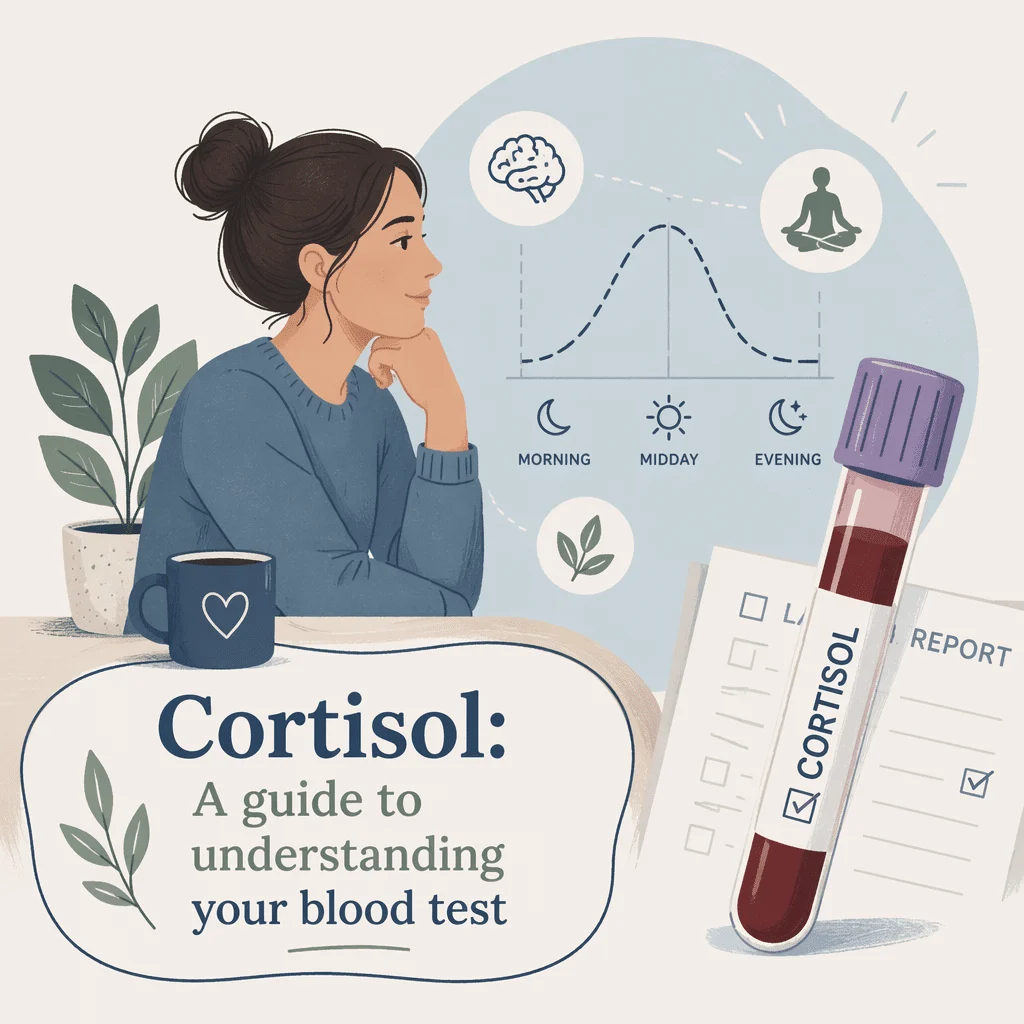
A cortisol blood test measures the main hormone your adrenal glands release under stress, and its result depends almost entirely on when the sample was taken. Cortisol follows a daily rhythm: it peaks shortly after you wake and drops to its lowest point around midnight. A number that looks alarming at 8 a.m. can be perfectly normal, and a reassuring number at 4 p.m. can still hide a problem. In this article you’ll learn what cortisol does in the body, why timing dominates interpretation, what the blood, saliva, urine and dexamethasone tests each answer, how doctors read high and low results, why a single high value does not mean Cushing’s syndrome, and which symptoms deserve urgent attention.
What cortisol does, and the axis that controls it
Cortisol is a steroid hormone made by the adrenal glands, two small structures that sit on top of the kidneys. It belongs to a family called glucocorticoids, and it is far more than a stress signal. Cortisol helps keep blood sugar steady between meals, supports blood pressure, moderates inflammation and the immune response, and helps the body cope with illness, injury or surgery. Without it, the body cannot handle physical stress at all.
Its production runs on a feedback loop known as the HPA axis, short for hypothalamic-pituitary-adrenal axis. The hypothalamus in the brain releases a signal, the pituitary gland responds by sending out ACTH (adrenocorticotropic hormone), and ACTH tells the adrenal glands to make cortisol. Rising cortisol then switches the first two steps back off, the way a thermostat shuts off a boiler. This is why cortisol and ACTH are usually interpreted together rather than separately, and if you want the companion picture you can also read our guide to the ACTH blood test.
The adrenal glands make other hormones alongside cortisol, including aldosterone, which controls salt and water balance. When the whole gland is affected, several hormones fall together, which is why doctors often order an adrenal panel rather than cortisol on its own.
Why timing decides what your cortisol result means
Cortisol has a diurnal rhythm, meaning a pattern that repeats over roughly 24 hours. Levels climb steeply in the hour after waking, decline through the day, and reach a trough late at night. The difference between the morning peak and the midnight low is large: the same person can have a value several times higher at breakfast than at bedtime. Because of this, a cortisol value without a collection time is close to uninterpretable.
Laboratories publish separate reference ranges for morning and afternoon draws for exactly this reason. This is also why standard practice is to draw a diagnostic cortisol sample early in the morning, usually around 8 a.m., when the expected range is best established. If you work night shifts, have recently crossed time zones, or sleep on an unusual schedule, your internal clock may not match the clock on the wall, and your doctor needs to know that before reading the number. Our article explores how daily cortisol rhythms relate to burnout.
Two practical consequences follow. First, comparing a morning result to an afternoon result tells you almost nothing on its own. Second, one number is a snapshot, not a trend. Cortisol responds within minutes to pain, anxiety, a difficult venipuncture, exercise or illness, so a single reading captures that moment as much as it captures your baseline.
The cortisol tests, and what each one answers
There is no single cortisol test. Doctors choose among several, because each answers a different question. Blood measures total cortisol, which includes the fraction bound to a carrier protein plus the small free fraction that is biologically active. Saliva measures only the free fraction. Urine collected over 24 hours measures how much free cortisol the body excreted across a whole day, smoothing out minute-to-minute spikes. The dexamethasone suppression test checks whether the feedback loop still works: you take a small dose of a synthetic steroid at night, and a healthy HPA axis responds by switching cortisol production down by morning.
| Test | What it measures | Question it helps answer |
|---|---|---|
| Morning serum cortisol | Total cortisol in blood at the daily peak | Is adrenal output too low? A clearly normal morning value makes deficiency unlikely |
| Late-night salivary cortisol | Free cortisol at the expected daily trough | Has the night-time low disappeared, as it does in cortisol excess? |
| 24-hour urinary free cortisol | Total free cortisol excreted over a full day | Is overall daily production raised, rather than one spike? |
| Overnight dexamethasone suppression test | Whether cortisol falls after a synthetic steroid dose | Does the brain-adrenal feedback loop still switch production off? |
| ACTH stimulation test | Cortisol before and about 60 minutes after a synthetic ACTH injection | Can the adrenal glands respond when pushed? |
Saliva and urine are not lesser versions of the blood test; they are chosen deliberately. A late-night salivary sample is useful precisely because it targets the moment when cortisol should be at its lowest, and our article explains the 24-hour collection in more detail if you want to understand urine cortisol test results. None of these tests is meant to be ordered, collected or interpreted by yourself. The timing, the preparation and the sequence all matter, and a mis-timed sample produces a number that misleads rather than informs.
Reading a high cortisol result
A cortisol value above the reference range is common and usually does not signal disease. The single most frequent explanation is that the body is doing its job. Acute illness, infection, pain, recent surgery, poor sleep, strenuous exercise and even the anxiety of the blood draw itself all raise cortisol temporarily. In a hospital setting, a high cortisol during critical illness is generally an appropriate stress response, not a diagnosis.
The second common explanation is medication. Steroid tablets, injections, inhalers, creams and joint injections all contain glucocorticoids, and depending on the assay they can affect the picture directly or by suppressing your own production. Oestrogen works differently: oestrogen from combined contraceptive pills, some hormone therapy, or pregnancy increases corticosteroid-binding globulin, the carrier protein that ferries cortisol through the blood. More carrier protein means more total cortisol measured, whilst the active free fraction may be entirely normal. This is a measurement effect, not a disease, and it is one of the most common reasons a total cortisol looks high in a healthy person.
Why one high value is not Cushing’s syndrome
Cushing’s syndrome means prolonged, genuine exposure to too much cortisol. It is uncommon: the endogenous form, where the body itself overproduces, affects only a handful of people per million each year, and by far the most frequent cause of the full picture is steroid medication rather than a tumour. Crucially, no single cortisol measurement diagnoses it. Doctors look for the loss of the daily rhythm and for failure to suppress, using late-night salivary cortisol, 24-hour urinary free cortisol or a dexamethasone suppression test, usually repeating and combining them. They also weigh the clinical picture: skin that bruises easily, purple stretch marks, muscle weakness in the thighs and shoulders, new diabetes or blood pressure that resists treatment. You can go further into that evaluation with our articles on high cortisol levels and their causes and on Cushing’s syndrome symptoms and treatments.
Reading a low cortisol result
A cortisol level that is too low matters more than a high one, because cortisol deficiency can become dangerous. The condition is called adrenal insufficiency, and it comes in three forms.
- Primary adrenal insufficiency, also called Addison’s disease, means the adrenal glands themselves are damaged, most often by the immune system attacking them. Aldosterone usually falls alongside cortisol, so sodium tends to drop and potassium to rise. Skin may darken, particularly in creases and scars.
- Secondary adrenal insufficiency means the pituitary gland is not sending enough ACTH, because of a tumour, surgery, radiotherapy, inflammation or certain medicines. Aldosterone is usually preserved here.
- Glucocorticoid-induced adrenal insufficiency follows steroid treatment. Taking steroids for weeks or months tells the HPA axis to stand down, and the axis does not always restart promptly when the medicine is stopped or reduced. This is the most common form by a wide margin, and it is the reason steroid courses are tapered rather than halted abruptly.
The symptoms are frustratingly vague: persistent fatigue, poor appetite, weight loss, nausea, dizziness on standing, low blood pressure and salt craving. That vagueness is why diagnosis is often delayed, and why doctors combine a morning cortisol with ACTH and sometimes a stimulation test rather than relying on one figure. Related reading includes our articles on low morning cortisol and its causes and on the electrolyte panel, since sodium and potassium often carry the first clue.
What else shifts cortisol on a lab report
Several ordinary things move the number or the measurement without any adrenal disease being present.
- Time of day, which outweighs almost everything else.
- Acute illness, fever, pain, injury and surgery, which raise cortisol appropriately.
- Shift work, jet lag and disrupted sleep, which shift the rhythm out of step with the clock.
- Pregnancy and oestrogen-containing medicines, which raise the carrier protein and therefore total cortisol.
- Steroid medicines in any form, including inhaled, topical and injected, which suppress your own production.
- Biotin supplements, which can interfere with several immunoassays and produce falsely high or low results depending on the test. High-dose biotin is often taken for hair and nails, so mention it before any hormone test.
- Opioids and certain other drugs, which can suppress the axis.
- Severe obesity, uncontrolled diabetes, depression and heavy alcohol use, which can mimic parts of the cortisol-excess picture on testing.
Because cortisol interacts with glucose handling, an abnormal cortisol result is frequently interpreted alongside blood sugar results. Our guide covers that side of the picture and what changes. glucose levels.
Adrenal fatigue: what the evidence shows
If you are exhausted, that exhaustion is real, and it deserves to be taken seriously. What the evidence does not support is the specific explanation offered by the term adrenal fatigue: the idea that prolonged stress wears the adrenal glands down until they underproduce cortisol, and that saliva panels can detect this state.
A systematic review, meaning a study that gathers and appraises all the available research on a question, examined dozens of studies of cortisol and fatigue and found no consistent support for the concept. The results conflicted with each other, the testing methods were not validated for this purpose, and the fatigue itself was poorly measured. The Endocrine Society, the main professional body for hormone specialists, does not recognise adrenal fatigue as a diagnosis. Adrenal insufficiency, by contrast, is a real and well-defined condition with established tests, and it is not what adrenal fatigue describes.
This distinction matters for practical reasons, not academic ones. A label that lacks evidence can lead to unnecessary supplements, to products containing steroids that carry genuine risk, and to money spent on repeat saliva panels. More importantly, it can delay the search for what is actually causing the tiredness: anaemia, thyroid disease, sleep apnoea, depression, diabetes, coeliac disease, medication effects or, occasionally, genuine adrenal insufficiency. If you are persistently exhausted, the productive route is a proper assessment with your doctor, which usually starts with a history, an examination and a targeted set of blood tests rather than a cortisol panel bought online.
When to see a doctor
Bring a cortisol result to your doctor rather than acting on it yourself, and take the whole context with you: the collection time, your medicines including steroids and contraceptives, any recent illness, and your symptoms. Arrange a routine appointment if you have persistent unexplained fatigue, unexplained weight change, dizziness on standing, muscle weakness, easy bruising, purple stretch marks, or blood pressure that will not settle.
Adrenal crisis: red flags that need emergency care
Adrenal crisis is uncommon, but it is a medical emergency and it is treatable when caught early. It happens when the body cannot produce the extra cortisol that illness or injury demands, most often in someone who already has adrenal insufficiency, or who has recently stopped or reduced steroid treatment. Call emergency services or go to an emergency department if you or someone else has:
- Severe weakness, collapse or fainting, particularly during an illness, vomiting episode or injury.
- Severe vomiting or diarrhoea that prevents keeping medicines down.
- Confusion, drowsiness or difficulty staying awake.
- Severe abdominal, back or leg pain with a fever.
- Very low blood pressure, a racing pulse, or cold and clammy skin.
If you take long-term steroids or have known adrenal insufficiency, your specialist team should already have given you sick-day rules, an emergency injection kit and a steroid card. Those instructions come from your own team and are specific to you; this article cannot replace them. Knowing the plan in advance is what makes adrenal crisis a manageable risk rather than a frightening one.
Latest scientific advances in cortisol testing
Recent work has sharpened how clinicians order and read cortisol tests. Here is what stands out, and what it means for someone holding a result.
A 2025 review in JAMA set out how adrenal insufficiency is diagnosed in adults. What was found: primary and secondary adrenal insufficiency are genuinely rare, whilst the form caused by steroid treatment is common, and the recommended starting point is an early-morning measurement of cortisol together with ACTH and DHEAS, a related adrenal hormone. What this means for you: if your doctor asks for a repeat sample first thing in the morning alongside other hormones, that is the standard route to a reliable answer, not an extra hurdle.
A large single-centre cohort, meaning a group of patients followed and analysed together, of more than a thousand adults tested for adrenal insufficiency found that a clearly normal morning cortisol made the condition very unlikely, on the order of one person in a hundred, and that adding DHEAS to a borderline morning cortisol ruled the condition out in most cases. What this means for you: two well-timed blood tests can often spare you a longer stimulation test. The study was retrospective, meaning it analysed records already collected, so the exact thresholds are best applied by a specialist rather than read off a report.
The first joint guideline from the European Society of Endocrinology and the Endocrine Society, published in 2024, addressed adrenal insufficiency caused by glucocorticoid treatment. What was found: around one in a hundred people is on long-term steroid therapy and therefore carries some risk, and how quickly the HPA axis recovers after stopping varies enormously between individuals. What this means for you: if you have taken steroids for more than a few weeks, tapering should be planned with your doctor, and lingering fatigue during a taper deserves discussion rather than self-management.
On the cortisol-excess side, a 2023 JAMA review of Cushing’s syndrome confirmed that steroid medication is the most common cause overall, that the endogenous form is rare, and that screening relies on 24-hour urinary free cortisol, late-night salivary cortisol or a dexamethasone suppression test. A separate 2024 diagnostic study at a specialist centre compared those screening tests head to head and found that no single one is a gold standard: each misses or mislabels some cases, and combining them, together with the clinical picture, performed markedly better than any test alone. What this means for you: being asked to repeat a test, or to do a different one, is normal and expected. It is how the diagnosis is made accurately, and it is a strong argument against drawing conclusions from a single number.
Glossary
| Term | Definition |
|---|---|
| Cortisol | A steroid hormone from the adrenal glands that helps regulate blood sugar, blood pressure, inflammation and the body’s response to stress and illness. |
| HPA axis | The hypothalamic-pituitary-adrenal axis: the feedback loop between the brain, the pituitary gland and the adrenal glands that sets how much cortisol is made. |
| ACTH | Adrenocorticotropic hormone, released by the pituitary gland to tell the adrenal glands to produce cortisol. |
| Diurnal rhythm | A pattern that repeats roughly every 24 hours. Cortisol peaks after waking and reaches its lowest point around midnight. |
| Glucocorticoid | The family of steroid hormones that cortisol belongs to. Steroid medicines such as prednisolone are synthetic glucocorticoids. |
| Corticosteroid-binding globulin | The carrier protein that transports most cortisol in the blood. Oestrogen raises it, which raises total cortisol without raising the active free fraction. |
| Free cortisol | The unbound, biologically active portion of cortisol. Saliva and urine tests measure this fraction; a standard blood test measures the total. |
| Dexamethasone suppression test | A test in which a synthetic steroid is taken at night to check whether cortisol production switches down by the following morning, as it should. |
| Cushing’s syndrome | Prolonged exposure to too much cortisol, most often from steroid medicines and less commonly from a tumour producing cortisol or ACTH. |
| Adrenal insufficiency | A shortage of cortisol, caused by damage to the adrenal glands, by pituitary disease, or by withdrawal of steroid treatment. |
| Adrenal crisis | A medical emergency in which cortisol falls too low to meet the body’s demands, causing collapse, vomiting and very low blood pressure. |
Frequently asked questions
Do you need to fast for a cortisol blood test?
Usually not. Cortisol itself is not strongly affected by whether you have eaten, so most laboratories do not require fasting for a cortisol measurement alone. Fasting is sometimes requested because cortisol is drawn at the same time as glucose, insulin or a lipid panel, and those tests do need it. Follow the instructions on your lab form or ask the laboratory directly. What matters far more for cortisol is the time of the draw and being reasonably calm and rested beforehand. If you have been sprinting for the bus or are anxious about needles, mention it, because that can lift the result more than breakfast would.
What is cortisol called on a blood test?
It is usually printed simply as Cortisol, sometimes with the collection time attached, such as Cortisol, AM or Cortisol, 8 a.m. You may also see Cortisol, serum or Cortisol, total to indicate it was measured in blood and includes both bound and free hormone. Salivary results appear as Cortisol, saliva and urine collections as Urinary free cortisol or UFC. Hydrocortisone is another name for the same molecule, generally used when referring to the medicine. Results are reported in µg/dL or in nmol/L, so always compare your number with the reference range printed on your own report rather than one found elsewhere.
What time should a morning cortisol blood test be taken?
Around 8 a.m. is the convention, and it is not arbitrary. Cortisol peaks shortly after waking, so a sample taken then falls in the part of the rhythm for which laboratories have the best-established reference ranges. Arriving several hours late changes what a normal result looks like, which is why a mid-afternoon draw cannot be judged against morning figures. If you work nights or sleep at unusual hours, your peak may not fall at 8 a.m. at all. Tell your doctor and the phlebotomist, because the timing may need adjusting to your own sleep pattern rather than to the clock.
Can an at-home cortisol test tell me whether I have a problem?
Not reliably on its own. Direct-to-consumer saliva and finger-prick kits produce a number, but a number without the right clinical context, the right timing and the right follow-up tests cannot separate normal variation from disease. Cortisol swings with sleep, illness, stress and medicines, and the conditions that genuinely disturb it are diagnosed by combining several properly timed tests with an examination. A home result can also be falsely reassuring, which is the bigger risk if you feel unwell. If you have symptoms that worry you, the more useful step is to see a doctor, who can decide which test to order and how to read it.
Do birth control pills or hormone therapy change cortisol results?
Yes, and this catches many people out. Oestrogen raises corticosteroid-binding globulin, the protein that carries cortisol in the blood. Because a standard blood test measures total cortisol, more carrier protein means a higher number even though the active free cortisol is unchanged. Combined contraceptive pills, some menopausal hormone therapy and pregnancy can all do this. It is a measurement effect, not a sign that anything is wrong. Tell your doctor and the laboratory what you take, since interpretation may need adjusting, a different test may be preferred, or the oestrogen may need pausing beforehand, which is a decision only your doctor should make.
My cortisol is flagged high or low. What happens next?
Most often, a repeat. Because a single value is a snapshot, the usual next step is to confirm it under better-controlled conditions, typically an early-morning draw, and to measure ACTH at the same time so the two can be read together. Depending on the direction and your symptoms, your doctor may add a late-night salivary cortisol, a 24-hour urine collection, a dexamethasone suppression test or an ACTH stimulation test, and may check sodium, potassium and glucose. Imaging comes later, only if the hormone results point somewhere specific. Being asked for more tests is routine, and it usually means the process is being done properly.
Sources
- National Library of Medicine — Cortisol Test — MedlinePlus Medical Test — https://medlineplus.gov/lab-tests/cortisol-test/
- National Institute of Diabetes and Digestive and Kidney Diseases — Adrenal Insufficiency & Addison’s Disease — NIDDK — https://www.niddk.nih.gov/health-information/endocrine-diseases/adrenal-insufficiency-addisons-disease
- National Institute of Diabetes and Digestive and Kidney Diseases — Cushing’s Syndrome — NIDDK — https://www.niddk.nih.gov/health-information/endocrine-diseases/cushings-syndrome
- Endocrine Society — Adrenal Fatigue — Endocrine Library — https://www.endocrine.org/patient-engagement/endocrine-library/adrenal-fatigue
- Thau L, Gandhi J, Sharma S — Physiology, Cortisol — StatPearls, NCBI Bookshelf — https://www.ncbi.nlm.nih.gov/books/NBK538239/
- Vaidya A, Findling J, Bancos I — Adrenal Insufficiency in Adults: A Review — JAMA, 2025 — https://doi.org/10.1001/jama.2025.5485
- Han AJ, Suresh M, Gruber LM, et al. — Performance of Dehydroepiandrosterone Sulfate and Baseline Cortisol in Assessing Adrenal Insufficiency — The Journal of Clinical Endocrinology and Metabolism, 2025 — https://doi.org/10.1210/clinem/dgae855
- Beuschlein F, Else T, Bancos I, et al. — European Society of Endocrinology and Endocrine Society Joint Clinical Guideline: Diagnosis and Therapy of Glucocorticoid-induced Adrenal Insufficiency — The Journal of Clinical Endocrinology and Metabolism, 2024 — https://doi.org/10.1210/clinem/dgae250
- Reincke M, Fleseriu M — Cushing Syndrome: A Review — JAMA, 2023 — https://doi.org/10.1001/jama.2023.11305
- Efthymiadis A, et al. — Development of diagnostic algorithm for Cushing’s syndrome: a tertiary centre experience — Journal of Endocrinological Investigation, 2024 — https://consensus.app/papers/details/46f729e9649e550382129e60689a85bc/
- Cadegiani FA, Kater CE — Adrenal fatigue does not exist: a systematic review — BMC Endocrine Disorders, 2016 — https://consensus.app/papers/details/17522ec03d9250a7ae760298eb39a8ca/
Further reading
- Adrenal panel: cortisol, ACTH and DHEA explained
- How to read blood test results: a simple guide
- DHEA levels: benefits and risks explained
- Normal thyroid levels and how to understand the ranges
- Blood tests during pregnancy and what they check
Understand your lab results with AI DiagMe
A cortisol result rarely stands alone. It is usually read alongside ACTH, sodium and potassium, and often glucose, and each of those numbers carries its own reference range and its own caveats. AI DiagMe turns that page of figures into plain language you can actually use, so you arrive at your appointment with better questions. It helps you understand your results; it does not diagnose, and it does not replace your doctor.
Get your results interpreted in minutes