





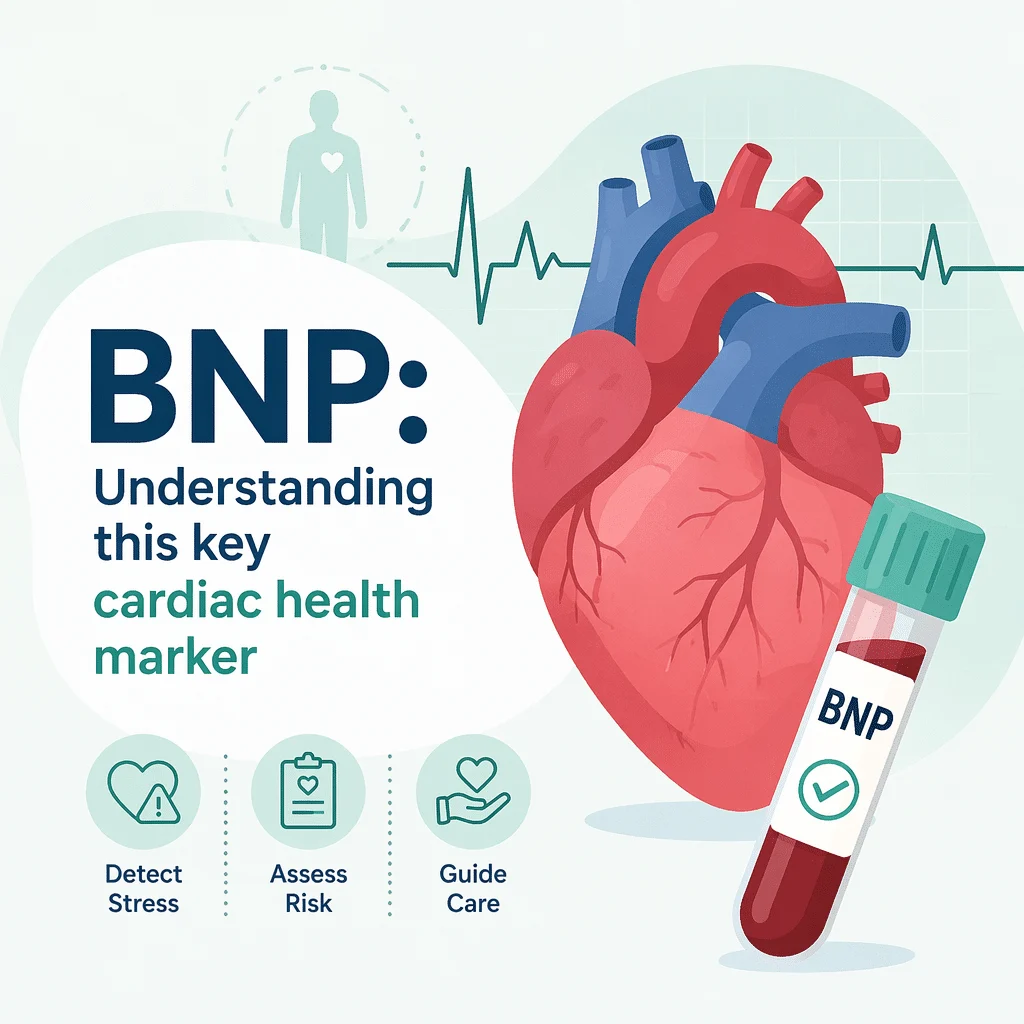
A BNP blood test measures B-type natriuretic peptide, a hormone your heart releases when its chambers are stretched by pressure or by extra fluid. Doctors order it mainly for one question: is this breathlessness coming from the heart, or from something else, such as the lungs? Its greatest strength is what it rules out. A low BNP makes heart failure unlikely.
If your breathlessness is severe or came on suddenly, if you are short of breath whilst resting, if you have chest pain, or if you cannot lie flat, treat that as an emergency and seek urgent medical care now. Do not wait for a blood test, and do not use an article to decide.
In this article you’ll learn what BNP is and why the heart releases it, why BNP and NT-proBNP numbers can never be compared to each other, which thresholds cardiology bodies actually use, what raises and lowers your level, and how repeat testing is used over time.
Seek emergency care straight away if you have any of the following:
- Breathlessness that is severe, or that started suddenly
- Breathlessness whilst sitting still or at rest
- Chest pain, chest pressure, or pain spreading to the arm, neck or jaw
- Being unable to lie flat, or waking at night gasping for air
- Fainting, blue-tinged lips, or coughing up pink frothy sputum
These symptoms need to be assessed by a clinician in person, today. A blood marker cannot make that decision for you, and a normal result would not make these symptoms safe.
What a BNP blood test measures, and why your heart releases it
BNP stands for B-type natriuretic peptide. Despite the older name “brain natriuretic peptide”, it comes mostly from the muscle of the heart’s lower chambers, the ventricles.
Heart muscle cells make a precursor molecule called proBNP. When the ventricle wall is stretched, that precursor is split into two pieces: active BNP, and an inactive fragment called NT-proBNP. Both enter the bloodstream, and both can be measured.
The trigger is mechanical. When the heart has to work against higher pressure, or when it is holding more blood volume than it comfortably can, the chamber walls stretch. Stretch is the signal. The more the wall stretches, and the longer it stays stretched, the more peptide is released.
BNP itself is a useful hormone, not a waste product. It widens blood vessels and prompts the kidneys to pass more sodium and water into the urine, both of which reduce the load on a struggling heart. A raised BNP is the heart trying to relieve its own pressure.
That physiology explains why the test is informative, and why it is easy to over-read. BNP reports mechanical strain. It does not report the cause of that strain.
Why the BNP blood test is ordered: heart or lungs?
Breathlessness is one of the hardest symptoms in medicine, because so many conditions produce it. Heart failure, asthma, COPD, pneumonia, a blood clot in the lung, anaemia and anxiety can all leave someone short of breath, and a patient’s story often fits several at once.
A BNP blood test helps split that list. Because the peptide is released by a stretched heart, a high level points attention toward a cardiac cause, and a low level points it away.
The test is used in two quite different situations. In an emergency department, someone arrives acutely breathless and the team needs an answer within the hour. In a clinic, someone describes months of breathlessness on the stairs, and the doctor needs to know whether to arrange an echocardiogram. These settings use different numbers, as we explain below.
The rule-out strength is the real value
If you take one thing from this article, take this: the BNP blood test is much better at excluding heart failure than at proving it.
A low result is powerful. The test is highly sensitive, meaning it rarely misses a genuinely failing heart, so a low value makes heart failure an unlikely explanation and sends the search elsewhere — toward the lungs, for example.
A high result is much weaker. Plenty of conditions other than heart failure stretch the heart or slow clearance of the peptide, so a raised BNP narrows the field without settling it. A raised BNP is not a diagnosis of heart failure. Confirming it needs a clinical assessment and, in nearly all cases, an echocardiogram. The blood test decides who gets scanned. The scan, plus the doctor, makes the diagnosis.
BNP and NT-proBNP: two tests, two scales, never interchangeable
This is the single most common source of confusion, and it matters enough to state plainly. BNP and NT-proBNP are two different molecules, measured by two different assays, reported on two different numeric scales. A number from one cannot be compared against a threshold for the other.
Both come from the same parent molecule, so they rise and fall together. But NT-proBNP is cleared from the blood more slowly, so it accumulates to substantially higher numbers in the same person at the same moment. Your lab runs one or the other, depending on its analyser, and the report will say which.
The practical trap is concrete. Someone reads that “under 100 is normal”, sees an NT-proBNP of 210, and concludes their result is alarmingly high. On the NT-proBNP scale in an emergency setting, 210 is a rule-out. They have compared their result to the wrong ruler.
The 2022 AHA/ACC/HFSA heart failure guideline makes this explicit, noting that BNP and NT-proBNP can be used in patient care as long as their absolute values and cut-points are not used interchangeably. Check the top of your lab report, find which of the two was actually measured, and only then look at a threshold.
| Feature | BNP | NT-proBNP |
|---|---|---|
| What it is | The active hormone | The inactive leftover fragment |
| Typical numbers | Lower | Higher, often several times higher in the same person |
| Cleared from blood | Faster, so it reacts more quickly to change | More slowly, so levels are steadier |
| Affected by sacubitril/valsartan | Yes — level goes up on treatment | No — level goes down as the heart improves |
| Can you compare the two numbers? | No | No |
Reading your BNP levels: the setting and your age change the number
There is no single universal BNP cut-off, and any source offering you one flat number is oversimplifying. The threshold depends on where you are being assessed and, for NT-proBNP especially, on how old you are. Results are reported in picograms per millilitre (pg/mL).
If you were tested in a clinic (non-acute)
This is the situation for most people reading a lab report at home: symptoms that have built up gradually. The European Society of Cardiology sets the upper limits of normal in the non-acute setting at 35 pg/mL for BNP and 125 pg/mL for NT-proBNP. Below those values, heart failure is unlikely.
Notice how low those numbers are. Someone with gradual breathlessness and a BNP of 60 is above the non-acute rule-out, even though 60 would be reassuring in an emergency department. Applying the emergency threshold to a clinic result is a genuine way to be falsely reassured.
If you were tested in an emergency department (acute)
For sudden, severe breathlessness, higher rule-out values apply: broadly, BNP below 100 pg/mL and NT-proBNP below 300 pg/mL make acute heart failure unlikely. These are the figures most often quoted online, which is exactly why they get misapplied to clinic results.
Age shifts the NT-proBNP scale
Natriuretic peptide levels drift upward with age even in healthy people, and NT-proBNP is particularly age-sensitive. To rule heart failure in rather than out in the emergency setting, a 2023 clinical consensus statement from the Heart Failure Association of the ESC proposes age-specific NT-proBNP thresholds: 450 pg/mL under age 50, 900 pg/mL between 50 and 75, and 1,800 pg/mL over 75.
The same value therefore means different things at 40 and at 80. Your own lab may also quote its own reference ranges, and those take precedence over any general figure.
What raises BNP besides heart failure
A raised BNP tells you the heart is under strain or the peptide is not being cleared normally. Neither of those is exclusive to heart failure. Common non-cardiac and non-failure explanations include:
- Older age, which lifts levels on its own
- Kidney disease, because the kidneys help clear the peptide — a reason your doctor reads BNP alongside a creatinine blood test and your estimated glomerular filtration rate
- Atrial fibrillation and other irregular rhythms, which raise pressures inside the heart
- A blood clot in the lung, which strains the right side of the heart and usually prompts a D-dimer blood test
- Sepsis and other severe acute illness, often alongside a raised C-reactive protein level
- Valve disease, which makes the ventricle work harder to move blood
- Pulmonary hypertension and some chronic lung disease
- Being female, which is associated with modestly higher levels
This list is the reason clinicians never read BNP alone. When a heart attack is the concern, the marker that answers that question is a troponin blood test, sometimes alongside a CK-MB cardiac marker. BNP answers a different question, and answers it best when the rest of the picture is on the table.
What lowers BNP — and why obesity matters here
Some things push BNP down, and this direction is less well known than it should be, because a falsely low result is the one that can reassure people wrongly.
Obesity is the important example. People with a higher body mass index have lower BNP and NT-proBNP concentrations than people of normal weight with the same degree of heart strain. The effect is well documented, and the 2022 AHA/ACC/HFSA guideline notes that obesity lowers both peptides and reduces their diagnostic sensitivity.
The consequence is worth stating slowly. If you have obesity, a “normal” BNP is less reassuring than the same number would be in someone slimmer. It does not exclude heart failure as confidently. It does not mean the test is useless — it means the result has to be read against your symptoms and your build, and it means a normal value should not end the conversation if you still feel breathless.
| Effect on your level | Examples |
|---|---|
| Raises BNP and NT-proBNP | Heart failure, older age, kidney disease, atrial fibrillation, pulmonary embolism, sepsis, valve disease, pulmonary hypertension |
| Lowers BNP and NT-proBNP | Obesity — the main one to know, because it can mask heart failure |
| Raises BNP but not NT-proBNP | Sacubitril/valsartan, a heart failure medicine |
Repeat BNP testing, and one medicine that flips the logic
A single BNP is a snapshot. Repeated measurements over time — serial testing — show direction, which can be more informative than any one value. In someone known to have heart failure, a falling level suggests the heart is under less strain, whilst a climbing level can signal that fluid is building up again.
Serial testing has limits. Natriuretic peptides vary from day to day in the same person, so a small change may mean nothing. Interpreting a trend is a job for the clinician who knows your history, your kidney function and your weight.
Why sacubitril/valsartan raises BNP but not NT-proBNP
Here is a quirk worth understanding, because it looks alarming on paper. Sacubitril/valsartan is a widely used heart failure medicine. Part of how it works is by blocking an enzyme called neprilysin, and neprilysin happens to be one of the things that breaks BNP down.
Block the enzyme, and BNP is cleared more slowly, so the measured level drifts up — even whilst the patient is genuinely improving. NT-proBNP is not broken down by neprilysin, so it is untouched by this effect and falls as the heart recovers.
So in someone taking sacubitril/valsartan, a rising BNP does not necessarily mean worsening heart failure, and NT-proBNP is the more dependable marker to follow. The rise in BNP is generally modest rather than dramatic. If you take this medicine and your BNP has gone up, raise it with your cardiologist rather than reading it as bad news. Never stop or change a heart medicine on the basis of a lab number.
When breathlessness needs urgent assessment
A blood marker cannot triage acute symptoms. The situations listed at the top of this article — sudden or severe breathlessness, breathlessness at rest, chest pain, an inability to lie flat — need to be seen by a clinician the same day, whatever any number says. That is true even if you had a reassuring BNP last month, because a snapshot from four weeks ago says nothing about today.
For gradual symptoms, the sensible route is an appointment rather than an accident and emergency department: persistent breathlessness on exertion, ankle swelling, unexplained rapid weight gain, or fatigue that is new for you all deserve a proper assessment, and a BNP blood test may well be part of it. Existing heart failure symptoms and management are best reviewed with the team that already knows you.
Latest scientific advances in BNP testing
Research since 2023 has sharpened both what BNP does well and where it falls short. Here is what recent work found, and what it means for you.
A 2025 systematic review and meta-analysis pooled 35 studies of people arriving at hospital acutely breathless, covering more than 16,000 patients for BNP. It found that as the cut-off is raised, sensitivity (the ability to catch true cases) falls whilst specificity (the ability to avoid false alarms) rises — the classic trade-off. Importantly, at the usual rule-out levels the performance of BNP and NT-proBNP overlapped, with no statistically significant difference between them. The authors also cautioned that some heart failure can still be missed. What this means for you: the two tests are comparably good at their job, but “good” is not “perfect”, and a reassuring number never overrides worrying symptoms.
A 2024 systematic review looked specifically at the hardest version of the heart-or-lungs problem: telling acute heart failure apart from a COPD flare-up, in people who have COPD and turn up breathless. Across ten studies it found the evidence base surprisingly thin, and concluded that BNP and NT-proBNP were among the most promising markers available but should be interpreted alongside imaging and clinical signs rather than on their own. What this means for you: if you have lung disease, expect your BNP to be one input amongst several, not the deciding vote.
A 2024 meta-analysis of the HFA-PEFF score — a scoring system that combines symptoms, echocardiography and natriuretic peptides to assess heart failure with preserved ejection fraction, a type in which the heart pumps normally but stiffens — pooled 15 studies and 6,420 people. Used to rule the condition out it was highly sensitive; used to rule it in it was more specific but missed more cases. What this means for you: this mirrors BNP itself. These tools are built to safely exclude, and confirmation still rests on the full clinical picture.
A 2025 meta-analysis in Heart followed 136,089 people across 16 groups and found that higher NT-proBNP was strongly associated with later developing atrial fibrillation, an irregular heart rhythm, with the link strongest in older adults. What this means for you: natriuretic peptides are not heart-failure-specific. They track cardiac strain broadly, another reason a raised value alone cannot name a diagnosis.
Finally, a 2024 analysis from the STEP-HFpEF programme, a randomised trial of semaglutide in obesity-related heart failure with preserved ejection fraction, reported that NT-proBNP fell on treatment, and that people starting with higher NT-proBNP gained more symptom improvement despite similar weight loss. What this means for you: in obesity-related heart failure, natriuretic peptides may help identify who benefits most — but this is trial data guiding decisions between doctors, not a self-monitoring tool.
Glossary
| Term | Definition |
|---|---|
| BNP | B-type natriuretic peptide. The active hormone released by heart muscle when the chamber walls are stretched. |
| NT-proBNP | The inactive fragment left over when proBNP is split. Measured on its own scale, with higher numbers than BNP. |
| pg/mL | Picograms per millilitre, the unit used to report both peptides. |
| Heart failure | A condition in which the heart cannot pump or fill well enough to meet the body’s needs. It does not mean the heart is about to stop. |
| Ventricle | One of the heart’s two lower chambers, which pump blood out to the lungs and body. |
| Echocardiogram | An ultrasound scan of the heart. The main test used to confirm or exclude heart failure. |
| Rule-out test | A test whose main strength is that a low result makes a condition unlikely, rather than proving it when high. |
| Sensitivity | How reliably a test identifies people who truly have the condition. High sensitivity is what makes a low BNP reassuring. |
| Neprilysin | An enzyme that breaks down BNP. Blocking it, as sacubitril/valsartan does, causes BNP levels to rise. |
| Preserved ejection fraction | A form of heart failure in which the heart pumps out a normal share of blood but has become stiff and fills poorly. |
Frequently asked questions
Is my NT-proBNP result the same thing as a BNP result?
No, and this is the mistake most worth avoiding. They are different molecules measured by different assays on different scales, and the numbers are not comparable. NT-proBNP is cleared more slowly, so it sits at substantially higher values than BNP in the same person at the same time. If you compare an NT-proBNP result against a BNP threshold you will misread it, usually by thinking a normal result is high. Look at the top of your lab report to see which test was run, then use the matching threshold. Your doctor will interpret whichever your lab measures.
What does a BNP over 1,000 mean?
On the BNP scale, a value in the high hundreds or above is a marked elevation and does make significant cardiac strain likely. But it is still not a diagnosis by itself. Kidney disease, atrial fibrillation, a clot in the lung, sepsis or valve disease can all drive levels that high, and severe kidney impairment can push them higher still. It also matters whether the number is BNP or NT-proBNP, since 1,000 means quite different things on the two scales. A result at this level should be discussed with a doctor promptly, and usually leads to an echocardiogram.
Can I have heart failure with a normal BNP blood test?
It is less likely, but it is possible. The test is designed to be a good rule-out, not a guarantee. Three situations weaken a reassuring result: obesity, which lowers levels and can mask the condition; heart failure with preserved ejection fraction, where levels can be less elevated; and treated or stable disease. Studies of acutely breathless patients confirm that some cases are still missed. If you have a normal BNP but ongoing breathlessness, ankle swelling or reduced exercise tolerance, say so — the symptom deserves follow-up regardless of the number.
Does a high BNP always mean heart failure?
No. This is the most common misreading of the test. BNP reports mechanical strain on the heart and how well the peptide is being cleared, and many conditions affect one or both without heart failure being present. Age alone raises levels. So do kidney disease, atrial fibrillation, pulmonary embolism, sepsis, valve disease and pulmonary hypertension. A raised BNP is a reason to investigate further, not a verdict. Diagnosis requires clinical assessment plus, in almost all cases, an echocardiogram to see how the heart is actually working.
Do I need to fast before a BNP blood test?
Generally no. A BNP or NT-proBNP test is a standard blood draw from a vein and does not usually require fasting or special preparation. If it is being run as part of a wider panel that includes glucose or lipids, the other tests may require fasting, so follow the instructions your lab or clinic gives you. Do tell whoever takes the sample about your medicines, particularly sacubitril/valsartan, and about kidney problems, since both change how the result should be read.
How often should BNP levels be rechecked?
There is no fixed schedule that applies to everyone, and any single interval you read online should be treated with caution. How often the test is repeated depends on why it was ordered, whether you have confirmed heart failure, whether your treatment has recently changed, and how you are feeling. Some people are tested once to answer a diagnostic question and never again. Others are monitored periodically. This is a decision for your doctor, based on your situation rather than on a rule. Do not schedule your own follow-up around a number.
Sources
- MedlinePlus (U.S. National Library of Medicine) — Natriuretic Peptide Tests (BNP, NT-proBNP)
- National Heart, Lung, and Blood Institute (NIH) — Heart Failure: Diagnosis
- Zubair M. Natriuretic Peptide B Type Test. StatPearls, NCBI Bookshelf
- Karimi MA, Kazemi Ferezghi Z, Khademi R, et al. The Diagnostic Utility of Brain Natriuretic Peptide in Heart Failure Patients Presenting with Acute Dyspnea: A Systematic Review and Meta-analysis. Acta Med Indones. 2025;57(2):175-199
- van Dijk SHB, Brusse-Keizer MGJ, Bucsán CC, et al. Lack of Evidence Regarding Markers Identifying Acute Heart Failure in Patients with COPD: An AI-Supported Systematic Review. Int J Chron Obstruct Pulmon Dis. 2024;19:531-541
- Li X, Liang Y, Lin X. Diagnostic and prognostic value of the HFA-PEFF score for heart failure with preserved ejection fraction: a systematic review and meta-analysis. Front Cardiovasc Med. 2024;11:1389813
- Wang W, Zhou T, Li J, et al. Association between NT-proBNP levels and risk of atrial fibrillation: a systematic review and meta-analysis of cohort studies. Heart. 2025;111(3):109-116
- Petrie MC, Borlaug BA, Butler J, et al. Semaglutide and NT-proBNP in Obesity-Related HFpEF: Insights From the STEP-HFpEF Program. J Am Coll Cardiol. 2024;84(1):27-40
- McDonagh TA, Metra M, Adamo M, et al. 2021 ESC Guidelines for the diagnosis and treatment of acute and chronic heart failure. Eur Heart J. 2021;42(36):3599-3726
- Bayes-Genis A, Docherty KF, Petrie MC, et al. Practical algorithms for early diagnosis of heart failure and heart stress using NT-proBNP: A clinical consensus statement from the Heart Failure Association of the ESC. Eur J Heart Fail. 2023;25(11):1891-1898
Further reading
- Heart failure: understanding and managing the condition
- Troponin: the cardiac marker used to detect heart attack
- Creatinine: what your level reveals about kidney function
- D-dimer: the blood test used to investigate suspected clots
- Sodium: reading your blood sodium result
Understand your lab results with AI DiagMe
A BNP or NT-proBNP result rarely stands alone. It is usually read alongside creatinine, sodium and sometimes troponin, and the combination is what carries the meaning. AI DiagMe turns those numbers into plain language so you can arrive at your appointment understanding what was measured and what to ask. It helps you understand your results — it does not diagnose you, exclude heart failure, or replace your doctor, and it is not for emergencies.
Get your results interpreted in minutes