




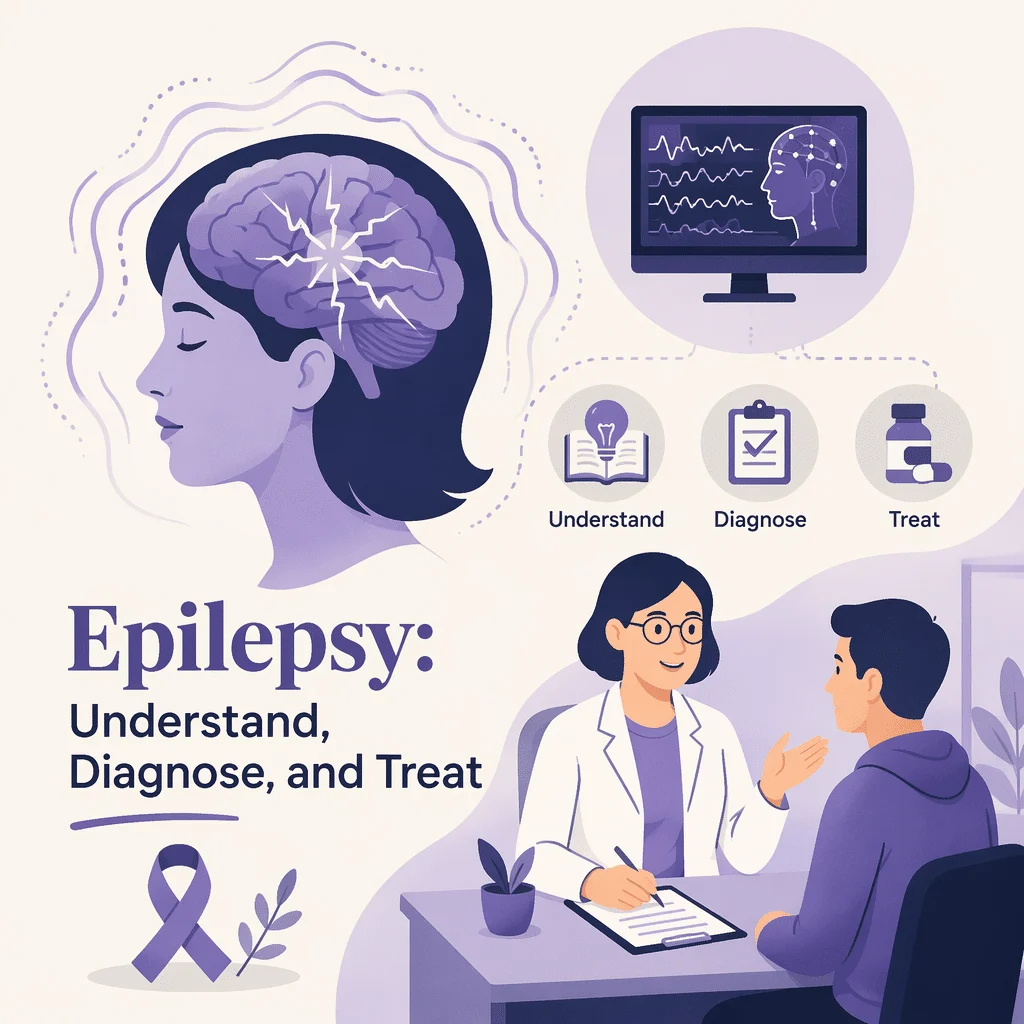
Epilepsy is a common neurological condition in which a person has a lasting tendency to experience seizures, the brief bursts of abnormal electrical activity in the brain that can change movement, sensation, awareness, or behaviour. It affects millions of people of every age, and with the right care most of them lead full, active lives. Because seizures can look very different from one person to the next, epilepsy is often misunderstood. One point causes particular confusion: there is no single blood test that can diagnose epilepsy, even though blood work still plays an important supporting role. In this article you’ll learn what epilepsy is, the main seizure types, what causes it, how doctors diagnose it using medical history, EEG, and brain imaging, and which treatments, from medication to surgery, can bring seizures under control.
What Is Epilepsy?
A seizure is a single event: a temporary surge of disorganised electrical signals among brain cells. Epilepsy is the ongoing condition of having a tendency to repeat those events. Doctors generally diagnose epilepsy after two unprovoked seizures more than 24 hours apart, or after a single seizure when tests show a high chance of more. That word “unprovoked” matters, because a seizure caused by a short-term trigger such as very low blood sugar is treated differently from epilepsy itself.
Epilepsy is one of the most common serious brain conditions worldwide. The Centers for Disease Control and Prevention estimates it affects roughly 3 million adults and hundreds of thousands of children in the United States alone. It is not contagious, it is not a form of intellectual disability, and for most people it is very manageable.
Seizure Versus Epilepsy
Many people have a single seizure in their lifetime and never have another. A high fever in a young child, a night without sleep, alcohol withdrawal, or a sudden drop in sodium can all set off a one-time event. Epilepsy is diagnosed only when the tendency to have seizures persists, which is why the story of what happened before, during, and after an episode is so important.
The Main Types of Seizures
Seizures are grouped by where they begin in the brain. Focal seizures start in one area of one side; generalised seizures involve networks on both sides from the start. The label matters because it guides both diagnosis and the choice of medication. The table below summarises the seizure types you are most likely to hear about.
| Seizure type | What it can look like |
|---|---|
| Focal aware (older term: simple partial) | The person stays awake and aware; twitching on one side, an odd smell or taste, a rising stomach feeling, or a sense of déjà vu. |
| Focal impaired awareness (complex partial) | Awareness is reduced; staring, confusion, and repeated movements such as lip-smacking, fumbling, or wandering. |
| Tonic-clonic (grand mal) | Loss of consciousness, body stiffening, then rhythmic jerking of the arms and legs; the best known type of seizure. |
| Absence (petit mal) | A brief blank stare lasting a few seconds, most common in children and easy to mistake for daydreaming. |
| Myoclonic | Sudden, quick muscle jerks, often in the arms, as if the person had a brief electric shock. |
| Atonic (drop attacks) | A sudden loss of muscle tone that can make the head drop or the person fall. |
A tonic-clonic seizure that lasts more than five minutes, or repeated seizures without recovery in between, is a medical emergency called status epilepticus and needs immediate treatment.
What Causes Epilepsy?
Epilepsy is not one disease but a symptom that many different brain conditions can share. In about half of all cases no clear cause is found. When a cause is identified, it usually falls into one of a few groups.
Structural Causes
Anything that scars or disturbs brain tissue can create a focus for seizures. A stroke can damage brain tissue and later lead to epilepsy; to go deeper, read our full guide to stroke and its warning signs. Head injury, a growth pressing on the brain, and problems present from birth can do the same; see our overview of brain tumour symptoms. Infections that inflame the brain or its lining can also leave a lasting tendency towards seizures, so it helps to review our guide to meningitis symptoms and testing.
Genetic and Metabolic Factors
Some epilepsies run in families or are linked to specific genes, especially the generalised epilepsies that begin in childhood or adolescence. Having a genetic tendency does not mean a child is destined to develop epilepsy; it simply raises the odds. Metabolic problems, from certain inherited conditions to imbalances in the body’s chemistry, can also lower the seizure threshold.
Provoked Seizures and Triggers
Not every seizure means epilepsy. A provoked seizure is set off by a temporary problem: very low or very high blood sugar, a sharp fall in sodium, low calcium or magnesium, alcohol withdrawal, or certain drugs. Correcting the trigger usually stops the seizures. This distinction is central to diagnosis, because it decides whether a person needs long-term epilepsy treatment or simply treatment of the underlying problem.
How Doctors Diagnose Epilepsy
Because no single test confirms epilepsy on its own, diagnosis is built from several pieces that fit together. The most valuable piece is often free: a clear account of what happened.
Medical History and Eyewitness Accounts
The neurologist wants to know what you or a witness noticed before, during, and after the event: any warning feeling, how the body moved, whether awareness was lost, how long it lasted, and how you recovered. A phone video of an episode, when one exists, can be more useful than any scan.
EEG and Brain Imaging
An electroencephalogram, or EEG, records the brain’s electrical activity through small sensors on the scalp and can reveal patterns typical of epilepsy. Because a routine EEG catches only a short window, doctors sometimes use sleep-deprived or multi-day recordings. Magnetic resonance imaging (MRI) looks at the brain’s structure for scars, malformations, or growths that might explain the seizures, while a CT scan is often the first step in an emergency.
The Supporting Role of Blood Tests
Blood tests do not diagnose epilepsy, but they answer a different and important question: could something else have caused this seizure? After a first seizure, doctors frequently order an electrolyte panel to check sodium and potassium; you can review our guide to reading an electrolyte panel. Very low blood sugar can trigger a seizure, so glucose is checked early, and you can read our explainer on blood glucose levels. Abnormal calcium can be responsible too; to interpret a result, read our guide to the calcium blood test. A low magnesium level can lower the seizure threshold as well, and you can consult our article on the signs of magnesium deficiency. These results help separate a provoked seizure from true epilepsy.
Treatments for Epilepsy
The goal of treatment is simple to state and often achievable: no seizures, and no troubling side effects. About two in three people with epilepsy gain good control with the first one or two medicines they try. The rest may need combinations or other approaches.
Antiseizure Medications
Antiseizure medications are the first-line treatment for almost everyone. Most work by calming overactive electrical signals in the brain. Some, such as lamotrigine, slow down the sodium channels that nerve cells use to fire; another widely used option, levetiracetam, acts on a protein at nerve endings that helps control the release of chemical messengers; valproate boosts a calming brain chemical called GABA. Doctors usually start with a single drug, an approach called monotherapy, because using one medicine at a time limits side effects and makes it easier to see what is working. The U.S. National Institute of Neurological Disorders and Stroke notes that more than 40 antiseizure medications are now available, which means there is real room to find a good personal fit.
Monitoring Treatment With Blood Tests
Once treatment begins, blood work shifts from ruling out causes to keeping treatment safe. Depending on the medicine, your care team may measure the drug level in your blood, watch your liver, and check your blood cells. If you take valproate, for instance, clinicians may monitor your liver; you can read our guide to liver function tests. Some medicines can lower sodium or affect blood counts over time, so doctors may repeat an electrolyte check and review our guide to reading a full blood count. These tests do not track the epilepsy itself; they make sure the treatment is doing more good than harm.
Options for Drug-Resistant Epilepsy
When two well-chosen medications fail to control seizures, the epilepsy is called drug-resistant, and it is time to consider other options at a specialised centre. Surgery to remove or disconnect the small area where seizures begin can be highly effective when that area is clearly identified and safe to treat. Vagus nerve stimulation, a small device implanted near the collarbone that sends gentle pulses to a nerve in the neck, can reduce seizure frequency. A ketogenic diet, high in fat and very low in carbohydrate, helps some children and adults, and newer implanted devices can sense and respond to seizure activity.
When to Get Emergency Help
Most seizures stop on their own within a couple of minutes and do not require an ambulance. Call the emergency services straight away if any of the following happens:
- A convulsive seizure lasts longer than five minutes.
- A second seizure begins before the person has recovered from the first.
- The person does not wake up or breathe normally after the shaking stops.
- The seizure happens in water, or causes a serious injury.
- It is the person’s first-ever seizure, or the person is pregnant or has diabetes.
While waiting, keep the person safe: ease them to the floor, turn them onto one side, cushion the head, and remove nearby hazards. Do not put anything in their mouth and do not hold them down.
Latest Scientific Advances in Epilepsy
Research on epilepsy keeps moving, and several recent findings are already changing everyday care. Here is what they mean in plain terms, with the usual caution that no single study is the final word.
Choosing Medicines That Are Safer in Pregnancy
A large international pregnancy registry that followed thousands of pregnancies found that some antiseizure medicines carry a much lower risk of birth defects than others. Levetiracetam, lamotrigine, and oxcarbazepine were linked to the lowest rates, whilst valproate carried the highest, and the risk rose with higher doses. As doctors shifted away from valproate towards safer options, the overall rate of malformations fell sharply. A separate Nordic study of millions of children, a population cohort (a very large group followed through health records over time), similarly found higher rates of autism and intellectual disability after valproate or topiramate, but not after levetiracetam or lamotrigine. What this means for you: if you are a woman who could become pregnant, there is often a medicine that controls seizures with less risk to a future pregnancy, well worth discussing with your neurologist before conceiving.
Comparing First-Choice Medicines
A multicentre study compared levetiracetam and lamotrigine as the first medicine for women with a common form called idiopathic generalised epilepsy. Levetiracetam was less likely to fail, especially in one subtype, but it caused side effects more often. What this means for you: there is no single best drug. The right first choice depends on your epilepsy type and on which side effects you can most easily live with, which is exactly the kind of trade-off worth talking through with your doctor.
New Options for Hard-to-Treat Epilepsy
About one in three people keep having seizures despite medication. A recent review of clinical trials found that adding cenobamate, a newer medicine, to existing treatment helped more people cut their focal seizures by at least half, and helped more become seizure-free, compared with a dummy pill; side effects were somewhat more common, and the reviewers noted that longer independent studies are still needed. For those who are candidates, surgery remains powerful: a 2024 review of studies including roughly 500 patients found that about eight in ten were free of seizures afterwards, with most staying seizure-free years later. What this means for you: drug-resistant epilepsy is not a dead end, and asking about a specialised epilepsy centre can open real options.
Understanding SUDEP
SUDEP stands for sudden unexpected death in epilepsy, a rare event in which a person with epilepsy dies suddenly with no other clear cause. Recent reviews stress that the strongest protection is good seizure control, mainly by taking medication consistently, along with practical safety awareness. What this means for you: it is a hard subject, but the takeaway is reassuring and actionable. Sticking with treatment and reducing seizures lowers the risk, and your doctor can discuss your personal situation.
Living With Epilepsy
Beyond medication, day-to-day habits make a real difference. Common triggers include missed medication, poor sleep, heavy alcohol use, and high stress, so a steady routine is protective. Taking your medicine at the same times each day is one of the most powerful things within your control. Driving rules depend on where you live and usually require a seizure-free period, often between six months and a year, so check your local regulations with your doctor. Most people with epilepsy work, study, exercise, and travel with only sensible precautions.
Glossary
| Term | Definition |
|---|---|
| Seizure | A temporary burst of abnormal electrical activity in the brain that can change movement, sensation, or awareness. |
| Epilepsy | A brain condition marked by a lasting tendency to have recurrent, unprovoked seizures. |
| Aura | An early warning symptom, such as an odd smell or a rising stomach feeling, that some people notice before a seizure. |
| Focal seizure | A seizure that begins in one area of one side of the brain. |
| Generalised seizure | A seizure that involves networks on both sides of the brain from the start. |
| Tonic-clonic seizure | A seizure with stiffening followed by rhythmic jerking and loss of consciousness; once called grand mal. |
| Absence seizure | A brief lapse of awareness with a blank stare, most often seen in children; once called petit mal. |
| Electroencephalogram (EEG) | A painless test that records the brain’s electrical activity through sensors placed on the scalp. |
| Status epilepticus | A seizure lasting more than five minutes, or repeated seizures without recovery; a medical emergency. |
| Provoked seizure | A seizure caused by a temporary trigger such as low blood sugar or low sodium, rather than by epilepsy itself. |
Frequently Asked Questions
Is there a blood test that can diagnose epilepsy?
No. There is no blood test that confirms epilepsy. Blood tests are still valuable, but they answer a different question: they help doctors find out whether something temporary, such as low sodium, low calcium, or very low blood sugar, caused a seizure. They are also used to keep medication safe once treatment starts. The diagnosis of epilepsy itself relies on your medical history, an EEG, and brain imaging such as MRI, pieced together by a neurologist.
Is epilepsy a mental illness?
No. Epilepsy is a neurological condition, meaning it involves the brain’s electrical activity, not a psychiatric or mental illness. People with epilepsy can of course also experience anxiety or depression, as anyone can, and living with a long-term condition can add stress. But epilepsy itself is a physical brain condition, and it is not a sign of reduced intelligence or a character flaw.
Can epilepsy be cured or outgrown?
Sometimes. A number of childhood epilepsies fade with age, and some children become seizure-free and eventually stop medication under medical guidance. For certain focal epilepsies, surgery can effectively end seizures. For many adults, epilepsy is a long-term condition that is controlled rather than cured, often very well, with the right medication and habits. Whether a cure is realistic depends on the cause and the type of epilepsy.
Is epilepsy hereditary?
It can be, but most epilepsy is not directly inherited. Some forms are linked to specific genes and can run in families, especially generalised epilepsies that start in childhood. Even then, genes usually raise the risk rather than guarantee the condition. Many epilepsies come from acquired causes such as stroke or head injury, where heredity plays little role. If you are concerned about family risk, a neurologist or genetic counsellor can help.
Can you drive if you have epilepsy?
Often, yes, once seizures are controlled. Most places require a seizure-free period before you can drive, commonly somewhere between six months and one year, and the exact rules vary by country and region. The aim is safety for you and others. Talk with your doctor about the regulations where you live and about how your treatment affects your eligibility, and never rely on assumptions.
What is the first aid for a seizure?
Stay calm and keep track of the time. Ease the person to the floor, turn them gently onto one side to keep the airway clear, and cushion the head. Move away anything hard or sharp, and loosen tight clothing around the neck. Do not put anything in the mouth and do not try to hold the person still. Stay until they are fully alert, and call the emergency services if the seizure lasts more than five minutes or another one follows.
Sources
- National Institute of Neurological Disorders and Stroke (NINDS) — Epilepsy and Seizures — ninds.nih.gov
- Centers for Disease Control and Prevention (CDC) — Epilepsy Basics — cdc.gov
- Mayo Clinic — Epilepsy: Symptoms and causes — mayoclinic.org
- Battino D, Tomson T, et al. — Risk of Major Congenital Malformations and Exposure to Antiseizure Medication Monotherapy — JAMA Neurology, 2024 — doi.org/10.1001/jamaneurol.2024.0258
- Bjørk MH, et al. — Association of Prenatal Exposure to Antiseizure Medication With Risk of Autism and Intellectual Disability — JAMA Neurology, 2022 — doi.org/10.1001/jamaneurol.2022.1269
- Cerulli Irelli E, et al. — Levetiracetam vs Lamotrigine as First-Line Antiseizure Medication in Female Patients With Idiopathic Generalised Epilepsy — JAMA Neurology, 2023 — doi.org/10.1001/jamaneurol.2023.3400
- Brigo F, Lattanzi S. — Cenobamate add-on therapy for drug-resistant focal epilepsy — Cochrane Database of Systematic Reviews, 2024 — doi.org/10.1002/14651858.CD014941.pub2
- Darko K, et al. — Epilepsy Surgery for Drug-Resistant Epilepsy in Africa: A Systematic Review — Neurosurgery, 2024 — doi.org/10.1227/neu.0000000000003307
- Mastrangelo M, Esposito D. — Paediatric sudden unexpected death in epilepsy: From pathophysiology to prevention — Seizure, 2022 — doi.org/10.1016/j.seizure.2022.07.020
Further Reading
- Read our walkthrough of a comprehensive metabolic panel.
- Explore our guide to migraine causes and treatments.
- See our guide to dementia symptoms, causes, and types.
- Read our overview of multiple sclerosis.
- Review our explainer on the AST/ALT ratio.
Understand your lab results with AI DiagMe
Epilepsy care often generates lab results that are easy to misread on your own. After a seizure you may leave the clinic with an electrolyte panel, a glucose reading, calcium and magnesium levels, or liver and blood-count tests used to monitor medication. AI DiagMe helps you understand what those numbers mean in clear language, so you can ask sharper questions at your next appointment. It is built to help you understand your results, not to diagnose epilepsy or replace your neurologist.
Get your results interpreted in minutes