Menopauze en bloedsuiker zijn nauwer met elkaar verbonden dan de meeste vrouwen te horen krijgen. Een studie gepubliceerd op 4 augustus 2026 in Menopauze, het tijdschrift van The Menopause Society, ontdekte dat vrouwen met diabetes type 2 of prediabetes zowel meer overgangsklachten rapporteerden als ernstigere klachten dan vrouwen met een normale bloedsuiker. Wat de bevinding praktisch maakt, is hoe de onderzoekers de deelnemers indeelden: niet op basis van een diagnose in een medisch dossier, maar aan de hand van twee gewone laboratoriumwaarden — nuchtere bloedglucose en HbA1c. In dit artikel leest u wat het onderzoek daadwerkelijk aantoonde, welke tests achter die twee waarden schuilgaan en hoe u ze kunt begrijpen zonder overhaaste conclusies te trekken.
Wat het nieuwe onderzoek heeft gevonden
Onderzoekers bestudeerden 296 Zuid-Koreaanse vrouwen tussen de 40 en 64 jaar. Bij elke deelnemer werden de nuchtere bloedglucose en HbA1c gemeten, en op basis daarvan alleen werd zij ingedeeld in een diabetische of een niet-diabetische groep. Menopauzeklachten werden vervolgens gescoord met een gestandaardiseerde vragenlijst, de Midlife Women’s Symptom Index.
Vrouwen in de diabetesgroep rapporteerden meer klachten en beoordeelden deze als heviger. Het verschil bleef bestaan nadat de onderzoekers rekening hadden gehouden met andere factoren die dit zouden kunnen verklaren. Eén detail is belangrijk voor de interpretatie: het verschil was duidelijk zichtbaar bij vrouwen die al in de postmenopauze waren, en niet bij vrouwen die nog in de premenopauze of in de perimenopauze zaten.
Dit was een cross-sectioneel onderzoek — een momentopname, in één land, bij minder dan 300 vrouwen. Het toont een verband aan, geen oorzaak. Een hogere bloedsuiker kan klachten daadwerkelijk verergeren; ernstige klachten kunnen de slaap en gewoonten verstoren die de glucosewaarden stabiel houden; of een derde factor, zoals gewichtstoename rond de buik, kan beide tegelijk veroorzaken.
Waarom de menopauze en bloedsuiker elkaar beïnvloeden
Oestrogeen beïnvloedt hoe het lichaam omgaat met glucose. Naarmate het oestrogeengehalte tijdens de overgang daalt, neemt de insulinegevoeligheid doorgaans af, verschuift vet naar de buikstreek en bewegen bloeddruk en bloedvetten vaak in een ongunstige richting. Overzichtsartikelen over de menopauzeovergang beschrijven dit cluster als een zelfstandige bijdrage aan het cardiovasculaire risico, los van veroudering alleen.
Het verband werkt twee kanten op. Nachtzweten en onderbroken slaap verhogen stresshormonen en verminderen de volgende dag de glucosetolerantie. Gewichtstoename rond de taille verergert insulineresistentie, en insulineresistentie is op zijn beurt in verband gebracht met hevigere opvliegers. Ons team heeft al eerder aandacht besteed aan insulineresistentie zonder obesitas, wat verklaart waarom een normaal gewicht het probleem niet uitsluit.
De bloedtests die dit beeld in kaart brengen
Geen enkele test geeft een volledig beeld van de metabole gezondheid in de middelbare leeftijd. Het panel hieronder is wat artsen doorgaans samen bekijken.
| Test | Wat het meet | Waarom het belangrijk is bij de menopauze |
|---|---|---|
| Nuchtere bloedglucose | Suiker in het bloed na 8 uur of langer zonder eten | Eerstelijns screeningstest; signaleert prediabetes lang voordat klachten optreden |
| HbA1c | Gemiddelde bloedsuiker over ongeveer drie maanden | Niet beïnvloed door de maaltijd van gisteren; gebruikt voor diagnose en follow-up |
| Nuchtere insuline en HOMA-IR | Hoe hard de alvleesklier werkt om de glucose op peil te houden | Kan jaren vóór de glucose zelf stijgt optreden |
| Lipidenpanel | LDL, HDL en triglyceriden | Verslechtert vaak tijdens de overgang, dikwijls zonder merkbare klachten |
| TSH | Schildklierfunctie | Schildklieraandoeningen bootsen de menopauze na: vermoeidheid, gewichtsverandering, stemmingswisselingen, zweten |
| FSH en estradiol | Hormonale status van de eierstokken | Alleen nuttig wanneer de menopauzefase werkelijk onduidelijk is |
De laatste rij verdient een kanttekening. De menopauze wordt doorgaans vastgesteld op basis van klachten en de cyclusgeschiedenis, niet op basis van een bloedtest. Onze gids legt uit wat het vrouwelijk hormonenpanel inhoudt en wat elk resultaat betekent, en een apart artikel behandelt oestradiolwaarden gedurende de cyclus.
Hoe u uw waarden kunt begrijpen
Nuchtere bloedglucose en HbA1c
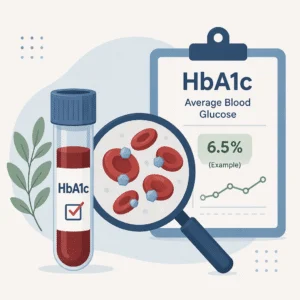
Het CDC hanteert dezelfde grenswaarden voor vrouwen van alle leeftijden. Een nuchtere bloedsuiker van 99 mg/dL of lager is normaal, 100 tot 125 mg/dL wijst op prediabetes, en 126 mg/dL of hoger bij twee afzonderlijke tests wijst op diabetes. Voor HbA1c geldt: onder 5,7% is normaal, 5,7% tot 6,4% is prediabetes, en 6,5% of hoger is diabetes. Onze referentiepagina's leggen uit nuchtere bloedglucosewaarden en hoe je die begrijpt En HbA1c-uitslag en streefwaarden.
Prediabetes is de categorie die hier het meest telt, omdat die veel voorkomt, geen klachten geeft en omkeerbaar is. Als je een percentage wilt omzetten naar een concreet getal in het dagelijks leven, publiceren wij een omrekeningstabel van HbA1c naar gemiddelde bloedglucose.
Eén uitslag is geen diagnose
Eén verhoogde waarde kan wijzen op een infectie, een kuur met steroïden, een stressvolle week of een vasten dat niet goed is nageleefd. Een diagnose wordt doorgaans gesteld op basis van twee afwijkende uitslagen, of één uitslag in combinatie met duidelijke klachten. Controleer vóór uw afspraak de regels voor vasten voor een bloedtest, en bekijk ons overzicht van bloedtesten bij diabetes.
Wanneer moet je je laten testen en wanneer moet je een arts raadplegen?
De US Preventive Services Task Force adviseert screening op prediabetes en diabetes type 2 bij volwassenen van 35 tot 70 jaar met overgewicht of obesitas, ongeveer elke drie jaar herhaald als de uitslag normaal is. Veel vrouwen in die leeftijdsgroep bevinden zich ook in de overgangsperiode, wat het een natuurlijk moment maakt om beide te laten controleren.
Maak eerder een afspraak als u ongewone dorst, frequent urineren, onverklaard gewichtsverlies, wazig zien, slecht genezende wonden of terugkerende infecties opmerkt. Bespreek het ook met uw arts als opvliegers, vermoeidheid of stemmingswisselingen het dagelijks leven verstoren, ongeacht uw glucosewaarde — die klachten verdienen op zichzelf behandeling.
Recente wetenschappelijke ontwikkelingen
Dit is wat recent onderzoek toevoegt, in begrijpelijke taal.
- De studie uit 2026 in Menopauze is de eerste die deze vraag onderzocht bij Koreaanse vrouwen in de middelbare leeftijd. De bevinding: vrouwen van wie de nuchtere bloedsuiker en het HbA1c in het diabetesbereik vielen, rapporteerden meer overgangsklachten, en hevigere, voornamelijk na de menopauze. Wat dit voor jou betekent: als de klachten zwaarder aanvoelen dan verwacht, is een metabole check-up een redelijk verzoek aan je arts. Het resultaat is een verband uit één momentopname en moet worden gelezen als een signaal, niet als bewijs.
- Een review uit 2024 over de overgangsperiode concludeerde dat de overgang zelf de cardiometabole gezondheid verandert — lichaamssamenstelling, bloeddruk, lipoproteïnen en insulinegevoeligheid verschuiven allemaal. Wat dit voor u betekent: waarden die twintig jaar stabiel waren, kunnen in uw veertigste en vijftigste levensjaar veranderen zonder dat uw gewoonten zijn gewijzigd. Een vergelijking met uw eigen eerdere uitslagen is daarom informatiever dan één momentopname.
- Een review uit 2023 over de metabole gezondheid na de menopauze beschreef hoe buikvet, atherogene dyslipidemie — een lipidenprofiel dat de vorming van slagaderplaque bevordert — insulineresistentie en verhoogde bloeddruk de neiging hebben samen op te treden. Wat dit voor u betekent: het is de moeite waard uw glucose en uw uitslagen van een lipidenpanel naast elkaar in plaats van één voor één.
- Een review uit 2025 over menopauze en diabetes zette uiteen hoeveel nog onbekend is, waaronder de vraag of de menopauze het diabetesrisico onafhankelijk van veroudering verhoogt. Wat dit voor u betekent: wees voorzichtig met stellige uitspraken in beide richtingen; het eerlijke antwoord is vandaag de dag dat de twee met elkaar samenhangen, maar dat de oorzakelijke relatie nog niet is vastgesteld.
Glossarium
| Termijn | Definitie |
|---|---|
| HbA1c | Geglycosyleerd hemoglobine. Geeft je gemiddelde bloedsuiker over ongeveer drie maanden weer, uitgedrukt als percentage. |
| Prediabetes | Bloedsuiker hoger dan normaal, maar onder de diabetesdrempel. Vaak omkeerbaar. |
| Insulineresistentie | Een toestand waarbij cellen slecht reageren op insuline, waardoor de alvleesklier meer moet aanmaken om de bloedsuiker normaal te houden. |
| Perimenopauze | De jaren van hormonale schommelingen voordat de menstruatie definitief stopt. |
| Postmenopauze | De periode die begint twaalf maanden na de laatste menstruatie. |
| Vasomotorische klachten | De medische term voor opvliegers en nachtelijk zweten. |
| Dwarsdoorsnede-onderzoek | Een onderzoek waarbij alles op één moment wordt gemeten. Het kan verbanden aantonen, maar geen oorzaken. |
| HOMA-IR | Een score berekend op basis van nuchtere glucose en nuchtere insuline, gebruikt om insulineresistentie te schatten. |
Veelgestelde vragen
Veroorzaakt de menopauze diabetes?
Nee, de menopauze veroorzaakt op zichzelf geen diabetes. Ze valt wel samen met veranderingen die het risico verhogen: een lagere insulinegevoeligheid, meer buikvet en minder gunstige bloedvetten. Leeftijd, familiegeschiedenis, gewicht en lichamelijke activiteit blijven de belangrijkste factoren. Onderzoekers hebben nog niet vastgesteld of de menopauze los van het verouderingsproces een extra risico met zich meebrengt.
Kan een hoge bloedsuiker opvliegers veroorzaken?
Niet rechtstreeks, en geen enkele studie heeft aangetoond dat het verlagen van de bloedsuiker opvliegers doet verdwijnen. Wat het onderzoek uit 2026 suggereert, is dat vrouwen in het diabetesbereik over het algemeen meer klachten rapporteren, en hevigere. Slechte slaap, nachtelijk zweten en bloedsuikerregulatie beïnvloeden elkaar ook onderling, waardoor een eenvoudige eenrichtingsverklaring onwaarschijnlijk is.
Welke bloedtest bevestigt de menopauze?
Meestal geen. Bij vrouwen boven de 45 met typische klachten en veranderende cycli is de menopauze een klinische diagnose. FSH en oestradiol worden alleen bepaald in onduidelijke situaties, zoals een menopauze vóór het 45e jaar, na een hysterectomie, of wanneer de klachten een andere oorzaak kunnen hebben. Onze pagina over de vrouwelijk hormoonpanel legt uit wanneer elke test iets toevoegt.
Moet ik mijn bloedsuiker laten controleren tijdens de menopauze, ook als ik me goed voel?
Prediabetes geeft meestal geen klachten, dus je kunt je prima voelen en toch een verhoogde bloedsuiker hebben. Als je tussen de 35 en 70 jaar oud bent en overgewicht hebt, wordt screening aanbevolen, ongeacht of je in de menopauze bent. Buiten die groep bespreek je je persoonlijk risico beter met je arts in plaats van op eigen initiatief te laten testen.
Kan hormoontherapie mijn glucosewaarden beïnvloeden?
Hormonale therapie bij de menopauze is in verschillende onderzoeken in verband gebracht met een bescheiden verbetering van de bloedsuikerregulatie en bloedvetten, maar wordt niet voorgeschreven om diabetes te behandelen of te voorkomen. Als je hormoontherapie gebruikt, vermeld dit dan bij je bloedonderzoek en bespreek eventuele veranderingen in je uitslagen met de voorschrijvend arts.
Moet ik nuchter zijn voor een HbA1c-test?
Nee. HbA1c weerspiegelt de gemiddelde bloedsuiker over drie maanden, dus eten van tevoren heeft er geen invloed op. Voor nuchtere bloedglucose is wel een nacht vasten vereist; als beide tegelijk worden aangevraagd, wordt je doorgaans gevraagd nuchter te komen.
Bronnen
- Centers for Disease Control and Prevention — Diabetestests, 2026 — https://www.cdc.gov/diabetes/diabetes-testing/index.html
- US Preventive Services Task Force — Prediabetes en diabetes type 2: screening — https://www.uspreventiveservicestaskforce.org/uspstf/recommendation/screening-for-prediabetes-and-type-2-diabetes
- National Institute on Aging, National Institutes of Health — Wat is de menopauze? — https://www.nia.nih.gov/health/menopause/what-menopause
- Yang YL, Kim Y, Shin Y — Verband tussen diabetes mellitus type 2 en menopauzeklachten bij Koreaanse vrouwen in de middelbare leeftijd — Menopause, 2026 — https://doi.org/10.1097/GME.0000000000002883
- Uddenberg ER et al. — De menopauzale overgang en het risico op hart- en vaatziekten — Maturitas, 2024 — https://consensus.app/papers/details/c250d2e7f68a5a9199a4915caad89428/
- Anagnostis P et al. — Cardiovasculaire gezondheid en de menopauze, metabole gezondheid — Best Practice & Research Clinical Endocrinology & Metabolism, 2023 — https://consensus.app/papers/details/208a411e7a5953969637011e111e2176/
- Rodriguez CP et al. — Menopauze en diabetes: onderling verbonden risicofactoren — Endocrine Research, 2025 — https://consensus.app/papers/details/40d4ff0268835edfa802d75a2ba7ecdd/
Verder lezen
- Menopauzeklachten, stadia en behandeling
- Hoe lees je de resultaten van je bloedonderzoek?
- De HOMA-IR-score voor insulineresistentie
- Het uitgebreid metabolisch panel
- De TSH-bloedtest en schildklieruitslagen
Begrijp uw laboratoriumresultaten met AI DiagMe.
Bloedonderzoek op middelbare leeftijd komt zelden met een uitleg. Een nuchtere bloedglucose in het prediabetesbereik, een HbA1c dat langzaam oploopt, een FSH-waarde die op zichzelf weinig zegt — elk getal krijgt meer betekenis als je het samen met de andere bekijkt. AI DiagMe vertaalt je labrapport naar begrijpelijke taal, zodat je bij je volgende afspraak precies weet welke uitslagen je wilt bespreken. Het helpt je je analyses te begrijpen; het stelt geen diagnose en vervangt je arts niet.
Ontvang binnen enkele minuten een interpretatie van uw resultaten.