Jumlah partikel LDL Anda adalah salah satu dari sedikit hasil kolesterol yang tidak pernah tercantum dalam panel lipid standar, dan sebuah uji klinis yang dilaporkan pada awal Agustus 2026 baru saja membawanya kembali ke sorotan. Para peneliti di Penn State memantau 786 orang dewasa dengan obesitas perut selama enam bulan dan menemukan bahwa perubahan pola makan yang sederhana menurunkan jumlah partikel LDL yang beredar dalam darah, meskipun berat badan dan lingkar pinggang tidak berubah. Hasil ini lebih penting bukan karena apa yang dikatakannya tentang makanan, melainkan karena apa yang diungkapkannya tentang pengukuran: dua orang bisa memiliki hasil kolesterol LDL yang sama namun jumlah partikel yang sangat berbeda. Dalam artikel ini Anda akan mempelajari apa yang diukur oleh hasil ini, mengapa bisa berbeda dengan angka kolesterol biasa Anda, apa yang sebenarnya ditunjukkan oleh uji klinis terbaru, dan kapan pemeriksaan lipid lanjutan layak didiskusikan dengan dokter.
Apa yang sebenarnya diukur dalam uji klinis 2026
Analisis ini merupakan studi tambahan dari Habitual Diet and Avocado Trial, sebuah uji klinis acak terkontrol yang diterbitkan dalam Journal of Clinical Lipidology. Peserta adalah orang dewasa berusia 25 tahun ke atas dengan obesitas perut, yang didefinisikan sebagai lingkar pinggang di atas 40 inci pada pria dan di atas 35 inci pada wanita. Setengah dari peserta melanjutkan pola makan biasa mereka. Setengah lainnya tetap menjalani rutinitas biasa dan menambahkan satu buah alpukat per hari selama enam bulan.
Pada akhir uji coba, kelompok yang mengonsumsi alpukat setiap hari menunjukkan penurunan konsentrasi partikel LDL sebesar 49 nanomol per liter. Para peneliti memperkirakan bahwa perubahan sebesar ini setara dengan penurunan risiko penyakit jantung sekitar 4 persen. Berat badan maupun lingkar pinggang tidak mengalami perubahan, yang menunjukkan kepada para peneliti bahwa efek tersebut terjadi melalui partikel pembawa kolesterol, bukan melalui penurunan berat badan.
Detail yang perlu diperhatikan adalah pilihan hasil ukur yang digunakan. Tim peneliti tidak mengutamakan kolesterol LDL. Mereka mengutamakan konsentrasi partikel, karena jumlah partikel menangkap informasi yang tidak bisa terlihat hanya dari angka kolesterol saja.
Mengapa jumlah partikel dan kolesterol LDL bisa berbeda
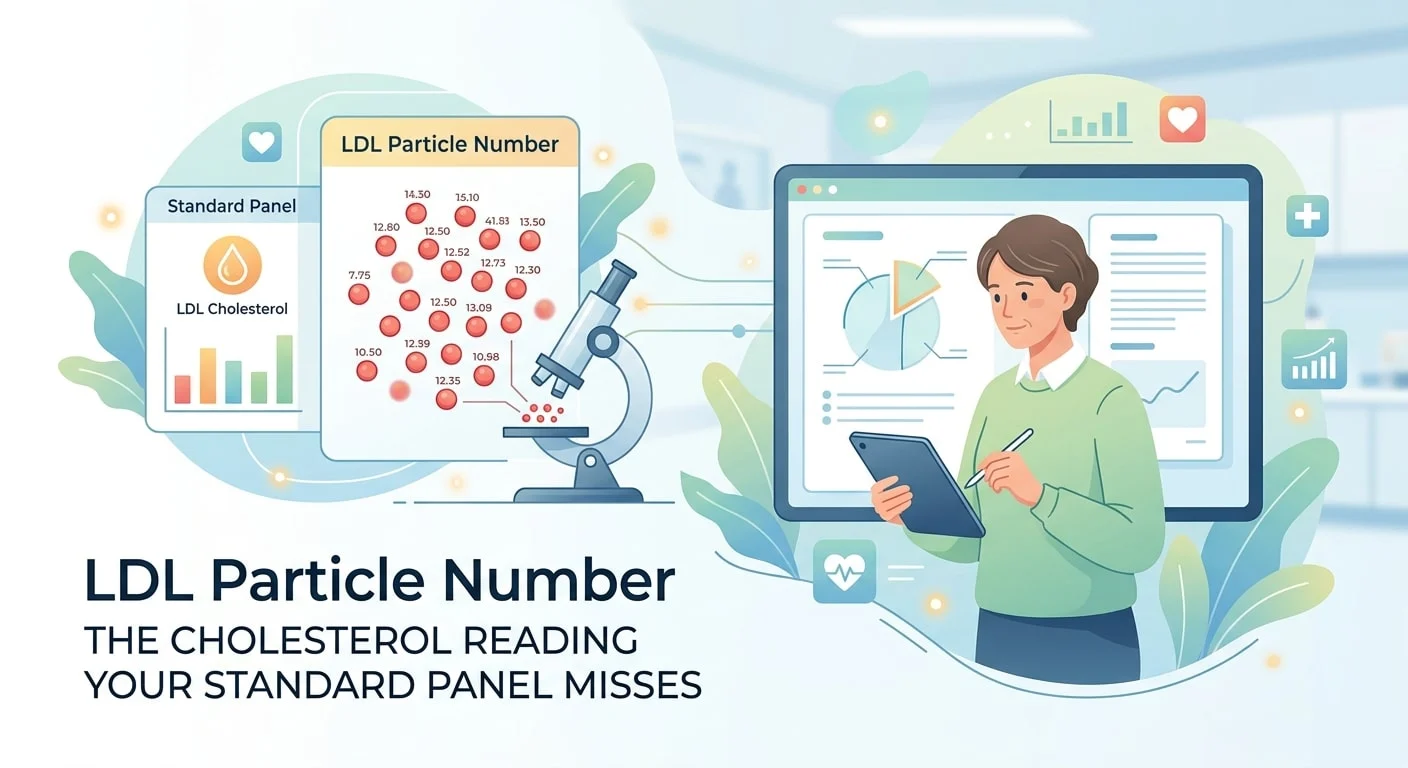
Cara mudah untuk memahami perbedaannya adalah dengan membayangkan armada truk pengiriman. Kolesterol LDL memberi tahu Anda berapa banyak muatan yang dibawa secara keseluruhan. Jumlah partikel LDL memberi tahu Anda berapa banyak truk yang ada di jalan. Panduan referensi kami menjelaskan panel lipid standar.
Sebagian besar waktu, keduanya bergerak beriringan. Namun terkadang tidak. Jika seseorang memiliki banyak partikel kecil yang miskin kolesterol, dibutuhkan lebih banyak partikel untuk mengangkut jumlah kolesterol total yang sama. Angka kolesterol terlihat meyakinkan, sementara lalu lintas di dinding arteri sebenarnya lebih padat dari yang tampak. Para spesialis lipid menyebut ketidaksesuaian ini sebagai diskordansi.
Siapa yang cenderung menunjukkan hasil diskordansi
Diskordansi lebih umum terjadi pada orang dengan trigliserida tinggi, kolesterol HDL rendah, diabetes tipe 2, atau resistensi insulin. Artikel terpisah membahas resistensi insulin tanpa obesitas. Kondisi ini juga lebih sering muncul pada orang yang sudah mengonsumsi obat penurun kolesterol, karena pengobatan menurunkan kandungan kolesterol dalam partikel lebih dapat diprediksi dibandingkan menurunkan jumlah partikelnya.
Inilah juga alasan mengapa laboratorium telah menyempurnakan cara menghasilkan angka yang biasa digunakan. Ruang berita kami membahas perhitungan kolesterol LDL.
LDL-C, LDL-P, dan ApoB secara berdampingan
Tiga angka berbeda dapat muncul dalam laporan lipid, dan masing-masing menjawab tiga pertanyaan yang berbeda.
| Pengukuran | Yang dijawab | Satuan yang umum digunakan | Tersedia dalam panel rutin? |
|---|---|---|---|
| Kolesterol LDL (LDL-C) | Berapa banyak kolesterol yang dibawa partikel LDL secara keseluruhan | mg/dL | Ya, standar |
| Jumlah partikel LDL (LDL-P) | Berapa banyak partikel LDL yang beredar | nmol/L | Tidak, hanya pada pemeriksaan lanjutan |
| Apolipoprotein B (ApoB) | Berapa banyak partikel yang masuk ke dinding arteri, dihitung berdasarkan protein permukaannya | mg/dL | Kadang-kadang, atas permintaan |
| Lipoprotein(a) | Apakah jenis partikel yang diwariskan dan sebagian besar bersifat tetap menambah risiko ekstra | nmol/L | Sekali seumur hidup, jika disarankan |
Setiap partikel LDL membawa tepat satu protein ApoB, itulah mengapa ApoB berfungsi sebagai penghitung jumlah partikel. Ruang berita kami membahas skrining lipoprotein(a), dan panduan pendamping menjelaskan apolipoprotein A1.
Kemajuan ilmiah terkini
Penghitungan partikel telah diteliti secara intensif selama beberapa tahun terakhir, sebagian besar dalam studi populasi berskala sangat besar. Berikut adalah apa yang disarankan oleh penelitian tersebut, dalam bahasa yang mudah dipahami.
Satu analisis mengikuti hampir 294.000 orang dewasa dari kohort penelitian besar di Inggris — yaitu sekelompok sukarelawan yang dipantau dari waktu ke waktu — selama sekitar sebelas tahun. Dua orang dengan hasil kolesterol LDL yang identik bisa memiliki nilai ApoB yang sangat berbeda, dan orang dengan ApoB lebih tinggi ternyata lebih banyak mengalami serangan jantung dan stroke. Artinya bagi Anda cukup sederhana: angka kolesterol yang normal tidak menjamin beban partikel yang rendah.
Studi kedua mengamati sekitar 41.000 orang dewasa dari kohort yang sama selama satu dekade dan menanyakan ukuran partikel mana yang lebih dapat dipercaya ketika keduanya tidak sejalan. Ketika ApoB dan jumlah partikel LDL menunjukkan arah yang berbeda, ApoB lebih akurat dalam memprediksi kejadian jantung di masa depan. Dalam praktiknya, jika laboratorium Anda hanya menawarkan salah satu dari keduanya, ApoB adalah angka tunggal yang lebih informatif untuk diminta.
Sebuah tinjauan tahun 2025 menambahkan catatan penting. Para peneliti mendefinisikan ketidaksesuaian antar penanda dengan beberapa cara yang berbeda, dan kesimpulannya berubah tergantung pada metode yang dipilih, sehingga hasil antar studi tidak dapat dibandingkan secara langsung. Tinjauan ini mencatat satu benang merah yang konsisten: pada orang yang sudah mengonsumsi obat penurun lemak darah, ukuran berbasis partikel adalah sinyal yang lebih baik untuk menilai risiko yang tersisa. Temuan ini berasal dari penelitian observasional, yang menunjukkan asosiasi bukan bukti sebab-akibat, dan tidak satu pun dari temuan ini mengubah kenyataan bahwa keputusan pengobatan tetap ada di tangan dokter Anda.
Kapan harus berbicara dengan dokter Anda tentang pemeriksaan partikel
Pemeriksaan partikel bukan merupakan tes lini pertama dan tidak menggantikan pemeriksaan rutin yang biasa. Sebagian besar orang sudah terlayani dengan baik oleh panel standar ditambah penilaian risiko keseluruhan. Perpustakaan kami membahas rentang normal hasil tes darah.
- Hasil kolesterol LDL yang normal disertai riwayat keluarga yang kuat dengan penyakit jantung dini.
- Trigliserida tinggi dikombinasikan dengan kolesterol HDL yang rendah.
- Diabetes tipe 2, pradiabetes, atau sindrom metabolik.
- Sudah mengonsumsi statin, dengan dokter yang ingin mengukur risiko yang tersisa.
- Perkiraan risiko kardiovaskular yang berada dekat dengan ambang batas pengobatan.
Ketersediaan, biaya, dan cakupan asuransi berbeda-beda antara satu laboratorium dan laboratorium lainnya, dan tes-tes ini sering kali tidak ditanggung. Panduan referensi kami menjelaskan hasil tes darah yang tidak normal, dan artikel lainnya membahas secara rinci panel penanda jantung.
Pertanyaan yang sering diajukan
Berapa jumlah partikel LDL yang dianggap tinggi?
Laboratorium umumnya menganggap nilai di atas sekitar 1.000 nmol/L sebagai meningkat dan nilai di atas sekitar 1.600 nmol/L sebagai tinggi, namun batas ambang ini berbeda antara satu laboratorium dan laboratorium lainnya serta antara metode pemeriksaan yang digunakan. Satu angka saja tidak berarti banyak jika berdiri sendiri. Angka tersebut harus dibaca bersama kadar kolesterol LDL Anda, trigliserida, tekanan darah, dan risiko kardiovaskular Anda secara keseluruhan — dan itulah yang dokter Anda terlatih untuk lakukan.
Apa yang menyebabkan jumlah partikel LDL tinggi?
Faktor penyebab yang umum adalah resistensi insulin, diabetes tipe 2, sindrom metabolik, trigliserida tinggi, kelebihan lemak tubuh di sekitar perut, pola makan tinggi karbohidrat olahan atau lemak jenuh, kurang aktivitas fisik, serta gangguan lipid bawaan seperti hiperkolesterolemia familial. Kondisi tiroid, ginjal, dan hati juga dapat meningkatkannya — itulah salah satu alasan dokter melihat keseluruhan panel, bukan hanya satu nilai saja.
Apakah jumlah partikel yang tinggi berbahaya jika kolesterol LDL saya normal?
Ini adalah sinyal yang perlu ditelusuri lebih lanjut, bukan kondisi darurat. Studi populasi besar menunjukkan bahwa ketika keduanya tidak sejalan, pengukuran berbasis partikel lebih mencerminkan risiko di masa depan dibandingkan angka kolesterol. Bukan berarti ada yang salah dengan kondisi Anda saat ini. Artinya, risiko Anda mungkin diremehkan jika hanya mengandalkan angka kolesterol saja — dan hal itu perlu Anda diskusikan dengan dokter Anda.
Apakah diet dapat menurunkan jumlah partikel LDL?
Uji coba tahun 2026 yang dijelaskan di atas menunjukkan bahwa satu tambahan makanan sederhana dapat mengubah angka tersebut dalam enam bulan, tanpa penurunan berat badan. Efeknya nyata namun kecil, dan para peneliti sendiri menyebutnya sebagai satu langkah, bukan pengganti pola makan sehat secara keseluruhan. Diet, aktivitas fisik, status merokok, dan obat yang diresepkan semuanya berperan, dan tidak ada satu makanan pun yang bersifat menentukan.
Haruskah saya meminta pemeriksaan jumlah partikel LDL atau ApoB?
ApoB umumnya merupakan pilihan yang lebih praktis. Lebih mudah didapatkan, lebih murah, lebih terstandarisasi antar laboratorium, dan penelitian terbaru menunjukkan bahwa ApoB mampu memperkirakan risiko setidaknya sebaik penghitungan partikel. Penghitungan partikel dengan NMR tetap berguna dalam pengaturan spesialis, terutama ketika ukuran partikel juga menjadi perhatian.
Apakah tes ini termasuk dalam pemeriksaan kolesterol rutin?
Tidak. Pemeriksaan rutin melaporkan kolesterol total, kolesterol LDL, kolesterol HDL, dan trigliserida. Penghitungan partikel memerlukan permintaan khusus dan laboratorium yang dilengkapi untuk itu. Panduan kami menjelaskan cara membaca hasil tes darah.
Glosarium
| Ketentuan | Definisi |
|---|---|
| Jumlah partikel LDL (LDL-P) | Jumlah partikel lipoprotein densitas rendah yang beredar dalam volume darah tertentu, bukan seberapa banyak kolesterol yang dibawanya. |
| Apolipoprotein B (ApoB) | Protein yang berada di permukaan setiap partikel lipoprotein yang masuk ke arteri. Karena ada satu per partikel, mengukurnya berarti menghitung partikel. |
| Diskordansi | Ketidaksesuaian antara dua ukuran lipid, seperti hasil kolesterol LDL yang normal namun jumlah partikel yang tinggi. |
| nmol/L | Nanomol per liter, satuan yang digunakan untuk melaporkan konsentrasi partikel. Satuan ini menghitung jumlah item, bukan beratnya. |
| Spektroskopi NMR | Resonansi magnetik nuklir, teknik laboratorium yang memilah dan menghitung partikel lipoprotein berdasarkan ukurannya. |
| Kolesterol non-HDL | Kolesterol total dikurangi kolesterol HDL. Perkiraan sederhana untuk semua partikel yang masuk ke arteri, tersedia pada panel standar mana pun. |
| Uji coba terkontrol secara acak | Studi di mana peserta ditempatkan ke dalam kelompok secara acak, sehingga lebih mudah untuk mengaitkan perbedaan yang ada dengan intervensi yang diberikan. |
| Studi kohort | Studi yang mengikuti sekelompok orang tertentu dari waktu ke waktu untuk melihat siapa yang mengembangkan suatu kondisi. Studi ini menunjukkan asosiasi, bukan bukti penyebab. |
| Lipoprotein(a) | Jenis partikel yang diwariskan secara genetik, di mana kadarnya sebagian besar ditentukan oleh faktor genetik dan memberikan risiko kardiovaskular yang independen. |
Sumber
- Damani JJ, et al. — Effect of incorporating 1 avocado per day on lipoprotein particle concentrations compared to habitual intake in adults with abdominal obesity: an ancillary study of the Habitual Diet and Avocado Trial — Journal of Clinical Lipidology, 2026 — baca penelitiannya
- Penn State University — Eating an avocado a day lowers heart disease risk factor for people with obesity, 2026 — baca pengumumannya
- National Heart, Lung, and Blood Institute (NIH) — Blood Cholesterol — nhlbi.nih.gov
- Centers for Disease Control and Prevention — About Cholesterol — cdc.gov
- Cleveland Clinic — Apolipoprotein B (ApoB) Test — my.clevelandclinic.org
- Johns Hopkins Medicine — Lipid Panel — hopkinsmedicine.org
- Sniderman A, dkk. — Discordance among apoB, non-high-density lipoprotein cholesterol, and triglycerides: implications for cardiovascular prevention — European Heart Journal, 2024 — baca makalah ini
- Epstein E, dkk. — Apolipoprotein B outperforms low density lipoprotein particle number as a marker of cardiovascular risk in the UK Biobank — European Journal of Preventive Cardiology, 2025 — baca makalah ini
- Johannesen C, dkk. — Discordance analyses comparing LDL cholesterol, non-HDL cholesterol, and apolipoprotein B for cardiovascular risk estimation — Atherosclerosis, 2025 — baca makalah ini
Bacaan lebih lanjut
- Penjelasan panel lipid
- Panel darah lengkap
- Panel metabolik komprehensif
- Tekanan darah dan tes darah
- Tes darah untuk perlemakan hati
Pahami hasil lab Anda dengan AI DiagMe.
Hasil pemeriksaan kolesterol adalah sekumpulan angka yang saling berkaitan, bukan sebuah vonis. Membaca kadar kolesterol LDL bersama trigliserida, kolesterol HDL, kolesterol non-HDL, dan gula darah puasa memberikan gambaran yang jauh lebih jelas dibandingkan satu angka saja — dan dari sinilah biasanya percakapan yang berguna dengan dokter Anda dimulai. AI DiagMe membantu Anda memahami arti nilai-nilai tersebut dalam konteksnya; layanan ini tidak memberikan diagnosis dan tidak menggantikan dokter Anda.
Dapatkan interpretasi hasil Anda dalam hitungan menit.