
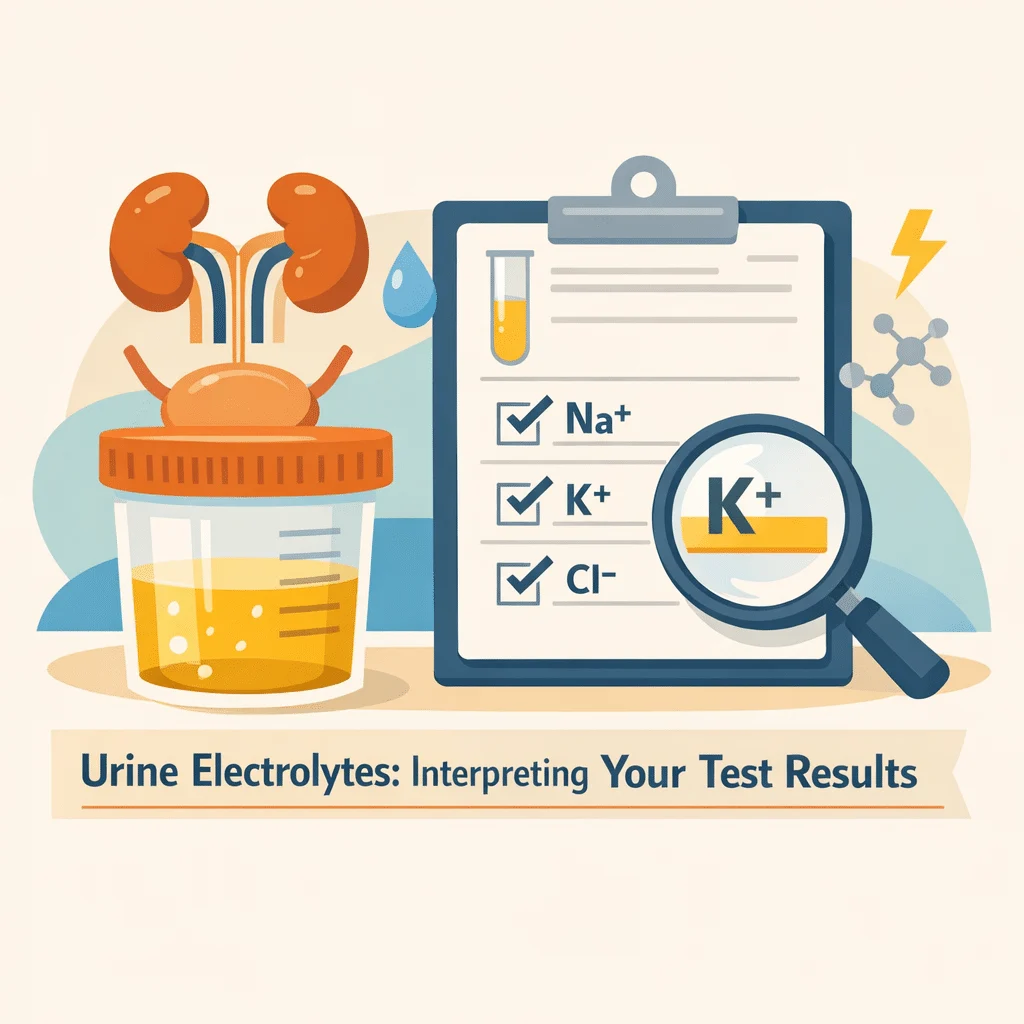
Urine electrolytes are the sodium, potassium and chloride your kidneys release into your urine, and measuring them tells a doctor something a blood test alone cannot: what your kidneys are doing with salt and water right now. A blood sodium level shows where your body has ended up; the urine shows how it got there. That is why this panel appears in the workup of low blood sodium, suspected dehydration, a sudden drop in kidney function, potassium problems and acid-base disorders.
In this article you’ll learn what each measurement on a urine electrolytes panel reflects, how a spot sample differs from a 24-hour collection, what calculated values such as FENa add, why the same number can mean opposite things in two people, and why one dose of a water pill can make the panel unreadable.
What urine electrolytes measure
Your kidneys filter roughly 180 liters of fluid a day and reclaim almost all of it. What reaches your urine is not random: the kidney adjusts how much sodium, potassium and chloride it keeps or discards from hour to hour, following signals about blood pressure, blood volume and hormones.
The core panel
Three measurements form the base of the panel. Urine sodium reflects how hard the kidney is working to hold on to salt. Urine potassium reflects how much is being discarded, which matters when the blood level is abnormal. Urine chloride usually tracks sodium, and when the two diverge that is a clue. Laboratories report each in milliequivalents per liter, written mEq/L, or the equivalent millimoles per liter. Your clinician reads these against the blood results, and we cover what a blood sodium test measures.
Why there is no single normal range
A urine electrolytes result has no fixed healthy value the way a blood count does, because the number depends almost entirely on what you ate and drank. MedlinePlus, the patient library of the U.S. National Library of Medicine, describes a random urine sodium above 20 mEq/L as the usual finding, and a 24-hour output between 40 and 220 mEq per day in an adult on an ordinary diet.
That span is so wide that the result means little in isolation, and becomes informative only against a specific clinical question and blood values drawn at the same time. A urine sodium of 10 mEq/L is appropriate in someone sweating in the heat, and alarming in someone whose blood sodium is low and who looks well hydrated.
Spot sample or 24-hour collection
How the sample is gathered changes what the number can answer, and the two methods are not interchangeable.
The spot sample
A spot sample, sometimes called a random sample, is a single cup of urine passed at one moment. It is fast, needs no preparation, and is what hospitals use when a decision has to be made within hours. Its weakness is that it captures one instant: drink a liter of water, and the next spot sample looks diluted whatever your underlying state.
The 24-hour collection
A 24-hour collection means saving every drop of urine over a full day in a container supplied by the laboratory, usually kept cool. It averages out the peaks and troughs, so it answers questions about habitual intake, such as how much salt you eat or why you keep forming kidney stones. Its weakness is human: one missed void makes the total wrong.
Urine creatinine, the correction factor
Laboratories often add urine creatinine. Creatinine is a waste product made by muscle at a steady rate, so its concentration marks how dilute the sample is. Dividing sodium by creatinine gives a ratio that partly cancels out a large drink of water, and it also checks whether a 24-hour collection was complete. For the details, read our guide to urine creatinine levels.
Reading the panel measurement by measurement
The table below maps each measurement on a urine electrolytes panel to what it reflects and what an unexpected value can point toward. Treat the framings as orientation, not thresholds: your laboratory prints its own ranges.
| Measurement | What it reflects | How it is usually framed | What an unexpected value can point toward |
|---|---|---|---|
| Urine sodium | How hard the kidney is conserving salt | Low is generally under 20 mEq/L on a spot sample | Low: the kidney senses low circulating volume. High: salt loss or high intake |
| Urine potassium | How much potassium the kidney is discarding | Judged against blood potassium, never alone | High output with low blood potassium points to a kidney or hormonal cause |
| Urine chloride | Salt handling, read alongside sodium | Normally moves with sodium | Chloride low while sodium runs higher can follow vomiting or diuretics |
| Urine osmolality | How concentrated the urine is | Above about 500 mOsm/kg is concentrated; above 750 mOsm/kg strongly so | Concentrated urine with low blood sodium raises inappropriate antidiuretic hormone |
| Urine creatinine | Sample dilution; completeness of a 24-hour collection | Depends on muscle mass, age and sex | A low 24-hour total suggests missed collections rather than disease |
| FENa (calculated) | Share of filtered sodium leaving in the urine | Under 1 percent is the classic prerenal pattern; above 2 percent suggests injury inside the kidney | Separates a kidney short of blood flow from a damaged one |
| Urine anion gap (calculated) | Indirect estimate of urine ammonium | Sodium plus potassium minus chloride | In acidosis, a positive result suggests the kidney is not excreting acid normally |
The calculated values: FENa, FEUrea and the urine anion gap
Three of the most useful numbers on a urine electrolytes report are not measured at all. They combine urine and blood results to strip out how dilute the sample happened to be.
Fractional excretion of sodium
The fractional excretion of sodium, shortened to FENa, answers one question: of all the sodium the kidney filtered, what percentage did it let go? It needs four values, sodium and creatinine in both urine and blood. StatPearls, the peer-reviewed clinical reference hosted by the National Center for Biotechnology Information, describes a FENa under 1 percent as a kidney conserving salt because it is short of blood flow, and a value above 2 percent as more typical of damage within the kidney tissue. It is a standard tool for separating dehydration from acute kidney injury, and we explain what a kidney function panel includes.
Fractional excretion of urea
The fractional excretion of urea, or FEUrea, applies the same arithmetic to urea. It exists because diuretics force sodium out and wreck FENa, while urea handling was thought to be less affected. As the research section below explains, that hope has not held up. Urea is measured in blood as blood urea nitrogen, and we cover what a blood urea nitrogen test shows.
The urine anion gap
The urine anion gap adds urine sodium and potassium, then subtracts urine chloride. It stands in for urinary ammonium, the main form in which the kidney disposes of acid, because most laboratories do not measure ammonium directly. When the body is acidic, a healthy kidney floods the urine with ammonium and the gap turns negative. A positive gap in the same situation suggests the kidney is not doing its share, pointing to a tubular problem rather than acid arriving from the gut. Urine acidity is read alongside it, and you can see our guide to normal urine pH levels.
Low blood sodium: what the urine tells your doctor
Low blood sodium, called hyponatremia, is the most common electrolyte abnormality in hospitals and the most frequent reason this panel is ordered. The urine values do not diagnose the cause, but they narrow a long list quickly. The reasoning usually runs in this order.
- Confirm the blood is genuinely dilute. Blood osmolality comes first, because very high blood sugar or fats can produce a falsely low sodium reading.
- Look at urine osmolality. Dilute urine means the kidney is correctly dumping excess water, pointing toward drinking too much or a very low-solute diet. Concentrated urine means it is holding water back when it should not.
- Read the urine sodium. Concentrated urine with a high sodium suggests the body is not short of fluid, raising the possibility of inappropriate antidiuretic hormone signaling. Concentrated urine with a low sodium suggests the body is defending its circulating volume, as in dehydration, heart failure or advanced liver disease.
- Cross-check against the examination and the medicine list. Thiazide diuretics and several psychiatric and pain medicines are frequent culprits, and thyroid or adrenal problems are ruled out before an inappropriate hormone diagnosis is accepted.
No step stands alone, which is why sending a urine electrolytes sample without the matching blood tests rarely helps.
The other questions this panel helps answer
Dehydration or kidney injury
When kidney function drops suddenly, the first fork is whether the kidney is starved of blood flow, called prerenal, or physically injured. A starved kidney clings to salt, so urine sodium and FENa run low while urine osmolality runs high; an injured kidney loses that grip and the pattern reverses. Getting this right matters because the two pull treatment in opposite directions. Dehydration also affects circulation more broadly, and we cover how dehydration affects blood pressure.
Potassium disorders
If blood potassium is low, the question is whether it is being lost through the kidneys or elsewhere. A high urine potassium alongside a low blood level indicates a kidney or hormonal route, pointing toward diuretics or an excess of the salt-retaining hormone aldosterone. A low urine potassium points to the gut or poor intake. To understand the hormone, read our guide to the aldosterone test, and for the blood value see how a blood potassium test is interpreted.
Estimating how much salt you eat
Almost all the sodium you swallow leaves in your urine, so it is the most objective measure of dietary salt that exists; food questionnaires consistently underestimate it. The Centers for Disease Control and Prevention advises less than 2,300 mg of sodium a day for teenagers and adults, and reports that Americans average more than 3,300 mg. A 24-hour collection is the reference method.
When to talk to your doctor
Book an appointment for persistent muscle cramps, unusual weakness or confusion, marked swelling in the legs, dizziness on standing, a clear change in how much urine you pass, or an abnormal result never followed up. Sudden confusion, seizures or fainting need urgent care. Never adjust your salt intake, your fluid intake or a diuretic dose on the strength of a urine result: those decisions belong to the clinician who can see the whole picture.
What throws the numbers off
Diuretics, the biggest single problem
Diuretics, commonly called water pills, force the kidney to release sodium. That is their purpose, and it is also why they overwrite the very signal the test is trying to read. Someone genuinely dehydrated will still show a high urine sodium and a high FENa for hours after a dose, which mimics kidney injury. Interpreting a urine electrolytes result without knowing when the last diuretic dose was taken is a common error. The same caution applies to laxatives, salt tablets and intravenous fluids given beforehand.
Everything else that shifts the result
- Recent meals, especially salty ones, and how much you drank beforehand.
- Vomiting or diarrhea, both of which change chloride handling before they change sodium.
- Chronic kidney disease, which blunts the ability to concentrate urine and flattens the differences the test relies on.
- Advanced liver or heart disease, in which the kidney conserves salt hard even though the body holds too much fluid.
- An incomplete 24-hour collection, or a sample left unrefrigerated.
Osmolality is sometimes confused with specific gravity, the quick density estimate printed on a dipstick strip; osmolality is the laboratory measurement and the more precise of the two, and we explain what the analytes on a standard urine dipstick mean. For the wider set of substances measured in urine, see our guide to specific urine chemistry tests. Sodium and chloride are also measured in blood, and we describe the role of chloride in the blood as well as the tests grouped in an electrolyte panel.
Latest scientific advances
Research over the past three years has clarified where urine electrolytes genuinely help and where they have been oversold.
The urea workaround does not rescue FENa
A 2024 systematic review and meta-analysis, a study that pools many earlier studies into one, gathered eleven studies covering just over 1,100 hospital patients and asked whether the fractional excretion of urea beats FENa when kidney function drops suddenly. It did not: FEUrea was right in roughly two cases out of three, and even in patients taking diuretics, where it was supposed to shine, it offered no clear advantage. What this means for you is that neither number is a verdict: if your discharge summary quotes one, read it as a single clue your team weighed alongside your examination, your history and your blood tests.
Urine sodium as a live readout in heart failure
A 2023 randomized trial, in which patients are assigned to one approach or another by chance so the comparison is fair, enrolled 310 people admitted with acute heart failure. Half had their diuretic dose adjusted according to the sodium in their urine, and half received usual care. The urine-guided group cleared noticeably more sodium, yet was no less likely to die or be readmitted over the following six months. A 2025 European expert consensus document concluded that urine sodium is a good direct marker of whether a diuretic is working, which is a different claim from saying it saves lives. What this means for you is that if you are hospitalized for fluid overload, a nurse may check a urine sample within hours of your first dose: a routine efficiency check, not a sign of a complication.
Spot samples are being used to estimate daily salt intake at scale
A 2024 population study analyzed single spot urine samples from more than 215,000 adults and used an established equation to estimate each person’s daily sodium output. The method is the point: researchers can now approximate habitual salt intake from one cup of urine rather than a full day’s collection. What this means for you is that a future check on your salt intake may not require the inconvenient 24-hour jug, though the collection remains the reference standard when precision matters.
The urine anion gap remains a stand-in, not a measurement
A 2023 review of urinary ammonium restated a limitation clinicians often forget: the urine anion gap is only a rough proxy for ammonium excretion, and it can mislead when unusual substances are present in the urine. What this means for you is that a urine anion gap is a signpost toward further testing, not a diagnosis. Your clinician confirms the picture with blood acid-base testing, and the relationship between urea and creatinine is another part of that assessment, so we explain what the BUN-to-creatinine ratio means.
Frequently asked questions
What is this test called at the laboratory?
Order forms rarely say “urine electrolytes” as a single item. You are more likely to see the individual components listed: urine sodium, urine potassium, urine chloride, urine creatinine and urine osmolality, sometimes grouped under a heading such as urine chemistry or renal panel, urine. If a fractional excretion is wanted, a matching blood sample is drawn at the same time, because the calculation cannot be done without it. If you are unsure what was ordered, the laboratory that took your sample can tell you which analytes were run.
What is the normal range for sodium and potassium in urine?
There is no single normal range, and that is not an evasion. Because output tracks intake, MedlinePlus gives a random urine sodium above 20 mEq/L as typical and a 24-hour total of 40 to 220 mEq per day for an adult eating an ordinary diet. Potassium is similarly variable. Laboratories print their own reference intervals, which differ with the method used and the units reported. The clinically useful question is never whether your number falls inside a printed band, but whether it fits what your kidney should be doing given your blood results and your symptoms.
Do I need to fast before a urine electrolytes test?
Fasting is not usually required. What matters more is telling the person collecting the sample what you have eaten and drunk recently and, above all, listing every medicine and supplement you take. Diuretics, laxatives, salt tablets, some blood pressure medicines and certain psychiatric drugs all change the result. If a 24-hour collection is requested, you will be given a container and asked to discard your first morning urine, then save everything for the next 24 hours including the first urine of the following morning.
What does a low urine sodium level mean?
A low urine sodium usually means your kidneys are holding on to salt, which they do when they sense that circulating volume is low. That can be entirely appropriate after vomiting, heavy sweating, poor fluid intake or blood loss. It can also occur when total body fluid is high but the circulation is under-filled, as in advanced heart failure or liver cirrhosis. Occasionally it simply reflects a low-salt diet. The finding is not a diagnosis on its own; it is a pointer that gains meaning from your blood sodium, your examination and your medicines.
What causes a high sodium level in urine?
The most common explanation is the least worrying: you ate a lot of salt, and your kidneys are clearing it. Beyond diet, diuretics are the leading cause, since releasing sodium is exactly what they are designed to do. Other possibilities include injury to the kidney tubules, adrenal conditions that reduce the salt-retaining hormone, and the syndrome of inappropriate antidiuretic hormone when the blood sodium is low at the same time. Interpretation depends heavily on whether your blood sodium is normal, high or low.
Why are urine electrolytes checked when SIADH is suspected?
SIADH, the syndrome of inappropriate antidiuretic hormone secretion, describes a state in which the body holds on to water it should be releasing. The diagnosis depends on a specific combination: low blood sodium, low blood osmolality, but urine that is inappropriately concentrated and contains a good deal of sodium. Urine electrolytes and urine osmolality supply two of those four pieces, which is why they are ordered together. Thyroid and adrenal problems and recent diuretic use are excluded before the diagnosis is confirmed.
Glossary of key terms
| Term | Definition |
|---|---|
| Electrolyte | A mineral that carries an electrical charge when dissolved in body fluid. Sodium, potassium and chloride are the three measured most often in urine. |
| Spot urine sample | A single sample passed at one moment, with no timed collection. Fast and convenient, but it captures only one instant of kidney behavior. |
| 24-hour urine collection | Every urine passed over a full day, saved in one container. It averages out short-term swings and is the reference method for daily salt output. |
| Osmolality | A measure of how many dissolved particles a fluid contains, reported in mOsm/kg. In urine it shows how strongly the kidney is concentrating. |
| Creatinine | A waste product made by muscle at a steady rate. In urine testing it is used to correct for dilution and to check that a timed collection was complete. |
| Fractional excretion of sodium (FENa) | The percentage of filtered sodium that ends up in the urine, calculated from sodium and creatinine in both blood and urine. |
| Fractional excretion of urea (FEUrea) | The same calculation applied to urea rather than sodium, originally proposed for patients taking diuretics. |
| Urine anion gap | Urine sodium plus potassium minus chloride. An indirect estimate of how much ammonium the kidney is excreting. |
| Natriuresis | The release of sodium into the urine. Doctors track it to judge whether a diuretic is having the intended effect. |
| Prerenal | A drop in kidney function caused by too little blood reaching the kidney, rather than by damage to the kidney tissue itself. |
| Hyponatremia | A blood sodium level below the normal range. It usually reflects too much water relative to salt rather than a true salt shortage. |
| mEq/L | Milliequivalents per liter, the unit most U.S. laboratories use for urine sodium, potassium and chloride. |
Sources
- MedlinePlus, U.S. National Library of Medicine — Sodium urine test — Medical Encyclopedia, 2026. MedlinePlus
- Gounden V, Bhatt H, Jialal I — Renal Function Tests — StatPearls, NCBI Bookshelf, 2026. NCBI Bookshelf
- Centers for Disease Control and Prevention — About Sodium and Health — CDC, 2025. CDC
- Lin R, Grossmann M, Warren AM — Diagnostic algorithm of hyponatremia — Best Practice & Research Clinical Endocrinology & Metabolism, 2025. PubMed
- Abdelhafez MO, Alhroob AA, Abu Hawilla MO, et al. — Utility of fractional excretion of urea in acute kidney injury with comparison to fractional excretion of sodium: a systematic review and meta-analysis — The American Journal of the Medical Sciences, 2024. PubMed
- Ter Maaten JM, Beldhuis IE, van der Meer P, et al. — Natriuresis-guided diuretic therapy in acute heart failure: a pragmatic randomized trial — Nature Medicine, 2023. PubMed
- Meekers E, Dauw J, Ter Maaten JM, et al. — Urinary sodium analysis: the key to effective diuretic titration? European Journal of Heart Failure expert consensus document — European Journal of Heart Failure, 2025. PubMed
- Chiang BM, Ye M, Chattopadhyay A, et al. — Sodium intake and atopic dermatitis — JAMA Dermatology, 2024. PubMed
- Rehman MZ, Melamed M, Harris A, et al. — Urinary ammonium in clinical medicine: direct measurement and the urine anion gap as a surrogate marker during metabolic acidosis — Advances in Kidney Disease and Health, 2023. PubMed
Further reading
- Find out how a urine sample is examined for abnormal cells under a microscope.
- Learn what the tube-shaped particles formed inside kidney tubules indicate.
- Discover what a change in the color of your urine can mean.
- See how the stress hormone is measured in a timed urine collection.
- Read what surface cells found in a urine sample suggest.
Understand your lab results with AI DiagMe
A urine electrolytes report is one of the clearest examples of a result that means little on its own and a great deal in context. AI DiagMe reads your urine electrolytes alongside the tests that give them meaning, including blood sodium and potassium, a kidney function panel and urine osmolality, and explains in plain language what the pattern suggests and which questions are worth raising. It helps you understand your results and prepare for your appointment. It does not diagnose, and it does not replace your doctor.
Get your results interpreted in minutes