

If you have found a bump and searched for HPV on the tongue, you are almost certainly asking one question: is this cancer? The most useful answer comes first. The bumps people can actually see on their tongue and the cancer they are afraid of are two different things, in two different places. Most visible oral HPV lesions are harmless growths linked to low-risk virus types. The cancer people worry about is driven mainly by HPV type 16 and starts in the oropharynx, the base of the tongue and the tonsils, a region you cannot see in a mirror.
In this article you’ll learn what oral HPV is, what these lesions look like, how HPV-related throat cancer really announces itself, why there is no test for oral HPV, who the vaccine is for, and what happens if a lesion needs treating. The red-flag box below lists the symptoms that always need an in-person appointment.
What oral HPV is, and how common it is
Human papillomavirus is a family of more than 200 viruses, around 40 of which infect the lining of the genitals, anus, mouth and throat. Low-risk types cause warts but almost never cancer. About a dozen high-risk types can, if they persist for years, drive cell changes that eventually become cancer.
Oral HPV infection is common and usually invisible. Most people who carry it have no bump and no symptom, and never know. The immune system clears the great majority of these infections on its own, typically within a couple of years. For the wider picture, see our guide to human papillomavirus: causes, symptoms and treatments.
Two facts belong side by side: high-risk oral HPV is the necessary starting point for one specific throat cancer, and the overwhelming majority of people who have had oral HPV never develop any cancer at all.
What HPV on the tongue actually looks like
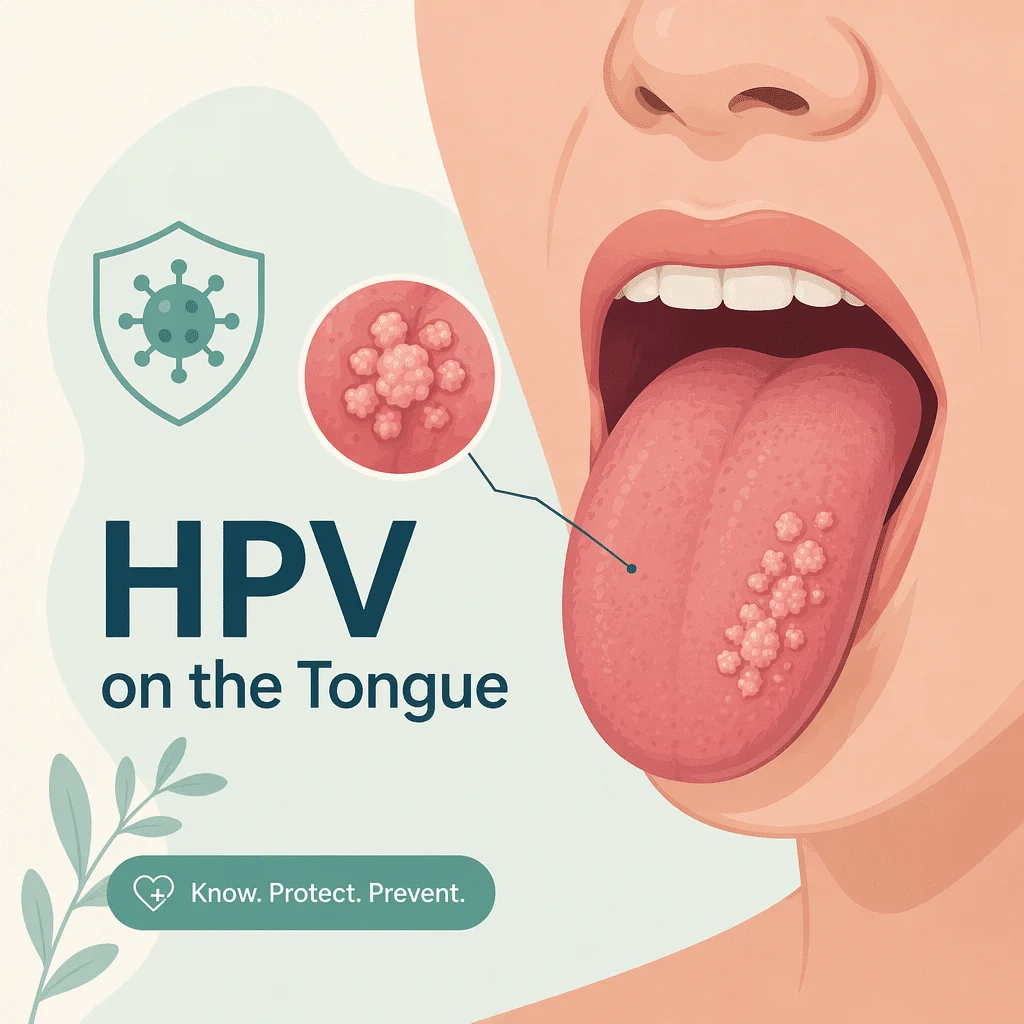
When HPV does produce a visible growth in the mouth, it is usually a benign one. Squamous papilloma is the most common: a soft, painless growth a few millimeters across, often pale or the color of the surrounding tissue, with a slightly rough, cauliflower-like surface, frequently on a narrow stalk. Oral warts look similar and are linked to low-risk types 6 and 11. They can appear on the tongue, lip, palate or floor of the mouth, and typically do not hurt or bleed.
What these lesions do not usually do is ulcerate, bleed, spread quickly or change color. A growth that does any of those things is not necessarily cancer, but it needs examining rather than watching at home. Only a clinician looking in your mouth can tell a papilloma from something else, because several unrelated conditions look almost identical to a non-specialist. This page deliberately offers no photo gallery to match yourself against: it would mislead more readers than it helped.
The cancer risk sits in a place you cannot see
This is the correction that matters most. HPV-related cancer of the head and neck does not usually begin on the visible surface of the tongue. It begins in the oropharynx: the middle part of the throat that includes the base of the tongue, the tonsils and the soft palate. The National Cancer Institute is explicit that oropharyngeal cancer is a different disease from oral cavity cancer, which forms in the mouth proper, and that most of it is caused by HPV.
The consequence is uncomfortable but freeing. Examining your tongue in the mirror tells you very little about the risk you are worried about, because the tissue involved sits around a corner, behind the last molars and below the level you can see. A bump you can see is usually not the thing to fear.
How HPV-related oropharyngeal cancer actually shows up
Because the starting site is hidden, this cancer rarely announces itself as an obvious sore. The most common first sign is a painless lump in the neck, an enlarged lymph node rather than the tumor itself. Many people notice it while shaving or washing and feel completely well otherwise.
Other presentations include a sore throat that will not settle, pain in one ear with no infection to explain it, difficulty or pain on swallowing, a feeling of something caught in the throat, and a change in the voice. One-sidedness is striking: symptoms that stay stubbornly on the left or the right deserve more attention than symptoms that move around. Persistent one-sided throat symptoms have many ordinary causes, including unilateral tonsillitis and hidden tonsil stones, but they should be assessed rather than assumed.
HPV-positive oropharyngeal cancer has risen over recent decades in high-income countries, particularly in men, while smoking-related head and neck cancers have fallen. It remains uncommon and responds better to treatment than the smoking-related form. Any symptom above lasting more than about three weeks warrants an appointment.
Why there is no test for oral HPV
Many people arrive here hoping to book an oral HPV test. It is worth saying plainly: that test does not exist as a clinical service. There is no approved screening test for oral HPV and no equivalent of cervical screening for the mouth or throat. You cannot ask a clinic for an HPV test of the mouth as you would for HIV screening or an RPR test for syphilis.
The reason is not neglect. Cervical screening works because the cervix can be sampled directly, because precancerous change there is visible and treatable, and because decades of data tell clinicians what an abnormal result means. None of that holds for the oropharynx, where precursor lesions are hidden and there is no treatable intermediate stage. Cervical testing is a different proposition, as our articles on a normal Pap with a positive HPV test and HPV self-collection testing explain.
What happens in practice is straightforward. A dentist or doctor examines your mouth, throat and neck. If anything looks or feels unusual, they take a small tissue sample, a biopsy, which a pathologist examines. Diagnosis comes from the tissue, not from a virus test.
What a bump on the tongue usually turns out to be
Most tongue bumps that send people searching at midnight are not HPV at all. Circumvallate papillae are the classic false alarm: eight to twelve larger bumps in a V shape at the back of the tongue. They are normal taste anatomy that everybody has.
Other frequent explanations include a fibroma, a firm painless nodule of scar tissue where the tongue or cheek is repeatedly bitten; lie bumps, properly transient lingual papillitis, small tender spots that flare for days and settle; a canker sore, which is an ulcer rather than a growth; and pigment changes such as a black spot on the tongue. Painful blistering clusters point towards conditions such as throat herpes, while bumpy tissue at the back of the throat is often cobblestone throat from post-nasal drip.
| What you have noticed | What it usually is | What to do |
|---|---|---|
| A small, painless, cauliflower-textured bump on the tongue or lip | Most often a squamous papilloma or a wart linked to low-risk HPV types 6 and 11 | Have it examined. It can usually be removed if it bothers you or the diagnosis is unclear |
| A white patch that will not scrape off | Anything from friction keratosis to leukoplakia. A coating that wipes away is more often thrush | Needs an in-person look. If it has lasted more than three weeks, book now |
| A painless lump in the neck that has not gone away | An enlarged lymph node. Most are not cancer, but this is the commonest first sign of HPV-related oropharyngeal cancer | See a doctor promptly, even if you feel completely well |
| A sore throat or earache on one side only, lasting over three weeks | Usually an ordinary infection, but one-sided symptoms are the pattern clinicians investigate | Ask for an ear, nose and throat assessment |
| Small bumps in a V-shaped row at the very back of the tongue | Almost always circumvallate papillae, normal taste anatomy everybody has | No action needed if symmetrical and unchanged. Mention them at your next dental visit if unsure |
HPV vaccination: what it prevents and who it is for
This is the part of the story with genuinely good news in it. Gardasil 9, the vaccine used in the United States, protects against nine HPV types, including 16 and 18, which cause most HPV-related cancers, and low-risk types 6 and 11. Because HPV 16 drives the large majority of HPV-related oropharyngeal cancers, vaccination targets the exact types that matter for the throat, and higher coverage is associated with less oral HPV infection.
The current recommendations from the Centers for Disease Control and Prevention are as follows. Routine vaccination is recommended at ages 11 to 12, and the series can start as early as age 9. Two doses six to twelve months apart are enough if the first dose is given before the fifteenth birthday. Those who start at 15 through 26 need three doses, as do people with weakened immune systems aged 9 through 26. Catch-up vaccination is recommended through age 26 for anyone who did not start or finish the series. Vaccination is not routinely recommended after 26: some adults aged 27 through 45 may still choose it after a shared decision-making conversation with their clinician, but the benefit is smaller because most people that age have already been exposed.
The vaccine prevents new infections. It does not treat an infection you already have and it does not remove a lesion. It is still worth discussing if you are within the recommended ages, because it protects against types you have not met. It is the same vaccine behind prevention of cervical cancer.
How oral HPV spreads, and why it is nobody’s fault
Oral HPV is transmitted mainly through oral sexual contact, and the likelihood of exposure rises with the number of partners over a lifetime. Deep kissing has been studied as a route, with weaker evidence. Smoking does not cause the infection, but it makes persistence more likely, and persistence is the step that matters. A weakened immune system, including untreated HIV, has the same effect.
Now the part that causes more distress than the virus itself. HPV is close to universal: nearly everyone who has been sexually active is exposed at some point, and for most people the infection comes and goes without a single symptom. An HPV infection tells you nothing about a person’s character, and finding it is not evidence that a partner has been dishonest with you: the virus can sit silently for years, and in most cases there is simply no way to know when, or from whom, it was acquired.
Condoms and dental dams reduce transmission but do not eliminate it, because HPV spreads by skin and mucosal contact rather than fluids alone. Not smoking has the clearest effect on whether an infection persists. Beyond that, there is no behavior to correct and nothing to feel ashamed of.
When to get checked, and what treating a lesion involves
The rule that overrides everything else here is simple. Any lump, ulcer, or white or red patch in the mouth lasting more than three weeks needs to be looked at by a dentist or a doctor. Not photographed, not compared with images online, not waited out. Nothing on this page can tell you that a lesion in your mouth is harmless, and no article should try.
Red flags: see a dentist or doctor without delay
- Any mouth ulcer, lump, or white or red patch lasting more than three weeks
- A painless lump in the neck
- A persistent sore throat or ear pain on one side
- Difficulty or pain when swallowing
- Unexplained bleeding in the mouth
- A loose tooth with no dental cause
- Numbness of the lip or tongue
- Unexplained weight loss
These signs have many causes, most not cancer. They are here because they should always be assessed rather than watched.
When a benign HPV-related lesion is treated, the reason is usually to obtain a diagnosis, or because it is uncomfortable or catches on the teeth. Removal is typically a short procedure under local anesthetic, and the tissue is sent for examination. Laser and cryotherapy are alternatives, and healing in the mouth is generally quick.
Recurrence is possible, because removing a lesion removes the tissue, not the virus in surrounding cells. Antiviral drugs do not clear HPV and are not used for these growths. Which option a clinician recommends depends on the lesion, its site and the biopsy result.
What not to put on a lesion in your mouth
Do not use over-the-counter wart treatments on oral tissue. Salicylic acid preparations, freezing kits and similar products are made for the thick skin of hands and feet. The lining of the mouth is thin, moist and far more permeable, and these products cause chemical burns, ulceration and lasting damage. The same applies to apple cider vinegar, bleach, tea tree oil, garlic and every other corrosive home remedy circulating online. Do not cut, tie off, scrape or pick at a growth either: you risk infection, bleeding, and destroying the very tissue a pathologist needs to give you an answer.
Latest scientific advances in oral HPV research
According to PubMed, the studies below are among the most useful recent contributions.
A 2025 systematic review in BMC Cancer pooled 51 studies on how often HPV is found in the mouth and tonsils. What was found: oral HPV DNA is detected in a small minority of the general population, more often in men, with HPV 16 the commonest type; vaccination was associated with a significant reduction in vaccine-type oral infection; and data on clearance and sampling remain incomplete. What this means for you: carrying oral HPV is unremarkable, the vaccine measurably reduces it, and no mouth swab can yet tell you anything reliable about your own risk (DOI).
A 2026 analysis in Human Vaccines & Immunotherapeutics used nationally representative United States survey data on more than 12,000 adults. What was found: infection with the oral HPV types the vaccine covers was uncommon overall, more frequent in men, and substantially less likely among vaccinated than unvaccinated adults of the same age. What this means for you: the benefit shows up in the general population, not only in trials (DOI).
A 2024 multicenter cohort in Cancer Epidemiology, Biomarkers & Prevention followed participants for up to ten years with repeated oral rinse samples. What was found: most newly acquired high-risk oral infections cleared, the majority within about two years, while infections already present at the outset were far more likely to persist for five years or more. What this means for you: a first oral HPV infection usually resolves unnoticed, and it is persistence, not exposure, that carries risk (DOI).
Finally, a 2025 review in the Journal of Clinical Medicine assessed saliva and blood tests for HPV-associated oral and oropharyngeal cancer. What was found: circulating tumor HPV DNA and salivary markers look promising for monitoring people already diagnosed and spotting recurrence early, but there is still no screening approach for healthy people, because the precursor lesions are hidden and hard to sample. What this means for you: a reliable test may come, and it has not arrived yet (DOI).
Frequently asked questions
Can I get tested for oral HPV?
No, not in any way that would help you. There is no approved oral HPV screening test and no service that can reliably tell a healthy person whether they carry the virus in their mouth. Research studies do use oral rinse samples, but a positive result changes nothing: most oral HPV clears on its own, and no guideline says what to do with the information. If you have a visible lesion, the useful step is an examination and, if needed, a biopsy, which answers the question that actually matters: what is this tissue?
Does HPV on the tongue mean I have cancer?
Almost always no. Visible HPV growths on the tongue are usually squamous papillomas or warts caused by low-risk types, which do not turn into cancer. The cancer linked to HPV starts in the oropharynx, behind the visible mouth, and is driven mainly by type 16. Most people who have carried oral HPV never develop any cancer. That said, nobody can tell from a description whether a growth is harmless, so anything lasting more than three weeks needs an in-person look.
Will HPV on the tongue go away on its own?
Usually, yes. Most oral HPV infections are cleared by the immune system, typically within about two years, and many people never know they had one. Visible lesions can shrink or disappear as the infection clears, although a papilloma that has been present for months often stays until it is removed. What matters is not waiting indefinitely: if a bump, ulcer or patch has been there for more than three weeks, have it checked rather than watching for another month.
Are there pictures I can compare my tongue to?
You will find plenty online, and they are more likely to frighten you than to help. Papillomas, fibromas, lie bumps, canker sores and early cancers overlap enough visually that even clinicians confirm a diagnosis with a biopsy rather than by eye. Comparing photographs tends to produce one of two wrong answers: unnecessary panic, or false reassurance that delays an appointment. If you want a real answer about a specific bump, the only route is someone looking at it in person.
Can I get rid of HPV warts on the tongue at home?
No, and trying is genuinely harmful. Wart removers sold for hands and feet contain acids or freezing agents designed for thick skin; on the thin lining of the mouth they cause chemical burns and ulcers. Apple cider vinegar, bleach and similar remedies do the same. Cutting, tying off or picking at a growth risks bleeding and infection, and it destroys the tissue a pathologist would need. Removal, when it is appropriate, is a short clinical procedure, not a home project.
What does an oral HPV diagnosis say about my relationship?
Nothing. HPV is close to universal among people who have been sexually active, infections can stay silent for years, and there is usually no way to date when one was acquired. A finding of oral HPV proves nothing about a current partner, and it does not reflect on anyone’s character. Practically, it is worth discussing vaccination with a clinician if you are within the recommended ages, and worth remembering that most exposures come and go without ever causing a symptom.
Glossary of key terms
| Term | Definition |
|---|---|
| Human papillomavirus (HPV) | A family of more than 200 viruses that infect skin and the moist linings of the body, including the mouth and throat. |
| Oropharynx | The middle part of the throat, including the base of the tongue, the tonsils and the soft palate. Not visible in a mirror. |
| Oral cavity | The mouth proper: lips, gums, cheeks, the front two-thirds of the tongue and the floor of the mouth. |
| Squamous papilloma | A small benign growth with a rough, cauliflower-like surface, the commonest visible HPV lesion in the mouth. |
| Low-risk HPV types | Types such as 6 and 11 that can cause warts but essentially never cause cancer. |
| High-risk HPV types | About a dozen types, led by 16 and 18, that can cause cancer if the infection persists for many years. |
| Persistence | An infection the immune system fails to clear, which stays detectable over repeated tests. Persistence, not exposure, drives risk. |
| Biopsy | Removal of a small piece of tissue so a pathologist can examine it under a microscope and give a definite diagnosis. |
| Leukoplakia | A white patch in the mouth that cannot be rubbed off and that needs assessment because a minority carry precancerous change. |
| Circumvallate papillae | Eight to twelve normal taste structures arranged in a V at the back of the tongue, often mistaken for lesions. |
| Transient lingual papillitis | The medical name for lie bumps: small, tender, short-lived swellings of the taste papillae on the tongue. |
Sources
- Centers for Disease Control and Prevention. HPV Vaccination. https://www.cdc.gov/hpv/vaccines/index.html
- National Cancer Institute. HPV and Cancer. https://www.cancer.gov/about-cancer/causes-prevention/risk/infectious-agents/hpv-and-cancer
- National Institute of Dental and Craniofacial Research. Oral Cancer. https://www.nidcr.nih.gov/health-info/oral-cancer
- Maltseva M, Klasen C, Wuerdemann N, Hannich M, Klussmann JP, Wieland U. Detection and natural history of HPV infection of oral cavity and tonsils: a systematic literature review. BMC Cancer, 2025. https://doi.org/10.1186/s12885-025-14547-5
- Byrd MC, Hunter AE, Atekha O, Zasloff R, Jiang R, White MC, Boakye EA, Watts TL, Osazuwa-Peters N. Population-level prevalence and risk of oral HPV infection with or without HPV vaccination. Human Vaccines & Immunotherapeutics, 2026. https://doi.org/10.1080/21645515.2026.2667416
- D’Souza G, Tewari SR, Troy T, Webster-Cyriaque J, Wiley DJ, Lahiri CD, et al. Oncogenic oral human papillomavirus clearance patterns over 10 years. Cancer Epidemiology, Biomarkers & Prevention, 2024. https://doi.org/10.1158/1055-9965.EPI-23-1272
- Warnakulasuriya S, Patil S. Salivary and serum liquid biopsy biomarkers for HPV-associated oral and oropharyngeal cancer: a narrative review. Journal of Clinical Medicine, 2025. https://doi.org/10.3390/jcm14217598
Further reading
- Human papillomavirus: causes, symptoms and treatments
- Understanding a normal Pap with a positive HPV test
- Black spot on the tongue: causes, symptoms and treatments
- Throat herpes: symptoms, causes and treatments
- Canker sore: causes, symptoms and treatments
Understand your lab results with AI DiagMe
Oral HPV is not diagnosed by a blood test, and AI DiagMe cannot look at a lesion, diagnose HPV or detect cancer. What can happen is that a doctor investigating mouth or throat symptoms orders other tests along the way, from a blood count to inflammation markers, and hands you a report full of numbers. AI DiagMe explains what each line means in plain language, so you walk into your next appointment able to ask better questions.
Get your results interpreted in minutes