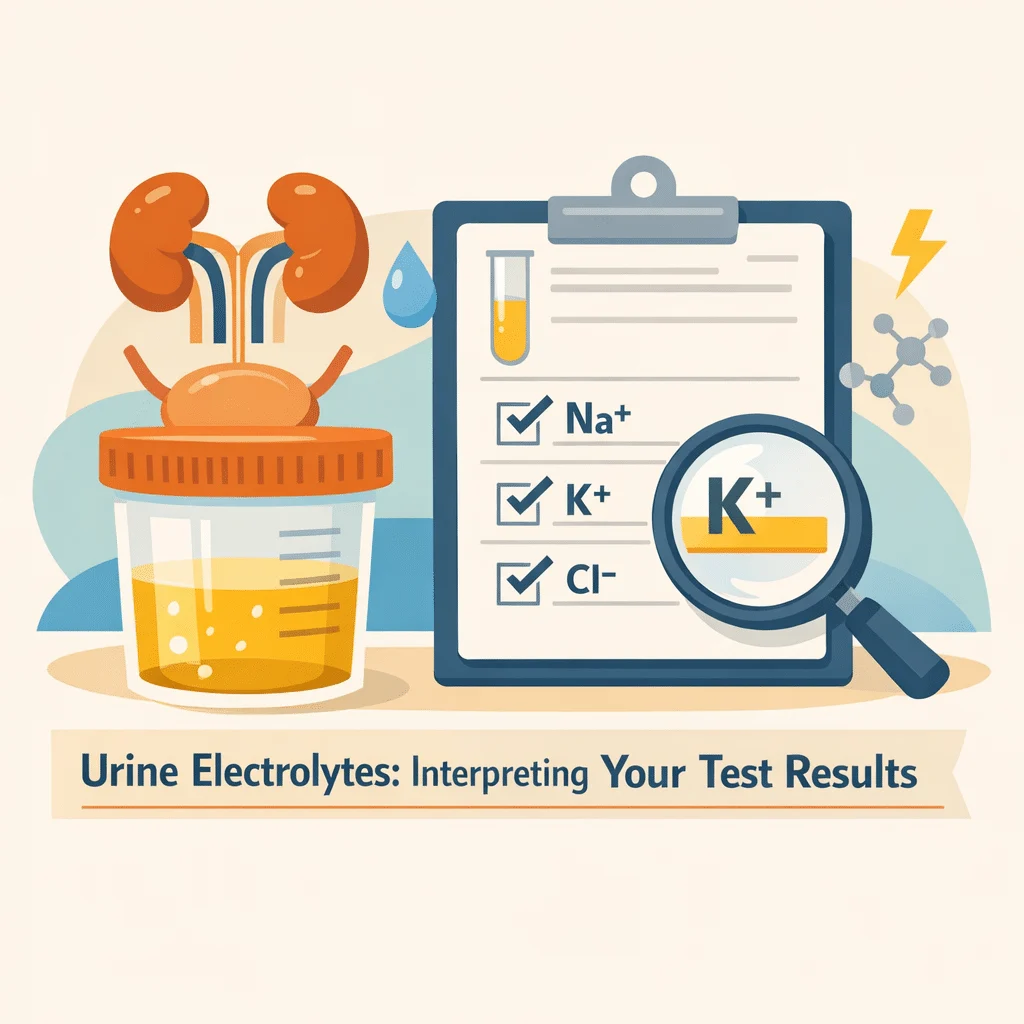
Os eletrólitos urinários são o sódio, o potássio e o cloreto que os rins eliminam pela urina, e medi-los revela ao médico algo que um exame de sangue sozinho não consegue mostrar: o que os rins estão fazendo com o sal e a água neste momento. O nível de sódio no sangue mostra onde o organismo chegou; a urina mostra como chegou lá. Por isso esse painel aparece na investigação de sódio baixo no sangue, suspeita de desidratação, queda súbita da função renal, alterações de potássio e distúrbios do equilíbrio ácido-base.
Neste artigo você vai entender o que cada medida do painel de eletrólitos urinários representa, como uma amostra isolada difere da coleta de 24 horas, o que valores calculados como o FENa acrescentam, por que o mesmo número pode significar coisas opostas em duas pessoas diferentes e por que uma única dose de diurético pode tornar o painel impossível de interpretar.
O que os eletrólitos urinários medem
Os rins filtram cerca de 180 litros de líquido por dia e reabsorvem quase tudo. O que chega à urina não é aleatório: o rim ajusta a quantidade de sódio, potássio e cloreto que retém ou descarta a cada hora, seguindo sinais sobre pressão arterial, volume sanguíneo e hormônios.
O painel básico
Três medidas formam a base do painel. O sódio urinário reflete o quanto o rim está se esforçando para reter sal. O potássio urinário reflete o quanto está sendo eliminado, o que importa quando o nível no sangue está alterado. O cloreto urinário geralmente acompanha o sódio, e quando os dois divergem isso é uma pista. Os laboratórios reportam cada um em miliequivalentes por litro, escrito mEq/L, ou o equivalente em milimoles por litro. Seu médico interpreta esses valores junto com os resultados do sangue, e abordamos o que o exame de sódio no sangue mede.
Por que não existe um valor de referência único
Um resultado de eletrólitos na urina não tem um valor saudável fixo como tem um hemograma, porque o número depende quase inteiramente do que você comeu e bebeu. O MedlinePlus, a biblioteca de saúde para pacientes da Biblioteca Nacional de Medicina dos EUA, descreve um sódio urinário aleatório acima de 20 mEq/L como o resultado habitual, e uma eliminação em 24 horas entre 40 e 220 mEq por dia em um adulto com alimentação comum.
Essa amplitude é tão grande que o resultado pouco significa isoladamente, tornando-se informativo apenas diante de uma pergunta clínica específica e de valores sanguíneos coletados ao mesmo tempo. Um sódio urinário de 10 mEq/L é adequado em alguém que está suando muito no calor, e preocupante em alguém com sódio baixo no sangue que aparenta estar bem hidratado.
Amostra isolada ou coleta de 24 horas
A forma como a amostra é coletada muda o que o número pode responder, e os dois métodos não são intercambiáveis.
A amostra isolada
Uma amostra isolada, às vezes chamada de amostra aleatória, é uma única porção de urina coletada em um determinado momento. É rápida, não exige preparo e é o que os hospitais usam quando uma decisão precisa ser tomada em poucas horas. Sua limitação é que registra apenas um instante: beba um litro de água e a próxima amostra isolada parecerá diluída, independentemente do seu estado real.
A coleta de 24 horas
A coleta de 24 horas consiste em guardar toda a urina produzida ao longo de um dia inteiro em um recipiente fornecido pelo laboratório, geralmente mantido refrigerado. Ela equilibra os picos e as quedas, respondendo a perguntas sobre o consumo habitual, como a quantidade de sal que você ingere ou por que você continua formando cálculos renais. Sua limitação é humana: uma micção esquecida compromete o total.
Creatinina urinária, o fator de correção
Os laboratórios frequentemente incluem a creatinina urinária. A creatinina é um produto residual produzido pelos músculos em uma taxa constante, portanto sua concentração indica o quanto a amostra está diluída. Dividir o sódio pela creatinina gera uma relação que compensa parcialmente o efeito de ingerir grande quantidade de água, além de verificar se uma coleta de 24 horas foi completa. Para mais detalhes, leia nosso guia sobre os níveis de creatinina na urina.
Entendendo cada medição do painel
A tabela abaixo mostra o que cada medição de um painel de eletrólitos urinários representa e o que um valor inesperado pode indicar. Use as descrições como orientação, não como limites definitivos: cada laboratório define seus próprios valores de referência.
| Medida | O que isso reflete | Como geralmente é apresentado | O que um valor inesperado pode indicar |
|---|---|---|---|
| Sódio urinário | O quanto o rim está retendo sal | Valor baixo é geralmente abaixo de 20 mEq/L em uma amostra isolada | Baixo: o rim percebe baixo volume circulante. Alto: perda de sal ou ingestão elevada |
| Potássio urinário | Quanto potássio o rim está eliminando | Avaliado em conjunto com o potássio no sangue, nunca isoladamente | Excreção elevada com potássio baixo no sangue aponta para uma causa renal ou hormonal |
| Cloreto urinário | Manejo do sal, analisado junto com o sódio | Normalmente varia junto com o sódio | Cloro baixo com sódio mais elevado pode ocorrer após vômitos ou uso de diuréticos |
| Osmolalidade urinária | Quão concentrada está a urina | Acima de aproximadamente 500 mOsm/kg a urina é concentrada; acima de 750 mOsm/kg, muito concentrada | Urina concentrada com sódio baixo no sangue levanta a suspeita de síndrome da secreção inapropriada do hormônio antidiurético |
| Creatinina na urina | Diluição da amostra; completude de uma coleta de 24 horas | Depende da massa muscular, da idade e do sexo | Um total baixo em 24 horas sugere coletas perdidas em vez de doença |
| FENa (calculado) | Proporção do sódio filtrado que é eliminada na urina | Abaixo de 1% é o padrão clássico pré-renal; acima de 2% sugere lesão dentro do rim | Diferencia um rim com fluxo sanguíneo reduzido de um rim lesionado |
| Ânion gap urinário (calculado) | Estimativa indireta do amônio urinário | Sódio mais potássio menos cloreto | Na acidose, um resultado positivo sugere que o rim não está excretando ácido normalmente |
Os valores calculados: FENa, FEUreia e o ânion gap urinário
Três dos números mais úteis em um laudo de eletrólitos urinários não são medidos diretamente. Eles combinam resultados da urina e do sangue para eliminar o efeito da diluição da amostra.
Fração de excreção de sódio
A excreção fracionada de sódio, abreviada como FENa, responde a uma pergunta: de todo o sódio filtrado pelo rim, qual porcentagem foi eliminada? São necessários quatro valores: sódio e creatinina tanto na urina quanto no sangue. O StatPearls, referência clínica revisada por pares hospedada pelo National Center for Biotechnology Information, descreve um FENa abaixo de 1% como indicativo de um rim retendo sal por falta de fluxo sanguíneo, e um valor acima de 2% como mais típico de lesão no tecido renal. É uma ferramenta padrão para diferenciar desidratação de lesão renal aguda, e explicamos o que um painel de função renal inclui.
Excreção fracionada de ureia
A fração de excreção de ureia, ou FEUreia, aplica o mesmo cálculo à ureia. Ela existe porque os diuréticos forçam a saída de sódio e comprometem a FENa, enquanto o manejo da ureia era considerado menos afetado. Como a seção de pesquisa abaixo explica, essa expectativa não se confirmou. A ureia é medida no sangue como nitrogênio ureico sanguíneo, e abordamos o que o exame de nitrogênio ureico no sangue indica.
O ânion gap urinário
O ânion gap urinário soma o sódio e o potássio na urina e subtrai o cloreto urinário. Ele serve como indicador do amônio urinário, a principal forma pela qual o rim elimina o ácido, pois a maioria dos laboratórios não mede o amônio diretamente. Quando o organismo está acidificado, um rim saudável inunda a urina de amônio e o gap se torna negativo. Um gap positivo na mesma situação sugere que o rim não está cumprindo sua parte, apontando para um problema tubular em vez de ácido proveniente do intestino. A acidez da urina é avaliada junto com ele, e você pode conferir nosso guia sobre os níveis normais de pH urinário.
Sódio baixo no sangue: o que a urina revela ao seu médico
O sódio baixo no sangue, chamado de hiponatremia, é o distúrbio eletrolítico mais comum em hospitais e o motivo mais frequente para a solicitação desse painel. Os valores urinários não diagnosticam a causa, mas reduzem rapidamente uma lista extensa. O raciocínio geralmente segue esta ordem.
- Confirme se o sangue está realmente diluído. A osmolalidade sanguínea vem primeiro, pois glicose ou gorduras muito elevadas no sangue podem gerar uma leitura falsamente baixa de sódio.
- Observe a osmolalidade urinária. Urina diluída significa que o rim está eliminando corretamente o excesso de água, apontando para ingestão excessiva de líquidos ou uma dieta muito pobre em solutos. Urina concentrada significa que o rim está retendo água quando não deveria.
- Avalie o sódio urinário. Urina concentrada com sódio elevado sugere que o organismo não está com falta de líquido, levantando a possibilidade de sinalização inadequada do hormônio antidiurético. Urina concentrada com sódio baixo sugere que o organismo está defendendo seu volume circulante, como ocorre na desidratação, na insuficiência cardíaca ou na doença hepática avançada.
- Verifique em relação ao exame clínico e à lista de medicamentos. Diuréticos tiazídicos e vários medicamentos psiquiátricos e para dor são causas frequentes, e problemas de tireoide ou suprarrenais são descartados antes de se aceitar o diagnóstico de hormônio inapropriado.
Nenhuma etapa é suficiente por si só, por isso enviar uma amostra de eletrólitos urinários sem os exames de sangue correspondentes raramente é útil.
Outras questões que esse painel ajuda a responder
Desidratação ou lesão renal
Quando a função renal cai de repente, o primeiro passo é determinar se o rim está com falta de fluxo sanguíneo — chamado de pré-renal — ou se sofreu uma lesão direta. Um rim com fluxo reduzido retém sal, por isso o sódio urinário e a FENa ficam baixos enquanto a osmolalidade urinária fica alta; um rim lesado perde esse controle e o padrão se inverte. Acertar esse diagnóstico é importante porque os dois casos levam a tratamentos opostos. A desidratação também afeta a circulação de forma mais ampla, e abordamos como a desidratação afeta a pressão arterial.
Distúrbios do potássio
Se o potássio no sangue estiver baixo, a questão é saber se ele está sendo perdido pelos rins ou por outra via. Um potássio urinário alto junto com um nível sanguíneo baixo indica uma causa renal ou hormonal, apontando para o uso de diuréticos ou excesso do hormônio aldosterona, responsável pela retenção de sal. Um potássio urinário baixo aponta para o trato gastrointestinal ou ingestão insuficiente. Para entender o hormônio, leia nosso guia sobre o exame de aldosterona, e para o valor sanguíneo veja como o exame de potássio no sangue é interpretado.
Estimar a quantidade de sal que você consome
Quase todo o sódio que você ingere é eliminado pela urina, tornando-a a medida mais objetiva de sal na dieta que existe; questionários alimentares subestimam consistentemente esse valor. Os Centros de Controle e Prevenção de Doenças (CDC) recomendam menos de 2.300 mg de sódio por dia para adolescentes e adultos, e relatam que os americanos consomem em média mais de 3.300 mg. A coleta de 24 horas é o método de referência.
Quando falar com seu médico
Marque uma consulta em caso de cãibras musculares persistentes, fraqueza ou confusão incomuns, inchaço acentuado nas pernas, tontura ao se levantar, mudança clara na quantidade de urina que você produz ou resultado alterado que nunca foi acompanhado. Confusão súbita, convulsões ou desmaios exigem atendimento de urgência. Nunca ajuste sua ingestão de sal, de líquidos ou a dose de um diurético com base em um resultado de urina: essas decisões cabem ao médico que pode ver o quadro completo.
O que pode alterar os resultados
Diuréticos, o maior problema isolado
Os diuréticos, popularmente chamados de remédios para eliminar líquido, forçam o rim a liberar sódio. Esse é o objetivo deles — e também o motivo pelo qual eles sobrescrevem exatamente o sinal que o exame tenta captar. Uma pessoa genuinamente desidratada ainda pode apresentar sódio urinário elevado e FENa alta por horas após uma dose, o que imita uma lesão renal. Interpretar um resultado de eletrólitos na urina sem saber quando foi tomada a última dose do diurético é um erro comum. O mesmo cuidado se aplica a laxantes, comprimidos de sal e soluções intravenosas administradas antes do exame.
Tudo o mais que pode alterar o resultado
- Refeições recentes, especialmente as mais salgadas, e a quantidade de líquido ingerida antes do exame.
- Vômitos ou diarreia, ambos alteram o manejo do cloreto antes de alterarem o sódio.
- A doença renal crônica, que reduz a capacidade de concentrar a urina e diminui as diferenças das quais o exame depende.
- A doença hepática ou cardíaca avançada, na qual o rim retém sal intensamente mesmo quando o organismo já acumula líquido em excesso.
- Uma coleta de 24 horas incompleta ou uma amostra mantida fora da geladeira.
A osmolalidade é às vezes confundida com a densidade urinária, a estimativa rápida impressa na fita reagente; a osmolalidade é a medição laboratorial e a mais precisa das duas. Explicamos o que significam os analitos de uma fita reagente de urina padrão. Para o conjunto mais amplo de substâncias medidas na urina, veja nosso guia sobre os principais exames de química urinária. Sódio e cloreto também são medidos no sangue, e descrevemos o papel do cloreto no sangue assim como os exames agrupados em um painel de eletrólitos.
Últimos avanços científicos
Pesquisas dos últimos três anos esclareceram em quais situações os eletrólitos urinários realmente ajudam e em quais seu uso foi superestimado.
O recurso da ureia não salva a FENa
Uma revisão sistemática com meta-análise de 2024 — um estudo que reúne vários estudos anteriores em um só — agrupou onze estudos com pouco mais de 1.100 pacientes hospitalizados e investigou se a excreção fracionada de ureia supera a FENa quando a função renal cai de forma súbita. O resultado foi negativo: a FEUreia acertou em aproximadamente dois casos a cada três, e mesmo em pacientes que usavam diuréticos, situação em que ela supostamente se destacaria, não ofereceu vantagem clara. O que isso significa para você é que nenhum dos dois números é um veredicto: se o seu resumo de alta mencionar um deles, leia-o como uma pista que sua equipe médica avaliou junto com o exame físico, seu histórico e seus exames de sangue.
Sódio urinário como monitoramento em tempo real na insuficiência cardíaca
Um ensaio clínico randomizado de 2023, no qual os pacientes foram distribuídos aleatoriamente entre uma abordagem ou outra para garantir uma comparação justa, incluiu 310 pessoas internadas com insuficiência cardíaca aguda. Metade teve a dose do diurético ajustada de acordo com o sódio na urina, e a outra metade recebeu o tratamento habitual. O grupo guiado pela urina eliminou visivelmente mais sódio, mas não apresentou menor probabilidade de morrer ou ser reinternado nos seis meses seguintes. Um documento de consenso europeu de especialistas de 2025 concluiu que o sódio urinário é um bom marcador direto para avaliar se o diurético está funcionando — o que é diferente de afirmar que ele salva vidas. O que isso significa para você é que, se for hospitalizado por retenção de líquidos, um enfermeiro poderá verificar uma amostra de urina poucas horas após a primeira dose: uma verificação de rotina de eficiência, não um sinal de complicação.
Amostras isoladas estão sendo usadas para estimar a ingestão diária de sal em larga escala
Um estudo populacional de 2024 analisou amostras únicas de urina de mais de 215.000 adultos e utilizou uma equação estabelecida para estimar a eliminação diária de sódio de cada pessoa. O método é o ponto central: os pesquisadores agora conseguem aproximar o consumo habitual de sal a partir de um único copo de urina, em vez de uma coleta de 24 horas. O que isso significa para você é que uma futura avaliação do seu consumo de sal pode não exigir o inconveniente frasco de coleta de 24 horas, embora essa coleta continue sendo o padrão de referência quando a precisão é importante.
O ânion gap urinário continua sendo uma estimativa, não uma medição direta
Uma revisão de 2023 sobre o amônio urinário reafirmou uma limitação que os clínicos frequentemente esquecem: o ânion gap urinário é apenas uma estimativa aproximada da excreção de amônio e pode ser enganoso quando substâncias incomuns estão presentes na urina. O que isso significa para você é que o ânion gap urinário é um indicador para exames adicionais, não um diagnóstico. Seu médico confirma o quadro com exames de equilíbrio ácido-base no sangue, e a relação entre ureia e creatinina é outra parte dessa avaliação — por isso explicamos o que significa a relação ureia/creatinina (BUN/creatinina).
Perguntas frequentes
Como esse exame é chamado no laboratório?
Os formulários de solicitação raramente trazem “eletrólitos urinários” como um item único. É mais comum ver os componentes listados individualmente: sódio na urina, potássio na urina, cloreto na urina, creatinina na urina e osmolalidade urinária, às vezes agrupados sob um título como química urinária ou painel renal de urina. Se for solicitada a excreção fracionada, uma amostra de sangue correspondente é coletada ao mesmo tempo, pois o cálculo não pode ser feito sem ela. Se você não tiver certeza do que foi pedido, o laboratório que coletou sua amostra pode informar quais analitos foram analisados.
Qual é o valor de referência para sódio e potássio na urina?
Não existe um intervalo de referência único, e isso não é uma evasão. Como a excreção acompanha a ingestão, o MedlinePlus indica que um sódio urinário aleatório acima de 20 mEq/L é considerado típico, e que o total em 24 horas varia de 40 a 220 mEq por dia para um adulto com alimentação comum. O potássio é igualmente variável. Os laboratórios definem seus próprios intervalos de referência, que diferem conforme o método utilizado e as unidades adotadas. A pergunta clinicamente útil nunca é se o seu valor está dentro de uma faixa impressa, mas sim se ele é compatível com o que os seus rins deveriam estar fazendo, levando em conta seus exames de sangue e seus sintomas.
Preciso estar em jejum antes de fazer o exame de eletrólitos na urina?
O jejum geralmente não é necessário. O mais importante é informar ao profissional que coleta a amostra o que você comeu e bebeu recentemente e, acima de tudo, listar todos os medicamentos e suplementos que você toma. Diuréticos, laxantes, comprimidos de sal, alguns remédios para pressão arterial e certos medicamentos psiquiátricos podem alterar o resultado. Se for solicitada uma coleta de 24 horas, você receberá um recipiente e deverá descartar a primeira urina da manhã, depois guardar tudo o que urinar nas 24 horas seguintes, incluindo a primeira urina da manhã do dia seguinte.
O que significa um nível baixo de sódio na urina?
Um sódio urinário baixo geralmente significa que seus rins estão retendo sal, o que ocorre quando percebem que o volume circulante está reduzido. Isso pode ser completamente normal após vômitos, suor excessivo, ingestão insuficiente de líquidos ou perda de sangue. Também pode ocorrer quando o volume total de líquido no corpo está elevado, mas a circulação está com baixo preenchimento, como na insuficiência cardíaca avançada ou na cirrose hepática. Às vezes, simplesmente reflete uma dieta com pouco sal. O resultado isolado não é um diagnóstico; é um indicador que ganha significado quando analisado junto com o sódio no sangue, o exame clínico e os medicamentos que você usa.
O que causa um nível alto de sódio na urina?
A explicação mais comum é também a menos preocupante: você consumiu muito sal e seus rins estão eliminando o excesso. Além da alimentação, os diuréticos são a principal causa, já que liberar sódio é exatamente para o que eles foram desenvolvidos. Outras possibilidades incluem lesão nos túbulos renais, condições das glândulas suprarrenais que reduzem o hormônio responsável pela retenção de sal, e a síndrome da secreção inapropriada do hormônio antidiurético quando o sódio no sangue está baixo ao mesmo tempo. A interpretação depende muito de saber se o seu sódio no sangue está normal, alto ou baixo.
Por que os eletrólitos urinários são solicitados quando se suspeita de SIADH?
A SIADH, síndrome da secreção inapropriada do hormônio antidiurético, descreve um estado em que o organismo retém água que deveria ser eliminada. O diagnóstico depende de uma combinação específica: sódio baixo no sangue, osmolalidade plasmática baixa, mas urina inapropriadamente concentrada e com quantidade considerável de sódio. Os eletrólitos urinários e a osmolalidade urinária fornecem dois desses quatro critérios, por isso são solicitados juntos. Problemas na tireoide, nas suprarrenais e o uso recente de diuréticos são descartados antes de o diagnóstico ser confirmado.
Glossário de termos-chave
| Prazo | Definição |
|---|---|
| Eletrólito | Um mineral que carrega carga elétrica quando dissolvido nos fluidos corporais. Sódio, potássio e cloreto são os três mais medidos na urina. |
| Amostra de urina isolada | Uma amostra coletada em um único momento, sem coleta cronometrada. Rápida e prática, mas representa apenas um instante do funcionamento dos rins. |
| Coleta de urina de 24 horas | Toda a urina produzida ao longo de um dia completo, guardada em um único recipiente. Ela equilibra as variações de curto prazo e é o método de referência para medir a eliminação diária de sal. |
| Osmolalidade | Uma medida da quantidade de partículas dissolvidas em um líquido, expressa em mOsm/kg. Na urina, indica com que intensidade os rins estão concentrando o líquido. |
| Creatinina | Um produto residual produzido pelos músculos em ritmo constante. No exame de urina, é usado para corrigir a diluição e verificar se a coleta cronometrada foi completa. |
| Fração de excreção de sódio (FENa) | O percentual do sódio filtrado que acaba sendo eliminado na urina, calculado a partir do sódio e da creatinina tanto no sangue quanto na urina. |
| Fração de excreção de ureia (FEUreia) | O mesmo cálculo aplicado à ureia em vez do sódio, originalmente proposto para pacientes em uso de diuréticos. |
| Ânion gap urinário | Sódio urinário mais potássio menos cloreto. Uma estimativa indireta de quanto amônio o rim está excretando. |
| Natriurese | A eliminação de sódio pela urina. Os médicos a monitoram para avaliar se um diurético está tendo o efeito desejado. |
| Pré-renal | Uma queda na função renal causada por fluxo sanguíneo insuficiente chegando aos rins, e não por dano ao próprio tecido renal. |
| Hiponatremia | Um nível de sódio no sangue abaixo da faixa normal. Geralmente reflete excesso de água em relação ao sal, e não uma falta real de sal. |
| mEq/L | Miliequivalentes por litro, a unidade mais utilizada pelos laboratórios para medir sódio, potássio e cloreto na urina. |
Fontes
- MedlinePlus, Biblioteca Nacional de Medicina dos EUA — Exame de sódio na urina — Enciclopédia Médica, 2026. MedlinePlus
- Gounden V, Bhatt H, Jialal I — Exames de Função Renal — StatPearls, NCBI Bookshelf, 2026. NCBI Bookshelf
- Centers for Disease Control and Prevention — Sobre Sódio e Saúde — CDC, 2025. CDC
- Lin R, Grossmann M, Warren AM — Algoritmo diagnóstico da hiponatremia — Best Practice & Research Clinical Endocrinology & Metabolism, 2025. PubMed
- Abdelhafez MO, Alhroob AA, Abu Hawilla MO, et al. — Utilidade da fração de excreção de ureia na lesão renal aguda com comparação à fração de excreção de sódio: uma revisão sistemática e meta-análise — The American Journal of the Medical Sciences, 2024. PubMed
- Ter Maaten JM, Beldhuis IE, van der Meer P, et al. — Terapia diurética guiada pela natriurese na insuficiência cardíaca aguda: um ensaio clínico randomizado pragmático — Nature Medicine, 2023. PubMed
- Meekers E, Dauw J, Ter Maaten JM, et al. — Análise do sódio urinário: a chave para a titulação eficaz de diuréticos? Documento de consenso de especialistas do European Journal of Heart Failure — European Journal of Heart Failure, 2025. PubMed
- Chiang BM, Ye M, Chattopadhyay A, et al. — Ingestão de sódio e dermatite atópica — JAMA Dermatology, 2024. PubMed
- Rehman MZ, Melamed M, Harris A, et al. — Amônio urinário na prática clínica: medição direta e o ânion gap urinário como marcador substituto na acidose metabólica — Advances in Kidney Disease and Health, 2023. PubMed
Leitura complementar
- Saiba como uma amostra de urina é examinada em busca de células anormais ao microscópio.
- Entenda o que as partículas em forma de cilindro formadas nos túbulos renais indicam.
- Descubra o que uma mudança na cor da sua urina pode significar.
- Veja como o hormônio do estresse é medido em uma coleta de urina cronometrada.
- Leia o que as células de superfície encontradas em uma amostra de urina podem indicar.
Entenda os resultados dos seus exames com o AI DiagMe.
Um resultado de eletrólitos na urina é um dos exemplos mais claros de um exame que, sozinho, diz pouco — mas que, em contexto, diz muito. O AI DiagMe analisa seus eletrólitos urinários junto com os exames que lhes dão sentido, incluindo sódio e potássio no sangue, painel de função renal e osmolalidade urinária, e explica em linguagem simples o que o conjunto de resultados sugere e quais perguntas vale a pena levar ao médico. Ele ajuda você a entender seus exames e a se preparar para a consulta. Não faz diagnóstico e não substitui seu médico.
Obtenha a interpretação dos seus resultados em minutos.