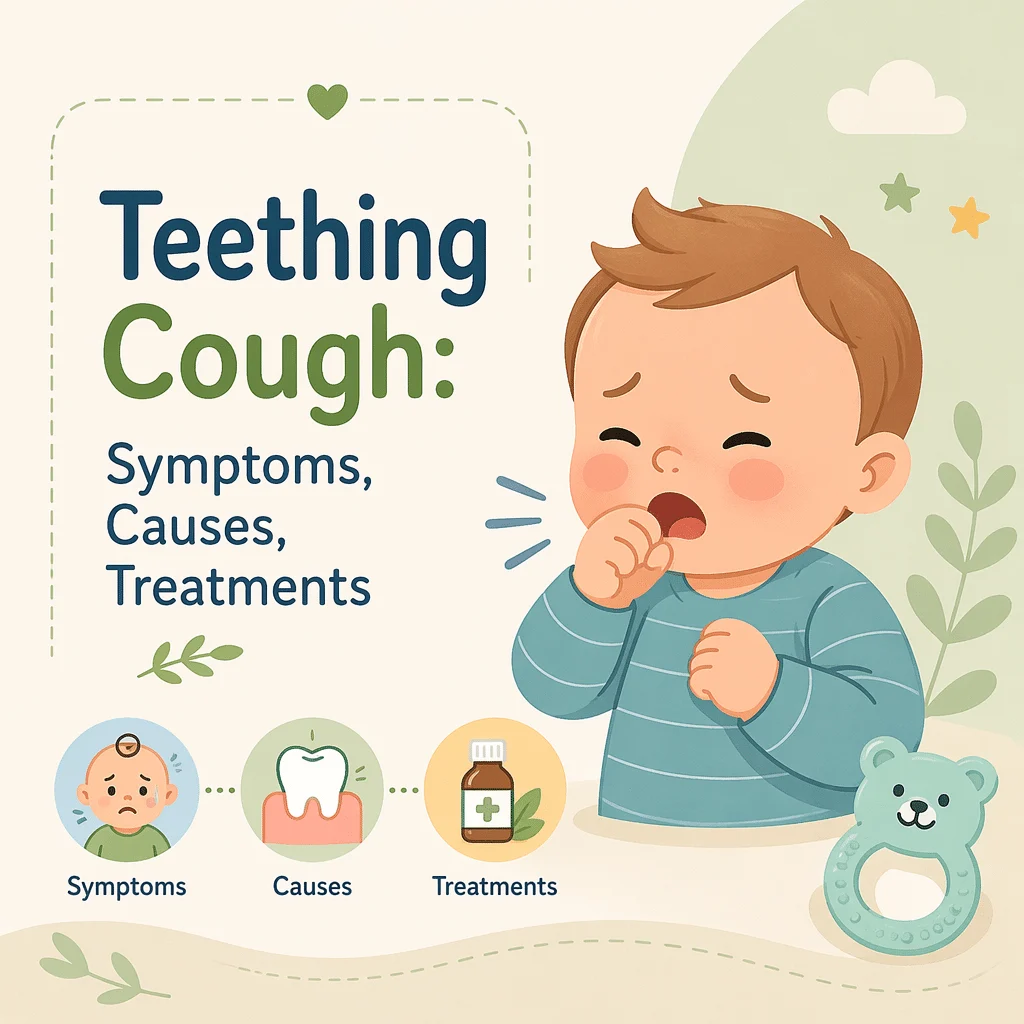
If you are searching for teething cough at two in the morning because your baby is cutting a tooth and will not stop coughing, here is the short answer: teething does not cause a cough, and it does not cause a real fever either. Teething makes gums sore and swollen, and makes babies drool, chew and grizzle. A cough is something else, and deserves to be looked at on its own terms.
That is no criticism of anyone who believed otherwise, because the belief makes perfect sense and this article explains why. You will learn what teething genuinely does, what a cough at this age usually is, which products are unsafe, and which signs mean you should call someone. Those are in the box below.
Get emergency help now if your baby has any of these
Do not wait, and do not assume teething explains any of them.
- Any fever in a baby under 3 months old. The American Academy of Pediatrics advises calling the doctor right away for a rectal temperature of 100.4°F (38.0°C) or higher at this age. In a newborn it is treated as an emergency.
- Trouble breathing: fast breathing, grunting, flaring nostrils, or skin pulling in between or below the ribs.
- Blue, gray or dusky lips, tongue or face.
- A harsh barking cough, or a high-pitched noise as your baby breathes in.
- Pauses in breathing, or any episode where your baby stops breathing.
- Refusing to feed or drink, or unable to feed because of coughing.
- Far fewer wet diapers, no tears when crying, a sunken soft spot, or a dry mouth.
- Unusual sleepiness, floppiness, or a baby who is very hard to wake.
- A seizure or fit of any kind.
- Coughing until they vomit, or long coughing fits followed by a whooping gasp.
If you are worried and cannot decide, call. Nobody will think less of you for asking.
Does teething cause a cough? The direct answer
No. When researchers have followed healthy babies day by day, recording symptoms alongside the exact days teeth came through, coughing has not lined up with tooth eruption. Nor has congestion, vomiting or genuine fever. What does line up is a small, local, unglamorous cluster: chewing and biting, drooling, rubbing at the gums, extra irritability and slightly worse sleep.
One real connection is worth naming, because parents notice it and it is not imaginary. Teething babies drool a great deal, and a mouthful of extra saliva can make a baby gag or clear their throat, especially lying flat. That is a momentary noise tied to a swallow, not a cough that returns all evening or lasts for days. If what you hear is persistent, teething is not the explanation, and looking for another one is the right instinct.
Why the teething explanation feels so convincing
Babies teethe from roughly 6 months to 24 months. That is also, almost exactly, the window in which the protective antibodies a baby received from their mother fade away and the baby starts meeting the respiratory viruses that circulate everywhere. A healthy child this age may pick up six to ten viral infections in a year, while twenty baby teeth arrive over the same period.
Put those facts together. For most of that period a baby is both teething and, fairly often, fighting a virus, so the two collide by chance. When a tooth appears the same week as a cough, the tooth is visible and easy to point at while the virus is invisible, so the mind reaches for the explanation it can see. Add centuries of inherited advice passed down with total sincerity, and you get a belief that feels like common sense.
What teething actually does cause
Teething is real and can make a baby miserable. The evidence supports a narrow, local list: sore swollen gums, sometimes with a bluish bump over the emerging tooth; heavy drooling that can chap the chin and neck; an urge to bite and chew; rubbing at the gums, cheek or ear; extra fussiness around a tooth breaking through; and slightly broken sleep. At most there may be a very slight rise in temperature. The American Academy of Pediatrics is explicit that anything above 101°F (38.3°C) is probably not teething and warrants a call to your pediatrician.
Ear-rubbing deserves a note. It genuinely is a teething sign, because a lower molar can refer pain toward the ear, but it is also a classic sign of a middle ear infection, common at this age and often following a cold. If your baby pulls at one ear and also has a cough or fever, an ear infection is worth ruling out rather than assuming.
What a cough in a teething-age baby usually is
A cough is a protective reflex clearing an irritated airway. In babies aged 6 to 24 months, a few causes account for nearly all of it.
An ordinary viral cold
By far the most common answer. A runny or blocked nose, a wet cough worse at night as mucus drains down the throat, mild fussiness, maybe a low-grade temperature. It builds over a few days, then eases over one to two weeks, with the cough outlasting everything else. For what the color of nasal mucus does and does not tell you, see our guide to white mucus.
Bronchiolitis, usually from RSV
This starts like a cold, then moves into the smallest airways. Watch for faster breathing, wheezing, a tight persistent cough, and feeding that becomes hard work because the baby cannot breathe and suck at once. The CDC notes that respiratory syncytial virus is the most common cause of bronchiolitis and pneumonia in children under one year old. It can look manageable on day two and worse on day four, so a baby sliding backwards needs to be seen.
Croup
Unmistakable once heard: a harsh barking cough like a seal, often arriving suddenly at night, sometimes with a high-pitched rasp on breathing in. It comes from swelling in the voice box and windpipe, and noisy breathing in at rest is an emergency.
Whooping cough (pertussis)
Less common where vaccination coverage is good, but dangerous in infants. It begins like a mild cold, then develops into long exhausting coughing fits, sometimes ending in vomiting or a whooping gasp. Very young babies may not whoop at all and may simply stop breathing instead.
Reflux
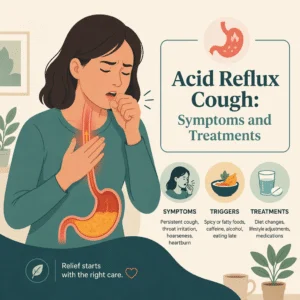
Stomach contents traveling back up can irritate the throat and trigger coughing, typically worse lying flat or after feeds, often with arching, spitting up or feeding refusal. The mechanism is the one behind an acid reflux cough in adults, though management in babies is a matter for your pediatrician.
An inhaled object
A baby who was well, suddenly began choking, and has coughed or wheezed ever since may have inhaled a small object or piece of food. Teething babies put everything in their mouths, which makes this age especially vulnerable, and a cough starting abruptly in a well child needs urgent assessment. Post-nasal drip can also nag, though a true sinus infection is uncommon this young.
Teething, illness or emergency: reading what you are seeing
Use this as a rough guide, not a diagnosis. Your instinct outranks any table.
| What you are seeing | Likely meaning | What to do |
|---|---|---|
| Drooling, chewing, swollen gums, grumpy but feeding well | Teething | Comfort measures at home |
| Runny nose and wet cough, still feeding and playing | Viral cold, not teething | Home care; call if it worsens |
| 100.4°F (38.0°C) or higher, baby under 3 months | Possible serious infection | Emergency: assess now |
| Fever above 101°F (38.3°C) at any teething age | Illness, not teething | Call your pediatrician |
| Fast breathing, grunting, ribs pulling in | Respiratory distress | Emergency: go now |
| Barking cough, noisy breathing in at rest | Croup, airway narrowing | Emergency: go now |
| Coughing fits ending in vomiting, or breathing pauses | Possible whooping cough | Emergency: go now |
| Sudden coughing or choking in a well baby | Possible inhaled object | Emergency: go now |
| Fewer wet diapers, no tears, dry mouth, very sleepy | Dehydration | Emergency: go now |
Dehydration in a small baby develops faster than most parents expect. For the broader physiology, we cover dehydration and blood pressure in a separate article written for adults.
Why the phrase “it’s just teething” is the actual risk
Attributing a symptom to teething closes the question. The moment a cough, a fever or a listless baby is filed under teething, the observing stops. Nobody counts the breaths per minute or notices the diapers staying dry. The 4am call is postponed until morning, and the morning call until afternoon. In bronchiolitis, in pertussis and in serious bacterial infection, the hours lost that way are the ones that mattered most.
The researchers behind the largest prospective study of teething were direct: before any sign of a potentially serious illness is put down to teething, other causes must be ruled out. One habit helps. When your baby is unwell, ask what you would think was going on if this baby had no teeth coming through at all. Answer that first, then decide.
Teething products: what is safe, and what is genuinely dangerous
Some products marketed to exhausted parents have caused real harm to children.
Do not use these
- Benzocaine teething gels and creams. The FDA states these should not be used for teething pain in children, because they can cause methemoglobinemia, a serious and sometimes fatal condition in which red blood cells lose the ability to carry oxygen.
- Prescription viscous lidocaine solution. The FDA warns it can cause heart problems, severe brain injury, seizures and death in infants if too much is used or swallowed.
- Homeopathic teething tablets and gels. The FDA has warned about these, some found to contain inconsistent amounts of belladonna, a toxic plant substance. The AAP states they provide no benefit.
- Amber teething necklaces and any teething jewelry. The FDA has received reports of deaths and serious injuries from strangulation and choking, and the AAP notes amber necklaces do nothing for pain. Nothing should ever be tied around a baby’s neck.
- Cough medicines and lozenges, which are not appropriate for infants. Cough drops are a serious choking hazard at this age; our guide to them covers older children and adults, and none of it applies to a baby.
These are reasonable
- Rubbing or massaging the gums gently with a clean finger. The AAP recommends this first.
- A teething ring made of firm rubber. The FDA and AAP both advise against freezing it, because a frozen teether gets hard enough to bruise the gums; cool from the refrigerator is fine. Avoid liquid-filled teethers and supervise your baby.
- Wiping drool away often, with a plain barrier ointment on the chin if the skin is sore.
On pain and fever medicines, this article deliberately gives no doses. Whether a medicine suits your baby, which one, and how much depends on exact age and weight, and is a conversation for your pediatrician or pharmacist.
When to call the doctor, and when to go to the emergency room
Go to the emergency room, or call emergency services, for anything in the red box above.
Call your pediatrician the same day for a fever above 101°F (38.3°C), a cough getting steadily worse, a cough lasting over two weeks, wheezing, a fever over 24 hours in a child under 2, feeding that has dropped off, or a baby who does not seem themselves. Call sooner if your baby was premature, has a heart or lung condition, a weakened immune system, or is under 6 months old.
If your doctor investigates, they may examine the chest, measure oxygen with a small clip, swab the nose for viruses such as RSV, or order blood work such as a complete blood count or an inflammatory marker like C-reactive protein. Afterwards, we explain raised readings in our article on high CRP levels, and compare two confused panels in our guide to CBC and CMP tests.
What the research actually shows about teething
The evidence is unusually clear and consistent. A note on timing: the two studies that settled the question were published in 2000 and no one has needed to repeat them, while newer work summarizes them and measures how widespread the misconceptions remain. We say which is which rather than padding with recent papers that add nothing. All studies below were identified through PubMed.
The study that looked specifically at cough
Macknin and colleagues, in Pediatrics in 2000, ran a prospective cohort study: healthy babies followed forward in time, with symptoms recorded day by day as teeth came in rather than remembered afterwards.
What was found: increased biting, drooling, gum-rubbing, irritability, wakefulness, ear-rubbing, facial rash and a slight temperature rise were linked to a tooth coming through. Cough was not, and neither was congestion, loose stools, vomiting, or fever above 102°F.
What this means for you: watched closely in real time, coughing simply does not track with teething. The authors concluded that other causes must be ruled out before symptoms are blamed on teeth.
The study that looked specifically at fever
Wake and colleagues, also in Pediatrics in 2000, followed children aged 6 to 24 months in daycare, with a dental therapist checking gums daily and temperatures taken every day.
What was found: temperatures around a tooth erupting were essentially identical to those on days with no tooth activity, and almost none of the classic teething symptoms held up. Yet every parent, asked afterwards, remembered their own child suffering them.
What this means for you: the gap between what was measured and what parents recalled is the myth in miniature, because memory reorganizes itself around the explanation we already hold. One caveat: the group was small, so weak associations could not be excluded, but it found nothing like the strong link most people assume.
How widespread the misconception is
Pereira and colleagues published a systematic review in the International Journal of Paediatric Dentistry in 2023, gathering twenty-nine studies of parents’ beliefs worldwide.
What was found: the large majority of parents believe teething causes at least one sign or symptom, and only a small minority would wait and see. Belief levels did not differ meaningfully between countries.
What this means for you: if you believed teething caused your baby’s cough, you are in the overwhelming worldwide majority. This is not a gap in your knowledge but in everyone’s.
What parents most often report
Garima and colleagues published a systematic review and meta-analysis in the same journal in 2024, pooling twenty-five studies on how commonly teething problems are reported. A meta-analysis statistically combines separate studies for a clearer overall picture.
What was found: teething problems are reported very commonly, the most frequent local symptom being increased biting and the most frequent general symptom irritability. Reported rates varied greatly between regions.
What this means for you: notice which symptoms top the list, namely biting and irritability, not coughing. The wide regional variation is itself a clue that much of what gets recorded reflects local belief rather than teething itself, a genuine limitation of this research.
Glossary of key terms
| Term | Definition |
|---|---|
| Tooth eruption | The process of a tooth pushing through the gum. In babies this usually runs from about 6 months to 24 months, for twenty baby teeth in total. |
| Prospective cohort study | A study in which a group is followed forward in time and events are recorded as they happen, rather than remembered afterwards. It avoids the distortions of memory. |
| Meta-analysis | A method that statistically combines the results of several separate studies to produce a clearer overall answer than any single study can give. |
| Bronchiolitis | Inflammation of the smallest airways in the lungs, common in babies under one year old and most often caused by RSV. It typically brings wheezing, fast breathing and feeding difficulty. |
| RSV | Respiratory syncytial virus, a very common winter virus that causes mild cold symptoms in most people but can make young infants seriously unwell. |
| Croup | Swelling of the voice box and windpipe, usually viral, producing a barking cough and sometimes a high-pitched noise on breathing in. |
| Stridor | A harsh, high-pitched sound heard when a child breathes in, caused by narrowing of the upper airway. In an infant it is always urgent. |
| Retractions | Visible sucking-in of the skin between or below the ribs with each breath, a sign that a child is working hard to breathe. |
| Methemoglobinemia | A rare but dangerous condition in which red blood cells lose the ability to carry oxygen properly. Benzocaine teething gels can trigger it in young children. |
| Pertussis | Whooping cough, a bacterial infection causing prolonged coughing fits. It is particularly dangerous in unvaccinated infants, who may stop breathing rather than whoop. |
Frequently asked questions
Can teething cause a cough?
No. Prospective studies that tracked babies day by day found no link between coughing and teeth coming through. The one honest caveat is that heavy drooling can make a baby gag or clear their throat momentarily, especially lying down. That is a splutter tied to a swallow, not a cough that repeats over hours or days. A persistent cough in a baby of teething age is almost always a viral infection, and occasionally something that needs treating, so it should be assessed on its own rather than attributed to a tooth.
Can teething cause a fever?
Not a real fever. Research has found at most a very slight rise in temperature around a tooth erupting, well below the threshold that counts as fever. The American Academy of Pediatrics states that a temperature above 101°F (38.3°C) is probably not from teething and should prompt a call to your pediatrician. Critically, any temperature of 100.4°F (38.0°C) or higher in a baby under 3 months old needs immediate medical assessment, regardless of whether teeth are coming through.
Are amber teething necklaces safe?
No. The FDA has received reports of deaths and serious injuries in infants from teething jewelry, including strangulation and choking. The American Academy of Pediatrics states that amber necklaces do nothing whatsoever to relieve teething pain, and warns against leaving anything around a baby’s neck. The theory behind them, that amber releases a pain-relieving substance through the skin, has no scientific support. There is no safe version, including bracelets and anklets, which can still break and release beads.
Can teething cause diarrhea or a runny nose?
The evidence does not support either. Loose stools have appeared inconsistently in a couple of studies and disappeared when the analysis was adjusted, and congestion has not been linked to tooth eruption at all. Both are far better explained by the ordinary gut and respiratory infections that babies of this age catch frequently. Diarrhea in an infant is worth watching closely because of the dehydration risk, and it should not be dismissed as teething.
What does a teething cough sound like?
There is no such sound, because there is no such condition. What parents sometimes hear is a wet gurgle or a single throat-clear as a baby swallows a mouthful of drool. If you are hearing something with a recognizable character, that character is a clue: a wet chesty cough suggests a viral cold, a harsh barking cough suggests croup, a whistling wheeze suggests bronchiolitis, and long fits ending in vomiting suggest whooping cough. Each needs a different response, and none of them is teething.
How long should a baby’s cough last before I call?
You never need to wait to call if you are worried, and a baby under 3 months with any cough or fever should be assessed promptly. For an older baby who is otherwise feeding, playing and breathing comfortably, a cold-related cough that improves over one to two weeks is expected. Call if it worsens after the first few days, lasts beyond two weeks, disturbs sleep every night, or comes with fever, wheeze, fast breathing or reduced feeding. Any of the emergency signs listed near the top of this page means go now.
Sources
- U.S. Food and Drug Administration. Safely Soothing Teething Pain in Infants and Children. https://www.fda.gov/consumers/consumer-updates/safely-soothing-teething-pain-infants-and-children
- American Academy of Pediatrics, HealthyChildren.org. When Does Teething Start? https://www.healthychildren.org/English/ages-stages/baby/teething-tooth-care/Pages/Teething-4-to-7-Months.aspx
- American Academy of Pediatrics, HealthyChildren.org. Fever: When to Call the Pediatrician. https://www.healthychildren.org/English/health-issues/conditions/fever/Pages/When-to-Call-the-Pediatrician.aspx
- Centers for Disease Control and Prevention. About RSV. https://www.cdc.gov/rsv/about/index.html
- Macknin ML, Piedmonte M, Jacobs J, Skibinski C. Symptoms associated with infant teething: a prospective study. Pediatrics, 2000. https://doi.org/10.1542/peds.105.4.747
- Wake M, Hesketh K, Lucas J. Teething and tooth eruption in infants: a cohort study. Pediatrics, 2000. https://doi.org/10.1542/peds.106.6.1374
- Pereira TS, da Silva CA, Quirino ECS, Xavier Junior GF, Takeshita EM, Oliveira LB, De Luca Canto G, Massignan C. Parental beliefs in and attitudes toward teething signs and symptoms: a systematic review. International Journal of Paediatric Dentistry, 2023. https://doi.org/10.1111/ipd.13071
- Garima J, Mathur VP, Tewari N, Rahul M, Sultan F, Haldar P, Bansal K, Upadhyay AD. Global prevalence of teething problems in infants and children: a systematic review and meta-analysis. International Journal of Paediatric Dentistry, 2024. https://doi.org/10.1111/ipd.13272
Further reading
- Complete blood count: what the test measures
- CRP: the C-reactive protein inflammation marker
- Ear infection: symptoms, causes and treatments
- Acid reflux cough: symptoms and treatments
- White mucus: causes, symptoms and treatments
Understand your lab results with AI DiagMe
If a doctor investigates a child’s illness, they may order tests such as a complete blood count or an inflammatory marker like CRP. AI DiagMe helps a parent read and understand those numbers afterwards, in plain language, before or after the follow-up appointment. It does not diagnose, it does not assess a sick infant, and it is never for emergencies. If your baby is unwell right now, contact your pediatrician or emergency services instead.
Get your results interpreted in minutes