



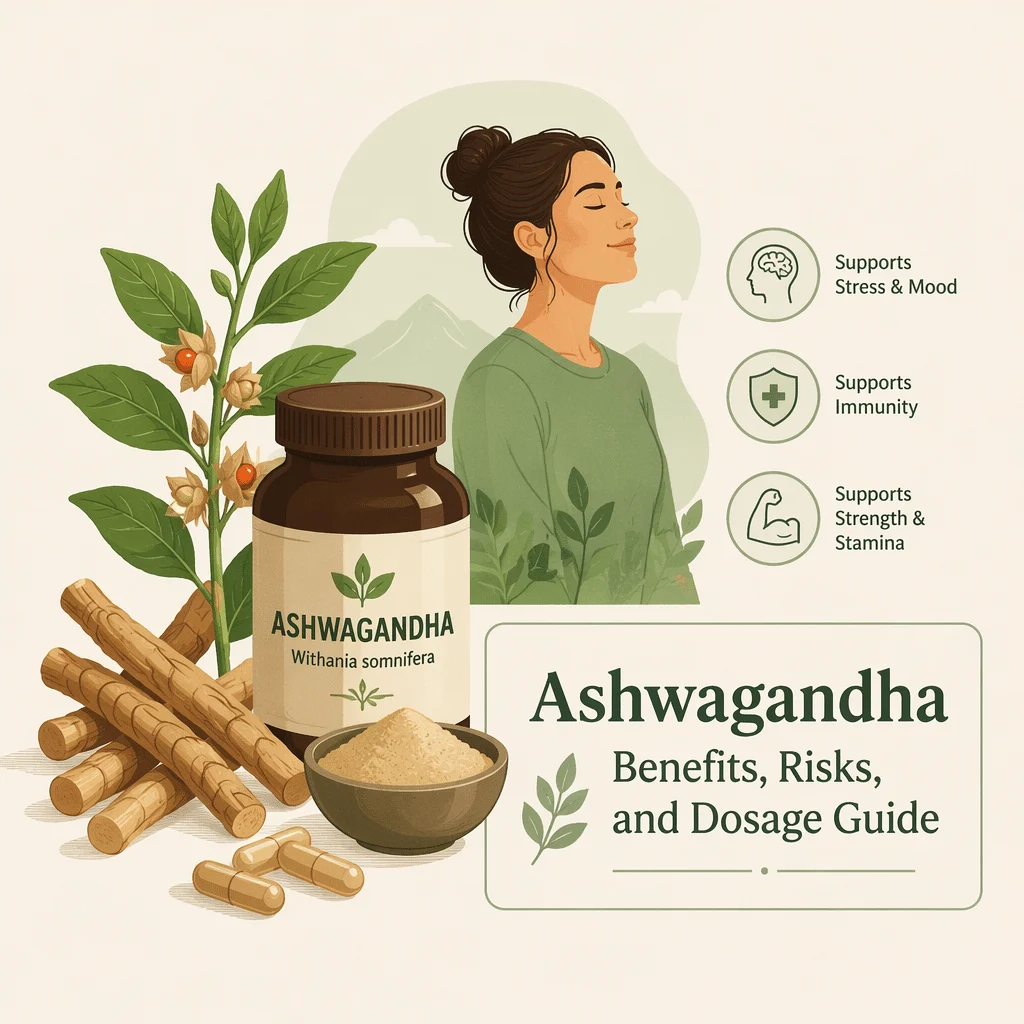
Ashwagandha benefits are promoted on thousands of supplement labels, in podcasts and in pharmacy aisles, usually with far more confidence than the research supports. Withania somnifera, the plant behind the name, has been used in traditional Ayurvedic practice for centuries, and modern trials have tested it for stress, sleep and anxiety. Some of those trials are encouraging. Most of them are also small, short, run with preparations that are not interchangeable with one another, and funded by the companies that sell the extract.
There is also a safety side that marketing rarely mentions: documented cases of liver injury, reports of thyroid overactivity, and a regulatory system in the United States that does not check supplements for safety or effectiveness before they reach the shelf. In this article you’ll learn what the evidence does and does not support, which warning signs matter, who is generally advised to avoid this herb, and which blood tests make an unexpected result far easier to interpret.
What ashwagandha is, and what “adaptogen” really means
Ashwagandha is the root of Withania somnifera, a small shrub grown mainly in India and parts of Africa. Supplements are made from powdered root, from concentrated root extracts, and sometimes from leaf material. The compounds most often measured are withanolides, a family of naturally occurring steroid-like molecules, and products are frequently labeled with a withanolide percentage.
The word adaptogen appears on almost every package. It is a traditional-medicine and marketing term, not a regulated pharmacological category. It suggests that a plant helps the body adapt to stress and return to balance, but no agency defines what a product must do to earn the label, and no test confirms it. Reading “adaptogen” on a box tells you nothing about the dose, the extract used, the strength of the evidence, or whether the product is safe for you specifically.
What the evidence actually shows for the main ashwagandha benefits
The table below is the short version. The sections that follow explain the reasoning behind each line.
| Claim | What the evidence actually shows | What to watch for |
|---|---|---|
| Lowers stress and cortisol | Several small trials report lower perceived-stress scores and lower cortisol over roughly one to three months, using different extracts and doses | No study has followed the stress hormone system beyond a few months |
| Improves sleep | Pooled reviews of a handful of small trials suggest modest gains, mainly in people with insomnia, with results that vary widely between studies | Daytime drowsiness, especially alongside sedatives |
| Reduces anxiety | Reviews describe a possible benefit but rate the evidence as inconsistent; US federal health information calls it unclear | A supplement is not treatment for an anxiety disorder |
| Raises testosterone or builds muscle | A few small, short studies in selected groups, often funded by the manufacturer; not enough for a confident claim | Marketing that runs far ahead of the data |
| Improves memory and focus | Preliminary; the studies are few, small, and use different cognitive tests that are hard to compare | Brain-benefit claims usually recycle the same few studies |
| “It is an adaptogen, so it is gentle” | Adaptogen is not a safety category; liver injury and thyroid effects are documented | The assumption that natural means harmless |
Stress and cortisol
This is the best-studied claim, and it is still modest. A 2023 systematic review in Nutrients gathered nine studies of stressed adults lasting between one and four months and found reductions in cortisol in most of them, while noting that the designs, the formulations and the doses differed so much that the results are hard to combine. None of those studies looked at what happens to the adrenal system over the longer term. Cortisol also moves through the day and reacts to sleep, illness and timing, so a single number is a snapshot rather than a verdict. Our team explains the cortisol blood test and what it actually measures, and a separate guide describes the symptoms and causes of high cortisol levels.
Sleep and anxiety
Reviews published in 2024 pooled small randomized trials on anxiety and insomnia and reported possible improvements, while flagging very high variability between studies and calling for larger, longer research. The National Center for Complementary and Integrative Health, part of the National Institutes of Health, sums it up carefully: some preparations may be helpful for insomnia and stress, and the evidence for anxiety is unclear. If anxiety is affecting your daily life, that is a conversation for a clinician rather than a supplement aisle. Our team covers the symptoms and causes of anxiety in a dedicated guide.
The weaker claims
Testosterone, muscle strength, athletic performance and cognition are where the gap between marketing and evidence is widest. The trials are few, small, short and often industry funded, and their results have not been reproduced at a scale that would justify confident statements. If you want to know where your own levels sit, a blood test answers that question directly; our team explains the testosterone blood marker and how it is interpreted.
Why the evidence behind ashwagandha benefits is weaker than it looks
Four structural problems recur across this literature, and they matter more than any single positive result.
- Size and length. Most trials enroll a few dozen participants for 8 to 12 weeks. That is enough to detect a short-term change in a questionnaire score, not enough to detect an uncommon harm such as liver injury.
- Extracts are not interchangeable. A branded, standardized root extract, a generic root powder and a leaf-containing product are different products with different chemistry. Evidence for one does not transfer to another, even at the same milligram dose.
- Funding and reporting. Many trials are sponsored by the company producing the extract, and reviews repeatedly note incomplete reporting of adverse events.
- Heterogeneity. When reviewers try to pool the studies statistically, the results disagree so strongly that the combined figure becomes hard to trust.
None of this proves ashwagandha does nothing. It means the honest answer to “does it work?” is “possibly, modestly, for stress and sleep, in the short term, with the specific extract that was tested” rather than a yes.
Ashwagandha and the liver: the safety signal that matters most
The LiverTox database maintained by the National Institutes of Health now carries a dedicated record for ashwagandha. It describes liver injury appearing typically two to twelve weeks after starting the supplement, usually with a cholestatic pattern, meaning the flow of bile is affected rather than the liver cells alone. Most people recover within one to four months of stopping. A minority do not, and severe cases requiring emergency transplant, or ending in death, have been reported.
A 2023 case series published in Hepatology Communications described eight people who developed liver injury while taking single-ingredient ashwagandha products. Chemical analysis of the products found no contamination or adulteration, which points to the herb itself rather than a tainted batch. Three of those patients already had underlying liver disease and did not survive. Separately, a 2024 analysis in JAMA Network Open estimated that millions of American adults take at least one potentially liver-toxic botanical in any given month, a scale of exposure comparable to common prescription medicines.
Warning signs that mean stop and call a clinician
- Unusual or persistent fatigue
- Nausea or loss of appetite
- Pain or discomfort in the upper right abdomen
- Dark urine or unusually pale stools
- Itching without a rash
- Yellowing of the eyes or skin
If any of these appear, stop the supplement and contact a clinician promptly. Tell them exactly what you were taking, including the brand and the dose, and bring the bottle if you can. This guide explains how to read a liver panel line by line.
Who appears to be most at risk
Existing liver disease, including fatty liver disease or cirrhosis, is the clearest risk factor in the published cases. Heavy alcohol use, other medicines or supplements that stress the liver, and stacking several herbal products at once all add to the load. Herbal and dietary supplements are now behind a substantial share of drug-induced liver injury cases recorded in US research networks, according to a 2024 review in Liver International.
Ashwagandha, the thyroid, and confusing test results
Ashwagandha can increase thyroid hormone activity. In someone with a healthy thyroid this may pass unnoticed, but it can tip a borderline or already overactive thyroid into thyrotoxicosis, a state of excess thyroid hormone that causes palpitations, weight loss, tremor, heat intolerance and anxiety. A 2024 case report in Cureus described a man in his forties who developed thyroid inflammation and thyrotoxicosis about two months after starting ashwagandha, and who recovered after stopping it. A 2025 review in Phytotherapy Research examined the herb’s possible effects on the thyroid, stress and reproductive hormone systems and concluded that the human data remain limited.
There is a practical consequence beyond symptoms. If your TSH drops or your free T4 rises while you are taking a supplement nobody knows about, the result can be misread, and you may be investigated or treated for a thyroid problem that is actually a supplement effect. Anyone already taking thyroid medication has a second issue: the doses may no longer match. We explain a low TSH level and what causes it, our guide sets out the normal thyroid reference ranges, and we also describe the free T4 test and how to read it.
Who is advised to avoid it, and what doses studies have used
People generally advised not to take ashwagandha
- Anyone who is pregnant or trying to conceive. The plant has a traditional reputation as an abortifacient. A 2025 systematic and ethnobotanical review in Phytotherapy Research found the historical claims poorly documented and the evidence inconclusive, which is a reason for caution rather than reassurance, and federal health information advises against use in pregnancy.
- Anyone breastfeeding.
- People with an autoimmune condition or taking immunosuppressant medication.
- People with a thyroid disorder, or taking thyroid hormone.
- People with liver disease of any kind.
- People with hormone-sensitive prostate cancer.
- Anyone with surgery scheduled, because of possible sedative effects; stopping well in advance is usually advised.
- People taking sedatives, anticonvulsants, diabetes medication or blood pressure medication, where interactions are plausible.
What doses studies have used
Published trials have generally used root extracts in the range of a few hundred milligrams per day, taken for 8 to 12 weeks, with a small number running to around three or four months. That is a description of what researchers did, not a recommendation. There is no established safe or effective dose, extracts are not standardized across brands and cannot be swapped milligram for milligram, and safety beyond a few months has not been established in humans. If you are considering ashwagandha, discuss it with your physician or pharmacist first, particularly if you take any other medication.
Quality, labeling and regulation
In the United States, dietary supplements are not approved before they are sold. The Food and Drug Administration states plainly that it has no authority to approve supplements for safety and effectiveness before marketing, and does not test them beforehand; its role is largely to act after a problem emerges. Independent testing has repeatedly found products whose contents do not match the label. A capsule labeled with a given withanolide percentage may contain more, less, or a different plant part entirely. A companion guide reviews the benefits and risks of cholesterol supplements, where the same regulatory gap applies.
Which lab tests help you and your clinician
Liver and thyroid tests are precisely what a clinician orders when a supplement is suspected of causing trouble. Knowing your baseline before you start anything makes an abnormal result far easier to interpret afterward, because the question becomes “has this changed?” rather than “is this normal for you?”.
- Liver panel: ALT, AST, alkaline phosphatase and bilirubin. A cholestatic pattern, where alkaline phosphatase and bilirubin rise more than the transaminases, is the picture most often described with ashwagandha.
- Thyroid panel: TSH and free T4, with free T3 if symptoms suggest an overactive thyroid.
Our team details the causes of a high ALT result, we also cover the AST normal range and what raises it, and a companion article explains the AST/ALT ratio and how to read it. Whatever you are taking, tell the clinician who ordered the test. Supplements are one of the most common missing pieces of information on a lab request.
Latest scientific advances
Research published since 2023 has shifted noticeably from asking what ashwagandha can do toward asking how safe it is.
The clearest development is on the liver. A case series from India, published in 2023, gathered eight people who developed liver injury on single-ingredient ashwagandha and, crucially, tested the products and found nothing added to them. What this means for you: the risk appears to come from the herb, so choosing a reputable brand does not remove it. In 2024, US researchers used a large national health survey to estimate how many adults are exposed to botanicals with known liver risk, and the figure ran into the millions each month. What this means for you: this is a common exposure, not a fringe one, which is exactly why clinicians now ask about supplements when liver tests come back abnormal.
A 2024 review of drug-induced liver injury noted that herbal and dietary supplements now account for roughly one in five cases identified in US research networks, with ashwagandha among the named agents. A critical review published in 2026 in Phytotherapy Research pulled together the reported adverse effects across laboratory and human studies, including digestive upset, allergic-type reactions, liver toxicity and hormonal effects such as thyroid overactivity, and called for standardized dosing and proper safety monitoring. These are reviews of accumulated reports rather than randomized trials, so they establish a pattern worth taking seriously rather than a precise risk figure.
On the benefit side, the picture has not changed much. Meta-analyses published in 2024 on stress, anxiety and insomnia found possible short-term improvements but described the underlying studies as small and highly variable, and a 2023 review of cortisol studies made the same point about differing formulations and durations. What this means for you: the most reasonable reading of the current science is a modest, uncertain short-term effect on stress and sleep, set against a small but real and documented risk to the liver and thyroid. That trade-off is worth discussing with your own clinician, who knows your history and your medications.
Glossary
| Term | Definition |
|---|---|
| Adaptogen | A traditional-medicine and marketing term for a plant said to help the body cope with stress. It is not a regulated category and carries no safety guarantee. |
| Withanolides | The steroid-like compounds found in Withania somnifera. Product labels often state a withanolide percentage, which brands use as a marker of strength. |
| Cholestatic liver injury | Liver damage in which the flow of bile is impaired. It typically causes itching, jaundice and a rise in alkaline phosphatase and bilirubin. |
| ALT (alanine aminotransferase) | An enzyme found mainly in liver cells. When those cells are damaged, ALT leaks into the blood and the measured level rises. |
| AST (aspartate aminotransferase) | An enzyme present in the liver but also in muscle and other tissues, usually interpreted alongside ALT rather than on its own. |
| Alkaline phosphatase (ALP) | An enzyme linked to the bile ducts and to bone. A marked rise points toward a problem with bile flow. |
| Bilirubin | A yellow pigment produced when red blood cells break down. When the liver cannot clear it, it builds up and the skin and eyes turn yellow. |
| Thyrotoxicosis | A state of excess thyroid hormone in the body, causing palpitations, tremor, weight loss, heat intolerance and anxiety. |
| TSH (thyroid-stimulating hormone) | The pituitary hormone that tells the thyroid how much to produce. It usually falls when thyroid hormone levels rise. |
| Standardized extract | An extract adjusted to contain a stated amount of a marker compound. Standardization differs between brands, so products are not interchangeable. |
Frequently asked questions
Do side effects go away after stopping ashwagandha?
Common complaints such as stomach upset, loose stools, nausea or drowsiness usually settle quickly once the supplement is stopped. Liver injury is different: published cases describe recovery over one to four months after stopping, and a minority of people do not recover fully. That is why the advice is to stop at the first sign of jaundice, dark urine, itching or unexplained fatigue and to have it assessed rather than waiting to see whether it passes on its own.
How quickly would a liver problem show up?
Not on day one. The reported cases cluster between two and twelve weeks after starting, and some appear several months in. Because the delay is long, people often do not connect the two events and may keep taking the supplement while symptoms build. If you start any new supplement, note the date, and mention it if you feel unwell in the weeks that follow.
Should I tell my doctor I take ashwagandha before a blood test?
Yes, and it genuinely changes how results are read. Ashwagandha can alter thyroid results and liver enzymes, so a clinician who does not know about it may investigate a thyroid or liver condition that is really a supplement effect. Bring the actual product or a photo of the label, because the brand, the plant part and the stated dose all matter more than the word ashwagandha alone.
Is ashwagandha safe to take long term?
Nobody knows. Federal health information describes it as possibly safe for short-term use of up to about three months, and that is simply the limit of what has been studied. Trials rarely run longer, so there is no reliable evidence about a year of daily use, and the delayed nature of the reported liver cases means longer exposure is exactly the situation least well documented.
Can I take ashwagandha with an antidepressant or a sleeping pill?
Discuss it with your prescriber or pharmacist before you do. Ashwagandha may add to the sedative effect of medicines that make you drowsy, including sleeping tablets, anti-anxiety drugs and anticonvulsants, and interactions are also plausible with diabetes and blood pressure medication. This is a conversation worth having in advance rather than a risk worth testing on yourself.
Does the form matter, powder, capsule or gummy?
It does, and not in a way you can judge from the shelf. Root powder, concentrated root extract and leaf-containing products differ chemically, and standardized branded extracts are not equivalent to generic powder at the same milligram figure. Gummies add sugar and often state a lower amount of actual extract. Since supplements are not verified before sale, the label is a claim rather than a measurement.
Sources
- National Institute of Diabetes and Digestive and Kidney Diseases — Ashwagandha, LiverTox: Clinical and Research Information on Drug-Induced Liver Injury, National Institutes of Health, 2024 — https://www.ncbi.nlm.nih.gov/books/NBK548536/
- National Center for Complementary and Integrative Health — Ashwagandha: Usefulness and Safety, National Institutes of Health — https://www.nccih.nih.gov/health/ashwagandha
- US Food and Drug Administration — Questions and Answers on Dietary Supplements — https://www.fda.gov/food/information-consumers-using-dietary-supplements/questions-and-answers-dietary-supplements
- Cleveland Clinic — Benefits of Ashwagandha and How Much To Take — https://health.clevelandclinic.org/what-is-ashwagandha
- Philips CA et al. — Ashwagandha-induced liver injury: a case series from India and literature review — Hepatology Communications, 2023 — https://doi.org/10.1097/HC9.0000000000000270
- Likhitsup A, Chen VL, Fontana RJ — Estimated exposure to 6 potentially hepatotoxic botanicals in US adults — JAMA Network Open, 2024 — https://doi.org/10.1001/jamanetworkopen.2024.25822
- Halegoua-DeMarzio D, Navarro V — Challenges in herbal-induced liver injury identification and prevention — Liver International, 2024 — https://doi.org/10.1111/liv.16071
- Kumar A et al. — Potential adverse effects of ashwagandha: a critical review of preclinical and clinical evidence — Phytotherapy Research, 2026 — https://doi.org/10.1002/ptr.70158
- Arumugam V et al. — Effects of ashwagandha (Withania somnifera) on stress and anxiety: a systematic review and meta-analysis — Explore, 2024 — https://doi.org/10.1016/j.explore.2024.103062
- Fatima K et al. — Safety and efficacy of Withania somnifera for anxiety and insomnia: systematic review and meta-analysis — Human Psychopharmacology, 2024 — https://doi.org/10.1002/hup.2911
- Della Porta M, Maier JA, Cazzola R — Effects of Withania somnifera on cortisol levels in stressed human subjects: a systematic review — Nutrients, 2023 — https://doi.org/10.3390/nu15245015
- Hayashi M et al. — Painless thyroiditis by Withania somnifera (ashwagandha) — Cureus, 2024 — https://doi.org/10.7759/cureus.55352
- Vollmer G, Brendler T — Evaluation of potential hormonal activities of ashwagandha (Withania somnifera) — Phytotherapy Research, 2025 — https://doi.org/10.1002/ptr.70155
- Tallon MJ, Koturbash I, Blum JL — A systematic and ethnobotanical review of ashwagandha’s teratogenic and abortifacient potentials — Phytotherapy Research, 2025 — https://doi.org/10.1002/ptr.70079
Further reading
- High TSH symptoms explained: causes and risks
- Free T3: understanding this thyroid marker
- Hypothyroidism: symptoms, diagnosis and treatments
- Low morning cortisol: causes, symptoms and treatments
- Magnesium deficiency: symptoms, causes and treatments
Understand your lab results with AI DiagMe
If you take ashwagandha, or any supplement, the questions that matter show up on a lab report: are the liver enzymes ALT and AST steady, is alkaline phosphatase or bilirubin creeping up, has TSH or free T4 shifted since last year? AI DiagMe turns those numbers into clear explanations you can actually use, including what is within range and what deserves a follow-up. It helps you understand your results and prepare better questions; it does not diagnose and it does not replace your doctor.
Get your results interpreted in minutes