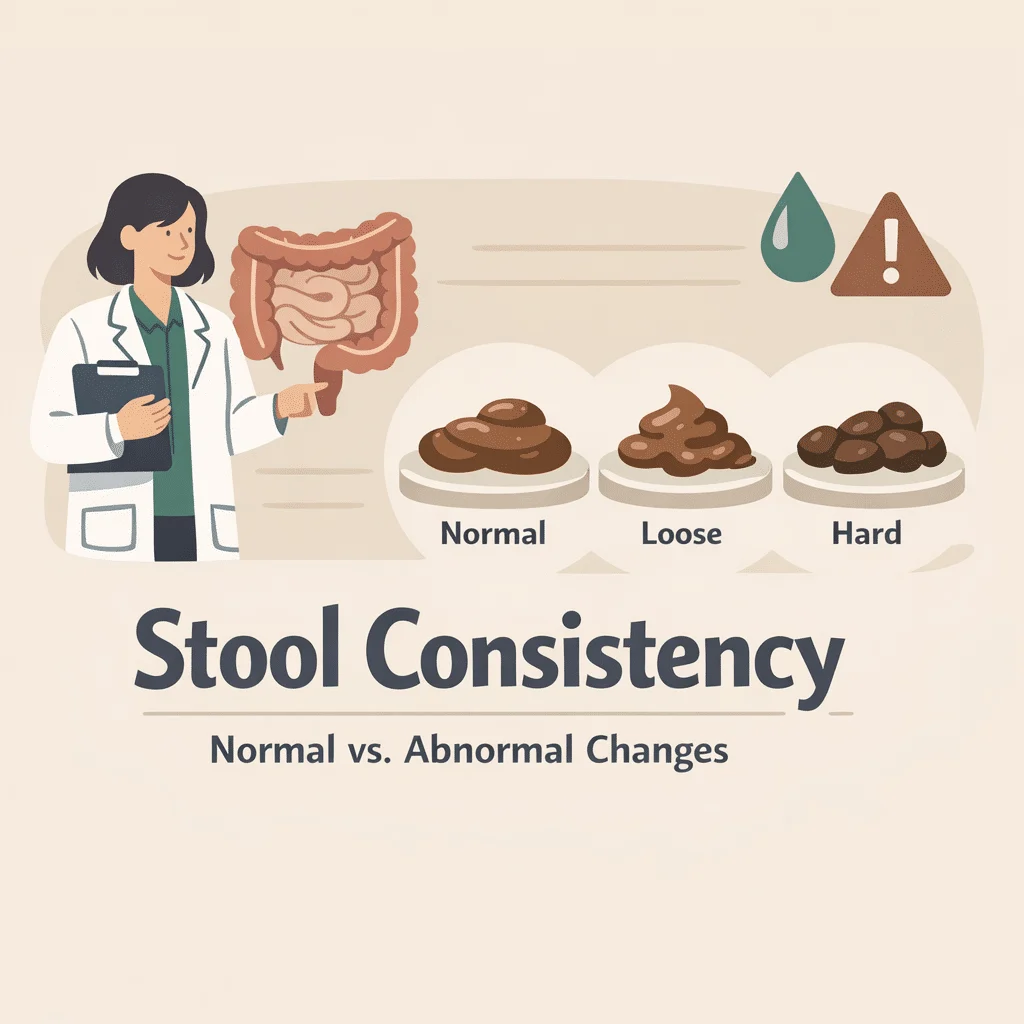
Die Stuhlkonsistenz ist eines der wenigen Gesundheitssignale, die Sie ohne Labor ablesen können – und sie verändert sich weit häufiger, als die meisten Menschen erwarten. Die Beschaffenheit des Stuhlgangs spiegelt wider, wie lange der Darminhalt im Dickdarm verblieben ist und wie viel Wasser der Dickdarm dabei wieder aufgenommen hat. Inhalt, der schnell passiert, bleibt weich; Inhalt, der lange verweilt, wird fest und schwer auszuscheiden. Beides kann an einem bestimmten Tag völlig normal sein. In diesem Artikel erfahren Sie, was die Bristol-Stuhlformen-Skala tatsächlich misst, wie ein normaler Bereich für Häufigkeit und Konsistenz aussieht, welche Lebensmittel, Flüssigkeiten, Medikamente und Lebensereignisse die Beschaffenheit beeinflussen, wie lange eine Veränderung anhalten sollte, bevor sie Aufmerksamkeit verdient, und wie Sie das Beobachtete einem Arzt beschreiben können.
Was die Stuhlkonsistenz wirklich misst
Wenn Nahrungsreste den Dickdarm erreichen, sind sie flüssig. Die Hauptaufgabe des Dickdarms besteht darin, Wasser und Elektrolyte zurückzugewinnen und die Rückstände zu einem geformten Stuhl zu verdichten. Das National Institute of Diabetes and Digestive and Kidney Diseases formuliert es klar: Der Dickdarm nimmt Wasser auf und wandelt die flüssigen Abfallstoffe in Stuhl um.
Dieser eine Mechanismus erklärt fast alles über die Stuhlkonsistenz. Je länger der Darminhalt mit der Dickdarmwand in Kontakt bleibt, desto mehr Wasser wird entzogen und desto fester wird das Ergebnis. Beschleunigt sich die Passage, wird weniger Wasser aufgenommen, sodass der Stuhl weich, breiig oder wässrig ankommt. Die Konsistenz ist daher ein grober Hinweis auf die Transitzeit – keine Erkrankung an sich.
Wie lange eine normale Darmpassage dauert
Die Mayo Clinic beschreibt, dass Nahrung etwa sechs Stunden benötigt, um durch den Magen und den Dünndarm zu gelangen. Die anschließende Passage durch den Dickdarm kann bis zu 36 bis 48 Stunden dauern. Dieses breite Zeitfenster ist normal – und erklärt auch, warum eine späte Mahlzeit, ein vergessenes Glas Wasser oder ein Reisetag den Stuhl am nächsten Morgen sichtbar verändern können.
Warum die Konsistenz als Signal aussagekräftiger ist als die Häufigkeit
Forscher vergleichen seit Jahrzehnten das Stuhlverhalten mit der gemessenen Darmpassagezeit. Die Originalarbeit hinter der Bristol-Stuhlformen-Skala, 1997 von Lewis und Heaton veröffentlicht, zeigte, dass die Stuhlform die Darmpassagezeit so eng widerspiegelt, dass sie als praktischer Ersatzwert dafür verwendet werden kann. Eine spätere Studie von Saad und Kollegen bestätigte, dass die Stuhlform mit der Gesamt- und Dickdarmpassagezeit korreliert, während die Häufigkeit des Stuhlgangs weit weniger aussagekräftig ist. In der Praxis verrät das Aussehen des Stuhls einem Arzt mehr als die Anzahl der Stuhlgänge pro Woche.
Die Bristol-Stuhlformen-Skala, Typ für Typ
Die Bristol-Stuhlformen-Skala unterteilt den Stuhlgang in sieben Typen – von harten Kügelchen bis hin zu vollständig flüssigem Stuhl. Sie ist die am weitesten verbreitete Kurzform zur Beschreibung der Stuhlkonsistenz in Kliniken und der Forschung und gibt Ihnen eine Zahl, die Sie angeben können, anstatt eine vage Beschreibung zu liefern. Die Cleveland Clinic fasst die Typen 1 und 2 als Verstopfung zusammen, die Typen 3 und 4 als idealen Bereich und die Typen 5 bis 7 als Tendenz zu Durchfall.
| Typ | So sieht es aus | Was dies üblicherweise über die Transitzeit aussagt |
|---|---|---|
| Typ 1 | Einzelne harte Klümpchen, wie kleine Kieselsteine, schwer auszuscheiden | Darminhalt verblieb sehr lange im Dickdarm; deutlich verlangsamte Transitzeit |
| Typ 2 | Wurstförmig, aber mit Klumpen entlang der Oberfläche | Langsame Passage; typisches Bild bei leichter Verstopfung |
| Typ 3 | Wurstförmig mit Rissen auf der Oberfläche | Klar im Normalbereich |
| Typ 4 | Glatt und weich, geformt wie eine Wurst oder eine Schlange | Normale Passage; die Form, die am häufigsten als ideal beschrieben wird |
| Typ 5 | Weiche Klümpchen mit klar abgegrenzten Rändern, leicht auszuscheiden | Leicht beschleunigte Passage; häufig bei geringer Ballaststoffzufuhr |
| Typ 6 | Flockige Stücke mit unregelmäßigen Rändern, insgesamt breiig | Schnelle Passage; der Dickdarm hatte kaum Zeit, Wasser zurückzugewinnen |
| Typ 7 | Wässrig, vollständig flüssig, ohne feste Bestandteile | Sehr schnelle Transitzeit; klassischer Durchfall |
Die Skala nutzen, ohne sie zu überinterpretieren
Die Skala ist eine Beschreibung, keine Diagnose. Ein einzelner Typ 6 am Morgen nach einem üppigen Restaurantbesuch bedeutet wenig; eine Reihe von Typ-6-Morgen über drei Wochen hinweg hingegen schon. Die Skala verdichtet außerdem viele Informationen in einer einzigen Zahl, und Forscher haben darauf hingewiesen, dass die Konsistenz physikalische Eigenschaften besitzt – wie Wassergehalt und Festigkeit –, die ein siebenstufiges Bilddiagramm nicht vollständig erfassen kann. Betrachten Sie Ihre Typ-Nummer als nützliche Zusammenfassung, die ein Gespräch einleitet, nicht als endgültiges Urteil.
Was normale Stuhlfrequenz und -konsistenz bedeuten
Es gibt keine einzig richtige Anzahl von Stuhlgängen. Der allgemein genannte Normalbereich liegt bei etwa drei Mal täglich bis etwa drei Mal pro Woche, und die meisten Menschen finden ihren eigenen stabilen Rhythmus. Das National Institute of Diabetes and Digestive and Kidney Diseases definiert Verstopfung als weniger als drei Stuhlgänge pro Woche, betont jedoch auch, dass Menschen unterschiedliche Muster haben können und dass nur Sie selbst wissen, was für Sie normal ist.
Dieser letzte Punkt ist wichtiger als die Durchschnittswerte. Eine Person, die zuverlässig jeden zweiten Tag einen Typ-4-Stuhl hat, leidet nicht an Verstopfung. Eine Person, die normalerweise zweimal täglich zur Toilette geht und plötzlich nur noch zweimal pro Woche, hat sich verändert – auch wenn beide Werte innerhalb des veröffentlichten Normalbereichs liegen. Ihr persönlicher Ausgangswert ist der Referenzwert, der zählt.
Ein kurzer Hinweis zur Farbe
Braun ist die erwartete Farbe, die durch den Abbau von Gallenfarbstoffen entsteht. Grün bedeutet häufig nur eine schnelle Passage oder einen hohen Verzehr von Blattgemüse. Dunkle Flecken sind oft Nahrungsreste und kein Grund zur Sorge. Ein Ratgeber erläutert schwarze Punkte im Stuhl und ihre mögliche Bedeutung. Zwei Farbveränderungen erfordern zeitnahe ärztliche Abklärung statt abwartendem Beobachten: sichtbares Blut oder ein schwarz-teeriges Aussehen sowie anhaltend blasser, fettiger Stuhl. Ein separater Artikel beschreibt Ursachen von Blut im Stuhl, Symptome und wann Sie ärztliche Hilfe suchen sollten, und ein weiterer Ratgeber erläutert Ursachen von fettigem Stuhl, Symptome und Behandlungsmöglichkeiten.
Was die Stuhlkonsistenz von Tag zu Tag beeinflusst
Ballaststoffe und Flüssigkeit
Ballaststoffe verändern die Stuhlkonsistenz auf zwei gegensätzliche Arten – weshalb der allgemeine Rat, mehr Ballaststoffe zu essen, manchmal enttäuscht. Unlösliche Ballaststoffe, die in Weizenkleie, Gemüseschalen und Nüssen vorkommen, erhöhen das Stuhlvolumen und beschleunigen die Darmpassage. Lösliche und viskose Ballaststoffe, die in Hafer, Flohsamenschalen, Gerste und Hülsenfrüchten enthalten sind, binden Wasser im Stuhl und machen ihn weicher und leichter passierbar. Bei hartem Stuhl vom Typ 1 oder Typ 2 sind meist die viskosen, wasserbindenden Ballaststoffe hilfreicher.
Flüssigkeit ergänzt die Wirkung von Ballaststoffen, ersetzt sie aber nicht. Ballaststoffe können den Stuhl nur dann aufweichen, wenn genügend Wasser vorhanden ist, das sie binden können. Deshalb kann eine erhöhte Ballaststoffzufuhr bei gleichzeitig zu geringer Flüssigkeitsaufnahme den Stuhl eher härter als weicher machen. Starke Flüssigkeitsverluste kippen die Konsistenz in die andere Richtung und können auch den Kreislauf beeinflussen; ein weiterer Artikel behandelt Dehydration und ihre Auswirkung auf den Blutdruck.
Medikamente
Medikamente gehören zu den häufigsten und am häufigsten übersehenen Ursachen für eine veränderte Stuhlkonsistenz. Der Effekt tritt meist innerhalb weniger Tage nach Beginn oder Absetzen eines Medikaments auf – der zeitliche Zusammenhang lässt sich daher leicht anhand eines Tagebuchs nachvollziehen.
| Medikament | Übliche Auswirkung auf die Stuhlkonsistenz |
|---|---|
| Opioid-Schmerzmittel | Verlangsamen die Darmtätigkeit deutlich und führen zu hartem Stuhl vom Typ 1 bis Typ 2 |
| Orales Eisenpräparat | Festerer, dunklerer Stuhl; gelegentlich auch weicher Stuhl |
| Antazida mit Aluminiumgehalt | Neigen dazu, den Stuhl zu festigen und die Passage zu verlangsamen |
| Antazida mit Magnesiumgehalt | Ziehen Wasser in den Darm und lockern den Stuhl auf |
| Antibiotika | Lockern den Stuhl häufig durch Störung der Darmflora; Verstopfung kommt ebenfalls vor |
| Metformin | Verursacht häufig weicheren, drängenderen Stuhlgang, besonders zu Beginn |
Antibiotika verdienen eine eigene Erwähnung, da sie in beide Richtungen wirken können. Ein Artikel untersucht Antibiotika und Verstopfung: Ursachen und Behandlung. Wenn weicher Stuhl während oder nach einer Antibiotika-Behandlung stark oder anhaltend wird, muss eine spezifische Infektion ausgeschlossen werden – eine weitere Seite erklärt der C.-diff-Toxin-Test und wie Sie seine Ergebnisse lesen.
Reisen, Alltagsroutine und der Menstruationszyklus
Reisen wirkt auf den Darm über mehrere Wege gleichzeitig ein: andere Ernährung, anderes Wasser, gestörter Schlaf, weniger Bewegung auf langen Reisen und eine Toilettenroutine, die sich nicht einhalten lässt. Verstopfung auf der Hinreise und lockerere Stühle nach einigen Tagen sind beide häufig. Anhaltend lockere Stühle nach einer Reise – insbesondere nach dem Konsum von unbehandeltem Wasser oder einem Aufenthalt in einer Risikoregion – sind das eine Muster, das untersucht werden sollte, anstatt abzuwarten. Unsere Bibliothek erklärt den Stuhltest auf Eier und Parasiten und wie Sie seine Ergebnisse lesen.
Der Menstruationszyklus führt bei vielen Menschen zu einem vorhersehbaren, harmlosen Schwankungsmuster. Ansteigende Prostaglandine zu Beginn der Periode verstärken die Darmkontraktionen, sodass der Stuhl für ein bis zwei Tage weicher wird, während die progesterondominante Phase davor den Darm eher verlangsamt. Wir behandeln außerdem Durchfall während der Periode: Ursachen, Symptome und Behandlung ausführlich.
Stress und die Darm-Hirn-Achse
Der Darm verfügt über ein eigenes dichtes Nervensystem, das über bidirektionale Signalwege – oft als Darm-Hirn-Achse bezeichnet – mit dem Gehirn verbunden ist. Akuter Stress beschleunigt bei vielen Menschen die Darmpassage, weshalb Prüfungen, Deadlines und schlechte Nachrichten zu plötzlichem, lockerem Stuhlgang führen können. Anhaltender Stress kann das Muster in beide Richtungen verschieben. Wenn abwechselnd lockerer und harter Stuhlgang mit Bauchschmerzen auftreten, die nach dem Stuhlgang nachlassen, könnte dies auf eine funktionelle Störung hinweisen – unsere Bibliothek erklärt Reizdarmsyndrom und wie man damit umgeht.
Wie lange eine Veränderung anhalten sollte, bevor sie ernst genommen werden muss
Die meisten Veränderungen der Stuhlkonsistenz klingen innerhalb weniger Tage ab, sobald der Auslöser wegfällt. Eine praktische Faustregel lautet: Dauer und Richtung gemeinsam betrachten. Eine Veränderung, die weniger als eine Woche anhält, eine offensichtliche Erklärung hat und von selbst verschwindet, bedarf selten einer Abklärung. Eine Veränderung, die länger als zwei bis vier Wochen anhält, keinen erkennbaren Auslöser hat oder sich zunehmend verstärkt, sollte ärztlich beurteilt werden – auch wenn keine Schmerzen bestehen.
Einige Befunde sollten nicht auf sich warten lassen. Sichtbares Blut im Stuhl, schwarzer teerartiger Stuhl, unerklärlicher Gewichtsverlust, Fieber, Stuhlgang, der Sie nachts aufweckt, eine neue und anhaltende Veränderung der Stuhlgewohnheiten nach dem 45. Lebensjahr oder eine familiäre Vorbelastung mit Darmerkrankungen – all das rechtfertigt eine frühzeitige ärztliche Abklärung. Dies ist eine allgemeine Übersicht und keine diagnostische Untersuchung: Die ausführliche Beurteilung von Blutungen finden Sie in einem eigenen Leitfaden.
Wenn hinter wochenlangem lockerem Stuhlgang eine Entzündung vermutet wird, kann ein Stuhltest helfen, eine entzündliche Darmerkrankung von einem funktionellen Muster zu unterscheiden. Ein weiterer Artikel behandelt Ergebnisse des fäkalen Calprotectin-Tests und was die Werte bedeuten. Wenn eine Infektion vermutet wird, beschreibt eine weitere Seite den Stuhlkulturtest und was er nachweist.
Wie Sie Ihren Stuhlgang einem Arzt beschreiben
Kliniker sind vage Antworten gewohnt – und vage Antworten verzögern die Diagnose. Eine genaue Beschreibung der Stuhlkonsistenz kostet Sie nichts und verkürzt oft den Weg zur Erklärung. Fünf Details leisten dabei die meiste Arbeit.
- Die Bristol-Typ-Nummer oder eine kurze Beschreibung, falls Sie die Skala lieber nicht verwenden möchten.
- Wie häufig Sie derzeit Stuhlgang haben, verglichen mit Ihrem üblichen Muster vor der Veränderung.
- Wann es begann und ob es dauerhaft oder wiederkehrend ist.
- Begleitende Beschwerden: Stuhldrang, Pressen, Schmerzen, Blähungen, nächtliches Aufwachen, Blut, Schleim, fettige Konsistenz.
- Was sich ungefähr zur gleichen Zeit verändert hat: ein neues Medikament, eine Reise, eine Ernährungsumstellung, eine Erkrankung oder eine stressreiche Phase.
Ein kurzes Stuhltagebuch führen
Ein Tagebuch mit einer Zeile pro Tag, das über zwei Wochen geführt wird, ist aussagekräftiger als der Versuch, vier Wochen Stuhlgewohnheiten in einer Konsultation aus dem Gedächtnis zu rekonstruieren. Notieren Sie das Datum, den Bristol-Typ, die Anzahl der Stuhlgänge, alles Sichtbare in der Schüssel sowie ein Stichwort für alles Ungewöhnliche an diesem Tag – etwa ein neues Medikament, ein Restaurantbesuch oder ein langer Flug. Muster, die im Gedächtnis unsichtbar bleiben, treten auf Papier schnell zutage. Ein Tagebuch ist der einfachste Weg, einem Arzt zu zeigen, ob sich Ihre Stuhlkonsistenz wirklich verändert hat oder sich nur anders angefühlt hat.
Neueste wissenschaftliche Fortschritte
Die Forschung zur Stuhlkonsistenz hat sich in den letzten drei Jahren rasch weiterentwickelt – vor allem in zwei Richtungen: die Bestätigung, dass die Bristol-Skala tatsächlich das misst, was sie messen soll, und die Frage, welche Ernährungsumstellungen die Stuhlform zuverlässig verändern.
Die Bristol-Skala wurde mit modernen Abbildungen neu validiert
Eine Validierungsstudie aus dem Jahr 2025 überarbeitete die Skala mit neuen Abbildungen und prüfte, ob Menschen ihre Stühle damit einheitlich einordnen. Die Bilder schnitten gut ab und bestätigen den weiteren Einsatz der Skala als selbst berichtetes Maß. Was das für Sie bedeutet: Die Typnummer, die Sie anhand einer Tabelle im Wartezimmer oder in einer App angeben, ist eine verlässliche Beschreibung dessen, was ein Arzt dokumentieren würde – es lohnt sich also, sie zu verwenden.
Ballaststoffe machen den Stuhl weicher – aber die Art des Ballaststoffs entscheidet, wie stark
Ein systematischer Review aus dem Jahr 2026, der mehr als hundert randomisierte Studien an Menschen mit normaler Darmfunktion zusammenfasste, untersuchte, wie die Ballaststoffzufuhr die Stuhlmenge und -form beeinflusst. Ergänzend dazu verglichen zwei Netzwerk-Metaanalysen aus dem Jahr 2026 – eine Methode, die mehrere Behandlungen anhand der kombinierten Studienlage miteinander vergleicht – verschiedene Ernährungsinterventionen bei chronischer Verstopfung. Viskose lösliche Ballaststoffe, also die wasserbindende Art, die in Flohsamenschalen und Hafer vorkommt, schnitten bei der Verbesserung der Stuhlkonsistenz am besten ab. Was das für Sie bedeutet: Wenn Ihr Stuhl hart ist, ist der Wechsel zu viskosen löslichen Ballaststoffen bei gleichzeitig ausreichender Flüssigkeitszufuhr ein besser belegter erster Schritt als einfach mehr Kleie hinzuzufügen.
Die Stuhlkonsistenz kann sich verbessern, bevor die Häufigkeit abnimmt
Eine Übersichtsarbeit aus dem Jahr 2023, die Studien zu Ballaststoffen und Probiotika auswertete, stellte fest, dass diese Maßnahmen den Stuhl weicher machten und den Bristol-Wert in Richtung Skalenmitte verschoben, ohne die Stuhlhäufigkeit zuverlässig zu verändern. Dieselbe Arbeit berichtete, dass die Zusammensetzung der Darmbakterien einer Person vor Beginn der Behandlung dabei half vorherzusagen, wer ansprach. Was das für Sie bedeutet: Wenn Sie ein Ballaststoffpräparat einnehmen und der Stuhl leichter abgeht, ohne dass sich die Häufigkeit ändert, ist das ein echter Fortschritt und kein Misserfolg – es lohnt sich, mehrere Wochen durchzuhalten.
Die Stuhlkonsistenz ist eines der aussagekräftigsten Signale in Darmmikrobiom-Studien
Eine 2015 veröffentlichte und seitdem wiederholt bestätigte Studie zeigte, dass die Stuhlkonsistenz eng mit der Vielfalt und Zusammensetzung der Darmbakterien zusammenhängt und bei jeder Mikrobiom-Analyse berücksichtigt werden muss. Was das für Sie bedeutet: Kommerzielle Darmmikrobiom-Berichte, die Ihre Stuhlkonsistenz nicht einbeziehen, werten eine Probe aus, deren Bakterienprofil zum Teil allein durch die Transitzeit erklärt wird – interpretieren Sie solche Ergebnisse daher mit Vorsicht.
Die Skala hat bekannte Grenzen
Eine Analyse aus dem Jahr 2019 argumentierte, dass die Stuhlkonsistenz messbare physikalische Eigenschaften hat, die eine siebenstufige Bildskala nur unvollständig erfasst, und forderte objektivere Messmethoden in der Forschung. Was das für Sie bedeutet: Der Bristol-Typ ist ein ausgezeichneter Gesprächseinstieg, aber kein präzises Messinstrument. Anhaltende Beschwerden erfordern nach wie vor eine klinische Untersuchung und nicht nur eine Zahl.
Glossar
| Begriff | Definition |
|---|---|
| Bristol-Stuhlformen-Skala | Eine siebenstufige Skala, die den Stuhl nach Form und Konsistenz einteilt – von harten, einzelnen Klümpchen bis hin zu vollständig flüssigem Stuhl. |
| Transitzeit | Die Zeit, die Nahrungsreste benötigen, um vom Mund bis zur Toilette zu gelangen. Die Gesamtdarmpassage umfasst den gesamten Weg. |
| Dickdarm | Der Dickdarm, in dem Wasser und Elektrolyte rückresorbiert und flüssige Rückstände zu Stuhl verdichtet werden. |
| Lösliche Ballaststoffe | Ballaststoff, der sich in Wasser löst und ein Gel bildet, das Wasser im Stuhl bindet. Enthalten in Hafer, Flohsamenschalen, Gerste und Hülsenfrüchten. |
| Unlösliche Ballaststoffe | Ballaststoff, der sich nicht löst und das Stuhlvolumen erhöht, wodurch die Passage durch den Darm beschleunigt wird. Enthalten in Weizenkleie, Schalen und Nüssen. |
| Darmmikrobiom | Die Gemeinschaft aus Bakterien und anderen Mikroorganismen im Darm, die sich je nach Ernährung, Medikamenten und Transitzeit verändert. |
| Darm-Hirn-Achse | Die bidirektionale Kommunikation zwischen dem Verdauungstrakt und dem Gehirn, durch die Stress die Darmtätigkeit beeinflussen kann. |
| Steatorrhö | Stuhl mit übermäßigem Fettgehalt, typischerweise blass, voluminös, fettig und schwer zu spülen. |
| Osmotischer Effekt | Der Einstrom von Wasser in den Darm durch schlecht resorbierte Substanzen wie Magnesiumsalze oder bestimmte Süßungsmittel. |
| Stuhltagebuch | Ein kurzes tägliches Protokoll über Stuhlgang, Stuhlform und mögliche Auslöser, das geführt wird, um einem Arzt ein genaues Muster zu zeigen. |
Häufig gestellte Fragen
Ist Typ 6 normal?
Ein gelegentlicher Typ-6-Stuhl – breiig mit unregelmäßigen Rändern – ist häufig und spiegelt meist nichts weiter als einen Tag mit schneller Darmpassage wider, etwa nach einer üppigen Mahlzeit, viel Kaffee, einem stressigen Morgen oder einem neuen Medikament. Er wird erst dann beachtenswert, wenn er zur Regel statt zur Ausnahme wird. Wenn die meisten Ihrer Stühle seit mehr als zwei bis vier Wochen vom Typ 6 sind oder wenn die Veränderung mit Gewichtsverlust, Blut, nächtlichen Beschwerden oder Fieber einhergeht, wenden Sie sich an einen Arzt, anstatt Ihre Ernährung eigenständig anzupassen.
Was bedeutet ein Stuhltyp 4?
Typ 4 ist der glatte, weiche, wurstförmige Stuhl, der ohne Pressen abgeht – er gilt als ideal, weil er in der Mitte des Transitbereichs liegt. Er deutet darauf hin, dass der Dickdarm ungefähr die richtige Zeit hatte, Wasser rückzuresorbieren. Typ 3 ist ebenso akzeptabel. Meistens die Typen 3 und 4 anzustreben ist ein sinnvolles praktisches Ziel, aber niemand hat jeden einzelnen Tag denselben Stuhltyp.
Wie oft sollte ich Stuhlgang haben?
Etwa drei Mal täglich bis etwa drei Mal pro Woche gilt als normaler Bereich, wobei Ihr persönlicher Rhythmus wichtiger ist als der Durchschnitt. Das National Institute of Diabetes and Digestive and Kidney Diseases definiert weniger als drei Stuhlgänge pro Woche als Verstopfung und weist darauf hin, dass die Muster von Person zu Person unterschiedlich sind. Ein stabiler Rhythmus mit weichem, leicht abzusetzendem Stuhl ist beruhigender als jede bestimmte Häufigkeit.
Kann mehr Trinken die Stuhlkonsistenz verändern?
Wasser allein verändert einen harten Stuhl selten, wenn die Ballaststoffzufuhr gering ist, da der Dickdarm frei verfügbares Wasser effizient rückresorbiert. Flüssigkeit wirkt am besten in Kombination mit löslichen Ballaststoffen, die das Wasser im Stuhl halten, wo es gebraucht wird. Wenn Sie die Ballaststoffzufuhr erhöhen, ist es wichtig, gleichzeitig mehr zu trinken, da Ballaststoffe ohne ausreichend Flüssigkeit den Stuhl verhärten können. Starkes Schwitzen, Fieber oder Erbrechen erhöhen Ihren Flüssigkeitsbedarf spürbar.
Warum verändert sich meine Stuhlkonsistenz von Tag zu Tag?
Tägliche Schwankungen sind normal und spiegeln wider, wie viel Ballaststoffe und Flüssigkeit Sie zu sich genommen haben, wie viel Sie sich bewegt haben, wie gut Sie geschlafen haben, wo Sie sich in Ihrem Menstruationszyklus befanden (falls zutreffend), Ihr Stressniveau und etwaige Medikamente, die Sie eingenommen haben. Jeder dieser Faktoren beeinflusst die Transitzeit, und die Transitzeit bestimmt den Wassergehalt des Stuhls. Schwankungen im Laufe einer Woche sind zu erwarten; eine anhaltende Veränderung in eine Richtung über mehrere Wochen hinweg ist das Muster, das Beachtung verdient.
Wie lange sollte ich ein Stuhltagebuch führen, bevor ich einen Arzt aufsuche?
Zwei Wochen reichen in der Regel aus, um ein Muster zu erkennen, ohne zur Belastung zu werden. Notieren Sie das Datum, den Bristol-Typ, die Anzahl der Stuhlgänge und alles Ungewöhnliche an diesem Tag. Wenn zu irgendeinem Zeitpunkt Warnsignale auftreten – wie sichtbares Blut, schwarzer teerartiger Stuhl, unerklärlicher Gewichtsverlust oder starke Schmerzen – warten Sie nicht die zwei Wochen ab, bevor Sie ärztlichen Rat suchen.
Quellen
- Cleveland Clinic — Bristol-Stuhlformen-Skala: Typen und ihre Bedeutung — my.clevelandclinic.org
- National Institute of Diabetes and Digestive and Kidney Diseases — Ihr Verdauungssystem und seine Funktionsweise — niddk.nih.gov
- National Institute of Diabetes and Digestive and Kidney Diseases — Definition und Fakten zur Verstopfung — niddk.nih.gov
- Mayo Clinic — Verdauung: Wie lange dauert sie? — mayoclinic.org
- Lewis SJ, Heaton KW — Stool form scale as a useful guide to intestinal transit time — Scandinavian Journal of Gastroenterology, 1997 — consensus.app
- Saad RJ, Rao SSC, Koch KL, et al. — Do stool form and frequency correlate with whole-gut and colonic transit? — American Journal of Gastroenterology, 2010 — consensus.app
- Vandeputte D, Falony G, Vieira-Silva S, et al. — Stool consistency is strongly associated with gut microbiota richness and composition, enterotypes and bacterial growth rates — Gut, 2015 — consensus.app
- Vork L, Wilms E, Penders J, Jonkers DMAE — Stool consistency: looking beyond the Bristol Stool Form Scale — Journal of Neurogastroenterology and Motility, 2019 — consensus.app
- Dekimeche O, et al. — Iconographic validation of the Bristol Stool Form Scale — French Journal of Urology, 2025 — consensus.app
- Balk EM, et al. — Fiber intake and laxation in people with normal bowel function: a systematic review — American Journal of Clinical Nutrition, 2026 — consensus.app
- Mou Y, et al. — Efficacy of dietary interventions for functional constipation: a network meta-analysis — American Journal of Clinical Nutrition, 2026 — consensus.app
- Mou Y, et al. — Efficacy of different dietary fibers for chronic idiopathic constipation: a network meta-analysis — Food and Function, 2026 — consensus.app
- Lai H, et al. — Effects of dietary fibers or probiotics on functional constipation symptoms and roles of gut microbiota — Gut Microbes, 2023 — pubmed.ncbi.nlm.nih.gov
Weiterführende Literatur
- Morbus Crohn: Ursachen, Symptome und Behandlung
- Darmkrebs: Ursachen, Symptome und Behandlungsmöglichkeiten
- Zöliakie und Glutenunverträglichkeit einfach erklärt
- Durchfall nach dem Fasten: Ursachen und Behandlung
- Elektrolytpanel: Natrium, Kalium, Chlorid und Bikarbonat
Verstehen Sie Ihre Laborergebnisse mit AI DiagMe
Eine Veränderung der Stuhlkonsistenz ist oft das Erste, was man bemerkt – und Blut- sowie Stuhltests sind es, die aus dieser Beobachtung eine Erklärung machen. Ein großes Blutbild, Ferritin, ein Entzündungsmarker wie das C-reaktive Protein (CRP) und ein Elektrolytpanel werden häufig zusammen mit einer Stuhluntersuchung angeordnet, wenn Veränderungen der Darmgewohnheiten anhalten. AI DiagMe liest diese Befunde und erklärt in verständlicher Sprache, was jeder Wert im Zusammenhang bedeutet. Es hilft Ihnen, Ihren Befund zu verstehen und bessere Fragen für Ihren Arzt vorzubereiten – es stellt keine Diagnose und ersetzt Ihren Arzt nicht.
Erhalten Sie Ihre Ergebnisse innerhalb weniger Minuten.