



A diagnosis of hereditary hemochromatosis usually arrives through a blood test, but the questions that follow are all about what happens next. Hemochromatosis treatment is well established, largely low-tech, and highly effective when it begins before organs are damaged. It is also lifelong, and several parts of it are widely misunderstood.
This guide is about the pathway after diagnosis rather than the diagnostic workup itself. In this article you’ll learn how therapeutic phlebotomy works and why it is delivered in two phases, when erythrocytapheresis or iron chelation are used instead, what treatment genuinely reverses and what it does not, how monitoring continues for life, why first-degree relatives should be offered testing, and where diet, alcohol and blood donation honestly fit.
Hereditary hemochromatosis in one paragraph
Hereditary hemochromatosis is an inherited condition in which the gut absorbs more iron from food than the body needs. Because humans have no efficient way of excreting iron, the surplus accumulates over years in the liver, heart, pancreas, endocrine glands and joints. According to the National Institute of Diabetes and Digestive and Kidney Diseases (NIDDK), the diagnosis is built from blood tests of iron status, genetic testing, and sometimes a liver assessment. If you are still at the testing stage, our companion guides cover that in depth: iron saturation explained covers what the saturation percentage measures, how it is calculated and how it is read alongside ferritin, while transferrin and iron transport covers the transport protein and total iron-binding capacity. Everything below assumes the diagnosis has already been made.
Therapeutic phlebotomy: the mainstay of hemochromatosis treatment
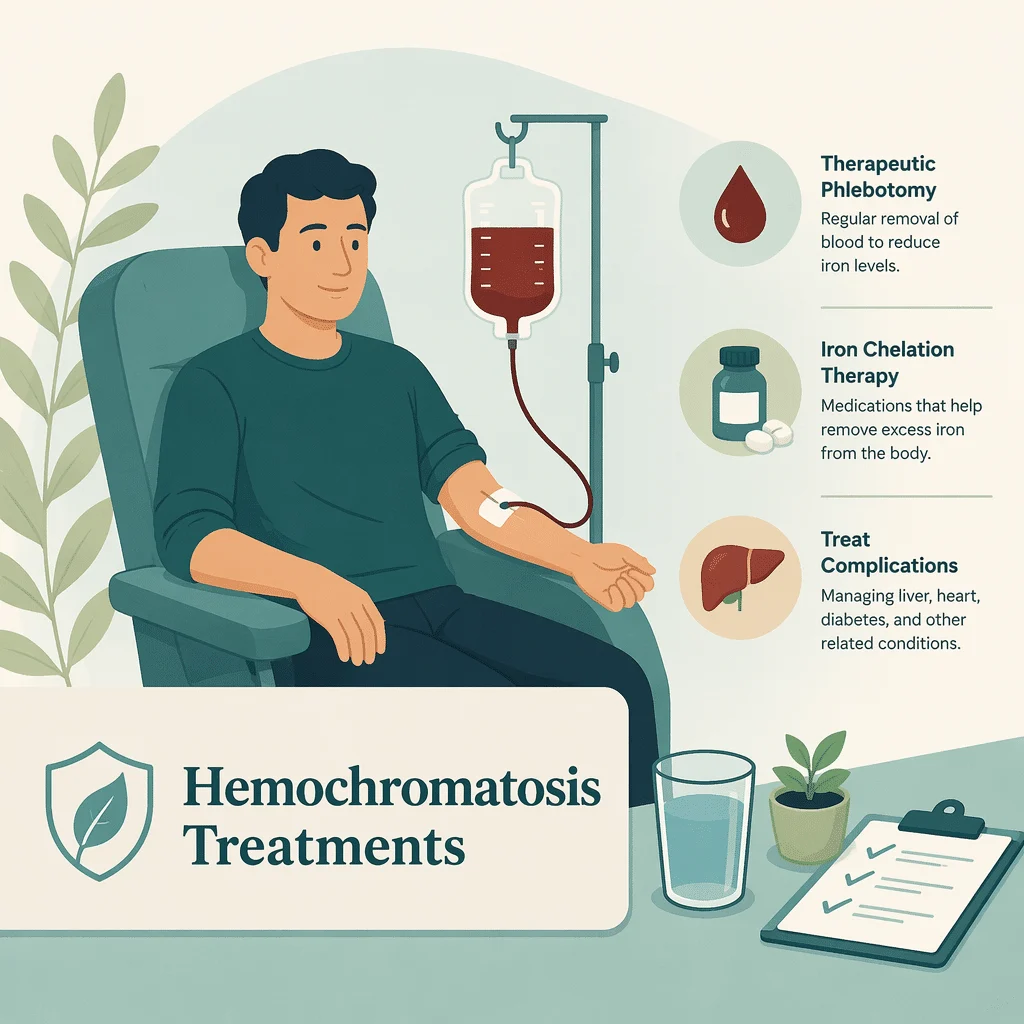
For most people with hereditary hemochromatosis, treatment means therapeutic phlebotomy — the scheduled removal of blood by a clinical team. NIDDK describes it as the most direct and safe way to lower the body’s iron stores, and it remains first-line care in essentially every published guideline.
Why removing blood lowers iron
The logic is simple once you see it. Most of the iron circulating in your body is locked inside the hemoglobin of red blood cells. When a unit of blood is removed, the bone marrow immediately starts building replacement red cells, and it needs iron to do so. Because there is no extra iron coming in fast enough from the diet, the marrow draws on stored iron instead — the iron sitting in the liver and elsewhere. Repeat that enough times and the stores fall. Nothing is being “flushed out”; the surplus is simply being spent.
Two numbers are watched throughout. Ferritin reflects how much iron remains in storage and shows whether the treatment is working. Hemoglobin, usually checked as part of a full blood count, shows whether you are tolerating the pace. If you want background on the storage marker itself, see our guides to ferritin and to high ferritin levels.
The induction phase
Treatment starts with an induction phase, sometimes called the depletion phase. Sessions are relatively frequent, and each one removes a unit of blood — the same volume taken at an ordinary blood donation. The aim is to bring stored iron down from wherever it started to a level your clinician judges safe.
How long this takes varies enormously. Someone found early through a family screen may need only a short course; someone diagnosed after years of accumulation may be in induction far longer. The end point is not a number you choose: your treating team sets an individual target range and decides when you have reached it, weighing your ferritin trend, your hemoglobin and how you feel between sessions.
Lifelong maintenance
Once stores are down, treatment does not stop — it changes gear. Because the underlying absorption problem is genetic and permanent, iron creeps back up as soon as removal stops. Maintenance phlebotomy continues indefinitely at a much lower frequency, spaced to hold iron in the range your clinician has set for you. Most people find this phase easy to live with.
Why this is never something to arrange yourself
This is the single most important safety point on the page. Therapeutic phlebotomy is a prescribed medical treatment, delivered and monitored by a clinical team. It is not something to arrange privately, accelerate, extend, or judge for yourself from your own lab results.
The reason is straightforward: it is entirely possible to overshoot. Removing blood faster or for longer than intended drives iron stores below normal and causes iron deficiency and anemia — trading one problem for another, with fatigue, breathlessness and dizziness of its own. The interval between sessions and the point at which induction ends are clinical decisions that depend on your blood counts, your other conditions and how your body is responding. Never adjust a phlebotomy schedule, skip monitoring blood tests, or seek blood removal outside your treatment program.
Hemochromatosis treatment stages at a glance
| Situation | What it typically involves | What the team monitors |
|---|---|---|
| Induction phase | Regular sessions removing a unit of blood each time, continued until stored iron reaches the clinician-set target | Ferritin trend, hemoglobin and full blood count before sessions, symptoms and tolerance |
| Maintenance phase | The same procedure, indefinitely, at a much lower frequency to stop iron re-accumulating | Periodic ferritin and iron studies, hemoglobin, review of any organ complications |
| Unable to tolerate phlebotomy | Erythrocytapheresis in centers that offer it, or iron chelation medication where blood removal is unsuitable | Iron markers plus the specific safety monitoring each alternative requires |
| Established cirrhosis | Iron removal continues, alongside specialist liver care and complete avoidance of alcohol | Liver function tests, imaging, and ongoing surveillance for liver cancer |
Alternatives when standard phlebotomy is not suitable
Erythrocytapheresis
Some specialist centers offer erythrocytapheresis, in which blood passes through a cell separator that removes red cells selectively and returns the plasma and platelets to you. Because each session takes out more red cell volume than a standard phlebotomy, iron stores fall with fewer visits overall. It requires apheresis equipment and trained staff, so it is not offered everywhere. The European Association for the Study of the Liver has recognized it as an alternative to classical phlebotomy, and it is worth asking your team whether it is available locally.
Iron chelation
Iron chelation uses medication that binds iron so the body can excrete it. In hereditary hemochromatosis it is a second-line option, reserved for people in whom blood removal is not appropriate — for example those who are already anemic, who have poor venous access, or who have heart disease. The medicines in this category include deferasirox, deferoxamine and deferiprone.
Chelators are prescription drugs with their own monitoring requirements, including checks on kidney and liver function, and they are not interchangeable with phlebotomy. Choice of drug, dosing and monitoring are entirely decisions for a specialist, and no dosing information belongs in a patient guide.
What treatment reverses, and what it does not
This is where honesty matters more than reassurance, and where a lot of patient information quietly glosses over the truth.
What treatment reliably does is stop the disease progressing. Removing the iron surplus prevents further accumulation in the liver, heart and pancreas, and for people treated before organ damage sets in, life expectancy is essentially normal. Many also notice real symptomatic improvement: fatigue often lifts, skin pigmentation can fade, and raised liver enzymes such as ALT and AST frequently settle back toward the AST normal range.
What treatment does not do is undo established structural damage. Cirrhosis — scarring that has already replaced healthy liver tissue — does not reverse with iron removal, and the raised risk of liver cancer that comes with it persists even after iron stores are normalized. That is why surveillance continues for life in people who have cirrhosis.
The point most often left unsaid is joint disease. Hemochromatosis arthropathy, which typically affects the second and third knuckles as well as larger joints, commonly persists after iron depletion and in many people continues to progress despite otherwise successful treatment. Some report less joint pain; many do not. Knowing this in advance prevents the demoralizing experience of completing a long induction course and concluding that treatment “failed” because the hands still hurt. Joint symptoms need their own management, usually with rheumatology input, and they are not a reason to abandon iron removal, which is still protecting the liver and heart.
Monitoring over the long term
Hemochromatosis care does not end when ferritin comes down. Long-term follow-up typically covers several strands, tailored to what your iron load did before it was treated.
Iron status is rechecked periodically so maintenance can be adjusted. Liver health is assessed with liver function tests and, where relevant, non-invasive fibrosis assessment such as elastography. If iron reached the pancreas, blood sugar is followed with fasting glucose and HbA1c, because diabetes can appear or persist after treatment. Cardiac assessment is arranged where there is any suggestion of iron affecting the heart, and endocrine review is added when hormone problems such as hypogonadism are present.
The strand that matters most is liver cancer surveillance. In people who have developed cirrhosis, the risk of hepatocellular carcinoma remains elevated after iron depletion, so guidelines recommend continued surveillance — usually periodic liver ultrasound, sometimes combined with the blood marker alpha-fetoprotein (AFP). Surveillance is offered to people with established cirrhosis, not to everyone with hemochromatosis.
Family screening: the most actionable thing on this page
If you have hereditary hemochromatosis, your first-degree relatives — parents, siblings and adult children — should be offered testing. This single step probably prevents more harm than anything else described here, because relatives identified before iron has accumulated can be treated early and may never develop complications at all.
The reasoning is genetic. The common form of hereditary hemochromatosis is inherited in an autosomal recessive pattern, meaning an affected person has two altered copies of the gene, one from each parent. Siblings therefore carry a substantial chance of having inherited the same pair. Testing usually combines iron blood tests with genetic testing, and MedlinePlus Genetics notes that not everyone who carries the genetic change goes on to develop iron overload — which is exactly why relatives are tested rather than assumed to be affected or unaffected.
Practically, raise it with your own clinician and ask how testing should be arranged for your family. Children under 18 are usually handled differently, and genetic counseling is often offered.
Diet, alcohol and blood donation, in proportion
Dietary iron restriction is not the treatment for hemochromatosis and cannot substitute for it. NIDDK is unambiguous: most people with hemochromatosis do not need to change their diet to eat less iron, because diet changes have a relatively small effect on iron levels compared with the much larger effect of removing iron through phlebotomy. There is no reason to build your life around avoiding iron in food.
A small number of specific cautions are genuinely evidence-based. NIDDK advises avoiding supplements containing iron, and supplements containing vitamin C, which increases the body’s absorption of iron. It also advises limiting alcohol to help prevent liver damage, and stopping completely if you have cirrhosis — alcohol compounds risk in a condition already targeting the liver.
The raw shellfish caution
One food-safety point deserves to be taken seriously rather than filed with general diet advice. NIDDK advises people with hemochromatosis to avoid raw or undercooked shellfish, which can cause a serious infection in people with liver disease. The organism of concern is Vibrio vulnificus, which lives in warm coastal waters and is most often acquired from raw or undercooked shellfish, particularly oysters. The Centers for Disease Control and Prevention (CDC) lists liver disease among the conditions that increase the risk of severe complications, and notes the infection can be life-threatening. Cooking shellfish thoroughly removes the risk.
Can you donate blood?
In a number of countries, people with hereditary hemochromatosis can donate blood, and some blood services accept those donations as part of their normal supply — allowing maintenance treatment and donation to overlap. Rules differ substantially between countries and services, and eligibility depends on your own clinical situation, so raise this with your treating team and your local blood service rather than acting on it independently.
Red flags that need prompt medical attention
Contact your doctor promptly, or seek urgent care, if you develop any of the following.
- Yellowing of the skin or eyes (jaundice), swelling of the abdomen, new confusion or drowsiness, vomiting blood, or black tarry stools — these can indicate advanced liver disease and need immediate assessment.
- Chest pain, breathlessness at rest or on mild exertion, or palpitations and an irregular heartbeat — iron affecting the heart requires prompt cardiac review.
- Severe fatigue with dizziness, lightheadedness or fainting during a course of phlebotomy — this may signal over-treatment or anemia, and your schedule and blood counts need reviewing before the next session.
None of these should be watched and waited on. They are all reasons to contact your treating team the same day.
Latest scientific advances in hemochromatosis treatment
Research since 2023 has largely reinforced the existing pathway while refining how it is delivered and who needs it.
A 2023 seminar in The Lancet by Adams and colleagues emphasized that the disease is simultaneously overdiagnosed in people without genuine iron overload and underdiagnosed in many who have it, and that early genetic diagnosis followed by periodic phlebotomy can prevent its most serious consequences, including liver cirrhosis, liver cancer and premature death. What this means for you: a genetic result on its own does not automatically mean treatment, and the decision to start phlebotomy rests on your actual iron status assessed by a clinician.
A 2025 clinical review in Annals of Internal Medicine by Palmer and Stancampiano noted that most people with hemochromatosis remain without symptoms while others develop advanced organ damage, and identified arthropathy, diabetes, cirrhosis, hypogonadotropic hypogonadism (a hormone deficiency arising from the pituitary) and cardiomyopathy as the key clinical manifestations. Early identification and therapeutic phlebotomy improved outcomes. What this means for you: joint disease sits alongside liver and heart complications as a recognized part of the condition, not as a side issue.
On the alternatives, a 2024 single-center report in Hematology, Transfusion and Cell Therapy by Burnać and colleagues described two decades of therapeutic erythrocytapheresis in people with polycythemia and hemochromatosis. Both cell-separator systems studied were efficient and safe at reducing red cell volume, with short procedure times, and the authors concluded that the technique reduces the number of procedures needed — something they argued particularly justifies its use in patients of working age. What this means for you: if travelling for frequent sessions is disruptive, erythrocytapheresis is worth asking about, though availability is limited.
Whether a drug could one day replace lifelong blood removal is being actively explored. A 2025 phase 1b randomized trial in Scientific Reports by Scribner and colleagues tested BBI-001, an oral compound that is not absorbed into the body but binds dietary iron in the gut so it passes out in the stool. No treatment-related adverse events occurred at the doses tested, and it reduced absorption of iron from meals compared with placebo, with the largest effect in people who absorbed the most iron. The authors were explicit that this is early-stage work. What this means for you: nothing changes in current care, but the motivation is real — the same paper noted that long-term adherence to regular phlebotomy is poor in some clinical settings.
Finally, a 2023 cross-sectional study in JAMA Network Open by Savatt and colleagues examined what happened when people learned through genomic screening that they carried the common high-risk genotype without a prior diagnosis. Most went on to have the recommended iron blood tests, and among those found to have iron overload, most began phlebotomy or chelation. Liver-related problems were less frequent than in people diagnosed the traditional way through symptoms. What this means for you: identifying affected relatives before symptoms appear leads to earlier treatment and less established damage — the whole argument for offering testing to your family.
Glossary of key terms
| Term | Definition |
|---|---|
| Therapeutic phlebotomy | The prescribed removal of a unit of blood by a clinical team, used to lower the body’s iron stores |
| Induction phase | The initial, more frequent course of phlebotomy that brings stored iron down to a clinician-set level |
| Maintenance phase | Lifelong, less frequent phlebotomy that keeps iron from building back up |
| Erythrocytapheresis | A machine-based procedure that removes red blood cells selectively and returns the rest of the blood |
| Iron chelation | Prescription medication that binds iron so the body can excrete it, used when phlebotomy is unsuitable |
| Ferritin | A blood marker reflecting how much iron is held in storage; followed to guide and monitor treatment |
| Arthropathy | Joint disease; in hemochromatosis it often persists or progresses even after iron is removed |
| Cirrhosis | Advanced scarring of the liver that does not reverse once established |
| Hepatocellular carcinoma surveillance | Regular checks for primary liver cancer, offered to people with cirrhosis |
| First-degree relative | A parent, sibling or child; the group offered testing when hereditary hemochromatosis is diagnosed |
Frequently asked questions
How often will I need phlebotomy?
There is no single answer, and it is not a number you set yourself. The frequency during induction and the much wider spacing during maintenance are both clinical decisions made by your treating team, based on your iron markers, your hemoglobin, any other conditions you have and how you tolerate each session. Two people with the same diagnosis can have very different schedules, and your own schedule will change over time as you move from induction into maintenance. Ask your team what they are aiming for and how often they plan to recheck your blood tests, rather than comparing your interval with someone else’s.
Can diet replace phlebotomy?
No. NIDDK states plainly that diet changes have a relatively small effect on iron levels compared with the much larger effect of removing iron through phlebotomy, and that most people with hemochromatosis do not need to eat less iron. Cutting iron from food does not remove the iron already stored in your organs, which is the actual problem. The genuinely useful dietary steps are narrow: avoid iron supplements, avoid high-dose vitamin C supplements, avoid raw or undercooked shellfish, and limit alcohol — or stop completely if you have cirrhosis. None of these replace treatment.
Should my family be tested?
Yes — first-degree relatives should be offered testing. That means parents, siblings and adult children. Because the common form is inherited in an autosomal recessive pattern, siblings in particular have a meaningful chance of carrying the same two altered gene copies. Testing usually combines iron blood tests with genetic testing. Relatives identified before iron has accumulated can be monitored or treated early and may avoid complications entirely, which is why this is the highest-value action available to you. Raise it with your clinician, who can advise how testing should be arranged and whether genetic counseling is appropriate.
Is therapeutic phlebotomy the same as giving blood?
The procedure feels similar and removes a comparable volume, but the purpose and the governance are different. A blood donation is voluntary and driven by supply needs; therapeutic phlebotomy is a prescribed treatment with a target, a schedule and monitoring blood tests attached to it. In some countries the two can overlap, because certain blood services accept donations from people with hemochromatosis. Whether that applies to you depends on local rules and your clinical situation, so ask your treating team and your local blood service.
What happens if I stop treatment?
Because the underlying absorption problem does not go away, stopping maintenance allows iron to accumulate again, and the risk of organ damage returns over time. Adherence to long-term phlebotomy is genuinely difficult for some people, and that is a reason to discuss the barriers — travel, veins, timing, work — with your team rather than to quietly lapse. If standard phlebotomy is the obstacle, alternatives such as erythrocytapheresis or, in specific circumstances, chelation may be considered. Do not stop or pause a treatment program without talking to the clinician who prescribed it.
Do I still need genetic testing if my iron blood tests are already high?
Usually yes, and for two reasons. Genetic testing confirms whether the iron overload is hereditary hemochromatosis rather than another cause, which affects how you are followed. It also underpins family screening: knowing which genetic change you carry lets relatives be tested precisely. Your clinician will explain which test is appropriate and interpret it alongside your iron results, since carrying a genetic change does not automatically mean you will develop iron overload.
Sources
- National Institute of Diabetes and Digestive and Kidney Diseases (NIDDK) — Hemochromatosis
- NIDDK — Eating, Diet, and Nutrition for Hemochromatosis
- MedlinePlus Genetics, U.S. National Library of Medicine — Hereditary hemochromatosis
- Centers for Disease Control and Prevention (CDC) — About Vibrio Infection
- GeneReviews, NCBI Bookshelf — HFE Hemochromatosis
- Adams PC, Jeffrey G, Ryan J. Haemochromatosis. The Lancet, 2023
- Palmer WC, Stancampiano FF. Hemochromatosis. Annals of Internal Medicine, 2025
- Burnać IL, Bojanić I, Mazić S, Lukić M, Golubić Ćepulić B. Performance and safety of therapeutic erythrocytapheresis in polycythemia and hemochromatosis treatment: single centre experience. Hematology, Transfusion and Cell Therapy, 2024
- Scribner C, Cope J, Ryan P, Olynyk JK, Ryan J, Griffin JD, Berkland C. A phase 1b randomised clinical trial evaluating BBI-001, a non-absorbed oral therapeutic for the treatment of iron overload. Scientific Reports, 2025
- Savatt JM, Johns A, Schwartz MLB, et al. Testing and Management of Iron Overload After Genetic Screening-Identified Hemochromatosis. JAMA Network Open, 2023
Further reading
- Iron saturation explained: levels and causes
- Transferrin: understanding its role in iron transport
- High ferritin levels: causes, symptoms and risks
- Serum iron analysis: low and high levels
- Liver function tests explained
Understand your lab results with AI DiagMe
Living with hemochromatosis means seeing the same handful of numbers again and again: ferritin, iron saturation, liver function tests and your full blood count. AI DiagMe turns those values into plain language so you can follow what is happening between appointments and arrive at your next review with better questions. It helps you understand your results; it does not diagnose anything. It does not replace your doctor or your treating team.
Get your results interpreted in minutes