

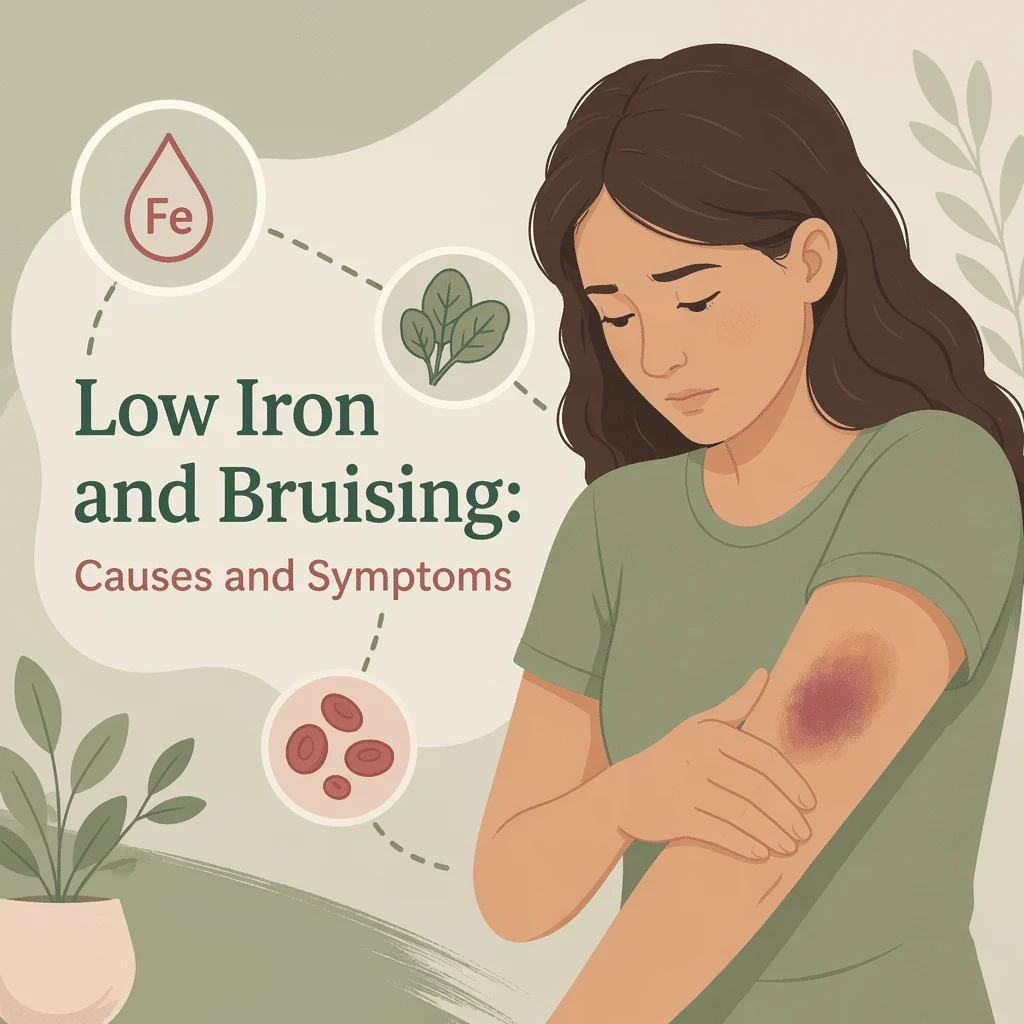
Low iron and bruising are two complaints that turn up together constantly in online searches, and the usual explanation given for the pairing is wrong. Iron deficiency on its own does not make you bruise. The reason the two so often travel together is that a single underlying problem, most commonly ongoing blood loss, can drain your iron stores and produce marks on your skin at the same time. Telling those threads apart matters, because one of them is easily corrected and the other occasionally points to a bleeding disorder that needs treatment. In this article you’ll learn what the evidence actually supports, which blood tests separate an iron problem from a platelet problem, and which combinations of symptoms deserve prompt medical attention.
Does low iron cause bruising? The honest answer
No. There is no established mechanism by which a shortage of iron makes small blood vessels leak or stops a bruise from being contained. A bruise forms when blood escapes from damaged capillaries into the surrounding tissue. Preventing that escape depends on three things: the strength of the vessel wall, the number of platelets available to plug it, and the clotting proteins that stabilize the plug. Iron is not a required ingredient in any of those three systems.
This distinction is not academic. If you accept that low iron explains your bruises, you may take an iron supplement, feel better as your energy returns, and never investigate why you are bruising. Iron treatment corrects the fatigue and the anemia. It does not address a platelet or clotting problem, because there was never an iron-related bruising problem to correct in the first place.
What iron deficiency does do
Iron deficiency reliably produces fatigue, breathlessness on exertion, pale skin, brittle nails, hair shedding, restless legs, and sometimes a craving for ice or other non-food items. When it becomes severe enough to cause anemia, red blood cells are made smaller and paler than usual. Our team covers the causes of a low MCV result, which is the measurement that captures that change.
Why low iron and bruising still appear together
The link is real, but it runs through a shared cause rather than from one symptom to the other. Something is making you lose blood, and losing blood does two things at once: it removes iron faster than your diet can replace it, and it may be a visible sign of a bleeding tendency that also shows up on your skin.
Heavy menstrual periods
This is by far the most common shared cause in people who menstruate. Heavy or prolonged bleeding steadily depletes iron stores. If the heavy bleeding is itself caused by an inherited bleeding disorder, that same disorder produces easy bruising. The result looks like low iron causing bruises, when in fact a single condition is driving both.
Bleeding in the digestive tract
Slow blood loss from an ulcer, inflammation, polyps, or a tumor can be completely invisible in the stool yet drain enough iron over months to cause anemia. Unexplained iron deficiency in men and in people past menopause is taken seriously for exactly this reason and usually prompts a look at the gut. Our guide explains what a fecal calprotectin result means when intestinal inflammation is suspected.
Poor absorption and chronic illness
Some people eat enough iron but cannot absorb it. Celiac disease is a classic example, and unexplained iron deficiency is sometimes its first clue. Our guide describes the signs of celiac disease and gluten intolerance. Chronic kidney disease, inflammatory conditions, and stomach surgery can all interfere with iron supply in similar ways. This article explains the main types and symptoms of anemia that arise from these different routes.
What iron deficiency actually does to your platelets
Here the evidence points firmly in the opposite direction from the popular claim. Iron deficiency does not typically lower the platelet count. It usually raises it. A high platelet count triggered by another condition is called reactive thrombocytosis, and iron deficiency is one of its best-recognized triggers. Since platelets are the cells that stop you from bruising, having more of them circulating is not a plausible route to easier bruising.
A CBC makes this easy to check, because the same sample that reveals microcytic anemia also reports your platelet count. Our team explains how to read a complete blood count. If your platelets are normal or raised while your hemoglobin is low, iron is not the explanation for your bruises and something else deserves attention.
The lab tests that separate the two problems
Bruising and iron deficiency are investigated with different tests, and running the right combination answers both questions in one visit. A separate guide details the causes and treatment of low ferritin, the single most useful measure of your iron reserves.
| Test | What it measures | What it settles |
|---|---|---|
| Complete blood count (CBC) with differential | Hemoglobin, red cell size (MCV), platelet count, white cell count | Separates an iron problem from a platelet problem in a single tube. Low hemoglobin with small red cells points to iron; a low platelet count points somewhere else entirely. |
| Ferritin | Your stored iron | The most sensitive marker of depleted iron stores. A low result confirms iron deficiency even when hemoglobin is still normal. |
| Iron studies (serum iron, TIBC, transferrin saturation) | Iron circulating in the blood and the capacity to carry it | Confirms and refines the ferritin result, and helps when inflammation makes ferritin misleading. |
| Coagulation screen (PT, INR, aPTT) | How long the blood takes to clot | Ordered when bruising is genuinely excessive. It screens for clotting factor problems and for the effect of blood thinners. |
| Von Willebrand panel | Von Willebrand factor level and activity | Warranted when there is lifelong easy bruising with heavy periods, nosebleeds, or bleeding after dental work or childbirth. |
| Peripheral blood smear | The appearance of the blood cells under a microscope | Requested when the CBC is abnormal in more than one cell line, to look for causes such as leukemia. |
Ferritin can be misleading when inflammation is present, because it rises during illness and can mask depleted stores. That is when the wider panel earns its place. We also break down the full iron studies panel. If the bruising side of the picture needs pursuing, our guide describes what a coagulation panel measures, and we explain what PT and INR results mean.
When easy bruising is a red flag
Most bruising is harmless. Bruises on the shins and forearms, bruises that follow a knock you have forgotten, and bruising that increases with age or with regular aspirin, anticoagulants, or steroids are all common and usually benign. The pattern below is the one that warrants a medical opinion rather than a supplement.
- Bruises appearing without any injury you can recall, especially on the trunk, back, or face
- Bruises that are unusually large, raised, or lumpy
- Pinpoint red or purple dots in the skin, which are petechiae rather than ordinary bruises
- Bruising alongside frequent nosebleeds, bleeding gums, or blood in the urine or stool
- Prolonged bleeding after minor cuts, dental work, childbirth, or surgery
- A family history of easy bruising or a diagnosed bleeding disorder
- Bruising accompanied by fever, night sweats, bone pain, or unexplained weight loss
- Any new bruising that starts after beginning a new medication
Seek care promptly rather than waiting if bruising appears together with petechiae, if bleeding will not stop, or if you feel severely unwell. A 2024 primary care review of bleeding and bruising in American Family Physician sets out this same approach: take a careful bleeding history first, then use a CBC and a clotting screen to decide who needs specialist referral.
Everyday causes of easy bruising that have nothing to do with iron
When bruising is investigated and the blood tests come back normal, the explanation is usually one of the ordinary factors below. None of them involve iron, and recognizing them can save a great deal of worry.
- Aging skin. The skin thins with age and loses some of the fatty layer that cushions small vessels, so the same knock produces a larger mark.
- Sun damage. Years of ultraviolet exposure weaken the vessel walls in the forearms and backs of the hands, producing flat purple patches that appear after minimal contact.
- Medications. Aspirin, clopidogrel, anticoagulants, and both oral and topical corticosteroids all increase bruising. This is expected rather than alarming, but never stop a prescribed blood thinner on your own.
- Vigorous exercise. Weight training and contact sports cause small vessel tears that show up as bruises you do not remember earning.
- Sex and genetics. Some people simply bruise more readily than others throughout their lives, without any detectable abnormality.
These causes can coexist with iron deficiency, which is precisely why the two get linked. An older adult on low-dose aspirin who also has a slow gastrointestinal bleed will have both bruises and low iron, and the aspirin explains one while the bleeding explains the other.
Conditions that genuinely cause both
A small group of conditions really does produce low iron and bruising together, and these are the reason the combination should not simply be dismissed.
Von Willebrand disease is the most common inherited bleeding disorder and the most likely explanation. A shortage of von Willebrand factor makes platelets less able to stick where they are needed, which causes easy bruising, nosebleeds, and heavy periods. The heavy periods then drain iron stores. Immune thrombocytopenia, in which the immune system destroys platelets, is another route, and it causes bruising and petechiae directly. Leukemia can present with both anemia and bruising because it crowds out normal blood cell production; this resource explains what a leukemia blood test can show. Advanced liver disease impairs the production of clotting proteins and often coexists with poor nutrition. Severe vitamin C deficiency weakens the vessel walls themselves, and we also review the benefits and risks of vitamin C.
Correcting low iron and what to expect
Treating iron deficiency has two halves, and the second is the one most often skipped. The first half replaces the missing iron. The second half finds out why it went missing, because iron that is being lost faster than it is replaced will simply run down again once supplements stop.
Replacement is usually oral to begin with. Iron is absorbed more efficiently on an empty stomach and alongside a source of vitamin C, while tea, coffee, calcium, and antacids taken at the same time reduce absorption. Your doctor will advise on the dose and schedule, since higher and more frequent dosing is not always better and often causes more digestive side effects. Diet alone rarely refills depleted stores quickly, though it helps maintain them afterward, and our guide covers the best iron-rich breakfast foods.
Expect the timeline to be longer than it feels it should be. Hemoglobin usually starts to recover within a few weeks, which is when energy improves, but ferritin stores take several months to rebuild. That gap is why treatment is normally continued well past the point where you feel better, and why a repeat ferritin test is worth doing rather than assuming the job is done. Intravenous iron is used when tablets are not tolerated, when absorption is impaired, or when losses are heavy. Throughout, bruising is tracked as its own question with its own tests, not as something expected to resolve with iron.
Latest scientific advances
Recent research has sharpened the picture, and it points consistently away from iron deficiency as a cause of bruising.
A 2026 review in the European Journal of Haematology examined why iron deficiency pushes platelet counts up rather than down, tracing it to the way the bone marrow responds when iron runs short. What this means for you is straightforward: the mechanism most often invoked to explain iron-related bruising works in the opposite direction. A 2025 study followed platelet counts before and after iron replacement and found that raised counts settled back toward normal once iron stores were restored, which supports the same conclusion.
Researchers have looked at whether iron shortage subtly changes how platelets behave, as opposed to how many there are. A 2024 laboratory analysis reviewed those mechanisms in detail. This work is done in the laboratory rather than at the bedside, and it has not shown that people with iron deficiency bruise more in everyday life, so it is best read as an open question rather than a finding you should act on.
The rare exception has also been documented. Isolated case reports, including one published in 2026, describe a very low platelet count appearing alongside severe iron deficiency anemia and recovering once the iron was replaced. A case report describes what happened to one patient, not what usually happens, and the practical lesson is simply that the platelet count should be looked at rather than assumed.
On the bleeding disorder side, a 2024 educational review set out when and how to test for von Willebrand disease in people with heavy menstrual bleeding, and a 2025 cohort study confirmed how frequently iron deficiency and anemia accompany heavy periods in women already diagnosed with it. What this means for you is that heavy periods plus easy bruising is a recognized pattern worth raising with a doctor, not a coincidence. Separately, a 2024 analysis in JAMA Network Open showed that the ferritin threshold a laboratory uses changes who gets diagnosed with iron deficiency at all, which is why a result sitting just inside the normal range may still deserve discussion if your symptoms fit.
Glossary
| Term | Definition |
|---|---|
| Anemia | A shortage of healthy red blood cells or of the hemoglobin inside them, which lowers the amount of oxygen your blood can carry. |
| Coagulation | The chain of chemical steps that turns liquid blood into a solid clot. Problems in this chain cause bleeding, not iron deficiency. |
| Ecchymosis | The medical word for a bruise: blood that has leaked out of small vessels and spread under the skin. |
| Ferritin | The protein that stores iron in your body. A blood ferritin measurement is the best single indicator of how much iron you have in reserve. |
| Hemoglobin | The iron-containing protein inside red blood cells that carries oxygen from your lungs to the rest of your body. |
| MCV (mean corpuscular volume) | The average size of your red blood cells. Iron deficiency makes them smaller than normal, which is called microcytic anemia. |
| Petechiae | Pinpoint red or purple dots in the skin, smaller than a bruise. Unlike ordinary bruises, they often signal a low platelet count and should be checked promptly. |
| Platelets | Tiny cell fragments that clump together to plug a damaged blood vessel. A low platelet count is a genuine cause of easy bruising. |
| Reactive thrombocytosis | A platelet count that rises above normal in response to another condition. Iron deficiency is one of the classic triggers. |
| Von Willebrand factor | A protein that helps platelets stick to a damaged vessel wall. A shortage of it causes the most common inherited bleeding disorder. |
Frequently asked questions
Is bruising a sign of low iron?
Bruising is not a recognized symptom of iron deficiency, and it is not used to diagnose it. If you are bruising more than usual and also have low iron, the most useful assumption is that both point back to a common cause such as blood loss, rather than that one produced the other. The symptoms that genuinely suggest low iron are fatigue, breathlessness on exertion, pallor, brittle nails, and unusual cravings. Bruising alongside those symptoms is worth mentioning to a doctor, because it prompts a check of the platelet count rather than a change in iron treatment.
Why do so many sources say low iron causes bruising?
The claim spreads because the association is real and easy to observe. Someone with heavy periods can plausibly have both low iron and frequent bruises, and it is a short step from noticing that pairing to assuming a causal link. The step is not supported by evidence. Iron deficiency typically raises the platelet count rather than lowering it, and iron plays no established role in vessel wall integrity or in the clotting cascade.
Will taking iron supplements stop my bruising?
Iron will correct iron deficiency and its genuine symptoms, but there is no reason to expect it to reduce bruising, because iron deficiency was not causing the bruises. If bruising improves after you start iron, the likely explanation is that the underlying problem, such as heavy menstrual bleeding, was treated at the same time. If bruising persists or worsens on iron, that is a reason to have it investigated rather than to increase the dose.
What does bruising on the legs mean if my iron is low?
Bruising on the shins and thighs is the most common location for ordinary knocks and is rarely a concern on its own, whatever your iron level. Location matters less than pattern. Bruises on the trunk, back, or face without a remembered injury are more meaningful, as are bruises accompanied by petechiae or by bleeding from the gums or nose. If your iron is low and you have that second pattern, ask for a platelet count.
Can anemia from another cause make me bruise?
Anemia itself does not cause bruising, but the conditions that produce certain anemias can. Leukemia and bone marrow failure reduce red cells and platelets together, so bruising appears alongside anemia. Advanced liver disease impairs clotting protein production. The distinction that matters is whether only the red cells are affected, which suggests a nutritional cause, or whether platelets and white cells are affected too, which needs prompt investigation.
Which tests should I ask for if I have both?
A complete blood count with differential and a ferritin level are the sensible starting pair, because together they show whether you are iron deficient and whether your platelet count is normal. If bruising is significant, a clotting screen is usually added. Testing for von Willebrand disease is considered when there is a lifelong history of easy bruising, heavy periods, nosebleeds, or bleeding after dental work or childbirth, particularly if relatives are affected.
Sources
- National Heart, Lung, and Blood Institute — Iron-Deficiency Anemia — NIH — nhlbi.nih.gov
- Centers for Disease Control and Prevention — About von Willebrand Disease — CDC — cdc.gov
- MedlinePlus Medical Encyclopedia — Bleeding into the skin — U.S. National Library of Medicine — medlineplus.gov
- Facco JV et al. — Mechanisms of Thrombocytosis in Iron-Deficiency Anemia — European Journal of Haematology, 2026 — PubMed
- Talamo G et al. — Platelet levels before and after iron replacement therapy in patients with iron deficiency anemia — Hematology, 2025 — PubMed
- Liu S et al. — Iron deficiency anemia and platelet dysfunction: a comprehensive analysis of the underlying mechanisms — Life Sciences, 2024 — PubMed
- Bahloul L et al. — Severe Thrombocytopenia Complicating Iron Deficiency Anemia: A Diagnostic Challenge? — The Journal of Applied Laboratory Medicine, 2026 — PubMed
- Perez Botero J — von Willebrand disease and heavy menstrual bleeding: when and how to test — Hematology, American Society of Hematology Education Program, 2024 — PubMed
- Myrin-Westesson L et al. — Prevalence of heavy menstrual bleeding, iron deficiency, iron deficiency anemia, and treatment in women with von Willebrand disease: a cohort study — Research and Practice in Thrombosis and Haemostasis, 2025 — PubMed
- Bleeding and Bruising: Primary Care Evaluation — American Family Physician, 2024 — PubMed
- Ferritin Cutoffs and Diagnosis of Iron Deficiency in Primary Care — JAMA Network Open, 2024 — PubMed
Further reading
- Iron saturation explained: levels and causes
- Folate deficiency: symptoms, causes and treatments
- Low MCHC: causes, symptoms and treatments
- Low vitamin B12: symptoms, causes and treatments
- High ferritin levels: causes, tests and what to do next
Understand your lab results with AI DiagMe
If you are dealing with low iron and bruising at the same time, the answers are usually sitting in results you already have. A complete blood count shows your hemoglobin, your red cell size, and your platelet count side by side, and a ferritin level tells you how much iron you have in reserve. AI DiagMe helps you read those numbers in plain language and see which ones fall outside the expected range. It is built to help you understand your results and prepare better questions, not to diagnose you or to replace your doctor.
Get your results interpreted in minutes