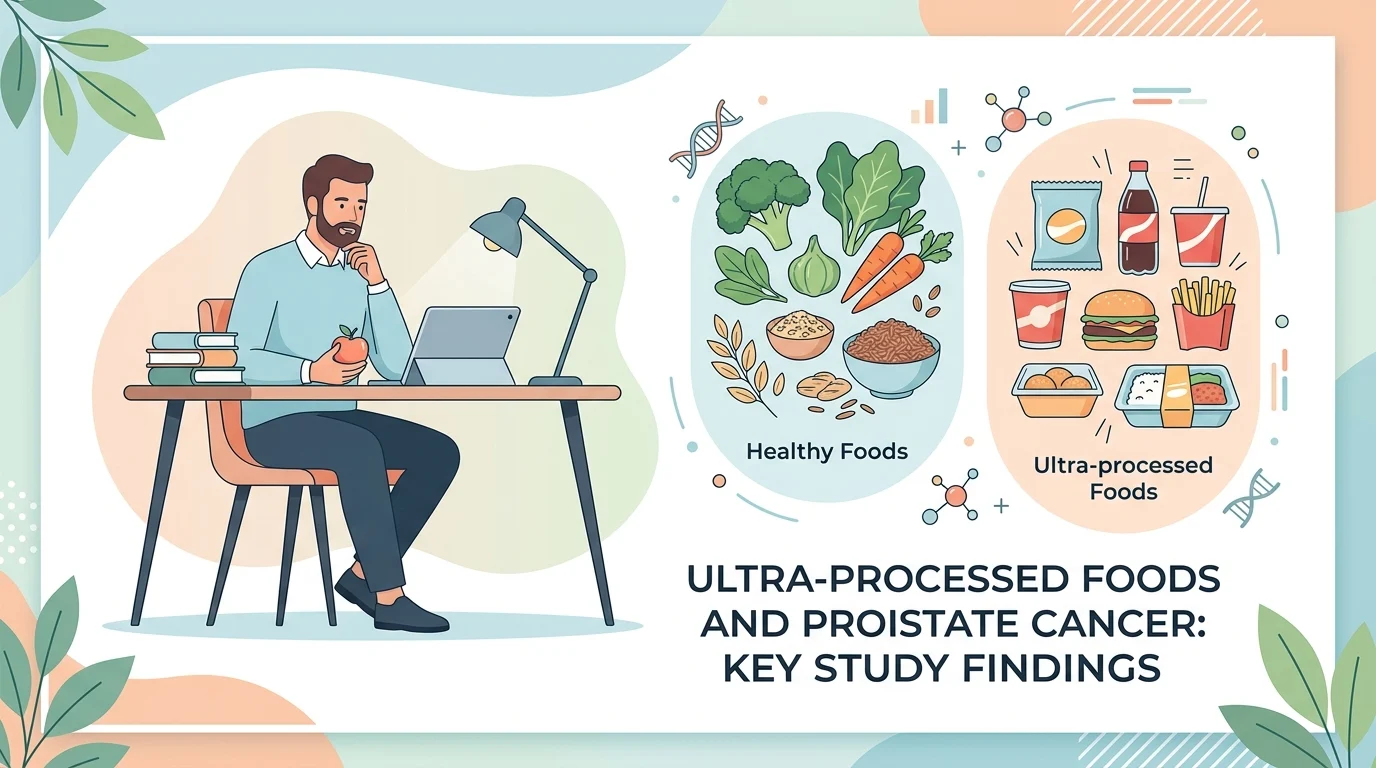
A study published in August 2026 has put ultra-processed foods and prostate cancer back in the headlines. Researchers at Florida Atlantic University analysed diet and health data from 17,024 American men and found that those eating the most ultra-processed food reported prostate cancer more often than those eating the least. The result travelled fast. It also sits awkwardly beside earlier research that found no such link at all. In this article you’ll learn what the new study measured, why the evidence remains divided, and what a blood test can realistically tell you about your own risk.
What the 2026 study actually measured
The team used the National Health and Nutrition Examination Survey, a long-running American survey that collects detailed diet records. Between 2003 and 2023, 17,024 men described everything they had eaten across two separate 24-hour periods. Each food was sorted using the NOVA classification, which ranks foods by how heavily they are industrially processed rather than by calories or nutrients. Participants were then split into four groups according to the share of their daily energy coming from ultra-processed products: soft drinks, packaged breads, breakfast cereals, snack foods and processed meats.
Compared with the lowest-intake group, men in the three higher groups reported prostate cancer 29% more often. After adjusting for age, smoking, race and ethnicity, and income, the figure was 27%. Two details matter. Prostate cancer was recorded by self-report rather than confirmed from medical records, and diet was captured at one point in time rather than tracked over the years leading up to a diagnosis. The authors state plainly that further analytic studies are needed to test the hypothesis.
Why the evidence is still divided
This is where a single headline can mislead. Several research teams have asked the same question and reached different answers, largely because they used different study designs.
| Study | Design | What it found |
|---|---|---|
| Scott et al., 2026 (Am J Med) | Survey snapshot, 17,024 US men | 27 to 29% more self-reported prostate cancer at higher intake |
| Fichtel-Epstein et al., 2024 (Cancers) | Pooled analysis of six studies | No significant link with prostate cancer risk |
| Isaksen et al., 2023 (Clinical Nutrition) | Systematic review, 11 reports | Link for overall, colorectal and breast cancer, but not prostate |
| Mahmoudizadeh et al., 2025 (J Health Popul Nutr) | Case-control, 120 men, Iran | Higher odds after adjustment, very small sample |
| Hasenbohler et al., 2026 (The BMJ) | Cohort, 105,260 French adults | Sodium nitrite linked to 32% more prostate cancers |
Read together, these results point to something more nuanced than the idea that processed food causes prostate cancer. Ultra-processed food shows a fairly consistent link with cancer overall, and with colorectal and breast cancer in particular, whilst the prostate signal remains unsettled. The size of the study, the way diet was measured, and whether a cancer was medically confirmed all change the answer.
What a PSA test can and cannot tell you about your diet
Many men reading a headline like this one will wonder whether a blood test would show whether their diet has already done damage. It will not, and understanding why is genuinely useful. Prostate-specific antigen is a protein made by the prostate gland. Levels rise with prostate cancer, but they also rise with an enlarged prostate, with inflammation, after ejaculation, and simply with age. The National Cancer Institute is explicit that a PSA test may detect prostate cancer early, but has not been shown to reduce the risk of dying from it. Our team covers the PSA blood test and what a result really means.
No dietary pattern leaves a signature on a PSA result. A man eating a Mediterranean diet and a man living on packaged food can return identical numbers. PSA measures prostate tissue activity at a moment in time, not accumulated dietary risk. The CDC frames screening as a conversation to have with a doctor rather than a routine test to book, precisely because an abnormal result leads to a biopsy that carries its own risks. AI DiagMe explains tumour markers and their real limits.
The blood markers that do respond to what you eat
Diet leaves no fingerprint on PSA, but it leaves plenty of them elsewhere in a standard panel. If this study has prompted you to look at your eating habits, these are the markers where a change would actually show up over weeks or months.
- Fasting glucose and HbA1c, which track blood sugar control across the previous two to three months. Our guide explains the A1C conversion chart and average glucose.
- Triglycerides, LDL and HDL cholesterol, which respond to added sugars, refined starches and saturated fat. Our team wrote a complete lipid panel guide.
- C-reactive protein, a general marker of inflammation that heavily processed diets tend to nudge upward. Our guide covers the CRP inflammation blood test.
- Liver enzymes and kidney function, both included in a routine metabolic screen. AI DiagMe details the comprehensive metabolic panel.
None of these predicts prostate cancer. They do describe the metabolic terrain that several proposed mechanisms are thought to run through: inflammation, insulin resistance and oxidative stress. That makes them a far more honest starting point than asking a PSA result a question it cannot answer. For blood-based cancer detection specifically, our team reviewed the 2026 multi-cancer early detection trial.
Latest scientific advances
Three strands of recent research help place the August 2026 finding in context.
The first is a 2024 review that pooled six earlier studies and found no meaningful difference in prostate cancer risk between men eating the most and the least ultra-processed food. What this means for you: the new study is one voice in a conversation, not a verdict. A single survey-based result rarely overturns a pooled analysis.
The second comes from France. Researchers followed more than 105,000 adults in the NutriNet-Santé cohort, a large group tracked over many years, and looked not at processing in general but at individual preservatives. Sodium nitrite, the additive used to cure ham and sausage, was linked to roughly a third more prostate cancers amongst the highest consumers. Eleven of the seventeen preservatives studied showed no link to cancer at all. What this means for you: if there is a real effect, it may come from specific additives in certain products rather than from an entire food category.
The third is a 2025 review that gathered the proposed biological explanations: whole foods being displaced from the diet, weight gain, additives and compounds formed during high-temperature processing, and disruption of the gut microbiome, the community of bacteria living in the intestine. All of these plausibly feed into inflammation and metabolic change. None has yet been shown to cause prostate cancer in humans. These results remain preliminary and need confirmation before anything changes in how prostate cancer is screened for or prevented.
When to talk to a doctor
A question about diet rarely needs an urgent appointment. These situations do.
- Trouble starting or stopping urination, a weak stream, or frequent night-time urination.
- Blood in the urine or semen.
- Persistent pain in the lower back, hips or pelvis.
- A father or brother diagnosed with prostate cancer, particularly before the age of 65.
- Being Black, which carries both a higher risk and often an earlier onset.
The American Cancer Society lists age, family history and ethnicity as the risk factors with the strongest evidence behind them. Diet sits further down that list, and its role is still being worked out. Our article details prostate cancer symptoms, diagnosis and treatment.
Glossary
| Term | Definition |
|---|---|
| Ultra-processed food | An industrial formulation made largely from refined ingredients and additives, with little or no whole food left in it. |
| NOVA classification | A system that sorts foods into four groups by how heavily they are industrially processed, rather than by their nutrients. |
| PSA (prostate-specific antigen) | A protein made by the prostate and measured in blood. It can rise with cancer, but also with infection, an enlarged prostate or age. |
| NHANES | The National Health and Nutrition Examination Survey, a recurring American survey of diet and health in a representative sample. |
| Cohort study | A study that follows a defined group of people forward in time to see who develops a condition. |
| Meta-analysis | A statistical method that combines the results of several studies to produce one overall estimate. |
| Confounding factor | Something else that differs between groups, such as age or smoking, and can create a false impression of cause and effect. |
| Sodium nitrite (E250) | A preservative used to cure meats such as ham and sausage, and to keep their colour stable. |
Frequently asked questions
Does eating ultra-processed food raise my PSA level?
There is no evidence that it does. PSA reflects what the prostate gland is doing at the time of the blood test. It rises with an enlarged prostate, with inflammation or infection, after ejaculation, and with age. Diet is not one of the recognised causes of a raised reading, so a normal PSA result should not be read as reassurance about eating habits, and a high one should not be blamed on last week’s takeaway.
Should I ask for a PSA test because of this study?
This study is not a reason on its own. Both the CDC and the National Cancer Institute describe PSA screening as a shared decision, because early detection has not been shown to reduce prostate cancer deaths and an abnormal result leads to a biopsy with real risks. Age, family history and ethnicity are far stronger reasons to open that conversation with a doctor than a headline about diet.
How much ultra-processed food counts as a lot?
In the 2026 study, the lowest group drew under roughly 20% of their daily calories from ultra-processed products, and the highest drew more than 44%. Those thresholds are research categories rather than official targets. As a practical guide, French and American public health bodies both recommend favouring fresh and minimally processed foods without setting a numeric limit.
Which blood tests would show a change if I improved my diet?
HbA1c reflects average blood sugar over two to three months, so it responds within that window. Triglycerides can move within weeks. LDL cholesterol and C-reactive protein typically shift over a few months. Liver enzymes often improve alongside weight loss. Our guide explains how to read blood test results.
Is processed meat the same as ultra-processed food?
Not quite. Under the NOVA system, meat that has simply been salted counts as processed, while smoked meats and those containing added nitrites or other preservatives, such as ham and sausage, count as ultra-processed. That distinction matters, because the French preservative research suggests the risk signal may sit with specific additives rather than with processing in general.
Does the study prove that processed food causes prostate cancer?
No. It is an observational snapshot: it compares people at a single point in time and cannot establish cause and effect. Prostate cancer was self-reported rather than confirmed medically, and a 2024 pooled analysis of six earlier studies found no significant association at all. The honest summary is that the question remains open.
Sources
- American Cancer Society. Prostate Cancer Risk Factors, 2023. cancer.org
- National Cancer Institute. Prostate Cancer Screening (PDQ) Patient Version, 2024. cancer.gov
- Centers for Disease Control and Prevention. Prostate Cancer Health Tips, 2025. cdc.gov
- Scott H, Willett Y, Dunn J, Dye TD, Hennekens CH. Consumption of Ultra-Processed Foods and Increased Risks of Prostate Cancer in a Random Sample of United States Adults. The American Journal of Medicine, 2026. doi.org/10.1016/j.amjmed.2026.07.043
- Fichtel-Epstein C, Huang J, Rich BJ, et al. Ultra-Processed Food and Prostate Cancer Risk: A Systematic Review and Meta-Analysis. Cancers, 2024. doi.org/10.3390/cancers16233953
- Hasenbohler A, Javaux G, Payen de la Garanderie M, et al. Intake of food additive preservatives and incidence of cancer: results from the NutriNet-Sante prospective cohort. The BMJ, 2026. doi.org/10.1136/bmj-2025-084917
- Kantilafti M, Magiakou E, Chrysostomou S. Ultra-processed foods and cancer risk: a narrative review of epidemiological findings and biological mechanisms. International Journal of Food Sciences and Nutrition, 2025. doi.org/10.1080/09637486.2025.2585354
- Isaksen IM, et al. Ultra-processed food consumption and cancer risk: a systematic review and meta-analysis. Clinical Nutrition, 2023. consensus.app
- Mahmoudizadeh M, et al. The association between ultra-processed foods intake and the odds of prostate cancer: a case-control study. Journal of Health, Population and Nutrition, 2025. consensus.app
Further reading
- How to read your blood test results
- The insulin blood test and fasting levels
- Insulin resistance without obesity
- The male hormone panel
- Biological versus chronological age
Understand your lab results with AI DiagMe
A headline about diet and cancer is easier to act on when you can see your own numbers in context. AI DiagMe reads a standard blood panel and explains, in plain language, what your blood sugar, cholesterol, inflammation and liver markers are saying about your metabolic health. It helps you understand a result and prepare the right questions, and it does not make a diagnosis or replace your doctor.
Get your results interpreted in minutes