





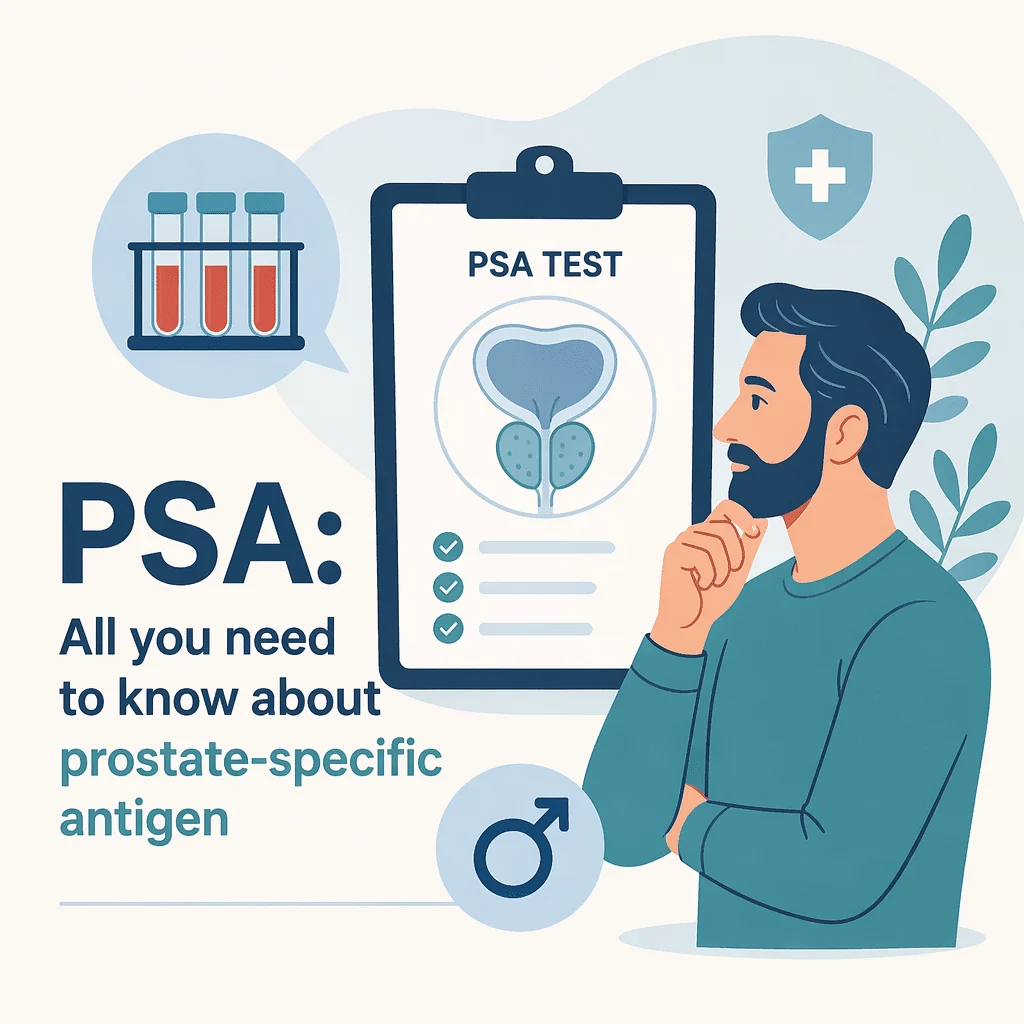
A PSA blood test measures prostate-specific antigen, a protein made by your prostate — not by cancer. That distinction matters more than almost anything else on this page, because most men who receive a mildly raised PSA result do not have prostate cancer. Far more often the cause is benign: an enlarged prostate, an inflamed prostate, a urine infection, or even a long bike ride two days earlier.
In this article you’ll learn what PSA actually is, why doctors order the test, and what pushes the number up apart from cancer. You’ll see how age, the free-to-total ratio, PSA density and PSA velocity change the way a result is read, and why 4 ng/mL is a convention rather than a cliff edge. You’ll also learn what usually happens after a raised result, how the benefits and harms of screening genuinely stack up, and what a normal PSA can and cannot rule out.
What PSA is, and why it is not a cancer-specific test
Prostate-specific antigen is an enzyme — a protein that speeds up a chemical reaction — produced by the cells of the prostate gland. The prostate sits below the bladder and wraps around the urethra, the tube that carries urine out of the body. PSA’s normal job has nothing to do with cancer at all: it liquefies semen after ejaculation so that sperm can move freely.
Most PSA stays in seminal fluid. Only a small fraction leaks into the bloodstream, and that trace amount is what a laboratory measures. The key point is in the name: PSA is prostate-specific, not cancer-specific. It is made by healthy prostate cells and by cancerous ones alike. Anything that disturbs the prostate — growth, inflammation, infection, pressure, injury — can let more PSA escape into the blood.
This is why PSA behaves differently from how many people imagine. It is not a switch that flips on when cancer appears. It is a rough gauge of how much prostate tissue you have and how settled that tissue is. The National Cancer Institute describes PSA plainly as a protein produced by normal as well as malignant prostate cells, and notes that both prostate cancer and several benign conditions can raise it. PSA sits in the broader family of substances doctors track in blood, and if you want the wider picture you can read our overview of tumour markers and their limits. The same “raised does not mean cancer” logic applies to related markers such as the CEA blood test and the alpha-fetoprotein (AFP) blood test.
Why your doctor orders a PSA blood test
The same test is used for three quite different purposes, and they carry very different weight. Confusing them is a common source of unnecessary worry.
Screening: a shared decision, not a routine
Screening means testing a man who has no symptoms, hoping to find cancer early. This is the contested use, and it is not a universal recommendation. The United States Preventive Services Task Force (USPSTF) advises that for men aged 55 to 69, the decision to have periodic PSA screening should be an individual one, made after discussing the benefits and harms with a clinician — a grade C recommendation, meaning the net benefit is small and depends on how you personally weigh the trade-offs. For men aged 70 and over, the USPSTF recommends against PSA-based screening — a grade D recommendation.
Other organisations set the line differently, and risk is not spread evenly. The National Cancer Institute notes that some bodies advise routine testing from age 40 or 45 for men at higher risk: Black men, men with inherited BRCA2 variants (and to a lesser extent BRCA1), and men whose father or brother had prostate cancer. There is no single right answer here. The decision is yours to make with your doctor, in light of your age, your risk, your health and what matters to you.
Monitoring a known prostate cancer
Once prostate cancer has been diagnosed, PSA becomes a far more useful tool. It helps track whether a cancer is behaving quietly or changing, and it underpins active surveillance — a strategy of careful monitoring rather than immediate treatment for low-risk disease. In this setting the number is being read against a known baseline, which makes it much more informative.
Follow-up after treatment
After surgery to remove the prostate, PSA should fall to undetectable levels, because the tissue that made it is gone. After radiation therapy it falls to a low level rather than to zero. A rising trend afterwards may be the first sign that cancer has returned, often months or years before any symptom appears. Even here, a single raised reading does not settle anything — doctors look for a trend over repeated tests. PSA is sometimes drawn alongside other tests, and you may see it reported with results from a male hormone panel.
What raises PSA apart from cancer
A raised PSA is a question, not an answer. Several ordinary things push the number up, and some are as mundane as what you did at the weekend.
Benign prostatic hyperplasia (BPH) — a non-cancerous enlargement of the prostate that becomes very common with age — is the most frequent explanation for a moderately raised PSA after 50. More prostate tissue simply means more PSA. Prostatitis, meaning inflammation of the prostate, can cause large but temporary rises. A urinary tract infection does the same; if you suspect one, our guide to urinary tract infection symptoms and causes explains what to look for. Recent ejaculation, vigorous cycling, a digital rectal examination, catheterisation and a recent prostate biopsy can all nudge or push the number upward.
Because of this, the National Cancer Institute suggests waiting for any such condition to settle before testing, and avoiding activities that raise PSA for about two days beforehand. If you had a biopsy or an infection, PSA can stay raised for a month or two.
| Common cause of a raised PSA | What usually happens next |
|---|---|
| Benign prostatic hyperplasia (age-related enlargement) | Doctor assesses urinary symptoms and prostate size; PSA is interpreted against gland volume rather than a fixed cutoff |
| Prostatitis (inflammation of the prostate) | Treated if needed, then PSA is repeated once the inflammation has settled |
| Urinary tract infection | Infection is treated first; PSA is rechecked weeks later, not immediately |
| Recent ejaculation or vigorous cycling | Test is simply repeated after avoiding these for about two days |
| Digital rectal exam, catheter or recent biopsy | PSA may stay raised for weeks; the doctor waits before drawing conclusions |
| Prostate cancer | Considered alongside all the above; usually a repeat test, then MRI before any biopsy is discussed |
How to read your PSA number
PSA is reported in nanograms per millilitre (ng/mL). A lab report may flag anything above its reference range with an arrow, which can look alarming. Context changes the meaning considerably. If lab reports in general feel opaque, our guide to reading your blood test results is a useful companion, and we also explain what abnormal blood test results tend to signify.
Why 4 ng/mL is a convention, not a cliff
You will see 4 ng/mL treated almost everywhere as the line between normal and abnormal. It is worth understanding what that number is and isn’t. The National Cancer Institute is explicit: there is no single threshold that separates a normal from an abnormal PSA, in part because there is no specific level that means someone has prostate cancer. What is true is a gradient — the higher the level, the likelier cancer becomes. Nothing changes at 3.9 that suddenly changes at 4.1. Treat it as a prompt for conversation, not a verdict.
Age changes the picture
PSA rises naturally with age as the prostate grows. A level that would be unusual in a man of 45 may be entirely ordinary at 75. For this reason some doctors apply a higher cutoff, such as 5 ng/mL, for older men, and a lower one, such as 2.5 ng/mL, for younger men. These age-adjusted ranges are aids to judgement rather than fixed rules, and different labs and clinicians apply them differently.
Free/total ratio, density and velocity
Three refinements help make sense of a borderline result, usually in the 4 to 10 ng/mL range.
- Free/total PSA ratio: PSA circulates either bound to other proteins or unbound (“free”). A higher proportion of free PSA is generally more reassuring and points towards benign enlargement; a lower proportion raises more concern.
- PSA density: your PSA divided by the volume of your prostate, measured on a scan. It asks a fairer question — is this level high for the amount of prostate you actually have? A large gland producing a moderate PSA is less worrying than a small gland doing the same.
- PSA velocity: how fast the number is moving across several tests. A steady value carries a different meaning from one climbing quickly, even when both sit inside the reference range.
Medicines that halve your PSA
This one catches people out. 5-alpha-reductase inhibitors — finasteride and dutasteride, prescribed for benign prostate enlargement and, at lower doses, for hair loss — roughly halve PSA levels after several months. A reading of 2 ng/mL on finasteride may correspond to about 4 ng/mL without it. The National Cancer Institute notes that a lower cutoff for “abnormal” is used in men taking these drugs. Always tell whoever interprets your result that you take one, so the number can be adjusted rather than falsely reassuring.
What happens after a raised PSA result
The modern pathway is deliberately unhurried, and that is a feature rather than a delay.
First, the test is usually repeated. The National Cancer Institute describes a repeat PSA after 6 to 8 weeks to confirm the original finding, because a single reading can be thrown off by any of the causes listed above. Many raised results simply settle on their own.
If the level remains up or keeps climbing, the next step in current practice is typically imaging rather than an immediate biopsy — the so-called MRI-first pathway. A multiparametric MRI scan of the prostate looks for suspicious areas and scores them. This matters because it lets many men avoid a biopsy altogether, and it helps target the needle when a biopsy is warranted. Additional blood or urine tests may also be used to sharpen the risk estimate.
A biopsy, when it happens, means taking small tissue samples through the wall of the rectum or through the perineum, guided by imaging. It is the only way to confirm or exclude cancer in the prostate — but it is not risk-free, which is precisely why the MRI step exists. Along the way your doctor may check a urinalysis to rule out infection, and sometimes a kidney function panel if urinary symptoms are prominent.
Benefits and harms of PSA screening, honestly
PSA screening is neither a scam nor a duty. It is a genuine trade-off, and you deserve to see both sides before deciding.
The benefit is real but modest: screening can find prostate cancer earlier, and pooled evidence from randomised trials points to a small reduction in prostate cancer deaths over about ten years. The harms are also real. The central one is overdiagnosis — finding cancers that grow so slowly they would never have caused symptoms or shortened life. Because it is impossible to know in advance which ones those are, many get treated, and treatment carries lasting costs.
The USPSTF has modelled what happens to 1,000 men aged 55 to 69 screened over 13 years, and the National Cancer Institute reproduces those figures. They are worth sitting with.
| Per 1,000 men screened for 13 years — benefits | Per 1,000 men screened for 13 years — harms |
|---|---|
| About 1 to 2 deaths from prostate cancer are avoided | About 240 men get a positive PSA result, many of them false alarms |
| About 3 men avoid developing cancer that has spread | About 100 men are diagnosed with prostate cancer; around 80 are treated |
| Some cancers are found whilst still confined to the prostate | Around 50 experience sexual dysfunction and about 15 urinary incontinence after treatment |
| A normal result can offer reassurance for a period | Some men have pain, bleeding or infection after biopsy; about 2 are hospitalised |
Roughly 200 of those 1,000 men die of something other than prostate cancer during the same period. That context is not meant to discourage you — it is meant to show why reasonable, well-informed men reach opposite conclusions about this test, and why both conclusions can be right for the man making them.
What a normal PSA does — and does not — rule out
A low or normal PSA is genuinely reassuring, and it is the most likely result. But it does not rule out prostate cancer. Some prostate cancers, including some aggressive ones, produce little PSA, and a man can have a level well under 4 ng/mL and still have cancer present. This is the mirror image of the point at the top of this article: the test is imperfect in both directions.
What that means in practice is straightforward. A normal PSA does not cancel out symptoms. If you have urinary difficulty, blood in your urine or semen, or bone pain, those deserve attention on their own terms regardless of what your PSA says. Our guide to blood in urine (haematuria) covers one such symptom in more detail.
When to see a doctor
Book an appointment, without panic but without delay, if any of the following apply:
- Your PSA is raised and has not been rechecked, or it is rising across successive tests.
- You have difficulty passing urine, a weak stream, or you need to urinate often at night.
- You notice blood in your urine or semen.
- You have persistent pelvic, hip or back pain that has no obvious explanation.
- You are considering PSA screening and want to talk the decision through properly.
- You have a father or brother who had prostate cancer, a known BRCA variant, or you are a Black man and want to discuss earlier testing.
- You take finasteride or dutasteride and your PSA has been interpreted without that being taken into account.
Latest scientific advances in PSA testing
Research since 2023 has moved away from asking whether PSA works and towards asking how to use it more intelligently. According to studies indexed in PubMed, four findings stand out.
The CAP trial, reported by Martin and colleagues in JAMA in 2024, followed more than 400,000 men in England and Wales for a median of 15 years after a single invitation to have a PSA test. What was found: the invited group had slightly fewer prostate cancer deaths than the group not invited — a difference of under one death per 1,000 men over 15 years. The invitation also detected noticeably more low-grade and localised cancers, but no more of the aggressive ones. What this means for you: a one-off PSA test delivers a small benefit, and much of what it finds is disease that was never going to cause harm. That is overdiagnosis measured directly, in a randomised trial — one where participants are assigned by chance to make the comparison fair.
Rajendran and colleagues, writing in The British Journal of Radiology in 2024, tested biopsy decision pathways on a real-world group of just over 2,000 men who had never had a biopsy. What was found: combining an MRI score with PSA density let roughly half to nearly two-thirds of men skip a biopsy, while missing only a small minority of the significant cancers. What this means for you: if your PSA is raised, an MRI plus a PSA density calculation may spare you the biopsy entirely — this is the evidence behind the MRI-first pathway your doctor may follow.
Zhang and colleagues published a systematic review — a structured summary of all the relevant studies — in Frontiers in Oncology in 2024. What was found: the benefit of PSA screening depends heavily on who is screened and how often, and blanket screening of everyone drives overdiagnosis and overtreatment without proportionate gain. What this means for you: it reinforces why your age, family history and personal preferences shape the answer more than the test itself does.
Finally, the PI-CAI study by Saha and colleagues in The Lancet Oncology in 2024 compared an artificial intelligence system against 62 radiologists reading prostate MRI scans. What was found: on average the AI matched or outperformed the radiologists using standard scoring, but when compared against real-world clinical practice — where radiologists also have your history and can consult colleagues — it did not prove non-inferior. The authors call for prospective testing before clinical use. What this means for you: AI may eventually help reduce unnecessary biopsies, but it is a research tool at this stage, not something that replaces the clinicians reading your scan.
For a plain-language institutional summary of where PSA research is heading, the National Cancer Institute PSA fact sheet is the best starting point.
Glossary
| Term | Definition |
|---|---|
| Prostate-specific antigen (PSA) | A protein made by the prostate gland, by both healthy and cancerous cells, whose main job is to liquefy semen. A trace amount reaches the blood. |
| ng/mL | Nanograms per millilitre — the unit PSA is measured in. A nanogram is one billionth of a gram. |
| Benign prostatic hyperplasia (BPH) | Non-cancerous enlargement of the prostate, very common with age, and the most frequent reason for a moderately raised PSA after 50. |
| Prostatitis | Inflammation of the prostate, which can be caused by infection and can raise PSA sharply but temporarily. |
| Free/total PSA ratio | The proportion of PSA circulating unbound to other proteins. A higher proportion generally points towards a benign cause. |
| PSA density | PSA level divided by prostate volume, measured on a scan. It judges the level against the amount of prostate tissue present. |
| PSA velocity | How quickly PSA changes across repeated tests over time, rather than its value on any single day. |
| Overdiagnosis | Finding a cancer that would never have caused symptoms or shortened life. Treating it is called overtreatment. |
| Multiparametric MRI | A detailed prostate scan combining several imaging techniques, used before biopsy to decide whether one is needed and where to aim. |
| Active surveillance | Monitoring a low-risk prostate cancer closely with repeat tests instead of treating it immediately. |
Frequently asked questions
What are normal PSA levels by age?
There is no universal answer, and that is the honest position rather than an evasion. PSA rises naturally as the prostate grows with age, so many clinicians read a result against age rather than one fixed line. Some apply a lower cutoff such as 2.5 ng/mL for younger men and a higher one such as 5 ng/mL for older men, but these thresholds vary between laboratories and doctors. The National Cancer Institute states directly that no single threshold separates normal from abnormal. Your own trend over time, your prostate size and your risk factors tell your doctor more than any age chart can.
What does a high PSA level actually mean?
Most often it means something benign. An enlarged prostate, prostatitis, a urine infection, recent ejaculation, a bike ride, a rectal examination or a recent biopsy can all raise the number. Cancer is one possibility among several, not the default explanation. Of the men who go on to have a biopsy because of a raised PSA, only about a quarter turn out to have prostate cancer. The usual next step is simply to repeat the test after a few weeks, because many raised results settle by themselves once the temporary cause has passed.
How can I lower my PSA level?
This is a common search, and it deserves a careful answer. Deliberately lowering a PSA number is not the goal — the number is a signal, and masking it does not improve your health. What is reasonable is avoiding things that falsely inflate a reading before a test: no ejaculation or vigorous cycling for about two days beforehand, and waiting for any infection or inflammation to settle. Some medicines, notably finasteride and dutasteride, genuinely halve PSA, but they are prescribed to treat prostate enlargement, not to improve a test result. Discuss any supplement or diet claims with your doctor before acting on them.
Does the PSA blood test require fasting?
No. PSA is a straightforward blood draw and you do not need to fast for it. What does matter is timing relative to other things: avoid ejaculation and vigorous cycling for about two days beforehand, and mention any recent digital rectal examination, catheter, biopsy or urine infection, since these can raise the result for weeks. Also tell whoever orders the test if you take finasteride or dutasteride, so your result is interpreted correctly.
Can a young man have a high PSA level?
It is uncommon but it does happen. In men under 40, the usual explanation is prostatitis — inflammation of the prostate, which can push PSA up substantially and then settle again once treated. Prostate cancer is rare at that age, though it is not impossible, particularly with a strong family history or a known BRCA variant. If you are young and have a raised PSA, the sensible route is a conversation with your doctor and a repeat test rather than alarm.
Should I have a PSA test at all?
That is genuinely your decision to make with your doctor, and there is no universally correct answer. The USPSTF suggests men aged 55 to 69 make an individual choice after weighing benefits and harms, and advises against screening at 70 and over. If you are at higher risk — Black men, a father or brother with prostate cancer, or a BRCA variant — some organisations suggest starting the conversation earlier, around 40 to 45. What helps is going in prepared: ask what a positive result would lead to, what the MRI-first pathway looks like where you are treated, and how you personally feel about the possibility of finding a cancer that might never have troubled you.
Sources
- National Cancer Institute — Prostate-Specific Antigen (PSA) Test — cancer.gov, updated 2025 — https://www.cancer.gov/types/prostate/psa-fact-sheet
- U.S. Preventive Services Task Force — Prostate Cancer: Screening (recommendation statement) — uspreventiveservicestaskforce.org — https://www.uspreventiveservicestaskforce.org/uspstf/recommendation/prostate-cancer-screening
- David J, Leslie SW — Prostate-Specific Antigen — StatPearls, NCBI Bookshelf, 2026 — https://www.ncbi.nlm.nih.gov/books/NBK557495/
- Martin RM, Turner EL, Young GJ, et al. — Prostate-Specific Antigen Screening and 15-Year Prostate Cancer Mortality: A Secondary Analysis of the CAP Randomised Clinical Trial — JAMA, 2024 — https://doi.org/10.1001/jama.2024.4011
- Rajendran I, Lee KL, Thavaraja L, Barrett T — Risk stratification of prostate cancer with MRI and prostate-specific antigen density-based tool for personalized decision making — The British Journal of Radiology, 2024 — https://doi.org/10.1093/bjr/tqad027
- Zhang Z, Tian A, Che J, et al. — Application and optimization of prostate-specific antigen screening strategy in the diagnosis of prostate cancer: a systematic review — Frontiers in Oncology, 2024 — https://doi.org/10.3389/fonc.2023.1320681
- Saha A, Bosma JS, Twilt JJ, et al. — Artificial intelligence and radiologists in prostate cancer detection on MRI (PI-CAI): an international, paired, non-inferiority, confirmatory study — The Lancet Oncology, 2024 — https://doi.org/10.1016/S1470-2045(24)00220-1
Further reading
- To understand another marker read with the same caution, see our guide to the CA 125 blood marker
- For a marker where benign causes are equally common, read our explanation of the CA 19-9 blood marker
- To put any lab flag in context, consult our reference chart of normal blood test ranges
- For where early detection research is heading, read our update on the multi-cancer early detection test
- For a related aspect of men’s health, see our guide to low testosterone in men
Understand your lab results with AI DiagMe
A report listing total PSA, free PSA, creatinine and a urinalysis can be hard to make sense of on your own, especially when arrows and reference ranges suggest more certainty than the numbers actually carry. AI DiagMe translates that language into plain English so you arrive at your appointment understanding what was measured and what to ask. It helps you understand your results — it does not diagnose you, it cannot confirm or exclude cancer, and it does not replace your doctor.
Get your results interpreted in minutes