






































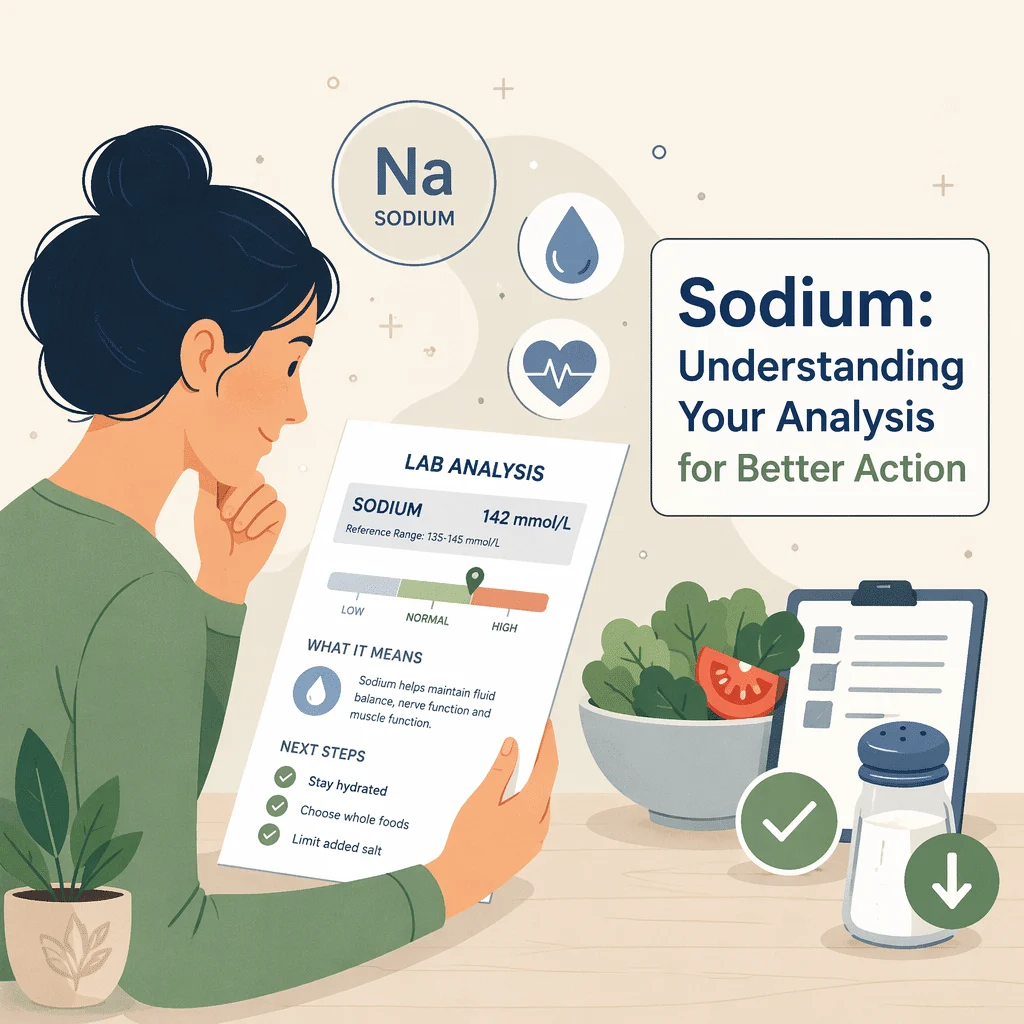
A sodium blood test measures the amount of sodium, an electrolyte, circulating in your blood. In this article, you’ll learn what counts as a normal sodium range, what low sodium (hyponatraemia) and high sodium (hypernatraemia) mean, why hydration and kidney or heart function influence your result, and when a change in this number is worth discussing with your doctor. Sodium is one of the most frequently ordered blood values, and most results fall comfortably within a narrow, reassuring range that your doctor can quickly interpret.
What sodium is and why your body needs it
Sodium (chemical symbol Na+) is an electrolyte, a mineral that carries a small electrical charge when dissolved in body fluids. Your body cannot make sodium on its own; it comes entirely from food and drinks, most commonly table salt (sodium chloride), though many processed foods contain far more hidden sodium than people expect.
Once absorbed by the intestine, sodium travels in the bloodstream and performs several essential jobs:
- Maintaining fluid balance between the inside and outside of your cells
- Supporting nerve signal transmission throughout the body
- Enabling muscle contraction, including the heartbeat
- Helping regulate blood pressure through blood volume
- Assisting the absorption of certain nutrients in the gut
Because sodium interacts closely with water balance, it also reflects how well your kidneys and cardiovascular system are managing fluid overall. Sodium concentration in your blood is not simply a measure of how much salt you have eaten. Instead, it reflects the ratio between the sodium in your body and the water surrounding it. This is an important distinction: a low sodium reading can happen even with completely normal salt intake if your body is holding onto extra water, and a high sodium reading can occur even without eating extra salt if you have lost more water than sodium. Several hormones, including one that signals the kidneys to conserve water, work continuously in the background to keep this ratio stable.
How the sodium blood test works
A sodium blood test uses a small blood sample drawn from a vein, usually in your arm, in the same way as most routine blood work. There is no special preparation required for the sodium measurement itself, and results are typically available within a day.
Doctors order a sodium test in many situations, including:
- As part of routine blood work or an annual check-up
- To investigate symptoms such as confusion, fatigue, muscle weakness, or unusual thirst
- To monitor chronic conditions affecting the heart, kidneys, or liver
- To check for side effects of medications known to influence sodium, such as diuretics
- Before and after surgery, or during hospitalisation, to track fluid status
Because sodium is so closely tied to hydration, your doctor will usually interpret the number together with your clinical picture, meaning your symptoms, your medication list, and sometimes additional tests such as urine sodium or osmolality, a measure of how concentrated a fluid is.
Normal sodium blood test ranges
A standard sodium blood test reports a concentration in millimoles per litre (mmol/L, sometimes written mEq/L). Most laboratories consider the same general interval normal for healthy adults, though exact cutoffs can vary slightly by lab and equipment.
| Result | Sodium level (mmol/L) | What it generally suggests |
|---|---|---|
| Low (hyponatraemia) | Below 135 | Excess water relative to sodium, or significant sodium loss |
| Normal | 135 to 145 | Typical range for most healthy adults |
| High (hypernatraemia) | Above 145 | Relative water deficit, most often linked to dehydration |
A single abnormal number rarely tells the whole story. Your doctor interprets your sodium result alongside your symptoms, your hydration status, and other values from the same comprehensive metabolic panel, including potassium and bicarbonate.
How to read your sodium result
Deciphering a sodium result is more approachable once you know a few conventions. A typical line on a lab report might look like: Sodium (Na+): 140 mmol/L, reference range 135–145 mmol/L.
- mmol/L stands for millimoles per litre, the standard unit for sodium concentration.
- The reference range is the interval considered typical for most healthy people at that laboratory; it can shift slightly between labs.
- Na+ is simply the chemical symbol for sodium, with a plus sign showing its electrical charge.
Before discussing results with your doctor, it can help to ask yourself a short set of questions. If you want a broader primer on interpreting any panel, see our guide on how to read blood test results.
- Is my value inside the reference range, or just outside it?
- If it is abnormal, is the difference small or substantial?
- Are related values, such as potassium or creatinine, also abnormal?
- Am I taking any medication known to affect sodium, such as a diuretic?
- Have I recently changed my fluid intake, diet, or activity level?
Hyponatraemia: when sodium is too low
Hyponatraemia means a blood sodium level below 135 mmol/L. It is the most common electrolyte disorder seen in medical practice, particularly amongst hospitalised and older patients. It typically develops when the body retains too much water relative to sodium, though it can also result from significant sodium loss.
Doctors generally describe hyponatraemia by how low the level is and how quickly it developed, since both factors shape the treatment approach. A mildly low level, roughly 130 to 134 mmol/L, often causes few or no symptoms and may simply be monitored. A moderate drop, around 125 to 129 mmol/L, is more likely to produce noticeable symptoms and typically prompts a closer look at the underlying cause. A severe or rapidly falling level, generally below 125 mmol/L, is treated as a more urgent situation, particularly if it develops quickly or is accompanied by neurological symptoms.
Common causes of low sodium
- Certain medications, especially diuretics, some antidepressants, and pain relievers
- Excess fluid intake relative to the kidneys’ ability to excrete water
- Hormonal conditions affecting water retention, including a condition called SIAD (syndrome of inappropriate antidiuresis, where the body releases a hormone that tells the kidneys to hold onto water even when it is not needed)
- Heart, liver, or kidney disease that alters fluid handling
- Significant vomiting, diarrhoea, or heavy sweating without adequate salt replacement
To find the underlying cause, your doctor will typically assess your fluid status first, checking whether you appear to have too little, too much, or a normal amount of fluid in your body overall. This assessment, combined with a urine sodium test and sometimes hormone levels, usually points towards one of the causes above.
Symptoms of hyponatraemia
Mild hyponatraemia can be symptom-free or cause only nonspecific complaints. Possible signs include nausea, headache, fatigue, muscle cramps, and confusion. Severe or rapidly developing hyponatraemia is more serious and can cause seizures or significant confusion, which is why sudden or pronounced drops warrant prompt medical attention. Even mild, long-standing low sodium is not entirely without consequence: it has been associated with subtle balance problems and an increased likelihood of falls in older adults, which is one reason doctors take seemingly small deviations seriously in this age group.
Seizures that keep coming back without such a trigger point elsewhere: read how epilepsy is diagnosed and treated.
Hypernatraemia: when sodium is too high
Hypernatraemia refers to a blood sodium level above 145 mmol/L. It is most often linked to dehydration, meaning the body has lost more water than sodium, which concentrates the sodium that remains. It is somewhat less common than hyponatraemia overall, but it disproportionately affects infants, older adults, and people who are hospitalised or unable to access water independently, since an intact thirst mechanism and the ability to drink are usually enough to prevent it.
Common causes of high sodium
- Inadequate fluid intake, particularly in older adults or people with reduced thirst sensation
- Excessive fluid losses from fever, prolonged sweating, vomiting, or diarrhoea
- Diabetes insipidus, a condition in which the kidneys are unable to concentrate urine properly
- Certain medications or, less commonly, excess salt intake without matching water intake
Symptoms of hypernatraemia
Typical symptoms include intense thirst, dry mouth and mucous membranes, irritability or confusion, and muscle weakness. As with low sodium, the severity of symptoms tends to track both how high the level is and how quickly it rose. A gradual, mild elevation may cause little more than increased thirst, while a sharp or severe rise can affect brain function more noticeably and is treated as a more urgent situation. Because dehydration is the leading driver, your doctor may also check your kidney function panel to understand how your kidneys are managing fluid and waste, and correction is typically done gradually with careful fluid replacement rather than all at once.
Sodium, hydration, kidney, and heart function
Sodium never works alone. Its balance depends on a close relationship with water intake, kidney filtering capacity, and cardiovascular function. When sodium rises too high, water moves out of cells to dilute the surrounding blood, which can concentrate blood volume and affect blood pressure. When sodium drops too low, water moves into cells, which can cause them to swell, a change that is particularly significant for brain tissue, since the skull leaves little room for expansion.
Because the kidneys are the main regulators of sodium and water excretion, impaired kidney function can make it harder to correct a sodium imbalance. Healthy kidneys can adjust how much sodium and water they excrete within a wide range, which is why sodium levels usually stay remarkably stable even when dietary salt or fluid intake varies from day to day. When kidney function declines, that adjustment capacity narrows, making both high and low sodium more likely and often slower to correct. You can learn more about this filtering capacity in our guide to eGFR (estimated glomerular filtration rate).
The heart and blood vessels are equally involved in this balance. Sodium and water together determine blood volume, and blood volume is one of the main factors your body uses to regulate blood pressure. Similarly, because sodium influences blood volume, chronic imbalance can play a role in high blood pressure and can complicate heart failure management, since both conditions involve careful fluid regulation. In heart failure specifically, the body sometimes retains water in a way that dilutes blood sodium even though total body sodium may actually be increased, which is why sodium results in this context are always interpreted alongside the broader clinical picture rather than in isolation. If your sodium sits at the edge of the normal range, your doctor may also review how well you are staying hydrated; our overview of dehydration and blood pressure explains this connection in more detail.
Sodium is usually measured as part of a broader electrolyte panel, alongside potassium, chloride, and bicarbonate. Looking at these values together gives a fuller picture than sodium alone, since imbalances in one electrolyte often affect the others, and an isolated sodium change can sometimes be explained by a shift in a neighbouring value rather than a separate problem.
When to see a doctor
Most sodium results that fall slightly outside the reference range are not emergencies, but certain situations call for prompt medical evaluation.
- Your sodium level is significantly outside the normal range, rather than just marginally so
- You experience new confusion, severe headache, muscle weakness, or seizures
- You have heart, liver, or kidney disease and notice new swelling, breathlessness, or fatigue
- You take a diuretic, antidepressant, or anti-seizure medication and develop nausea or unusual tiredness
- You show signs of dehydration, such as intense thirst and dry mouth, that do not improve with fluids
Contact your doctor promptly if any of these apply. For very sudden or severe symptoms, such as seizures or loss of consciousness, seek emergency care straight away.
Practical tips for supporting a healthy sodium balance
These general habits support balanced sodium levels but never replace personalised medical advice.
- If your level tends to run high, limit ultra-processed foods, which often contain hidden salt, and favour herbs and spices for flavour instead.
- If your level tends to run low and you have no medical contraindication, avoid restricting salt too aggressively without your doctor’s guidance.
- Maintain steady hydration with appropriate fluids, especially during exercise, hot weather, or illness.
- Never stop or adjust a diuretic, antidepressant, or other sodium-affecting medication without consulting your prescriber.
- Ask your doctor how often you should recheck your sodium if you have a chronic condition affecting the kidneys, heart, or hormones.
Recent scientific advances
A 2025 survey of endocrinologists across 36 European countries examined how doctors actually manage severe, symptomatic low sodium levels in hospital settings (Beck et al., European Journal of Endocrinology). Practice varied considerably: some clinicians used a single concentrated salt solution given in bolus doses, others preferred a slower continuous infusion, and about a third of respondents had encountered a patient with suspected overly rapid correction, a rare complication called osmotic demyelination syndrome (nerve damage in the brain that can occur if sodium is corrected too quickly). What this means for you: severe hyponatraemia is treated cautiously and deliberately in hospital, with doctors closely monitoring how fast your sodium rises rather than aiming for a rapid fix, precisely to avoid this rare complication.
A 2023 review in Endocrine Reviews examined the syndrome of inappropriate antidiuresis (SIAD), a hormonal cause of low sodium in which the body retains water it does not need (Warren et al.). The review noted that limiting fluid intake is the standard first-line approach, but it does not fully resolve the imbalance in roughly half of cases, prompting some patients to need additional medication. What this means for you: if you are diagnosed with SIAD-related low sodium, do not be discouraged if fluid restriction alone is not enough; doctors have several second-line options and will adjust the plan based on how your levels respond.
A comprehensive 2022 review in JAMA (Adrogue et al.) reported that hyponatraemia affects roughly 5 percent of adults overall and up to about a third of hospitalised patients, making it the most frequent electrolyte disorder encountered in medicine. The review also highlighted that even mild, chronic low sodium has been linked to a higher rate of falls and fractures in older adults. What this means for you: because low sodium can be subtle and common, especially with ageing, doctors often recheck sodium levels routinely in older patients or those on certain medications, even without dramatic symptoms.
Glossary
| Term | Definition |
|---|---|
| Electrolyte | A mineral that carries an electrical charge in body fluids. Sodium, potassium, and chloride are common examples that help regulate fluid balance and nerve function. |
| Hyponatraemia | A blood sodium level below 135 mmol/L. It is usually caused by the body retaining too much water relative to sodium. |
| Hypernatraemia | A blood sodium level above 145 mmol/L. It is most often related to dehydration, where water loss exceeds sodium loss. |
| mmol/L | Millimoles per litre, the standard laboratory unit used to report sodium concentration in blood. |
| SIAD (syndrome of inappropriate antidiuresis) | A hormonal condition in which the body releases too much antidiuretic hormone, causing the kidneys to retain water and diluting blood sodium. |
| Osmotic demyelination syndrome | A rare but serious nerve condition that can occur if chronically low sodium is corrected too quickly. It is why doctors raise sodium levels gradually. |
| Diuretic | A type of medication that increases urine output. Diuretics are a common cause of low sodium because they can increase sodium loss through the kidneys. |
| Diabetes insipidus | A condition in which the kidneys cannot concentrate urine properly, leading to excessive water loss and a risk of high sodium levels. |
| Comprehensive metabolic panel | A group of blood tests, including sodium, potassium, and kidney and liver markers, that gives a broad snapshot of metabolic health. |
Frequently asked questions about the sodium blood test
What is a sodium blood test called on a lab report?
It is usually listed simply as “Sodium” or “Na+” on a standard lab report, often as part of a basic or comprehensive metabolic panel or an electrolyte panel. Some reports may also label it “serum sodium” to specify that it was measured in the liquid portion of your blood rather than in urine.
Do I need to fast before a sodium blood test?
Fasting is generally not required for a sodium test itself, since sodium levels are not significantly affected by recent food intake. However, if it is taken alongside other tests, such as glucose or a lipid panel, your doctor may ask you to fast beforehand. Always follow the specific instructions given for your appointment.
Can sodium levels be low even with normal salt intake?
Yes. Several situations can lower blood sodium despite typical dietary salt intake. Certain medications, such as diuretics, increase sodium loss through urine. Hormonal conditions, including SIAD, or certain kidney and heart conditions can cause the body to retain water, which dilutes blood sodium even when salt intake has not changed.
What causes high sodium levels in the blood?
High sodium is most commonly caused by dehydration, meaning the body has lost more water than sodium. This can happen with inadequate fluid intake, prolonged fever, heavy sweating, vomiting, or diarrhoea. Less commonly, a condition called diabetes insipidus, or certain medications, can also raise sodium levels.
Is a low sodium level dangerous?
It depends on how low the level is and how quickly it developed. Mild, gradual hyponatraemia is often manageable and may cause few or no symptoms. Severe or rapidly developing low sodium is more serious and can cause confusion or seizures, so it requires prompt medical attention and careful, gradual correction under medical supervision.
What is the difference between blood sodium and table salt?
Table salt, or sodium chloride, is roughly 40 percent sodium and 60 percent chloride by weight. A blood sodium test measures only the sodium concentration circulating in your blood, not your dietary salt intake directly. High salt consumption does not automatically cause hypernatremia, since healthy kidneys typically eliminate the excess, though it remains a recognised risk factor for high blood pressure over time.
Further reading
- Learn how sodium fits into the broader electrolyte panel and why these markers are usually interpreted together.
- Understand what other values in your comprehensive metabolic panel can reveal about your metabolic health.
- Review general guidance on normal blood test ranges to understand how reference intervals are set.
- Find out what to do next if you receive abnormal blood test results on any marker.
- See our overview of the blood test process to know what to expect at your next draw.
Sources
- MedlinePlus (National Library of Medicine, NIH) — Sodium Blood Test, 2024 — https://medlineplus.gov/lab-tests/sodium-blood-test/
- Mayo Clinic — Hyponatraemia: Symptoms and Causes, 2024 — https://www.mayoclinic.org/diseases-conditions/hyponatremia/symptoms-causes/syc-20373711
- Cleveland Clinic — Hyponatraemia: Causes, Symptoms, Diagnosis and Treatment, 2024 — https://my.clevelandclinic.org/health/diseases/17762-hyponatremia
- Beck J, Arshad MF, Iqbal A, Christ-Crain M — Severe symptomatic hyponatraemia in Europe: insights into current clinical practice — European Journal of Endocrinology, 2025 — https://doi.org/10.1093/ejendo/lvaf115
- Warren AM, Grossmann M, Christ-Crain M, Russell N — Syndrome of Inappropriate Antidiuresis: From Pathophysiology to Management — Endocrine Reviews, 2023 — https://doi.org/10.1210/endrev/bnad010
- Adrogue HJ, Tucker BM, Madias NE — Diagnosis and Management of Hyponatraemia: A Review — JAMA, 2022 — https://doi.org/10.1001/jama.2022.11176
Understand your lab results with AI DiagMe
Sodium is just one of dozens of values on a typical blood panel, and its meaning often depends on the numbers around it. Interpreting your lab results in context, alongside markers like potassium, creatinine, and eGFR, can help you understand what your body is telling you and which questions to bring to your doctor. This kind of interpretation is meant to support your understanding, not to diagnose a condition or replace a consultation with a qualified physician.
Get your results interpreted in minutes