






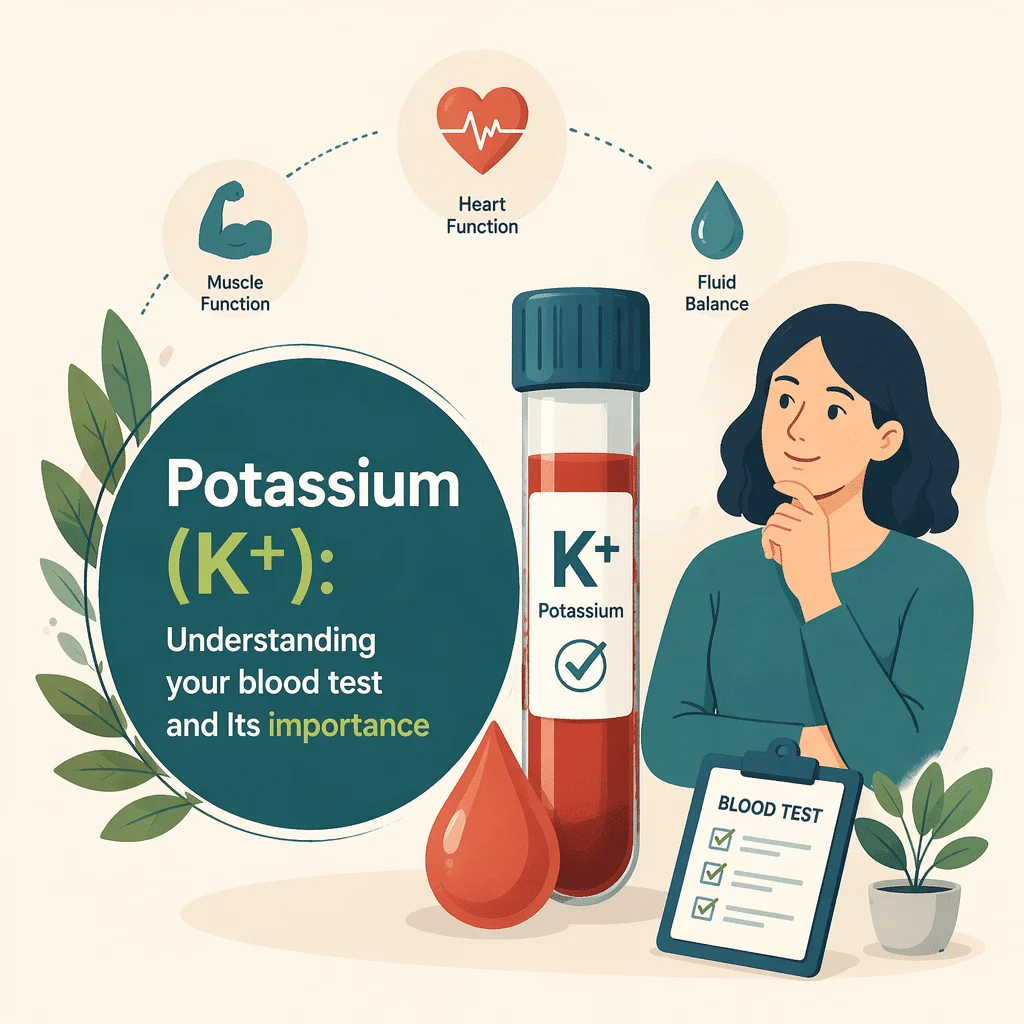
A potassium blood test measures how much potassium is circulating in your blood, a mineral that keeps your heart beating in rhythm, your muscles contracting properly, and your nerves signalling correctly. Doctors order this test often, whether as part of routine blood tests or to check on kidney function, blood pressure medications, or unexplained muscle symptoms. In this article, you’ll learn what a normal range looks like, what it means when your result is too high (hyperkalaemia) or too low (hypokalaemia), which medications and health conditions most often affect this marker, and when a result deserves urgent attention rather than simple monitoring.
What potassium does in your body
Potassium is an electrolyte, a mineral that carries a small electrical charge when dissolved in body fluids. Your body cannot manufacture it, so every bit comes from food, particularly fruits, vegetables, legumes, and dairy. Once absorbed by the intestine, potassium travels through the blood and is quickly taken up by cells.
About 98% of your body’s potassium sits inside cells, while only around 2% circulates in the blood, which is exactly what a standard electrolyte panel blood test measures. Alongside sodium, which sits mostly outside cells, potassium creates the electrical gradient that lets nerves fire and muscles, including the heart muscle, contract. Your kidneys act as the main gatekeepers of this balance, filtering blood continuously and adjusting how much potassium leaves in urine.
Normal potassium blood test range
Most laboratories consider a potassium blood test normal between 3.5 and 5.0 mmol/L (millimoles per litre) in adults, though the exact cutoffs can shift slightly depending on the lab and the equipment used. Values are typically listed alongside a reference range on your report, with a flag or colour code marking anything outside it.
The table below summarises how results are generally classified, though your doctor will always interpret your number in the context of your symptoms, medications, and overall health.
| Category | Typical range (mmol/L) | General interpretation |
|---|---|---|
| Hypokalemia (low) | Below 3.5 | Often from fluid loss, certain diuretics, or low intake |
| Normal | 3.5 to 5.0 | Expected range for most healthy adults |
| Mild hyperkalemia | 5.1 to 5.5 | Usually warrants a repeat test and review of medications |
| Moderate hyperkalemia | 5.6 to 6.0 | Typically needs prompt medical review within days |
| Severe hyperkalemia | Above 6.0 | Considered a medical emergency requiring immediate care |
Keep in mind that a single unexpected result is not always meaningful. Red blood cells can rupture during sample collection or transport, a process called haemolysis, which artificially releases potassium into the sample and can produce a falsely high reading. If your result looks surprising given your health history, your doctor may simply repeat the test.
Hyperkalemia: when potassium is too high
Hyperkalaemia describes a blood potassium level above the normal range, generally over 5.0 mmol/L. It can develop silently or announce itself through muscle weakness, tingling, nausea, or a heartbeat that feels irregular or slowed. The greatest concern with hyperkalaemia is its effect on the heart’s electrical system, since high potassium can disrupt the signals that keep your heartbeat steady.
Common causes of high potassium
- Reduced kidney function, which is the most frequent cause, since failing kidneys cannot clear potassium efficiently, a topic covered in more detail in our kidney function panel guide.
- Certain medications, especially ACE inhibitors and ARBs (angiotensin-converting-enzyme inhibitors and angiotensin receptor blockers) prescribed for high blood pressure, potassium-sparing diuretics such as spironolactone, and some anti-inflammatory drugs.
- Large-scale cell breakdown from severe trauma, burns, or certain cancer treatments, which releases the potassium normally stored inside cells.
- Metabolic acidosis (blood that is more acidic than normal), which pushes potassium out of cells and into the bloodstream.
- Rarely, excessive potassium intake from supplements or very large amounts of potassium-rich foods, particularly in someone whose kidneys are already struggling.
Hypokalaemia: when potassium is too low
Hypokalaemia means a blood potassium level below 3.5 mmol/L. It usually results from the body losing more potassium than it takes in, rather than from simply eating too little of it.
Common causes of low potassium
- Digestive losses from repeated vomiting or significant diarrhoea, which can drain potassium quickly.
- Diuretic medications, particularly thiazide and loop diuretics, which increase how much potassium the kidneys excrete in urine.
- Hormonal or kidney conditions, such as hyperaldosteronism, that push the kidneys to eliminate more potassium than usual.
- Metabolic alkalosis (blood that is more alkaline than normal), which drives potassium from the blood into cells.
- Severe malnutrition or chronic heavy alcohol use, which limits potassium intake and absorption over time.
Symptoms of hypokalaemia can include muscle weakness or cramps, constipation, persistent fatigue, and heart rhythm disturbances. Because roughly 98% of the body’s potassium is stored inside cells rather than in the blood, it is possible to have symptoms suggestive of deficiency even when a blood test looks normal, particularly if the imbalance is developing gradually.
How potassium connects to kidney and heart health
Your kidneys are the primary regulators of blood potassium, filtering it continuously and adjusting excretion based on the body’s needs. When kidney function declines, whether from chronic kidney disease, dehydration, or certain medications, potassium regulation becomes less reliable, which is why doctors frequently order a potassium test alongside creatinine and eGFR to assess overall kidney filtration.
Potassium also plays a direct role in heart rhythm. Both very high and very low levels can interfere with the heart’s electrical conduction system, sometimes producing arrhythmias detectable on an electrocardiogram (ECG). This is particularly relevant for people managing heart failure, where potassium-affecting medications are often essential to treatment but require regular monitoring to use safely.
Because sodium, chloride, and bicarbonate work together with potassium to maintain fluid and acid-base balance, doctors often review this marker as part of a broader panel rather than in isolation, such as a comprehensive metabolic panel, alongside sodium, chloride, and bicarbonate results.
Doctors typically recheck potassium every three to six months for people on stable RAAS inhibitor therapy or diuretics, and more often after a dose change or a new diagnosis of kidney disease, so that any drift out of range is caught early rather than after symptoms appear.
Medications that affect potassium levels
Several common medication classes shift potassium in predictable directions, which is why your doctor reviews your full medication list whenever a result comes back abnormal.
- ACE inhibitors and ARBs, widely prescribed for high blood pressure, heart failure, and kidney protection, reduce potassium excretion and can raise blood levels, especially when combined with reduced kidney function.
- Potassium-sparing diuretics, such as spironolactone and eplerenone, work by retaining potassium and can push levels upward if not monitored.
- Thiazide and loop diuretics tend to have the opposite effect, increasing potassium loss through urine and sometimes causing hypokalaemia.
- Beta-blockers can slightly raise blood potassium by limiting how easily potassium enters cells, an effect that is monitored more closely in people with reduced kidney function.
None of this means these medications are unsafe. RAAS inhibitors (renin-angiotensin-aldosterone system inhibitors, the drug family that includes ACE inhibitors and ARBs) remain central to treating high blood pressure, heart failure, and chronic kidney disease specifically because they protect the heart and kidneys over the long term. The goal of monitoring potassium is to keep using these protective medications safely, not to avoid them.
When to see a doctor
Most mildly abnormal potassium results are not emergencies, but the appropriate response depends on how far outside the normal range the value falls and whether symptoms are present.
- A mildly abnormal result, roughly between 5.1 and 5.5 mmol/L or between 3.0 and 3.4 mmol/L, is often addressed with a repeat test in the coming weeks and simple dietary or medication adjustments.
- A moderately abnormal result, roughly 5.6 to 6.0 mmol/L or 2.5 to 2.9 mmol/L, generally calls for a prompt appointment, often within days, so medications and follow-up testing can be reassessed.
- A severely abnormal result, above 6.0 mmol/L or below 2.5 mmol/L, is considered a medical emergency. This is especially true if it comes with palpitations, significant muscle weakness, dizziness, or fainting, and generally calls for immediate care at an emergency department rather than waiting for a routine appointment.
Never stop or adjust a prescribed medication on your own because of a potassium result. Changes to ACE inhibitors, ARBs, diuretics, or other heart and kidney medications should always be guided by your doctor, who can weigh the benefits of the treatment against the potassium-related risk.
Managing your potassium through diet and lifestyle
If you have been told to watch your potassium level, simple dietary awareness can help, though any structured dietary change should be discussed with your doctor or a dietitian first, particularly if you have kidney disease.
If your potassium runs high
Foods particularly rich in potassium include bananas, avocados, dried apricots, oranges, potatoes, spinach, and legumes such as lentils and beans. Salt substitutes labelled “reduced sodium” or “lite salt” often replace sodium chloride with potassium chloride, so they deserve a careful look at the label.
If your potassium runs low
The same potassium-rich foods, bananas, oranges, potatoes with the skin on, spinach, and squash, are generally encouraged if your levels are low, alongside adequate hydration to support normal kidney function.
In both cases, never start or stop a potassium supplement without medical guidance, since self-directed supplementation can push a low level too high, particularly if kidney function is reduced.
Recent scientific advances
Managing hyperkalaemia safely, especially in people who need RAAS inhibitors for heart or kidney protection, has been an active area of clinical research in recent years. Newer potassium-binding medications are changing how doctors approach this balance.
A 2025 review in Heart Failure Reviews examined how hyperkalaemia is managed in people with heart failure with reduced pumping strength (heart failure with reduced ejection fraction, a type of heart failure where the heart’s main pumping chamber does not contract as forcefully as it should). It found that newer potassium binders, patiromer and sodium zirconium cyclosilicate, along with combining treatments like SGLT2 inhibitors (a class of diabetes and heart failure medication) with RAAS inhibitors, can help patients stay on life-prolonging heart failure medications that might otherwise need to be reduced or stopped because of high potassium. What this means for you: if you take heart failure medications and have experienced elevated potassium in the past, ask your doctor whether a potassium-binding medication or an adjusted drug combination could help you continue your full treatment safely, rather than automatically lowering your dose (Beavers and Greene, 2025).
A 2023 narrative review in Frontiers in Medicine looked specifically at people with chronic kidney disease and found that the same two newer potassium binders can allow many patients to continue RAAS inhibitor therapy (the family of blood pressure and kidney-protective medications including ACE inhibitors and ARBs) that they would otherwise have to stop due to hyperkalaemia. What this means for you: stopping a kidney-protective medication because of a potassium problem is not always the only option, and newer treatments exist specifically to prevent that trade-off (Costa et al., 2023).
A 2024 multidisciplinary consensus statement from an Asia-Pacific expert panel, published in the journal Nephrology, formulated 25 practical recommendations for identifying who is at risk of hyperkalaemia, preventing it before it happens, and correcting it safely in people with heart and kidney disease. The panel noted that older potassium-binding resins often caused digestive discomfort that limited their long-term use, whilst newer oral binders showed better day-to-day tolerability in practice. What this means for you: if a potassium-lowering treatment you have tried before caused stomach upset, it is reasonable to ask your doctor whether a newer option might be better tolerated (Yap et al., 2024).
A 2023 clinical overview in the European Heart Journal Supplements reached a similar conclusion for people with heart failure, noting that these newer potassium binders may help clinicians increase heart failure medications to their full protective dose rather than holding back out of concern for potassium, though the authors were careful to note that more research is still needed to confirm the long-term impact on heart-related outcomes specifically. What this means for you: this is a promising and active area of research, but it is reasonable for your doctor to base decisions on your individual case rather than assuming every new treatment applies the same way to everyone (Sciatti et al., 2023).
Taken together, this body of research reflects a shift in clinical thinking: rather than treating hyperkalaemia as an automatic reason to reduce protective heart and kidney medications, many specialists now view newer potassium binders as tools that may help more patients stay on the treatments proven to protect their long-term health, under proper medical supervision.
Frequently asked questions about potassium blood tests
Is a slightly elevated potassium level serious?
A result modestly above normal, such as 5.1 to 5.5 mmol/L, is not automatically concerning, especially without symptoms and with normal kidney function. It can reflect a temporary shift or an issue with sample handling. Even so, doctors usually recommend a repeat test to confirm the value has returned to the normal range.
Do I need to fast before a potassium blood test?
Most potassium tests do not require fasting, though your doctor may ask you to fast if the test is being drawn alongside other bloodwork that does require it, such as a glucose or lipid panel. Short-term fasting can cause minor, temporary shifts in potassium, which is one reason labs prefer standardised collection conditions.
Can my potassium level be normal even if I have symptoms of a deficiency?
Yes, this is possible. Blood potassium reflects only a small fraction, about 2%, of the body’s total potassium store. A meaningful deficiency inside cells can coexist with a normal blood reading, particularly early on. Symptoms like cramps or fatigue can also stem from unrelated causes, so your doctor will consider the full clinical picture.
How does acid-base balance affect potassium results?
Blood pH and potassium are closely linked. Acidosis (blood that is more acidic than normal) pushes potassium out of cells and into the bloodstream, raising the measured level. Alkalosis (blood that is more alkaline than normal) does the opposite, pulling potassium into cells and lowering the blood reading. This is one reason doctors sometimes order a blood gas test alongside a potassium test.
What other tests are ordered alongside a potassium test?
Depending on the suspected cause, your doctor may add an electrocardiogram to check for cardiac effects, a kidney panel including creatinine and eGFR, a full electrolyte panel covering sodium, chloride, and bicarbonate, a blood gas test for acid-base balance, or hormone tests such as aldosterone if an endocrine cause is suspected.
Can excessive sweating cause low potassium?
Sweat itself contains relatively little potassium, so sweating alone rarely causes a significant deficiency. However, the dehydration that comes with heavy, prolonged sweating can trigger hormonal responses that increase how much potassium the kidneys excrete, which may indirectly contribute to hypokalaemia over time.
Glossary
| Term | Definition |
|---|---|
| Hyperkalaemia | A blood potassium level higher than the normal range, generally above 5.0 mmol/L. It can affect heart rhythm if significant. |
| Hypokalaemia | A blood potassium level lower than the normal range, generally below 3.5 mmol/L. It can cause muscle weakness and cramping. |
| Electrolyte | A mineral, such as potassium, sodium, or chloride, that carries an electrical charge in body fluids and supports nerve and muscle function. |
| RAAS inhibitor | Renin-angiotensin-aldosterone system inhibitor, a family of medications, including ACE inhibitors and ARBs, used to treat high blood pressure, heart failure, and chronic kidney disease. |
| ACE inhibitor | Angiotensin-converting-enzyme inhibitor, a medication that relaxes blood vessels and protects the kidneys, but can raise blood potassium. |
| ARB | Angiotensin receptor blocker, a medication similar in effect to an ACE inhibitor, also used for blood pressure and kidney protection. |
| Potassium binder | A medication, such as patiromer or sodium zirconium cyclosilicate, that binds excess potassium in the digestive tract so it can be removed from the body. |
| Haemolysis | The rupture of red blood cells, which can happen during sample collection and release potassium into the sample, causing a falsely high reading. |
| eGFR | Estimated glomerular filtration rate, a calculation that estimates how well the kidneys are filtering blood. |
| Metabolic acidosis/alkalosis | A shift in blood pH towards more acidic (acidosis) or more alkaline (alkalosis) conditions, both of which can move potassium between cells and the blood. |
Further reading
- Understanding normal blood test ranges
- What abnormal blood test results can mean
- How to read your blood test results
- What to expect during the blood test process
- Guidance on fasting before a blood test
Sources
- MedlinePlus (National Library of Medicine) — Potassium Blood Test, 2024 — medlineplus.gov/lab-tests/potassium-blood-test
- Mayo Clinic — High potassium (hyperkalemia), 2024 — mayoclinic.org: high potassium (hyperkalemia)
- National Kidney Foundation — High Potassium (Hyperkalemia): Causes, Symptoms, and Treatment, 2023 — kidney.org: hyperkalemia (high potassium)
- Beavers CJ, Greene SJ — Hyperkalemia in Heart Failure with Reduced Ejection Fraction: Implications and Management — Heart Failure Reviews, 2025 — pubmed.ncbi.nlm.nih.gov/40841869
- Costa D, Patella G, Provenzano M, et al. — Hyperkalemia in CKD: an overview of available therapeutic strategies — Frontiers in Medicine, 2023 — pubmed.ncbi.nlm.nih.gov/37583425
- Yap DYH, Ma RCW, Wong ECK, et al. — Consensus statement on the management of hyperkalaemia: an Asia-Pacific perspective — Nephrology, 2024 — pubmed.ncbi.nlm.nih.gov/38403867
- Sciatti E, D’Elia E, Balestrieri G, et al. — In pursuit of balance: renin-angiotensin-aldosterone system inhibitors and hyperkalaemia treatment — European Heart Journal Supplements, 2023 — pubmed.ncbi.nlm.nih.gov/37125304
Understand your lab results with AI DiagMe
A potassium result rarely tells the full story on its own; it usually needs to be read alongside related markers like sodium, creatinine, and eGFR to understand what is happening with your kidneys, hydration, and heart health. AI DiagMe helps you interpret these values together in plain language, using tests such as your electrolyte panel, kidney function panel, and comprehensive metabolic panel. This tool is designed to help you understand your labs, not to diagnose conditions or replace the guidance of your doctor.
Get your results interpreted in minutes