











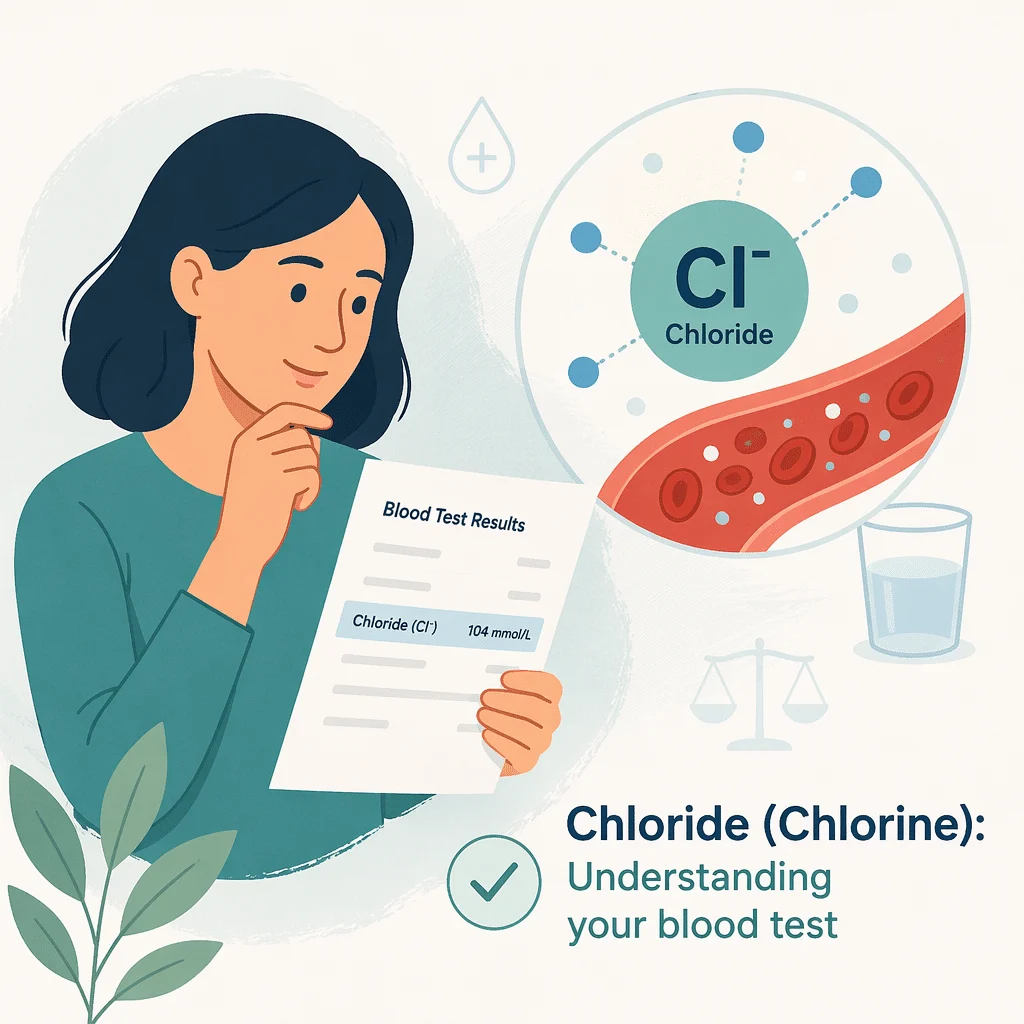
A chloride blood test measures the amount of chloride, a charged mineral known as an electrolyte, circulating in your blood. If you have spotted this line on your report and are wondering what a high or low number means, you are in the right place. Chloride works quietly in the background to manage your fluid balance, support healthy blood pressure, and help hold your blood at the right acidity, its acid-base balance. In this article you will learn what the test measures, what counts as a normal range, what pushes chloride up or down, how it connects to the anion gap, and when an abnormal result is worth a call to your doctor. The aim is to help you read your result calmly and with confidence, not to replace the conversation you will have with your clinician.
What a chloride blood test measures
Chloride (written Cl−) is one of the body’s most abundant electrolytes, alongside sodium and potassium. Electrolytes are minerals that carry a small electrical charge once they dissolve in body fluid, and that charge lets them move water, carry nerve signals, and steady the acidity of your blood. Your body does not make chloride on its own; you take it in through food, mostly as table salt, which is sodium chloride. The kidneys then fine-tune how much stays in the blood and how much leaves in the urine.
The jobs chloride does
Chloride pulls its weight in several everyday processes:
- Fluid balance: working with sodium, it helps control how much water sits inside and around your cells, which in turn influences blood pressure.
- Acid-base balance: it shifts up or down to help keep blood pH inside a narrow, healthy window.
- Digestion: it is a building block of the hydrochloric acid your stomach uses to break down food.
- Nerve and muscle function: it supports the electrical signalling that lets nerves fire and muscles contract.
Why chloride is never read on its own
A single chloride value rarely tells the whole story, so doctors read it as part of a group. Chloride is one of the four minerals measured on an electrolyte panel. Within that group, clinicians compare it with the sodium blood test, because the two usually move in the same direction, and they weigh it against the bicarbonate blood test, which tends to move the opposite way. Reading the electrolytes together is what turns a lone number into a meaningful pattern.
Why doctors order a chloride blood test
You will often see chloride on your results without ever asking for it, because laboratories bundle it into broader tests such as the comprehensive metabolic panel ordered for a general check-up. Measured this way, it offers a quick snapshot of your fluid status and acid-base balance before any symptoms appear.
Your provider may pay closer attention to chloride if you have signs of a fluid or acid imbalance, such as prolonged vomiting, ongoing diarrhoea, marked fatigue, weakness, or dehydration. Chloride is also a monitoring tool: people living with kidney disease, heart failure, or high blood pressure may have it checked regularly, as may anyone taking medicines that shift electrolytes, such as diuretics. Tracking the trend across several tests is usually more informative than any single reading.
The test itself is simple and low-risk. A healthcare professional draws a small blood sample from a vein in your arm, and the laboratory measures chloride from that sample, often at the same time as your other electrolytes. You may feel a brief sting and, rarely, a small bruise, but most people have no lasting effects. No special preparation is usually needed for chloride alone, though a wider panel may ask you to fast beforehand.
The normal range for chloride, and how to read your result
For most adults, a typical chloride result spans roughly 96 to 106 millimoles per litre (mmol/L), a range published by the Cleveland Clinic; some laboratories report a slightly different band, such as 98 to 107. Reference ranges vary with the analyser and the method, so the figures that matter most are the ones printed next to your own result.
A number just outside the range is not automatically a problem. What counts is how far it sits from the limit, whether it is drifting across repeated tests, and what your other results and symptoms show. A result can be:
- Normal: within the reference interval on your report.
- High: above the range, a state called hyperchloraemia.
- Low: below the range, a state called hypochloraemia.
A few everyday things can move a chloride result without signalling disease. Going into the test dehydrated concentrates the blood and can lift the number, while drinking a large amount of fluid beforehand can dilute it. Some medicines, including certain antacids and diuretics, can shift the level as well, which is why your provider will want to know everything you take, including supplements. If a value looks off and you otherwise feel well, a repeat test under steadier conditions often settles the question.
What high chloride (hyperchloraemia) means
Hyperchloraemia means a chloride level above the normal range. It rarely causes symptoms you would notice on its own; instead, it points to the situation driving it. The most common explanation is straightforward: dehydration. When you lose fluid through heavy sweating, vomiting, or diarrhoea, the minerals left behind become more concentrated, and chloride rises with them, a link explored in our guide to dehydration and blood pressure. A large salt intake, or saline fluids given through a drip in hospital, can do the same.
Beyond fluid balance, a high chloride can accompany an acid-base shift. In metabolic acidosis, where the blood carries too much acid, the body may hold on to chloride to keep its electrical charges balanced as bicarbonate falls. Certain kidney problems, including a condition called renal tubular acidosis, and some medicines can also raise the level. A persistently high chloride deserves medical attention, because over time it can contribute to acid build-up and reflect strain on the kidneys.
What low chloride (hypochloraemia) means
Hypochloraemia means a chloride level below the normal range. A frequent cause is the loss of stomach acid through prolonged or repeated vomiting, since that acid is rich in chloride. Diuretics, the water tablets used for blood pressure and fluid overload, increase how much chloride leaves in the urine and are another common reason. Heavy, uncompensated sweating can lower it too.
Low chloride also appears in metabolic alkalosis, where the blood becomes too alkaline, and it can accompany the fluid shifts of heart failure or certain lung and kidney conditions. Mild hypochloraemia often causes nothing noticeable, while larger drops may bring weakness, muscle cramps, or irritability. As always, the cause matters more than the number itself.
Repeated vomiting is one cause of that imbalance: read why self-induced vomiting happens and where to find help.
The table below summarises the common patterns at a glance.
| Pattern | Common causes | What it usually reflects |
|---|---|---|
| High chloride (hyperchloraemia) | Dehydration, high salt intake or saline drips, kidney conditions, metabolic acidosis, renal tubular acidosis | Concentrated blood or an acid build-up |
| Low chloride (hypochloraemia) | Prolonged vomiting, diuretics, heavy sweating, metabolic alkalosis, heart failure, some lung conditions | Lost stomach acid or shifting fluid balance |
Chloride, bicarbonate, and the anion gap
One of the most useful things chloride does is help calculate the anion gap. Your blood carries both positively charged minerals (mainly sodium) and negatively charged ones (mainly chloride and bicarbonate). The anion gap is a simple subtraction from these values that estimates whether the two sides are reasonably balanced.
A normal gap suggests the charges are in order. A wider-than-normal gap can signal that acids have built up in the blood, as happens in uncontrolled diabetes or advanced kidney disease. You do not need to work this out yourself, and it is mentioned here only so the term is not a surprise if it appears on your report. What is worth remembering is that chloride and bicarbonate move in opposite directions to defend your acid-base balance, which is exactly why doctors read them side by side.
Other tests your doctor may check alongside chloride
Because chloride is a team player, an unexpected value usually prompts a look at its neighbours rather than chloride alone. Your clinician will often review the sodium and potassium results on the same panel and weigh the bicarbonate that mirrors chloride. If the pattern points towards the kidneys, they may order a kidney function panel to see how well you are filtering waste. When imbalances seem to travel together, related minerals such as magnesium are sometimes added, and to understand what the kidneys are doing with salt in real time, doctors may measure urine electrolytes. Each of these adds a piece to the picture that a single chloride value cannot give on its own.
When to see a doctor
Most mild chloride shifts are handled calmly, with hydration advice, a medication review, or a simple repeat test. Some situations, though, deserve prompter attention. Treat the following as reasons to contact a healthcare professional rather than waiting:
- A chloride result far outside the range, or one your report flags as critical
- Severe or persistent vomiting or diarrhoea, which can drain electrolytes quickly
- Ongoing confusion, marked drowsiness, fainting, or a seizure
- Significant muscle weakness, cramps, or an irregular heartbeat
- Very little urine output, or noticeable swelling in the legs or face
- Breathing that is unusually fast and deep, which can accompany an acid-base problem
If you feel acutely unwell, seek urgent care rather than relying on a test result alone. A number on a page is only part of the picture, and a clinician will weigh it against your symptoms, your history, and your other results before deciding what, if anything, needs to be done. Never stop or change a prescribed medicine on your own.
Latest scientific advances
For decades, sodium was the electrolyte doctors linked most closely to outcomes. Recent research has put a new spotlight on chloride, especially in heart failure. The findings below are reassuring in tone but still evolving, and they guide clinicians rather than change anything you should do on your own.
A 2023 review in the journal Kidney Medicine gathered the evidence on chloride in heart failure and described how a low level (hypochloraemia) tends to go hand in hand with a poorer outlook and with diuretics working less effectively, a problem doctors call diuretic resistance. In plain terms, in someone with heart failure a low chloride can act as a useful early warning flag rather than a minor footnote.
A 2026 Spanish hospital study of people admitted with worsening heart failure added weight to this idea: those with a low chloride when they arrived tended to fare less well over the following six months. Because chloride is inexpensive and already sits on routine panels, the authors suggested it could help identify higher-risk patients early. Importantly, this kind of study shows an association, not proof that correcting chloride changes the outcome.
A separate 2023 analysis offered a helpful nuance. The link between low chloride and worse survival was clearest in heart-failure patients whose kidneys were still working relatively well, and far less clear when kidney function was already reduced, a reminder that one marker is always read in context.
On the high side, a 2024 study across several hospitals looked at people who received large volumes of intravenous fluid for diabetic emergencies. It found that a heavier chloride load from those fluids did not clearly change how the kidneys recovered. Researchers are still weighing how much the chloride in intravenous fluids matters, which is why this remains an active area of study.
Glossary
| Term | Definition |
|---|---|
| Chloride (Cl−) | A negatively charged electrolyte that works with sodium to manage fluid and acid-base balance. |
| Electrolyte | A mineral that carries an electrical charge in body fluid and helps control water, nerves, and acidity. |
| Serum chloride | The chloride measured in the liquid part of your blood, which is what the test reports. |
| Hyperchloraemia | A higher-than-normal level of chloride in the blood. |
| Hypochloraemia | A lower-than-normal level of chloride in the blood. |
| Acid-base balance | The body’s control of blood acidity (pH), kept within a narrow healthy range. |
| Anion gap | A calculation from your electrolytes that estimates whether positive and negative charges are balanced. |
| Metabolic acidosis | A state in which the blood becomes too acidic, sometimes linked to a high chloride. |
| Metabolic alkalosis | A state in which the blood becomes too alkaline, often linked to a low chloride. |
Frequently asked questions
Is a chloride level of 109 high?
A value of 109 mmol/L sits just above many laboratories’ upper limit, so your report may flag it as high. On its own, a mildly raised chloride is common and rarely a cause for alarm, especially if you feel well. It is often explained by something ordinary, such as not drinking enough before the test, and is usually rechecked rather than treated. What matters is the full pattern: your sodium, bicarbonate, and kidney markers, plus any symptoms. Compare the number to the range on your own report and ask the clinician who ordered the test to interpret it for you.
Can you raise low chloride levels through diet?
In a healthy person, chloride is controlled by the kidneys rather than by any single meal, so diet alone rarely moves it far. When chloride is low, the goal is to find and treat the cause, such as ongoing vomiting or a diuretic, rather than to chase the number with salt. If dehydration is involved, rehydrating often helps the level recover. Any meaningful correction should be guided by a clinician, and you should never adjust a prescribed medicine on your own to change an electrolyte reading.
Are high chloride levels a sign of cancer?
Usually not. A high chloride most often reflects dehydration, a high salt or fluid intake, an acid-base shift, or a kidney issue rather than cancer. Chloride is not a cancer screening test, and an out-of-range value cannot diagnose or rule out any disease on its own. If your level is persistently high, the sensible next step is a medical review to find the underlying reason, not alarm. Your doctor will read the result alongside your other tests, your history, and your symptoms.
Can sodium and chloride be low at the same time?
Yes, and it is a common combination, because chloride tends to follow sodium. Heavy fluid loss from vomiting, diarrhoea, or sweating can lower both, as can some medications and conditions that affect fluid balance. When both are low together, your doctor looks at your hydration, your medicines, and your other results to work out the cause. Because the two move as a pair, they are almost always interpreted together rather than one at a time.
Is blood chloride the same as swimming-pool chlorine?
No. Although they share the same chemical element, their form and role are completely different. In your body, chloride is a natural, vital ion (Cl−) that helps balance fluids and acidity. Pool chlorine is a disinfectant chemical that would be harmful if swallowed. Seeing chloride on your blood test has nothing to do with the chlorine used to keep water clean.
Which medications change chloride levels?
Diuretics are the best-known class, and they usually lower chloride by increasing how much leaves in the urine. Antacids and some other treatments, including certain steroids, can also shift electrolyte balance in either direction. Saline fluids given in hospital can raise chloride. Because so many everyday medicines and supplements can nudge the level, it is important to tell your provider everything you take, and to keep taking prescribed treatment unless your doctor advises otherwise.
Sources
- MedlinePlus, U.S. National Library of Medicine — Chloride Blood Test. https://medlineplus.gov/lab-tests/chloride-blood-test/
- Cleveland Clinic — Chloride Blood Test. https://my.clevelandclinic.org/health/diagnostics/22023-chloride-blood-test
- Merck Manual, Consumer Version — Overview of Electrolytes (Lewis JL, reviewed 2025). https://www.merckmanuals.com/home/kidney-disorders/electrolyte-balance/overview-of-electrolytes
- Arora N — Serum Chloride and Heart Failure — Kidney Medicine, 2023. https://consensus.app/papers/details/e510b940eb095966a0a456a173a9675f/
- Crespo-Aznarez S, et al. — Importance of hypochloremia in patients with acute heart failure — Revista Clinica Espanola, 2026. https://doi.org/10.1016/j.rceng.2026.502495
- Çetin Güvenç R, et al. — Effect of renal function on the prognostic importance of chloride in patients with heart failure — Journal of Investigative Medicine, 2023. https://doi.org/10.1177/10815589221149186
- Takahashi K, et al. — High versus low chloride load in adult hyperglycaemic emergencies with acute kidney injury — Internal and Emergency Medicine, 2024. https://consensus.app/papers/details/d17009fbb4d45e05bea4899253418f0f/
Further reading
- How to read your blood test results
- Normal blood test ranges: a reference chart
- Abnormal blood test results: what they mean
- Calcium blood test and the bone and mineral panel
- Magnesium: understanding your test results
Your chloride result is one line in a bigger story that also includes your sodium, potassium, and bicarbonate, and it makes the most sense when those numbers are read together. Understanding that pattern helps you walk into your next appointment with clearer questions about your fluid balance and kidney health. AI DiagMe is built to help you understand your results, not to diagnose you or replace your doctor.
Understand your lab results with AI DiagMe
Get your results interpreted in minutes