





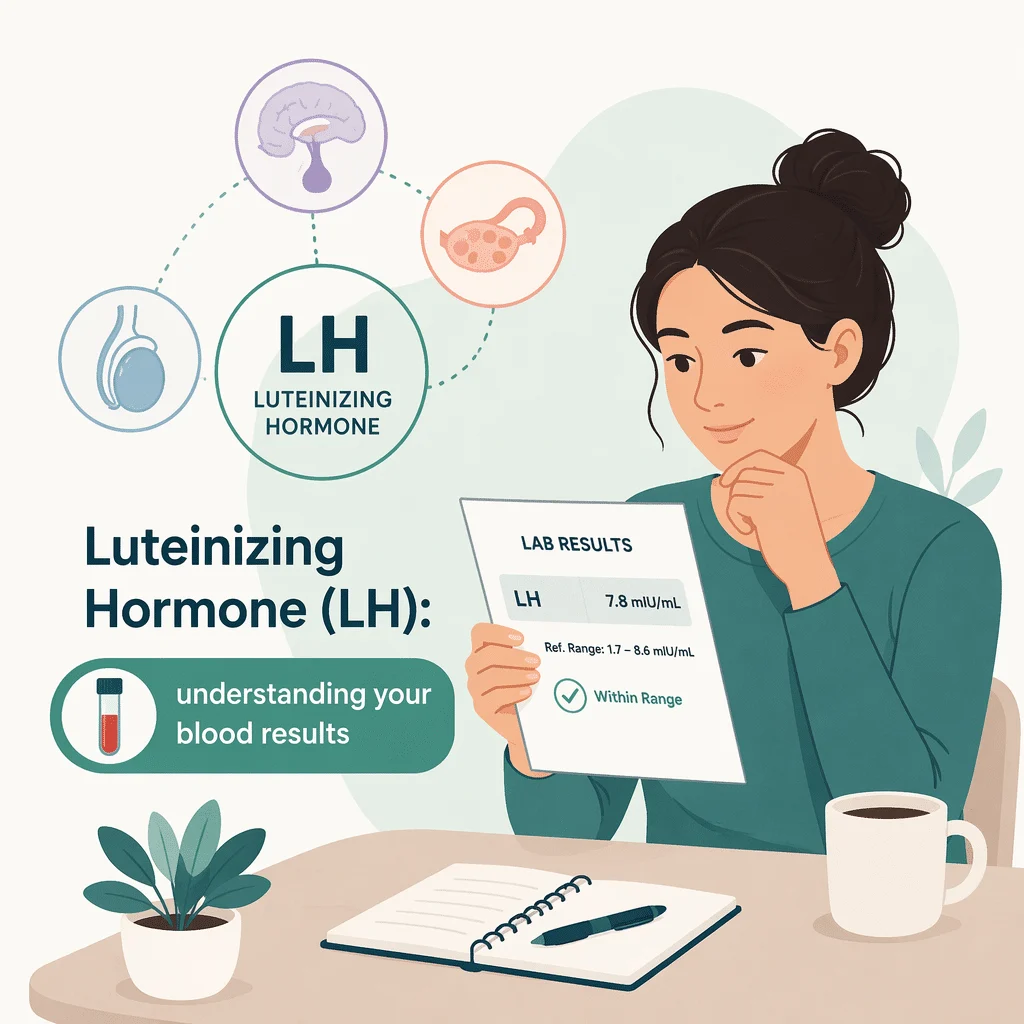
An LH blood test measures luteinising hormone, a messenger made by the pituitary gland at the base of your brain. LH tells the ovaries or the testicles what to do. In women, it rises sharply in the middle of the cycle and triggers ovulation. In men, it instructs the testicles to make testosterone. Because LH moves from day to day across a menstrual cycle, a single number means very little on its own: it becomes useful only once you know when the blood was taken and what the rest of your hormone results show.
In this article you’ll learn what LH does in women and in men, why cycle timing changes the interpretation, what high and low results can point to, and how doctors read LH alongside FSH, oestradiol and testosterone. You’ll also find a pattern grid that shows how LH and FSH together separate a problem in the gonads from a problem in the brain, plus the signs that are worth a conversation with your doctor.
What luteinising hormone actually does
LH never works alone. The hypothalamus, a small region just above the pituitary, releases GnRH (gonadotropin-releasing hormone) in pulses. Those pulses tell the pituitary how much LH and FSH (follicle-stimulating hormone) to send into the bloodstream. The ovaries and testicles answer back with their own hormones, which dial LH up or down. Doctors call this three-way conversation the hypothalamic-pituitary-gonadal axis, and an LH blood test is a snapshot of it.
LH in women
Across a menstrual cycle, LH has two jobs. Early on, it prompts cells in the ovarian follicle to make androgens, which neighbouring cells convert into oestradiol, the main oestrogen of the reproductive years. Then, once oestradiol stays high enough for long enough, the feedback flips from negative to positive and the pituitary releases a burst of LH. That burst is the LH surge, and it releases the egg. Afterwards the empty follicle becomes the corpus luteum, and LH keeps it producing progesterone, the hormone that prepares the lining of the uterus.
LH in men
In men the picture is steadier. LH travels to the Leydig cells of the testicles and tells them to make testosterone, whilst FSH supports sperm production. Because there is no monthly cycle, male LH levels stay relatively stable, though they still arrive in pulses, which is why two samples taken hours apart can differ slightly. Testosterone feeds back on the pituitary: when it falls, LH usually rises to compensate. That single relationship explains most of what a male LH result is telling you.
The LH surge and ovulation
The LH surge is the event that ovulation predictor kits are built around. Ovulation typically follows roughly 24 to 36 hours after the surge begins, which is why a positive urine test flags the fertile window rather than confirming that an egg has already been released. Home kits detect LH in urine. A laboratory LH blood test measures it directly in serum and gives an actual number rather than a yes-or-no line.
Surges are far less uniform than diagrams suggest. Some rise within a day, others climb gradually. Some show a single spike, others two peaks or a plateau. A kit that misses the peak by a day is not necessarily a sign that anything is wrong; it may simply reflect how your surge is shaped. If you track at home, our guide explains how to interpret a positive ovulation test result.
Why the day of your cycle matters
This is the single most common source of confusion on an LH report. In a woman who is cycling, LH stays low through most of the follicular phase, spikes for a day or two around ovulation, then settles back down through the luteal phase. A value that looks alarmingly high on day 13 may be a perfectly normal surge. The same value on day 3 means something quite different.
For this reason, baseline hormone testing is usually scheduled early in the cycle, commonly days 2 to 5, counting the first day of full flow as day 1. That is when LH, FSH and oestradiol can be compared against reference ranges built for the same moment. If your report does not state the cycle day, the interpretation is incomplete, and it is entirely reasonable to ask for it to be recorded.
Reference ranges also vary between laboratories, so compare your value with the range printed on your own report rather than one found online. Men do not need cycle timing, but a morning sample is often preferred, since testosterone, the hormone LH is interpreted against, is highest in the early hours.
Why a doctor orders an LH blood test
An LH blood test is rarely ordered by itself. It appears as part of a broader question, most often one of these:
- Irregular, infrequent or absent periods, where the aim is to find out whether ovulation is happening.
- Difficulty conceiving, in women or in men, usually alongside other markers on a female hormone panel or a male hormone panel.
- Symptoms of low testosterone in men, such as reduced libido, fatigue or loss of muscle, where LH shows whether the testicles or the pituitary is responsible.
- Puberty that seems to be arriving too early or too late in a child or teenager.
- Suspected pituitary disease, where LH is measured together with other pituitary hormones.
- Questions about the menopausal transition, although in women over 45 the diagnosis usually rests on symptoms and cycle history rather than blood tests.
The test is a standard blood draw and needs no fasting. Do tell your doctor about every medication and supplement you take, because several of them, including hormonal contraception, change the result substantially.
What a high LH result can mean
High LH usually means the pituitary is shouting. When the ovaries or testicles are not responding as expected, the brain increases its signal in an attempt to get an answer. So a high LH often points away from the pituitary and towards the gonads.
Perimenopause and menopause
As the ovaries run out of responsive follicles, oestradiol falls and the pituitary pushes harder. LH and FSH both climb, and FSH usually rises first and further. This is a normal physiological transition, not a disease. In women aged 45 and over, hormone testing is generally not needed to make the diagnosis, because levels swing widely during perimenopause and the pattern of menopause symptoms carries more weight than any single blood value.
Primary ovarian insufficiency
When the same picture appears before age 40, with high LH and FSH, low oestradiol and absent or erratic periods, it is called primary ovarian insufficiency. It affects roughly 1 in 100 women. Confirming it means repeating the test rather than acting on one result, since intermittent ovarian activity can still occur. This diagnosis carries real emotional weight and deserves a conversation with a specialist, not an interpretation drawn from a lab printout.
PCOS and the LH-to-FSH ratio
Many people arrive at this article having read that an LH-to-FSH ratio above 2 or 3 means polycystic ovary syndrome. It is worth being precise here. LH is often relatively higher than FSH in PCOS, particularly in leaner women, and you may well see that pattern on your report. But the raised ratio is a supportive observation, not a diagnostic criterion.
Current international guidance uses the Rotterdam framework: a diagnosis in adults requires two of three features, namely irregular ovulation, clinical or biochemical excess of androgens, and polycystic ovarian morphology on ultrasound or, as an alternative in adults, a raised AMH level. The LH-to-FSH ratio is not on that list. Plenty of women with PCOS have an entirely ordinary ratio, and plenty of women with a raised ratio do not have PCOS. If PCOS is being considered, our dedicated article covers PCOS symptoms, causes and diagnosis in more depth.
Testicular failure in men
In men, high LH with low testosterone is the signature of primary hypogonadism: the testicles are being asked for testosterone and cannot deliver. Causes include Klinefelter syndrome, undescended testicles, mumps affecting the testicles, injury, and chemotherapy or radiotherapy. The label sounds severe, but it simply localises the problem. What follows depends on the cause and on your symptoms. You can read more in our overview of hypogonadism symptoms and testing.
What a low LH result can mean
Low LH, especially low LH alongside low sex hormones, points upstream to the pituitary or the hypothalamus. Doctors call this secondary, or hypogonadotropic, hypogonadism.
- Hormonal contraception. The pill, patch, ring, implant and hormonal coil all work partly by suppressing LH, so a low value is expected rather than abnormal. This is the most frequent explanation, and the easiest to overlook.
- Hypothalamic amenorrhoea. Low energy availability, intensive training, significant weight loss, eating disorders or sustained stress can turn the GnRH pulse generator down. LH, FSH and oestradiol all fall and periods stop. It is generally reversible once energy balance and body weight recover.
- Raised prolactin. Excess prolactin, often from a small benign pituitary tumour or from certain medications, suppresses LH. Our article explains high prolactin levels and their causes.
- Pituitary disease. Tumours, surgery, radiotherapy, head injury or infiltrative conditions can reduce LH output, usually alongside other pituitary hormones.
- Congenital conditions. Kallmann syndrome and other forms of congenital hypogonadotropic hypogonadism typically present as absent or incomplete puberty.
- Other influences. Opioids taken long term, high-dose steroids and anabolic steroid use all suppress LH.
Reading LH with FSH, oestradiol and testosterone
LH on its own answers almost nothing. Read next to FSH and the relevant sex hormone, it becomes genuinely informative, because the combination tells you which floor of the building the problem is on. LH and FSH are the signal coming down from the brain. Oestradiol and testosterone are the reply coming back from the gonads. When both are low, the brain is quiet. When the signal is loud and the reply is faint, the gonads are struggling.
The grid below is the core teaching device of this whole topic. It applies to both sexes: read the oestradiol column if you are a woman, the testosterone column if you are a man.
| LH and FSH pattern | Oestradiol or testosterone | What it usually points to |
|---|---|---|
| Both high | Low | The gonads are not responding and the brain is compensating. Called primary hypogonadism. Covers menopause, primary ovarian insufficiency and testicular failure. |
| Both low, or normal when they should be high | Low | The signal from the brain is missing. Called secondary hypogonadism. Covers pituitary disease, hypothalamic amenorrhoea, raised prolactin, contraception and opioids. |
| Both normal | Normal | The axis is working. Symptoms, if present, are likely to have another explanation. |
| LH high relative to FSH, in a woman | Normal or raised testosterone | Often seen in PCOS, but supportive only. The diagnosis rests on the Rotterdam criteria, not on this ratio. |
| LH very high on a single mid-cycle sample | Oestradiol rising | Most likely the normal ovulatory surge rather than a problem. The cycle day settles the question. |
This is why your doctor almost always orders the FSH blood test next to LH, and why the panel usually adds the oestradiol blood test in women or the testosterone blood test in men. Prolactin and thyroid function are often included too, because both can disturb the axis from outside it.
When to see a doctor
An out-of-range LH is a prompt for a conversation, not a verdict. Book an appointment if you recognise any of the following:
- Periods that have stopped for three months or more, or that have become persistently irregular.
- Twelve months of trying to conceive without success, or six months if you are 35 or over.
- Symptoms of low testosterone in men: reduced libido, fatigue, loss of muscle or body hair, or erectile difficulties.
- Signs of puberty before age 8 in girls or age 9 in boys, or no signs by age 13 in girls or age 14 in boys.
- Headaches, changes in vision or milky nipple discharge, which can point to the pituitary and deserve prompt review.
- Hot flushes, night sweats or vaginal dryness before age 45.
Bring the actual report, the cycle day if it applies, and a full list of your medications. Those three things resolve a surprising number of confusing results.
Latest scientific advances in LH testing
Research published since 2023 has sharpened how LH is used, and just as importantly, clarified what it cannot tell you.
The 2023 international guideline settled the PCOS ratio question
What was found: an international group led by Helena Teede, spanning 39 organisations across 71 countries, published an updated evidence-based PCOS guideline in 2023. It refined the diagnostic criteria and allowed AMH (anti-Müllerian hormone, a marker of the ovarian follicle pool) to replace ultrasound in adults. The LH-to-FSH ratio was not adopted as a diagnostic criterion.
What this means for you: if you have been told that your ratio proves PCOS, that is not what current guidance says. The ratio can support a picture, but the diagnosis is made on ovulation pattern, androgen excess, and ovarian appearance or AMH. Knowing this can spare a lot of unnecessary worry.
Home ovulation kits are accurate, but they can miss surges
What was found: a prospective study at Brigham and Women’s Hospital, led by Anna Vanderhoff, compared five at-home ovulation predictor kits against daily blood LH measurements during fertility treatment. Agreement with the blood test was high for all five, and cheaper kits performed as well as expensive ones. But sensitivity, the ability to catch a surge that was genuinely happening, was noticeably lower for some kits.
What this means for you: a positive result on a home kit is worth trusting. A negative result is less reassuring, because a real surge can be missed. If kits repeatedly show nothing across several cycles, that is a reason to speak to a doctor rather than to spend more on a premium brand.
Normal cycles vary far more than the textbook diagram
What was found: researchers measured LH, FSH, oestradiol and progesterone every day through a full cycle in women whose ovulation was confirmed by ultrasound. Every woman followed the expected physiological sequence, but the timing and the height of the peaks varied considerably. Most of the variation in cycle length came from the follicular phase, the first half, rather than the second.
What this means for you: day 14 is an average, not a rule. If your surge arrives on day 11 or day 19, your cycle is not broken. This also explains why a single mistimed LH sample can look odd when nothing is actually wrong.
Hormone levels are not the same thing as fertility
What was found: a large genetic study covering more than 42,000 people with infertility and over 740,000 without identified 25 genetic regions linked to infertility, and hundreds more linked to LH, FSH, oestradiol and testosterone levels. Strikingly, the researchers found no genetic overlap between female infertility and reproductive hormone levels.
What this means for you: LH and its companions describe how the axis is functioning. They do not predict whether you will conceive. A hormone panel is a map of the machinery, not a forecast, and that distinction matters when marketing suggests otherwise.
Glossary
| Term | Definition |
|---|---|
| Luteinising hormone (LH) | A hormone made by the pituitary gland that triggers ovulation in women and testosterone production in men. |
| Pituitary gland | A pea-sized gland at the base of the brain that releases LH, FSH and several other hormones. |
| GnRH | Gonadotropin-releasing hormone, sent in pulses by the hypothalamus to tell the pituitary how much LH and FSH to release. |
| LH surge | The sharp mid-cycle rise in LH that releases the egg, usually 24 to 36 hours after it begins. |
| FSH | Follicle-stimulating hormone, released with LH; it grows ovarian follicles and supports sperm production. |
| Follicular phase | The first half of the menstrual cycle, from the first day of bleeding until ovulation. |
| Luteal phase | The second half of the cycle, from ovulation until the next period begins. |
| Leydig cells | Cells in the testicles that make testosterone when LH tells them to. |
| Primary hypogonadism | Reduced function of the ovaries or testicles themselves, marked by high LH and FSH with low sex hormones. |
| Secondary hypogonadism | Reduced signalling from the pituitary or hypothalamus, marked by low or unexpectedly normal LH and FSH with low sex hormones. |
Frequently asked questions
Do I need to fast for an LH blood test?
No. Fasting is not required for an LH blood test, and you can eat and drink normally beforehand. What matters far more is timing. If you have periods, your doctor may ask for the sample on a specific cycle day, most often between days 2 and 5. If you are a man, a morning appointment is often preferred, because testosterone is highest early in the day and LH is usually interpreted against it. Do mention any medications, supplements or hormonal contraception before the draw, as several of them shift the result.
What counts as a normal LH level?
There is no single normal number, which is why comparing your value to a figure found online is unhelpful. Ranges depend on your sex, your age, and for women the phase of the cycle: LH is low through most of the follicular and luteal phases, and many times higher during the ovulatory surge. Levels are also naturally high after the menopause and low before puberty. On top of that, each laboratory calibrates its own analyser, so ranges differ between labs. Use the reference range printed on your own report, next to your own result.
Does a high LH result mean I am ovulating right now?
It might, and that is exactly why the cycle day matters. A high LH on day 12 to 14 of a regular cycle is most likely the normal surge that precedes ovulation. The same value on day 3, or in someone whose periods have stopped, suggests something else, such as the menopausal transition or reduced ovarian function. A single high reading is not a diagnosis either way. Your doctor will look at when the sample was taken, at FSH and estradiol alongside it, and at your symptoms before drawing any conclusion.
Can I have an LH blood test whilst using hormonal contraception?
You can, but the result will be difficult to interpret. The pill, patch, ring, implant and hormonal coil all work partly by suppressing LH, so a low value is the expected effect of the method rather than a sign of a problem. If your doctor wants a meaningful baseline, they may suggest testing after a break from hormonal contraception, and they will advise you on how long to wait. Never stop a prescribed contraceptive on your own to prepare for a blood test.
How do I read LH on menopause blood test results?
In the menopausal transition, the ovaries respond less to the brain’s signal, so the pituitary sends more of it: LH and FSH both rise whilst estradiol falls. FSH usually rises earlier and higher than LH, which is why it tends to receive more attention. Importantly, if you are 45 or over, blood tests are generally not needed to diagnose menopause. Levels swing considerably during perimenopause, so one sample can be misleading. Your symptoms and your pattern of periods are more reliable than a single number.
Can my cycles be irregular even if my LH blood test is normal?
Yes, and this is common. LH is one part of a larger system. Irregular cycles can come from thyroid problems, raised prolactin, stress, weight change, PCOS with a normal ratio, or conditions affecting the uterus or ovaries directly. A normal LH simply means that this particular signal looks unremarkable on the day it was measured. If your cycles are irregular, the useful next step is a broader assessment rather than repeating LH on its own.
Sources
- MedlinePlus, National Library of Medicine — Luteinizing Hormone (LH) Levels Test — medlineplus.gov
- Nedresky D, Singh G — Physiology, Luteinizing Hormone — StatPearls, NCBI Bookshelf, updated 2022 — ncbi.nlm.nih.gov
- Eunice Kennedy Shriver National Institute of Child Health and Human Development — How do healthcare providers diagnose menopause? — nichd.nih.gov
- Teede H, et al. — Recommendations From the 2023 International Evidence-based Guideline for the Assessment and Management of Polycystic Ovary Syndrome — The Journal of Clinical Endocrinology and Metabolism, 2023 — consensus.app
- Vanderhoff AC, Lanes A, Waldman I, Ginsburg E — Similar accuracy and patient experience with different one-step ovulation predictor kits — Fertility and Sterility, 2024 — doi.org/10.1016/j.fertnstert.2024.09.031
- Francis G, et al. — Quantitative Hormone Analysis Reveals Sources of Variability in the Menstrual Cycle — Women in Sport and Physical Activity Journal, 2024 — consensus.app
- Venkatesh SS, et al. — Genome-wide analyses identify 25 infertility loci and relationships with reproductive traits across the allele frequency spectrum — Nature Genetics, 2025 — doi.org/10.1038/s41588-025-02156-8
Further reading
- To see which markers are checked together when conception is the question, read our guide to the fertility blood test.
- To understand a marker that is often added when androgens are being investigated, read our guide to the 17-OH progesterone blood test.
- To explore what happens when the testicles under-produce, read our article on low testosterone in men.
- To learn about the protein that carries sex hormones through the blood, read our guide to sex hormone-binding globulin levels.
- To get more comfortable with lab reports in general, read our simple guide on how to read blood test results.
Understand your lab results with AI DiagMe
Hormone reports rarely make sense one line at a time. LH, FSH, estradiol and testosterone only tell their story together, and alongside your cycle day and your symptoms. AI DiagMe turns that cluster of numbers into plain language you can actually use in the consulting room. It helps you understand your results; it does not diagnose you and it does not replace your doctor.
Get your results interpreted in minutes