




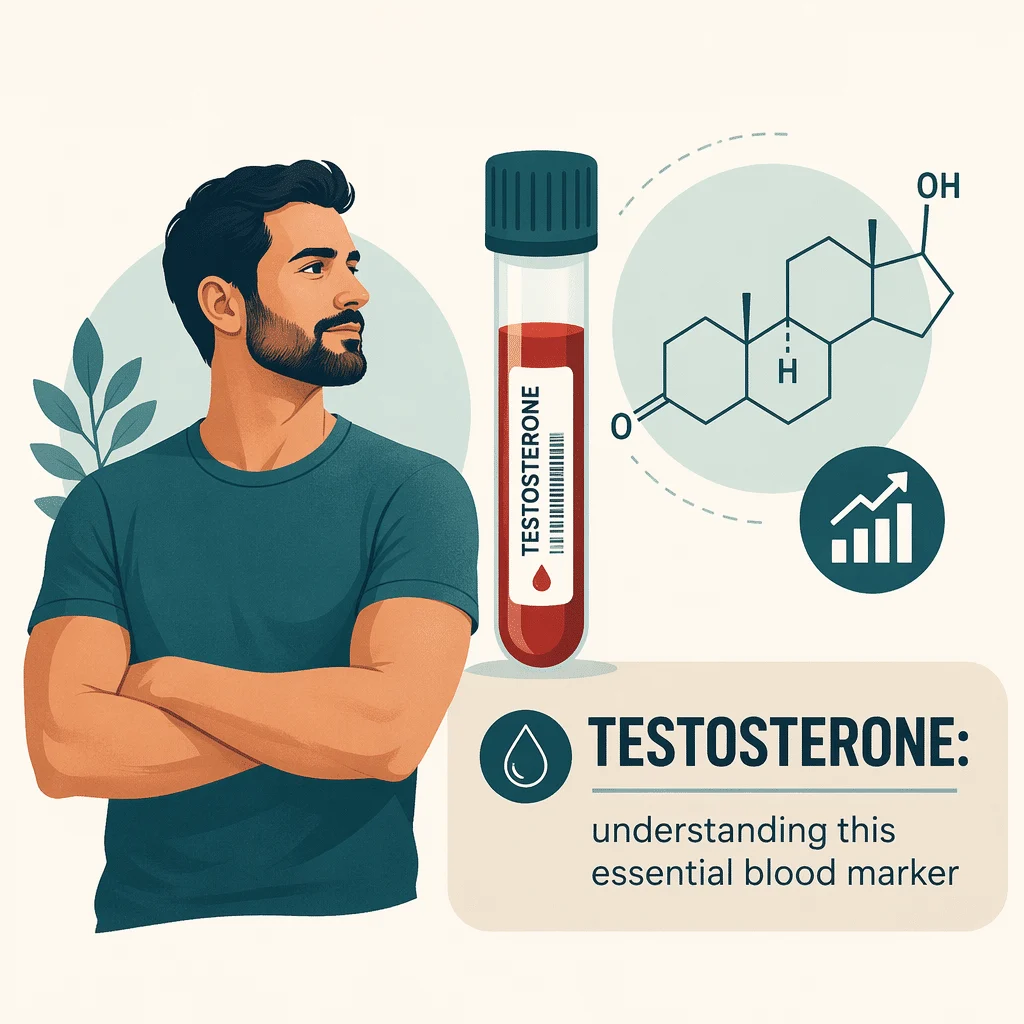
A testosterone blood test measures the amount of testosterone, the body’s main androgen (male sex hormone), moving through your bloodstream. Both men and women make testosterone, and it does far more than shape sex drive: it helps maintain muscle, bone strength, red blood cell production, mood, and energy. If your result came back flagged as high or low, or your doctor ordered the test to explain symptoms like fatigue or low libido, the numbers can feel confusing. In this article you’ll learn what the test measures, how total and free testosterone differ, how normal ranges shift with sex and age, and what abnormal results can point to. You’ll also see the latest research on testosterone therapy and on how laboratories now measure this hormone more accurately.
What a testosterone blood test measures
A testosterone blood test checks a single figure on your lab report, but that figure reflects a whole chain of signals. In men, the testicles produce most testosterone. In women, the ovaries and the adrenal glands make smaller amounts. The brain runs the system: the pituitary gland releases hormones that tell the gonads how much testosterone, sperm, or eggs to make.
Because of this feedback loop, doctors often measure related pituitary hormones at the same time. If your testosterone looks off, your provider may also request a luteinising hormone (LH) test. To locate where the problem starts, a doctor frequently adds a follicle-stimulating hormone (FSH) test. Together, these results show whether the issue lies in the gonads or in the brain’s signalling.
Doctors order a testosterone blood test for many reasons. In men, common triggers include low sex drive, erectile trouble, unexplained fatigue, shrinking muscle, or difficulty conceiving. In women, the test often follows signs of excess male hormones, such as acne, unwanted hair growth, or irregular periods. Providers also use it to track people already on testosterone therapy and to investigate delayed or unusually early puberty in young people. Your symptoms guide whether a single test or a broader hormone panel makes more sense.
The many jobs of testosterone
Testosterone influences much more than sexual desire. In both sexes it supports muscle mass, bone density, and the production of red blood cells. It also affects mood, motivation, concentration, and body hair. During puberty in boys, it deepens the voice and drives physical growth. Because testosterone touches so many systems, a level that runs too low or too high can produce a wide, sometimes vague, set of symptoms. That is exactly why a blood measurement is so useful.
Why both sexes matter
People often label testosterone a male hormone, but women depend on it too. A woman’s ovaries and adrenal glands make small amounts that help protect libido, muscle, bone, and energy. When a woman’s level climbs, it can signal conditions such as polycystic ovary syndrome and cause acne, extra body hair, or irregular periods. One companion article examines high testosterone in women. When the level drops, some women notice reduced desire or lasting fatigue.
Total, free, and bioavailable testosterone
Not all testosterone in your blood is ready for your tissues to use. Most of it travels attached to two proteins: sex hormone-binding globulin (SHBG) and albumin. Only a small, unbound share, called free testosterone, can act on cells right away. Testosterone loosely held by albumin can also be used fairly easily. Free plus albumin-bound testosterone together make up bioavailable testosterone.
A standard test reports total testosterone, which counts every form. That one number works well for most people. But when SHBG runs unusually high or low, total testosterone can paint a misleading picture, and a doctor may estimate free testosterone instead. Obesity, ageing, thyroid problems, and liver disease all shift SHBG. A separate guide breaks down sex hormone-binding globulin.
| Feature | Total testosterone | Free testosterone |
|---|---|---|
| What it measures | Every testosterone molecule in the blood, both protein-bound and unbound | Only the small unbound fraction that tissues can use immediately |
| Share of the pool | The entire amount (100 per cent) | Roughly 1 to 3 per cent of total testosterone |
| How it is obtained | Measured directly, ideally by mass spectrometry | Best calculated from total testosterone, SHBG, and albumin, or measured by equilibrium dialysis |
| When it helps most | First-choice test for most people | Useful when SHBG is high or low and the total result is borderline |
| Main limitation | Can mislead when SHBG is abnormal | Direct free-testosterone immunoassays are often unreliable |
Testosterone reference ranges by sex and age
Reference ranges give a rough sense of where a healthy result usually falls. They differ sharply between the sexes and shift with age. Testosterone is commonly reported in nanograms per decilitre (ng/dL) in the United States, or in nanomoles per litre (nmol/L) elsewhere. The table below shows approximate figures for total testosterone.
| Group | Approx. total testosterone (ng/dL) | Approx. total testosterone (nmol/L) |
|---|---|---|
| Adult men, about 19 to 39 years | 264 to 916 | 9.2 to 31.8 |
| Adult men, 40 years and older | Often read against the adult male range; average levels fall gradually with age | — |
| Adult women | 15 to 70 | 0.5 to 2.4 |
| Children and adolescents | Rise through puberty; read against pubertal stage | — |
These figures are only a guide, and ranges vary by laboratory and method. Every lab sets its own reference range based on the population it serves and the equipment it uses, so always compare your result with the range printed on your own report. For a plain-language overview, the U.S. National Library of Medicine keeps a testosterone levels test overview. To make sense of the columns on a lab printout, a dedicated guide explains how to read your blood test results.
Why your lab’s numbers may differ
Two labs can report the same sample differently because they use different methods. Older automated tests, called immunoassays, are quick and cheap but can be inaccurate at the low levels seen in women, children, and older men. A more precise method, liquid chromatography-mass spectrometry (LC-MS/MS), separates and weighs the hormone directly. National standardisation programmes now push labs towards harmonised reference ranges so that a result of, say, 300 ng/dL means the same thing across sites. When free testosterone is needed, many labs calculate it from your total testosterone, SHBG, and albumin rather than measuring it directly, because that calculation tends to be more trustworthy than a direct free-testosterone immunoassay. If your number sits close to the edge of the range, the method behind it genuinely matters.
What high and low testosterone can mean
A result outside the reference range is a starting point for questions, not a diagnosis on its own. The cause depends on your sex, age, symptoms, and other test results.
Low testosterone: signs and causes
In men, low testosterone (sometimes called low T, or hypogonadism when confirmed) can bring low sex drive, erectile difficulties, fatigue, low mood, loss of muscle, and reduced body hair. Many US guidelines flag a total level below roughly 300 ng/dL as low when it comes with symptoms. Causes range from testicular injury or infection to pituitary problems, obesity, type 2 diabetes, certain medications, and simple ageing. One in-depth article covers low testosterone in men. In women, low levels can dampen desire and energy, though the picture is harder to define.
High testosterone: signs and causes
In women, high testosterone is more common and more noticeable. It often points to polycystic ovary syndrome and can cause acne, unwanted facial or body hair, scalp hair thinning, and irregular periods. Less often, adrenal or ovarian tumours or congenital adrenal hyperplasia drive the rise. In men, naturally high testosterone is unusual; when it appears, the most frequent reason is the use of anabolic steroids or an over-generous dose of prescribed testosterone. Very high levels can reduce fertility and, in some cases, thicken the blood.
How to prepare for a testosterone test
A testosterone test is a routine blood draw, usually from a vein in the arm, and takes only a minute or two. A little preparation makes the result more reliable, because testosterone naturally rises and falls over a single day.
The best time of day to test
Testosterone peaks in the early morning and drifts down as the day goes on, especially in younger men. For that reason, labs and guidelines usually ask for a sample drawn between about 7 a.m. and 10 a.m. Fasting is not always required, though some clinicians prefer it because a large meal can temporarily lower testosterone. Follow the specific instructions your provider gives you.
Why one result is rarely enough
A single number can mislead. Poor sleep, acute illness, stress, hard exercise, and some medicines can all push testosterone down for a short time. If a first result comes back low, doctors typically repeat the test on another morning before making any decisions. Two consistent low readings, paired with real symptoms, carry far more weight than one lonely figure.
What happens during and after the test
A technician cleans a small spot on your arm, ties a band above it, and draws blood from a vein into a tube. The process usually takes under five minutes. Afterwards, you can return to normal activities straight away, and mild bruising is the only common side effect. Most testosterone results come back within a day or two, though exact timing depends on the laboratory. Your provider then reads the number in the context of your symptoms and any related hormone tests before suggesting next steps.
When to see a doctor
Testosterone results always belong in a conversation with a clinician, who can weigh them against your health history. Consider making an appointment if you notice any of the following:
- Ongoing low sex drive, erectile problems, or infertility
- Persistent fatigue, low mood, or loss of muscle strength that has no clear explanation
- In women, new acne, thinning scalp hair, or unwanted facial and body hair
- Irregular or missed periods
- Delayed or unusually early puberty in a child or teenager
- A lab result flagged as high or low, even without symptoms
Seek prompt care for sudden, severe symptoms such as testicular pain or swelling, which need separate evaluation.
Hormones often tested alongside testosterone
Testosterone rarely tells the whole story by itself. Depending on your symptoms, a doctor may order a small panel of related tests to see the bigger hormonal picture. Because estrogen and testosterone work in balance, a provider may also check an oestradiol test.
Before or during testosterone therapy, men usually need a prostate-specific antigen (PSA) test to keep an eye on prostate health. When a woman shows signs of excess androgens, a doctor may also measure DHEA levels, since the adrenal glands make this related hormone. A pituitary problem can raise prolactin and suppress testosterone at the same time, so a provider may add a prolactin measurement; one related article explains high prolactin levels.
Latest scientific advances
Testosterone testing and treatment have both moved forward in recent years. Here is what newer, high-quality research adds, in plain language.
Testosterone therapy and the heart
For years, doctors worried that testosterone treatment might raise the risk of heart attacks and strokes. A large 2023 trial called TRAVERSE, published in the New England Journal of Medicine, followed thousands of middle-aged and older men who had low testosterone along with existing heart risk. Men who used a testosterone gel did not have more major heart problems than men who used a dummy gel, known as a placebo. Independent reviews that pooled many trials in 2024 and 2025 reached the same broad conclusion. What this means for you: when a doctor prescribes testosterone for a genuine deficiency and monitors you, the treatment appears reasonably safe for the heart. It is not risk-free, though. The trial saw slightly more irregular heartbeats and a few other issues, so ongoing supervision matters.
Confirming low testosterone the right way
A 2024 review in The Lancet Diabetes and Endocrinology stressed that a single low number does not equal a diagnosis. Testosterone swings during the day and dips when you are ill, stressed, or short on sleep. The authors recommend confirming a low result with at least two morning blood samples, taken on separate days, alongside genuine symptoms. What this means for you: if one test comes back low, it is reasonable to ask about repeating it before starting any treatment.
Measuring the hormone accurately, including in women
Older automated blood tests can struggle at the very low testosterone levels seen in women and older adults. A 2025 systematic review of testing in polycystic ovary syndrome found that the precise mass spectrometry method gives more dependable numbers than standard automated tests. Harmonised reference ranges, built from large pooled studies, now help different laboratories agree on what counts as normal. What this means for you: if your result sits near the edge of the range, it is fair to ask which method your laboratory used, since it can change how the number is read.
Do the benefits match the risks?
A 2024 evidence review known as TestES combined data from many trials of testosterone treatment in men with low levels. It found that treatment improved sexual function and some measures of well-being, whilst long-term effects still need more study. What this means for you: testosterone therapy can ease certain symptoms of a true deficiency, but the evidence does not support it as a general tonic for ageing, energy, or muscle in men whose levels are already normal.
Glossary
| Term | Definition |
|---|---|
| Androgen | A group of sex hormones, including testosterone, that drive male traits and are present in both sexes. |
| Total testosterone | The full amount of testosterone in the blood, counting both protein-bound and unbound forms. |
| Free testosterone | The small share of testosterone not attached to proteins, ready for tissues to use immediately. |
| Bioavailable testosterone | Free testosterone plus the loosely albumin-bound portion the body can use fairly easily. |
| Sex hormone-binding globulin (SHBG) | A protein that carries testosterone in the blood and controls how much stays free. |
| Hypogonadism | A condition in which the body makes too little testosterone, from a problem in the gonads or the brain’s signalling. |
| Luteinising hormone (LH) | A pituitary hormone that signals the testicles or ovaries to make sex hormones. |
| Follicle-stimulating hormone (FSH) | A pituitary hormone that supports sperm and egg production and works alongside LH. |
| LC-MS/MS | Liquid chromatography-mass spectrometry, a precise laboratory method for measuring hormone levels, especially low ones. |
| Polycystic ovary syndrome (PCOS) | A common hormonal condition in women that can raise testosterone and disturb periods. |
Frequently asked questions
What is a testosterone blood test, and who needs one?
It is a simple blood test that measures how much testosterone is circulating in your body. Doctors order it when someone has symptoms of a hormone imbalance, such as low sex drive, fatigue, or infertility in men, or acne, extra body hair, and irregular periods in women. It is also used to monitor people already on testosterone therapy. A provider decides whether you need it based on your symptoms and history.
What are normal testosterone levels by age?
In healthy adult men roughly 19 to 39 years old, total testosterone often falls between about 264 and 916 ng/dL. Average levels then decline slowly with age. Adult women sit far lower, around 15 to 70 ng/dL. Children’s levels are low and rise through puberty. These are general figures only, and every laboratory reports its own reference range, so compare your value with the one on your report.
What are the symptoms of low testosterone?
In men, low testosterone can cause reduced sex drive, erectile difficulties, tiredness, low mood, loss of muscle, and thinning body hair. Because these symptoms are common and overlap with many other conditions, they cannot confirm low testosterone on their own. A blood test, ideally repeated on a second morning, is needed. In women, low levels may reduce desire and energy, though the link is less clearly defined.
What is the difference between free and total testosterone?
Total testosterone counts every molecule in your blood, including the large share bound to proteins. Free testosterone counts only the small unbound fraction that your tissues can use straight away. For most people, total testosterone is enough. When a protein called SHBG is unusually high or low, free testosterone gives a clearer picture and is usually calculated from your total testosterone, SHBG, and albumin values.
What is the best time of day to test testosterone?
Early morning, generally between about 7 a.m. and 10 a.m., because testosterone peaks after you wake and falls later in the day. A morning sample makes results easier to compare against reference ranges. If a first result is low, doctors often ask for a second morning test on a different day to confirm it before considering any treatment.
Can women have a testosterone blood test?
Yes. Women produce and need testosterone, and the test is common when a doctor suspects too much of it, as in polycystic ovary syndrome, or occasionally too little. Because women's levels are low, an accurate laboratory method matters, and results are always read against female reference ranges rather than male ones.
Sources
- Testosterone Levels Test — MedlinePlus, U.S. National Library of Medicine, 2024. medlineplus.gov
- Low Testosterone (Male Hypogonadism) — Cleveland Clinic, 2026. my.clevelandclinic.org
- Male Hypogonadism — Mayo Clinic, 2024. mayoclinic.org
- Lincoff AM, et al. Cardiovascular Safety of Testosterone-Replacement Therapy — New England Journal of Medicine, 2023. doi.org/10.1056/NEJMoa2215025
- Corona G, et al. Cardiovascular safety of testosterone replacement therapy in men: an updated systematic review and meta-analysis — Expert Opinion on Drug Safety, 2024. doi.org/10.1080/14740338.2024.2337741
- Braga MAP, et al. Long-Term Cardiovascular Safety of Testosterone-Replacement Therapy in Middle-Aged and Older Men: A Meta-analysis of Randomised Controlled Trials — American Journal of Cardiovascular Drugs, 2025. doi.org/10.1007/s40256-025-00737-w
- De Silva NL, et al. Male hypogonadism: pathogenesis, diagnosis, and management — The Lancet Diabetes and Endocrinology, 2024. doi.org/10.1016/S2213-8587(24)00199-2
- Cruickshank M, et al. The effects and safety of testosterone replacement therapy for men with hypogonadism: the TestES evidence synthesis — Health Technology Assessment, 2024. doi.org/10.3310/JRYT3981
- Bizuneh AD, et al. Evaluating the diagnostic accuracy of androgen measurement in polycystic ovary syndrome: a systematic review and diagnostic meta-analysis — Human Reproduction Update, 2025. doi.org/10.1093/humupd/dmae028
- Travison TG, et al. Harmonised Reference Ranges for Circulating Testosterone Levels in Men of Four Cohort Studies in the United States and Europe — Journal of Clinical Endocrinology and Metabolism, 2017. doi.org/10.1210/jc.2016-2935
Further reading
- Low testosterone in women
- High testosterone in men
- Cortisol blood test
- Normal blood test ranges
- What to expect during a blood test
Understand your lab results with AI DiagMe
A testosterone result rarely stands alone. It makes the most sense alongside related markers such as luteinising hormone, follicle-stimulating hormone, sex hormone-binding globulin, and oestradiol, which together reveal how your hormones are balanced. AI DiagMe reads your lab report in plain language, explains what each value means, and helps you prepare better questions for your doctor. It is built to help you understand your results, not to diagnose or replace medical care.
Get your results interpreted in minutes