







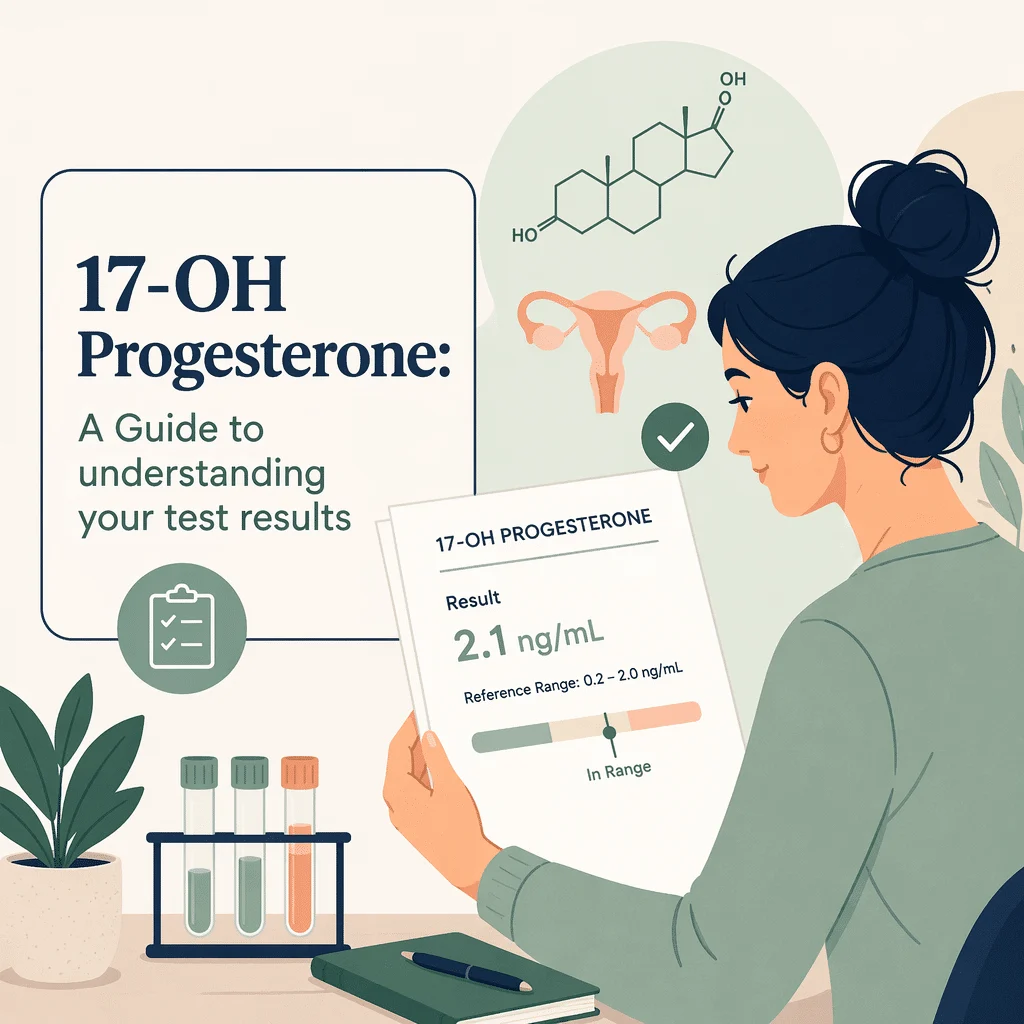
A 17-hydroxyprogesterone test measures a steroid your adrenal glands make on the way to producing cortisol, and it is the main blood marker doctors use when looking for congenital adrenal hyperplasia (CAH). Most people come across this test in one of two situations: a newborn screening result that has come back abnormal, or a work-up in a teenager or adult for irregular periods, acne, or unwanted hair growth. In both cases, the number is a starting point rather than an answer.
In this article you will learn what 17-OH progesterone does in the body, why an abnormal newborn screen is common and usually turns out not to be CAH, how classic and non-classic CAH differ, why non-classic CAH is so easily mistaken for polycystic ovary syndrome, and why timing changes what your result means.
What 17-OH progesterone is and where it sits in the cortisol pathway
17-OH progesterone, often shortened to 17-OHP, is a steroid your body makes but does not use as a finished product. It is a precursor, meaning a halfway product on an assembly line. The adrenal glands, two small glands sitting on top of the kidneys, use it as raw material to build cortisol.
The assembly line and the enzyme that moves it along
Think of cortisol production as a series of stations. At one of the last stations, an enzyme called 21-hydroxylase converts 17-OH progesterone into the next compound on the way to cortisol. An enzyme is simply a protein that speeds up one specific chemical step.
If that enzyme is missing or working poorly, two things happen at once. Cortisol production falls short, and 17-OH progesterone piles up behind the blocked station like cars behind a closed road. The body diverts the backed-up material down a side road, producing extra androgens, the male-type hormones such as testosterone that both men and women make. This mechanism explains almost everything else on this page: why 17-OHP is high in CAH, why CAH causes signs such as acne and extra hair growth, and why doctors measure this marker alongside a cortisol blood test.
17-OHP levels also move on a schedule of their own: they follow a daily rhythm, shift across the menstrual cycle, and are naturally high in the first days of life and in pregnancy. None of this is a problem, but it does mean a result cannot be read without knowing when the blood was taken.
Why doctors order a 17-hydroxyprogesterone test
The test answers a narrow question: is the cortisol assembly line blocked at the 21-hydroxylase station? Doctors order it in a handful of situations.
- As part of routine newborn screening, done on every baby in the United Kingdom.
- To follow up a newborn screening result that came back outside the expected range.
- In an infant or young child with early or unusual signs of puberty, faster-than-expected growth, or genitals that are not clearly typical at birth.
- In a teenager or adult woman with irregular or absent periods, persistent acne, hair growth in a male pattern (hirsutism), or difficulty conceiving.
- In someone already diagnosed with CAH, to help monitor how well things are controlled.
Because androgen excess has several possible sources, 17-OHP is rarely measured alone; it usually appears alongside testosterone, DHEA-sulphate, LH and FSH. Our overview of the adrenal panel explains how these markers are read together, and our guide to the female hormone panel covers the reproductive side.
Newborn screening: what a positive result does and does not mean
Every region in the UK screens newborns for CAH by measuring 17-OH progesterone in a few drops of blood taken from the baby’s heel, usually in the first day or two of life. The goal is to catch the severe form of CAH before a baby becomes seriously unwell.
If you have been called about your baby's screening result, the single most useful thing to understand is this: newborn screening is a screen, not a diagnosis. A screen is deliberately set to be over-inclusive, designed to miss as few affected babies as possible while accepting that many healthy babies will be flagged. Being flagged means “let’s look properly”, not “your baby has CAH”.
Why false positives are common
An out-of-range 17-OHP on a newborn screen is far more often a false positive than a true case. Several things push a newborn’s level up without any CAH being present.
- Prematurity. Babies born early have naturally higher levels, and the earlier the birth, the higher the level tends to be.
- Low birth weight, which follows a similar pattern.
- Stress or illness around the time of birth, including a difficult delivery.
- The test method itself. The rapid, low-cost assay used for first-round screening also picks up other steroids that look chemically similar, which nudges the reading upward.
Screening programmes compensate by using higher cut-offs for premature and low-birth-weight babies. Even so, the majority of flagged babies do not have CAH: that is the trade-off accepted in order not to miss the babies who do.
What happens next
An abnormal screen must always be followed up, and promptly. That usually means a repeat measurement, a more specific laboratory test on the original blood spot, or a referral to a paediatric endocrinologist. Genetic testing of the CYP21A2 gene may confirm or exclude the diagnosis. Most of these stories end with a normal result and no further action.
When to seek care urgently for a baby
Classic CAH with salt-wasting is genuinely serious, and it is the reason newborn screening exists. In this form, the adrenal glands cannot hold on to salt, and a baby can become dangerously unwell in the first two to three weeks of life. This is uncommon, but if your baby has any of the following, seek medical care straight away.
- Poor feeding, or refusing feeds.
- Repeated vomiting, especially with weight loss or failure to gain weight.
- Unusual sleepiness, floppiness, or being difficult to rouse.
- Dehydration: fewer wet nappies, a dry mouth, or a sunken soft spot on the head.
- Rapid breathing, a grey or mottled colour, or any collapse.
Tell whoever sees your baby that the newborn screen flagged 17-OH progesterone. That single sentence changes what the clinical team checks first. Because salt balance is what goes wrong here, they will check sodium and potassium; our guide to the electrolyte panel explains what those values track.
High 17-OHP in older children and adults: classic and non-classic CAH
Outside the newborn period, a high 17-OH progesterone points towards CAH, but the two forms behave very differently. Classic CAH is the severe form, usually identified in infancy. Non-classic CAH, sometimes called late-onset CAH, is the mild form, common enough that many people carry it without ever knowing.
| Feature | Classic CAH | Non-classic CAH |
|---|---|---|
| Enzyme activity | Absent or very low | Reduced but partly working |
| When it usually appears | At birth or in the first weeks of life | Childhood, adolescence or adulthood, sometimes never |
| How it is usually found | Newborn screening | Work-up for acne, hirsutism, irregular periods or infertility |
| Salt-wasting risk | Yes in most cases; a medical emergency in infancy | No |
| Typical 17-OHP level | Markedly high | Mildly to moderately high, and sometimes normal at rest |
| How common | Rare | Much more common, and often undiagnosed |
The size of the elevation matters as much as the fact of it: a markedly high 17-OHP in an unwell infant is a different conversation from a mildly high value in a healthy 22-year-old.
Non-classic CAH and PCOS: why they look so alike
Non-classic CAH and polycystic ovary syndrome (PCOS) can look almost identical from the outside. Both can produce irregular or absent periods, acne that does not settle, hair growth in a male pattern, thinning scalp hair, and difficulty conceiving, because both are driven by too much androgen activity. Our article on PCOS symptoms and diagnosis covers that condition in detail.
The difference is where the androgens come from. In PCOS, the ovaries are the main source. In non-classic CAH, the adrenal glands are, because of the blocked enzyme step.
This is why 17-OH progesterone is measured in women with these symptoms: it is the marker that separates the two. The Endocrine Society’s clinical practice guideline on congenital adrenal hyperplasia recommends an early-morning, follicular-phase 17-OHP measurement to screen for non-classic CAH in women with androgen excess, with a value below roughly 2 ng/mL making the diagnosis unlikely and higher values prompting further testing. Your laboratory’s threshold may differ, because it depends on the method used, so read your result against the range printed on your own report.
The distinction changes what happens next, including counselling about future pregnancies. Alongside 17-OHP, your doctor will often look at a testosterone blood test, and our explainer on high testosterone in women covers what raised androgens mean in practice. DHEA-sulphate, discussed in our article on DHEA levels, points more specifically at the adrenal glands, while luteinising hormone (LH) speaks to the ovarian side.
How timing and the ACTH stimulation test change interpretation
Two features of 17-OH progesterone make timing decisive.
First, the daily rhythm. Levels peak in the early morning, so a sample drawn in the afternoon can look reassuringly normal in someone who would have tested high at 8 a.m. This is why the test is normally requested first thing in the morning, ideally before 9 a.m.
Second, the menstrual cycle. Levels rise naturally after ovulation, in the luteal phase, which can make a healthy woman look abnormal. The test is therefore timed to the follicular phase, the first part of the cycle, usually within the first week after a period starts. Note the date your last period began and tell the laboratory.
What the ACTH stimulation test adds
In mild non-classic CAH, the enzyme still works well enough that a resting 17-OHP can sit inside the normal range. The blockage only becomes visible when the system is pushed, and that is what the ACTH stimulation test does. A synthetic version of ACTH, the pituitary hormone that tells the adrenal glands to make cortisol, is given as an injection, and 17-OHP is measured before and roughly an hour afterwards.
Without CAH, 17-OHP rises only modestly. When 21-hydroxylase is impaired, material backs up at the blocked station and it rises sharply. The test is used when a basal result is borderline rather than routinely. Our explainer on the ACTH blood test describes the same signal in more detail.
| Situation | What it may suggest | Typical next step |
|---|---|---|
| Newborn screen flagged, baby well | Most often a false positive, especially if premature or small | Prompt repeat or more specific test; specialist review |
| Newborn screen flagged, baby unwell | Possible classic CAH with salt-wasting | Urgent medical assessment, hormones and electrolytes |
| Adult, morning follicular level clearly below the lab threshold | Non-classic CAH unlikely | Look at other causes of androgen excess, such as PCOS |
| Adult, borderline or mildly raised level | Unclear; overlaps with PCOS and with healthy people | Repeat correctly timed, or ACTH stimulation test |
| Adult, markedly raised level | Non-classic CAH, or rarely classic CAH not previously found | Endocrinology referral; genetic testing may be offered |
| Sample taken in the afternoon or after ovulation | Result hard to interpret either way | Repeat at the right time before drawing conclusions |
Normal and low 17-OHP results
A normal 17-OH progesterone, measured at the right time of day and the right point in the cycle, makes classic CAH very unlikely and non-classic CAH unlikely too. It does not explain symptoms on its own; it simply takes one specific cause off the table.
Low results attract far less attention, because there is no established “too low” for this marker in the way there is for cortisol. A low 17-OHP on its own is generally not a finding to act on, and it can appear in people taking steroid medicines such as prednisolone, which switch off the ACTH signal. What matters clinically is the pattern across several hormones.
Several things shift the result without any disease being present: hormonal contraceptives, steroid treatments, pregnancy, and acute illness. Tell your doctor everything you take, including creams and inhalers.
When to see a doctor
Arrange an appointment promptly if you have been contacted about your baby's newborn screening result, even if your baby seems entirely well. This is one of the few situations where waiting is not a good idea, even though the odds favour a normal outcome.
Also speak to a doctor if you have periods that are irregular or have stopped, acne that persists past adolescence, hair growth in a male pattern that is new or worsening, thinning scalp hair, or you have been trying to conceive without success. Ask about a morning, follicular-phase 17-OHP if androgen excess is being considered.
Seek urgent care for a baby with poor feeding, repeated vomiting, marked sleepiness, dehydration, or any sudden deterioration in the first weeks of life, and at any age for sudden severe weakness, repeated vomiting, confusion, or collapse in someone known to have CAH.
Latest scientific advances in 17-OH progesterone testing
Research from the last three years has focused on one problem: making the test more precise, so that fewer families are frightened unnecessarily and no affected child is missed.
Why the newborn screen produces so many false alarms
A 2023 review in Frontiers in Endocrinology by de Hora and colleagues examined nearly 40 years of CAH newborn screening. What was found: the fast immunoassay used for first-round screening is not very specific, meaning it also detects other steroids that resemble 17-OHP, and a newborn’s blood is full of them. Prematurity, low birth weight, stress and illness all raise levels independently of CAH. Adjusting cut-offs for birth weight and gestational age helps, but a high false-positive rate remains.
What this means for you: if your baby’s screen was flagged, the odds strongly favour a healthy baby. The alarm is largely a known limitation of a deliberately over-sensitive first-round test, not a sign that something has been found.
A national programme’s first year, measured
Güran and colleagues reported in 2025 on the first year of nationwide newborn CAH screening in Türkiye, covering more than a million babies. What was found: the great majority of babies flagged by the first-round test did not have CAH, and most of those referred to a specialist were ultimately healthy. Refining the cut-offs according to how mature and how heavy each baby was could cut referrals substantially without missing cases.
What this means for you: being referred after a screen reflects the design of the system, not the likelihood of your baby being affected.
A second test on the same blood spot
Olthof and colleagues published a two-year evaluation in Archives of Disease in Childhood of the Dutch programme, which added a second-tier test measuring a different steroid, 21-deoxycortisol, on the original heel-prick sample. What was found: many families avoided a repeat heel prick entirely, and the proportion of babies sent unnecessarily to a specialist fell to roughly a third of what it had been, whilst the affected babies were still identified.
What this means for you: modern screening increasingly resolves an ambiguous first result in the laboratory rather than by calling you back in.
Telling non-classic CAH apart from PCOS
A 2025 review in Archives of Gynaecology and Obstetrics by Unfer and colleagues addressed the overlap between non-classic CAH and PCOS in women of reproductive age. What was found: the two conditions share nearly all their outward features, and a basal morning 17-OHP remains the practical way to separate them, with an ACTH stimulation test reserved for borderline results.
What this means for you: a borderline result is not a failure of the test; it is the expected point at which a stimulation test becomes useful.
Thresholds depend on the method
Bizzarri and colleagues reported in 2025 in the Journal of Endocrinological Investigation on children referred for suspected non-classic CAH, studied as a cohort, meaning a group followed and analysed together. What was found: when 17-OHP is measured by mass spectrometry, a newer and more specific laboratory method, the levels that best distinguish non-classic CAH from healthy children are meaningfully lower than the thresholds inherited from older immunoassays.
What this means for you: there is no single universal “high” for 17-OH progesterone. The number that matters depends on how your laboratory measured it, which is why comparing your value to a figure found online, or to a friend’s result from a different lab, is unreliable.
Glossary
| Term | Definition |
|---|---|
| 17-OH progesterone (17-OHP) | A steroid the adrenal glands make on the way to producing cortisol; it builds up when the pathway is blocked. |
| 21-hydroxylase | The enzyme that converts 17-OHP into the next compound on the way to cortisol. Its deficiency causes most cases of CAH. |
| Congenital adrenal hyperplasia (CAH) | An inherited condition in which an enzyme needed to make cortisol is missing or impaired. |
| Non-classic CAH | The mild, later-appearing form, often presenting with acne, hirsutism or irregular periods rather than illness in infancy. |
| Salt-wasting | The severe pattern of classic CAH in which the body cannot retain salt; a medical emergency in newborns. |
| ACTH | The pituitary hormone that signals the adrenal glands to make cortisol. |
| ACTH stimulation test | A short test in which synthetic ACTH is injected and 17-OHP is measured before and after, to reveal a mild enzyme block. |
| Androgens | Male-type hormones such as testosterone, made in smaller amounts by women as well as men. |
| Follicular phase | The first part of the menstrual cycle, starting with a period; the preferred window for measuring 17-OHP. |
| False positive | A screening result that flags a possible problem in someone who does not actually have the condition. |
Frequently asked questions
What is the normal range for 17-hydroxyprogesterone?
There is no single universal range. The expected values depend on your age, your sex, the time of day the blood was taken, where you are in your menstrual cycle, and the method your laboratory uses. Newborns and pregnant women naturally sit much higher than other adults. Because measurement methods differ, a value that is clearly normal at one laboratory could be flagged at another. This is why the only range worth comparing your result against is the one printed on your own report, next to your own value. If that range is not shown, ask the laboratory or your doctor for it.
Do I need to fast for a 17-hydroxyprogesterone test?
Fasting is generally not required. What matters far more is the timing: the sample should be taken early in the morning, ideally before 9 a.m., because levels peak then and fall throughout the day. If you menstruate, the test is usually scheduled in the first week of your cycle. The test itself is an ordinary blood draw from a vein in your arm and takes a couple of minutes. For a baby, it is a heel prick. Follow whatever specific instructions your laboratory gives you, as protocols vary slightly.
Can hormonal contraception change my 17-OHP result?
It can. Combined hormonal contraceptives suppress parts of the hormonal system and can lower 17-OH progesterone, which may mask a mild non-classic CAH. Steroid medicines such as prednisolone, including creams and inhalers used regularly, can do the same by switching off the ACTH signal. This does not mean you should stop anything before testing; stopping a prescribed medicine on your own can cause harm. Tell your doctor exactly what you take, including anything bought without a prescription, so they can decide whether the timing needs adjusting or the result needs interpreting differently.
My baby’s repeat newborn screen was also abnormal. Does that mean CAH?
Not necessarily, though it does make careful follow-up more important. A second abnormal screen still has explanations other than CAH, particularly in babies born early, born small, or unwell around delivery, since all of these raise 17-OHP on their own. The next step is usually a more specific laboratory test, a blood test through a paediatric endocrinologist, and sometimes genetic testing of the CYP21A2 gene, which gives a definitive answer. Ask your clinic what the plan and timeline are. Attending that appointment promptly is the single most useful thing you can do, whatever the eventual outcome.
Is non-classic CAH inherited, and should my family be tested?
Yes, it is genetic. It follows an autosomal recessive pattern, meaning a person must inherit a changed copy of the CYP21A2 gene from both parents to be affected. People with one changed copy are carriers and are usually healthy. If you are diagnosed with non-classic CAH, your parents are typically carriers, and siblings may be affected or carriers themselves. Whether relatives should be tested depends on their symptoms and their plans for children. Genetic counselling is worth asking about, particularly before pregnancy, because carrier status in both partners is what matters for a future child.
Can 17-OH progesterone be measured during pregnancy?
It can be measured, but the result is difficult to interpret. The placenta produces steroids that push 17-OHP well above non-pregnant levels, so a raised value during pregnancy usually reflects the pregnancy itself rather than a problem. For this reason, screening for non-classic CAH is normally done before conception or after delivery rather than during pregnancy. If you already have a CAH diagnosis and are pregnant or planning to be, your care will be managed by a specialist, and 17-OHP is only one of several things they will follow.
Sources
- 17-Hydroxyprogesterone — MedlinePlus, U.S. National Library of Medicine
- Congenital Adrenal Hyperplasia (CAH) — Eunice Kennedy Shriver National Institute of Child Health and Human Development (NICHD), NIH
- Congenital Adrenal Hyperplasia — Endocrine Society
- Congenital adrenal hyperplasia: newborn screening information — Baby’s First Test
- de Hora M, Heather N, Webster D, Albert B, Hofman P — The use of liquid chromatography-tandem mass spectrometry in newborn screening for congenital adrenal hyperplasia: improvements and future perspectives — Frontiers in Endocrinology, 2023 — https://doi.org/10.3389/fendo.2023.1226284
- Güran T, Yürüker E, Anık A, et al. — The First-Year Outcomes of the Nationwide Neonatal CAH Screening in Türkiye: High Rate of False Positives for 21-Hydroxylase Deficiency and a Higher Detection Rate of Non-Classical Cases — Journal of Clinical Research in Pediatric Endocrinology, 2025 — https://doi.org/10.4274/jcrpe.galenos.2025.2024-9-11
- Olthof A, Bouva MJ, Claahsen-van der Grinten HL, et al. — 21-deoxycortisol as a second-tier test in congenital adrenal hyperplasia newborn screening in The Netherlands: two-year evaluation — Archives of Disease in Childhood, 2025 — https://doi.org/10.1136/archdischild-2025-328929
- Unfer V, Lepore E, Forte G, Hernández Marín I, Wdowiak A, Pkhaladze L — Hyperandrogenism in polycystic ovary syndrome and adrenal hyperplasia: finding differences to make a specific diagnosis — Archives of Gynecology and Obstetrics, 2025 — https://doi.org/10.1007/s00404-024-07897-1
- Bizzarri C, et al. — Diagnostic cut-offs of 17-hydroxyprogesterone by LC-MS/MS in children with non-classical congenital adrenal hyperplasia — Journal of Endocrinological Investigation, 2025 — https://consensus.app/papers/details/a555622cca6d5b4d883e13e32f4eb93f/
Further reading
- Cortisol: a guide to understanding your blood test
- ACTH: deciphering this key hormone
- Adrenal panel explained: cortisol, ACTH, aldosterone and DHEA
- PCOS symptoms: causes, diagnosis and tests
- High testosterone in women: causes and risks
Understand your lab results with AI DiagMe
A 17-OH progesterone result makes far more sense next to the markers it travels with, such as cortisol, ACTH and testosterone, rather than read as a number on its own. AI DiagMe turns your blood test report into clear, plain-language explanations, so you walk into your appointment knowing which questions to ask. It is built to help you understand your results, not to diagnose you, and it never replaces your doctor’s judgement.
Get your results interpreted in minutes