










An FSH blood test measures follicle-stimulating hormone, the pituitary signal that tells the ovaries to grow eggs and the testicles to make sperm. A single number rarely tells the whole story: the same value can be reassuring on day 3 of a menstrual cycle and misleading on day 20, and doctors almost never read FSH alone. It is interpreted alongside LH and oestradiol, your age, your symptoms and your cycle history. In this article you’ll learn what FSH does in women and in men, why the day of your cycle changes the result, what high and low levels can point to, and what an FSH result cannot tell you about your fertility.
What FSH does in your body
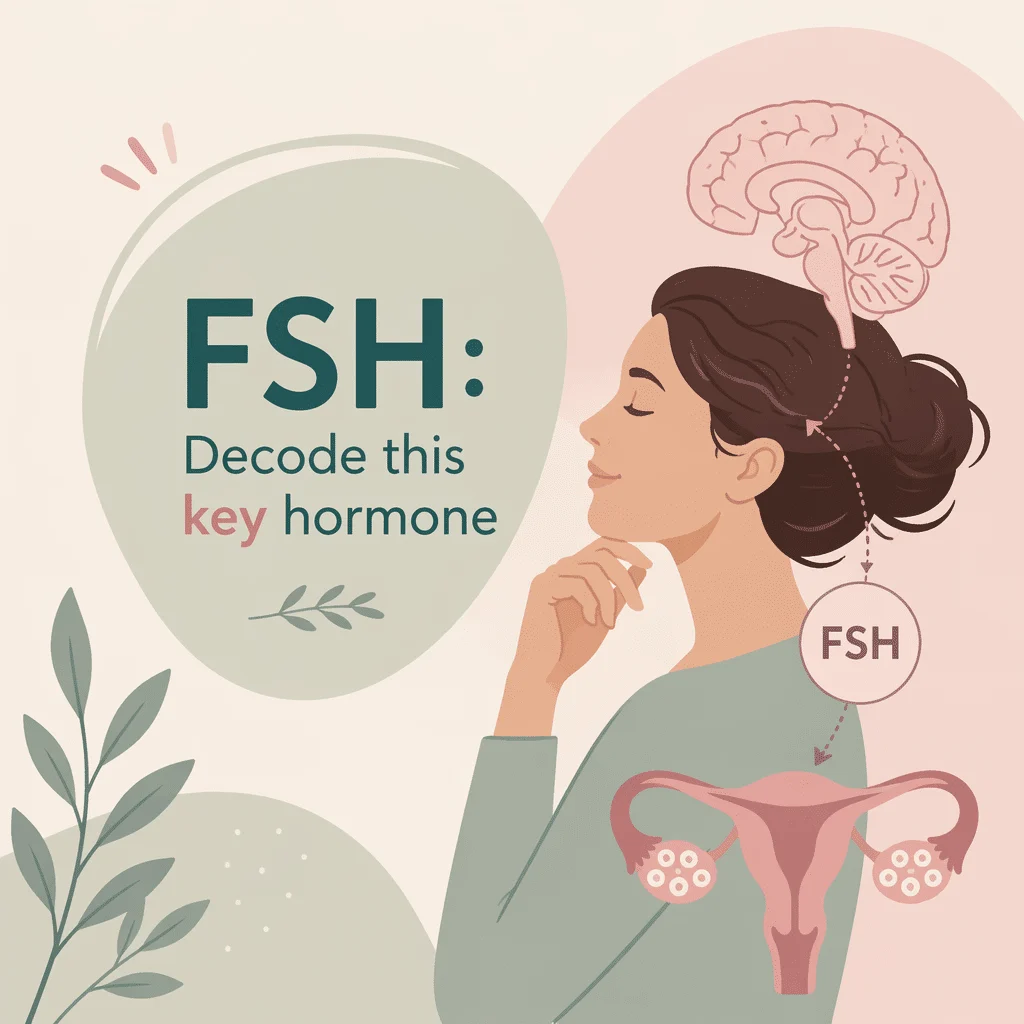
FSH is made by the pituitary gland, a pea-sized gland at the base of the brain. It responds to GnRH, a hormone released in pulses by the hypothalamus just above it. This chain — hypothalamus, pituitary, ovaries or testicles — is the reproductive axis, and FSH is one of its main messengers.
The system runs on feedback. When the ovaries or testicles work well, they signal back that the pituitary can ease off. When they respond poorly, that brake weakens and FSH rises. So FSH measures how loudly your brain is having to shout at your gonads, rather than counting eggs or sperm.
FSH in women
In women, FSH stimulates the growth of ovarian follicles — the small fluid-filled sacs in the ovaries, each holding an immature egg. Early in each cycle, FSH rises and recruits a group of follicles. As one becomes dominant, it produces oestradiol and other signals that suppress FSH again, so the rest stop developing. FSH also prompts follicle cells to make oestradiol, the main form of oestrogen in women of reproductive age.
FSH in men
In men, FSH acts on the Sertoli cells inside the testicles, which nurse developing sperm through spermatogenesis. Testosterone drives much of that process, whilst FSH supports sperm quantity and quality. Because men have no monthly cycle, male FSH levels are far more stable day to day, so timing matters much less.
Why the day of your cycle changes your FSH result
This is the most common source of confusion for women who still have periods. FSH is not a steady number: it moves in a predictable pattern across the cycle, so the same value means different things depending on when the blood was taken.
FSH is highest in the early follicular phase, in the first days after a period starts. It then falls as the dominant follicle takes over, spikes briefly around ovulation alongside the LH surge, and stays low through the luteal phase. For that reason, when FSH is measured to assess ovarian function, the sample is usually taken on day 2 to day 4 — counting day 1 as the first day of proper bleeding, not spotting.
Testing then gives a comparable baseline: a value taken on day 3 sits in a very different context from the same value on day 22. This is why clinics ask when your last period started. If your cycles are irregular or absent, your doctor may test at any point, or repeat it, leaning more on the whole hormone picture.
Why your doctor requests an FSH blood test
FSH testing investigates a specific question rather than acting as a routine screen. According to the National Library of Medicine’s MedlinePlus guide to the FSH levels test, common reasons include difficulty conceiving after about 12 months, periods that are irregular or have stopped, unclear symptoms that might reflect perimenopause, a low sperm count or testicular concerns in men, suspected pituitary problems, and puberty that starts unusually early or late in children.
It is worth knowing what FSH testing is not for. If you are 45 or older with menopausal symptoms, testing is usually unnecessary: a rising FSH is expected at that stage, and the diagnosis rests on your symptoms and cycle pattern. FSH is also not a wellness marker.
What a high FSH result can mean
A high FSH generally means the pituitary is working harder to get a response from the ovaries or testicles. The reason for that reduced response is what matters, and it varies with age and sex.
Reduced ovarian reserve, perimenopause and menopause
As the follicle pool declines with age, the ovaries send back weaker feedback and FSH drifts upward. During perimenopause — the years before the final period — this produces an erratic picture: FSH can be high one month and near-normal the next, alongside cycles that shorten, lengthen or skip. That variability is normal, and it is one reason a single high reading in your forties is not a diagnosis. Experiences that prompt testing at this stage are set out in our guide to menopause symptoms and stages, and less familiar ones in our article on nausea during perimenopause.
After menopause, once periods have stopped for 12 consecutive months, FSH settles at a persistently high level, confirming what symptoms and cycle history have usually made clear already.
Primary ovarian insufficiency
When the ovaries stop working normally before the age of 40, the condition is called primary ovarian insufficiency, or POI. It is not the same as early menopause: ovarian function in POI can fluctuate, periods sometimes return, and pregnancy remains possible in a minority of cases. POI is diagnosed on a raised FSH plus several months of irregular or absent periods before 40, and it deserves proper assessment, because it carries implications for bone and heart health as well as fertility. The Eunice Kennedy Shriver National Institute of Child Health and Human Development maintains a clear overview of primary ovarian insufficiency for patients.
High FSH in men
In men, a raised FSH points towards a primary testicular problem: the testicles are not producing sperm normally, and the pituitary is compensating. Causes include Klinefelter syndrome (an extra X chromosome), mumps affecting the testicles, injury, undescended testicles in childhood, and damage from chemotherapy or radiotherapy.
FSH is especially useful in one situation. If a man has very few or no sperm in the ejaculate, a raised FSH suggests the testicles are struggling to make sperm, whereas a normal FSH with normal testicular size raises the possibility of a blockage in the tubes that carry sperm — a distinction that changes what happens next. Testosterone tells a complementary part of this story, so the two are usually measured together; see our guides to the testosterone blood test and to low testosterone in men.
What a low FSH result can mean
A low FSH shifts attention upstream, to the brain. If the ovaries or testicles are underactive but FSH is low — or even unremarkably normal — the pituitary is not sending the signal it should be.
When the signal comes from the brain
The umbrella term is hypogonadotropic hypogonadism: low sex hormones caused by low gonadotropins (FSH and LH) rather than by a problem in the gonads. In women, one common form is hypothalamic amenorrhoea, where periods stop because the hypothalamus reduces its GnRH pulses. It is typically triggered by a sustained mismatch between energy intake and output — significant weight loss, being underweight, heavy training loads, or major stress. This is a protective adaptation rather than an ovarian disease, and is often reversible once the strain eases.
Other causes lie in the pituitary itself, including tumours and their treatment, and genetic conditions such as Kallmann syndrome, where hypogonadotropic hypogonadism comes with a reduced sense of smell. Because raised prolactin can suppress FSH and LH and mimic this picture, prolactin is usually checked alongside — see our article on high prolactin levels. Thyroid disorders can disturb cycles too, which is why a TSH blood test often appears on the same request form.
Hormonal contraception and other medicines
This one causes a lot of unnecessary worry. Combined hormonal contraception — the pill, patch or ring — works partly by suppressing FSH and LH. A low FSH whilst you are using it is the treatment doing its job, not a sign that anything is wrong with your ovaries, and it says nothing about your future fertility. It does make the result uninformative, though: to assess ovarian function, FSH generally needs to be interpreted off hormonal contraception.
Other medicines also move FSH, including GnRH agonists and antagonists used in endometriosis, fibroid and cancer care, and anabolic steroids in men. Always tell the laboratory and your doctor what you are taking, including anything bought without a prescription.
Reading FSH together with LH and oestradiol
FSH becomes far more informative as part of a pattern. LH is the pituitary’s other gonadotropin; oestradiol and testosterone are what the gonads make in response. The relationship between them shows where in the chain the problem sits — something no single hormone can do. Our companion guide to the luteinising hormone blood test explains LH in the same way, and the oestrogen side is covered in our guide to the oestradiol blood test.
The grid below maps how clinicians reason about these results. It is not a self-diagnosis tool — real reports rarely fall neatly into one row.
| Pattern | What it often suggests | Where the issue sits |
|---|---|---|
| High FSH, high LH, low oestradiol (woman) | Ovaries responding less to the pituitary signal: perimenopause or menopause; primary ovarian insufficiency if under 40 | The ovaries |
| High FSH, high LH, low testosterone (man) | Primary testicular failure, for example Klinefelter syndrome, past injury or infection, or cancer treatment | The testicles |
| Low or inappropriately normal FSH and LH, with low oestradiol or testosterone | Hypogonadotrophic hypogonadism: hypothalamic amenorrhoea, pituitary conditions, raised prolactin, or hormonal contraception | The hypothalamus or pituitary |
| Normal FSH with LH proportionally higher (woman) | Sometimes seen in polycystic ovary syndrome, though this ratio is neither required nor sufficient to diagnose it | The ovaries and the signal together |
| Raised FSH alongside a mid-cycle LH surge (woman) | Expected around ovulation, and a common reason a sample taken late in the cycle looks alarming | Normal cycle physiology |
Reference ranges differ between laboratories because they use different assays and units, so compare your value with the range printed on your own report rather than one found online.
What an FSH blood test can and cannot tell you about fertility
This deserves plain speaking, because FSH is often asked to answer questions it never could. An FSH result does not count your eggs. It does not tell you how many years of fertility you have left, and it does not predict whether you will conceive naturally this year. A raised FSH shifts the odds statistically across large groups, but it forecasts poorly for any individual. Women with a high FSH do conceive spontaneously, and women with a perfectly normal FSH sometimes struggle. Age remains the strongest single predictor of natural fertility, and FSH does not override it in either direction.
What FSH does well is different and still valuable: it helps locate where a problem lies in the reproductive chain, flags ovarian function that has declined earlier than expected, and contributes to diagnosing conditions such as POI. When the question is how many eggs the ovaries might yield in an IVF cycle, two other markers do that job better — anti-Müllerian hormone (AMH) and the antral follicle count (AFC), an ultrasound count of the small resting follicles. Both reflect the resting follicle pool more directly than FSH, and neither is thrown off by cycle day to the same degree.
At-home menopause tests based on FSH deserve caution. MedlinePlus is explicit that these urine kits can only identify a higher-than-normal FSH, and that they should not be used to check whether you can become pregnant, because they cannot accurately tell whether your ovaries are releasing eggs. Given how much FSH swings month to month during perimenopause, a home test can easily read normal in someone well into the transition, or high in someone whose cycles then continue for years. Treat the result as a prompt to talk to your doctor rather than as an answer.
When to see a doctor
An FSH result is information, not an emergency. Some situations are still worth raising promptly:
- Periods that stop for three months or more, or turn markedly irregular, when you are not pregnant and not using hormonal contraception.
- Menopausal symptoms such as hot flushes or vaginal dryness before age 40, or a raised FSH at that age — both warrant assessment for primary ovarian insufficiency.
- Twelve months of trying to conceive without success, or six months if you are over 35.
- In men, a low sperm count, shrinking testicles, loss of body hair, or a persistent drop in sex drive.
- Headaches, vision changes, unusual milk production or profound fatigue alongside a low FSH, which can point towards a pituitary cause.
- Puberty starting before age 8 in girls or 9 in boys, or absent by 13 in girls or 14 in boys.
Bring the whole picture: the date your last period started, recent cycle lengths, any medicines or supplements, and previous results. That context does more than the FSH number by itself.
Latest scientific advances in FSH testing
Recent research has sharpened what FSH is good for — and shortened the diagnostic path in one case.
The biggest practical change concerns primary ovarian insufficiency. A 2024 international guideline from ESHRE, the American Society for Reproductive Medicine and the International Menopause Society, led by Panay and colleagues, updated how POI is diagnosed. Previously, two raised FSH readings a month apart were required. A single FSH above 25 IU/L now suffices, together with several months of irregular or absent periods before age 40, with AMH or a repeat FSH reserved for unclear cases. The guideline also reports POI affects roughly 3.5% of women, more than previously believed. What this means for you: if POI is suspected, you are less likely to spend months in diagnostic limbo — though if your result is borderline or does not match your symptoms, repeating it or adding AMH remains reasonable.
On the question everyone actually wants answered — when will menopause happen — a systematic review by Nelson and colleagues in Human Reproduction Update in 2023, pooling 41 studies covering almost 29,000 women, examined whether AMH can diagnose or predict it. Lower age-specific AMH was consistently linked to earlier menopause, but AMH alone could not pin down the age with precision: for women under 40 the prediction window spanned several years either way, and accuracy improved only as menopause drew close. An undetectable AMH performed about as well as a raised FSH for identifying menopause that had already arrived. What this means for you: no blood test available today — not FSH, not AMH — can tell you the year you will reach menopause. These tests describe where your ovaries are now; they do not hand you a date.
For ovarian reserve, a 2024 systematic review and meta-analysis by Salemi and colleagues in Systematic Reviews compared four markers across 26 studies: AMH, antral follicle count, FSH and oestradiol. AFC and AMH clearly outperformed FSH and oestradiol at identifying both poor and high responders to ovarian stimulation. What this means for you: if the question is how your ovaries might respond to IVF medication, AMH and the follicle count answer it more reliably. FSH still earns its place, but it is not the best single measure of ovarian reserve, and a reassuring FSH does not cancel out a low AMH.
On the male side, a 2025 study by Bier and colleagues in Andrology assessed 997 men from infertile couples whose semen analysis looked entirely normal. Even there, a full assessment including FSH found meaningfully more hypogonadism and more physical and genetic findings than in fertile comparison groups. What this means for you: a normal semen analysis does not automatically close the question for men, and FSH adds information a sperm count alone misses.
Glossary
| Term | Definition |
|---|---|
| Follicle-stimulating hormone (FSH) | A hormone made by the pituitary gland that tells the ovaries to grow follicles and the testicles to support sperm production. |
| Pituitary gland | A pea-sized gland at the base of the brain that releases FSH and LH into the bloodstream. |
| Ovarian follicle | A small fluid-filled sac in the ovary containing an immature egg. FSH stimulates these to grow. |
| Ovarian reserve | The pool of follicles remaining in the ovaries. It describes quantity, not the chance of pregnancy. |
| Anti-Müllerian hormone (AMH) | A hormone made by small ovarian follicles. It reflects ovarian reserve more directly than FSH and varies little across the cycle. |
| Antral follicle count (AFC) | An ultrasound count of the small resting follicles visible in both ovaries, used alongside AMH to assess ovarian reserve. |
| Luteinising hormone (LH) | The pituitary’s other reproductive hormone. Its mid-cycle surge triggers ovulation, and it is almost always measured with FSH. |
| Estradiol | The main form of oestrogen in women of reproductive age, made by growing follicles in response to FSH. |
| Primary ovarian insufficiency (POI) | Loss of normal ovarian function before age 40, marked by a raised FSH and irregular or absent periods. Function can fluctuate. |
| Hypogonadotropic hypogonadism | Low sex hormones caused by low FSH and LH signals from the pituitary or hypothalamus, rather than by a problem in the ovaries or testicles. |
Frequently asked questions
Do you need to fast for an FSH blood test?
No. FSH is not affected by food, so fasting is not required for the test itself. What matters far more is timing within the menstrual cycle if you still have periods, which is why clinics often schedule the draw for day 2 to day 4. That said, FSH is frequently ordered as part of a panel, and other tests on the same form — glucose, cholesterol or insulin, for example — may require fasting. Check the instructions your clinic gives you when you book rather than assuming either way.
How long do FSH blood test results take?
Most laboratories process FSH within one to three working days, and many return it the same day if the sample is analysed on site. The delay you experience is usually administrative rather than technical: results often wait to be reviewed by the doctor who ordered them, or to be grouped with other tests from the same panel. If your FSH was taken alongside tests with longer turnaround times, such as genetic studies, the whole set may be reported together. Ask your clinic when to expect them.
Can FSH be tested in urine instead of blood?
Yes, and this is how at-home menopause kits work. FSH does appear in urine, and urine levels correlate reasonably well with blood levels. The limitation is what the test can tell you. MedlinePlus notes that home kits only detect a higher-than-normal FSH, and should not be used to check whether you can become pregnant, because they cannot show whether your ovaries are releasing eggs. Since FSH fluctuates considerably during perimenopause, a single urine result can easily mislead in either direction. A blood test interpreted with your symptoms remains more informative.
What is a normal FSH range on a blood test?
There is no single universal range, which is genuinely the honest answer. Values depend on your sex, your age, and — for women who menstruate — the day of the cycle, since FSH is naturally highest in the first days and lowest in the luteal phase. Laboratories also use different assays and units, so ranges differ between them. This is why your report prints its own reference range next to your result: that is the one to compare against. A value slightly outside the printed range is not automatically abnormal, and interpretation depends on context.
Can I still get pregnant with a high FSH?
Yes. A raised FSH suggests the ovaries are responding less readily, and across large groups it is associated with lower average fertility — but it does not close the door for any individual. Spontaneous pregnancies occur in women with high FSH, including some diagnosed with primary ovarian insufficiency, where ovarian function can fluctuate. Equally, a normal FSH is no guarantee. Age remains the stronger predictor. If you are trying to conceive, a raised FSH is a reason to talk to a doctor sooner rather than a verdict on your chances.
Can FSH results vary between laboratories?
Yes. Different laboratories use different assays and calibration standards, so the same blood sample can produce modestly different numbers, and some report in IU/L while others use mIU/mL. Biological variation adds more: in perimenopause especially, FSH can differ substantially from one month to the next in the same person. For both reasons, it helps to have repeat testing done by the same laboratory when you are tracking a trend, and to compare each result against that laboratory’s own reference range rather than against a previous report from elsewhere.
Sources
- MedlinePlus, National Library of Medicine — Follicle-Stimulating Hormone (FSH) Levels Test — https://medlineplus.gov/lab-tests/follicle-stimulating-hormone-fsh-levels-test/
- Eunice Kennedy Shriver National Institute of Child Health and Human Development (NICHD) — Primary Ovarian Insufficiency (POI) — https://www.nichd.nih.gov/health/topics/poi
- Orlowski M, Sarao MS — Physiology, Follicle Stimulating Hormone — StatPearls, NCBI Bookshelf, updated 2023 — https://www.ncbi.nlm.nih.gov/books/NBK535442/
- Panay N, Anderson RA, Bennie A, et al. — Evidence-based guideline: Premature Ovarian Insufficiency (ESHRE, ASRM, IMS, CRE-WHiRL) — Fertility and Sterility, 2024 — https://doi.org/10.1016/j.fertnstert.2024.11.007
- Nelson SM, Davis SR, Kalantaridou S, Lumsden MA, Panay N, Anderson RA — Anti-Müllerian hormone for the diagnosis and prediction of menopause: a systematic review — Human Reproduction Update, 2023 — https://doi.org/10.1093/humupd/dmac045
- Salemi F, Jambarsang S, Kheirkhah A, Salehi-Abargouei A, Ahmadnia Z, Hosseini HA, Lotfi M, Amer S — The best ovarian reserve marker to predict ovarian response following controlled ovarian hyperstimulation: a systematic review and meta-analysis — Systematic Reviews, 2024 — https://doi.org/10.1186/s13643-024-02684-0
- Bier S, Wolff A, Zitzmann M, Kliesch S — Normozoospermic men in infertile couples: Potential benefit of early medical diagnostic procedures — Andrology, 2025 — https://doi.org/10.1111/andr.70035
Further reading
- To see which hormones are checked when conception is proving difficult, read our guide to the fertility blood test.
- To understand how FSH fits alongside the other results on a woman’s request form, read our guide to the female hormone panel.
- To see the equivalent picture for men, read our guide to the male hormone panel.
- To explore the hormone measured most often alongside FSH, read our guide to the luteinising hormone blood test.
- To learn about another marker used when cycles are irregular, read our guide to the 17-OH progesterone blood test.
Understand your lab results with AI DiagMe
Hormone reports are rarely about one line. FSH only makes sense next to LH, estradiol and, when ovarian reserve is the question, AMH — and next to your age, your cycle and your symptoms. AI DiagMe turns those numbers into plain language so you can see how they fit together and arrive at your appointment with better questions. It helps you understand your results; it does not diagnose, and it does not replace your doctor.
Get your results interpreted in minutes