





































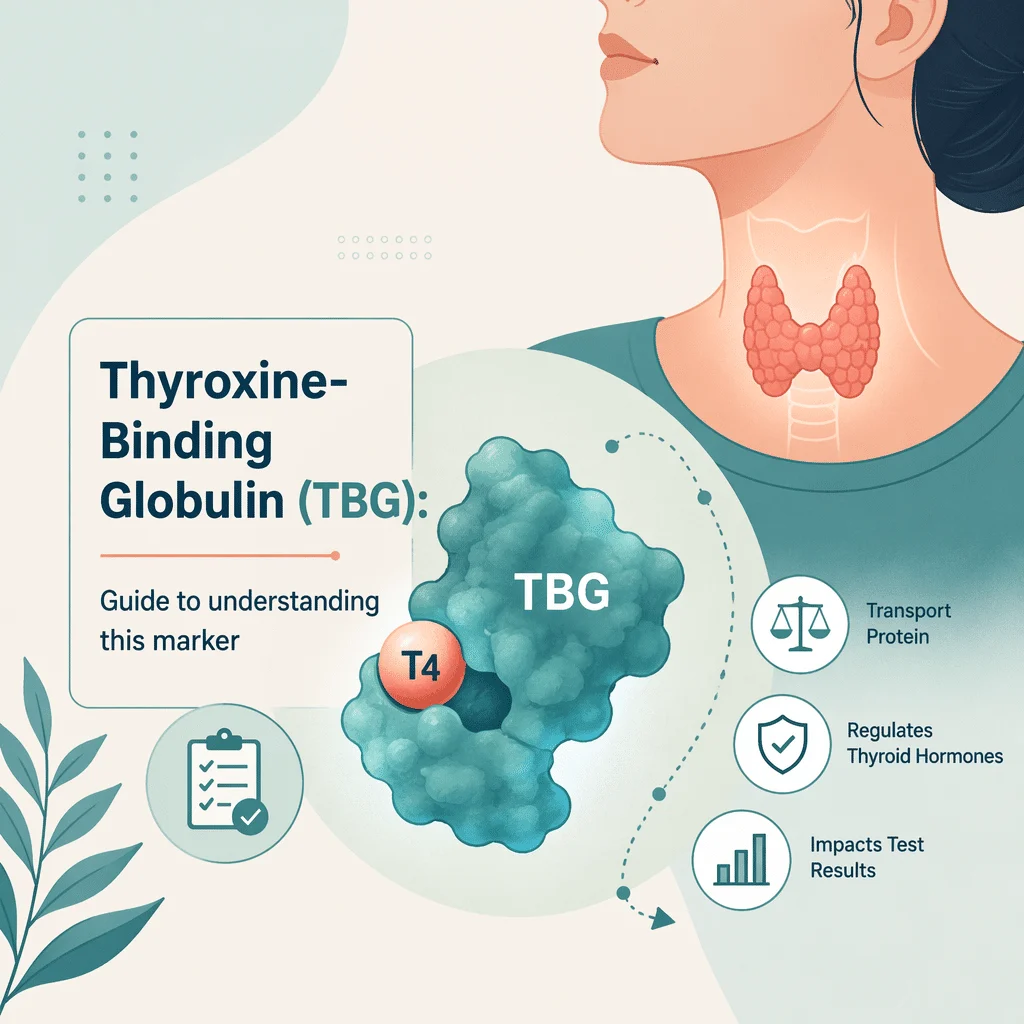
Thyroxine-binding globulin (TBG) is the main protein that carries thyroid hormones through your bloodstream, and it explains why a total T4 result can look abnormal whilst your thyroid is working perfectly well. If a lab report has handed you an unexpected total T4 or total T3 value, a shift in this carrier protein is one of the most common explanations, and one of the most reassuring. TBG changes how much hormone travels parked on a protein. It does not change how much active hormone reaches your cells.
In this article you’ll learn what TBG does, why it moves total thyroid hormones without touching the free ones, when doctors still order the test, what high and low results usually point to, and when a conversation with your doctor is worth having.
What thyroxine-binding globulin is and what it does
TBG is a protein made continuously by your liver. Its job is transport. Thyroid hormones are poorly soluble in blood, so they cannot simply float freely from the thyroid gland to your tissues. They need a carrier, and TBG is the principal one.
Your blood actually uses three carriers for thyroid hormones. TBG does most of the work, carrying roughly three quarters of your thyroxine. Transthyretin (also called prealbumin, a nutrition-related transport protein) and albumin (the most abundant protein in blood) carry the remainder. If you want to understand the wider family of transport proteins, we explain the albumin blood test and our guide to prealbumin levels.
TBG binds thyroid hormones tightly but reversibly. That combination creates a large circulating reservoir, a buffer that smooths out supply. Hormone releases from TBG gradually, so your tissues receive a steady trickle rather than surges. This buffering is why thyroid hormone levels stay remarkably stable from hour to hour.
The instructions for building TBG come from a gene called SERPINA7, which sits on the X chromosome. That location matters, and we return to it when we look at inherited TBG differences.
Why TBG changes total thyroid hormone but not free thyroid hormone
This is the single most useful idea on this page, and it explains almost every confusing TBG-related lab result.
More than 99% of the thyroxine in your blood is bound to a carrier protein at any moment. Less than 1% circulates unattached. That tiny unattached portion is called free T4, and it is the only part that can enter your cells and act. Bound hormone is inactive cargo. It is in transit, not at work.
A total T4 test measures everything: bound plus free. A free T4 test measures only the active fraction. So when your liver makes extra TBG, more hormone gets bound, and total T4 rises. But your pituitary gland monitors free hormone, not total. It quietly adjusts thyroid output until free T4 returns to your normal set point. Total T4 settles at a new, higher number. Free T4 and TSH stay where they always were. You feel no different, because nothing that matters biologically has changed.
The same logic runs in reverse when TBG is low. Less carrier means less cargo, so total T4 falls, sometimes strikingly. Free T4 and TSH remain normal, and thyroid function is normal too. To see how the active fraction is measured, you can consult our guide to the free T4 blood test.
How a TBG shift looks on a lab report
The table below shows the patterns doctors use to tell a carrier-protein effect apart from genuine thyroid disease. Notice that the TSH column does most of the diagnostic work.
| Total T4 | Free T4 | TSH | What this pattern usually suggests |
|---|---|---|---|
| High | Normal | Normal | High TBG carrying extra hormone. Thyroid function is normal. Common in pregnancy or with oestrogen. |
| Low | Normal | Normal | Low TBG carrying less hormone. Thyroid function is normal. Seen with androgens, protein loss or an inherited variant. |
| High | High | Low | A genuinely overactive thyroid. This is not a carrier-protein effect. |
| Low | Low | High | A genuinely underactive thyroid. This is not a carrier-protein effect. |
Read the first two rows again if a total T4 result has worried you. An isolated total T4 that sits outside the range, alongside a normal TSH, is the classic signature of a carrier protein doing something interesting whilst your thyroid does nothing unusual at all. For the reference ranges themselves, you can read our overview of normal thyroid levels.
When doctors actually order a TBG test
Honestly, not often. TBG measurement has become a niche test, and that is a sign of progress rather than neglect.
Decades ago, laboratories could measure only total thyroid hormones. Because totals are hostage to carrier proteins, doctors needed TBG (or indirect workarounds such as the T3 resin uptake) to correct the picture. Modern free T4 and TSH assays measure the active fraction directly, which sidesteps the carrier problem entirely. Those two tests now answer the great majority of thyroid questions, and TBG is rarely needed. You can explore the first-line test in our guide to the TSH blood test.
TBG still earns its place in a handful of situations:
- Your total and free thyroid hormone results disagree with each other, or disagree with how you feel and how your TSH looks.
- An inherited TBG excess or deficiency is suspected, often because odd total T4 results run in the family.
- A newborn screening result flags a low total T4 with a normal TSH, a pattern that often reflects inherited TBG deficiency rather than congenital hypothyroidism.
- A doctor needs to interpret thyroid results in someone with heavy protein loss, advanced liver disease or unusual hormone therapy.
What the test involves
A TBG test uses an ordinary blood sample from a vein in your arm. No fasting is required. Results come back as a concentration, and laboratories report them in different units, commonly mg/L or µg/mL. Reference ranges differ between laboratories and between assay methods, so always compare your number with the range printed on your own report rather than one you find online. TBG is nearly always interpreted next to TSH and free T4, never alone.
What a high TBG result usually means
Raised TBG almost always reflects something increasing production or slowing breakdown of the protein. It is not a thyroid disease, and it is not a disease of TBG either.
Oestrogen is by far the most common driver. It stimulates the liver to make more TBG and makes each molecule survive longer in circulation. So high TBG is entirely expected during pregnancy, when taking combined oral contraceptives, and during hormone replacement therapy. In pregnancy, TBG rises early and stays elevated, which is precisely why total T4 is unreliable in pregnancy and why free T4 and TSH are used instead. If you are pregnant, our overview of the blood tests checked during pregnancy puts thyroid testing in context.
Other recognised causes of high TBG include:
- Acute viral hepatitis, which can release TBG and raise levels for weeks.
- Medicines with oestrogen-like effects on the liver, such as tamoxifen and raloxifene.
- Certain other drugs, including methadone, mitotane and fluorouracil.
- Inherited TBG excess, an uncommon X-linked variant that produces lifelong high TBG and high total T4, with entirely normal thyroid function.
In every one of these situations, the reassuring finding is the same: free T4 and TSH stay normal. Your thyroid never received a different instruction. Only the size of the transport fleet changed.
What a low TBG result usually means
Low TBG follows one of three routes: your liver makes less of it, your body loses it, or your genes build less of it from the start.
Reduced production is typical with androgens and anabolic steroids, which suppress TBG synthesis. Long-term glucocorticoid treatment does the same, and high-dose nicotinic acid has a similar effect. Severe chronic liver disease, such as advanced cirrhosis, lowers TBG simply because a damaged liver makes fewer proteins of every kind. Our explanation of the liver function test panel covers how that synthetic capacity is assessed.
Excessive loss is the mechanism in nephrotic syndrome, a kidney condition in which proteins leak into the urine in large quantities. TBG leaves alongside albumin and other proteins, so total T4 drops. Severe protein-losing gut conditions and major illness can do something similar. We describe the underlying process in our article on protein in the urine, and the broader picture in our guide to the total protein blood test.
Inherited TBG deficiency is the third route, and it is worth understanding because it causes lifelong confusion if nobody recognises it. It comes from a change in the SERPINA7 gene on the X chromosome. Men carry a single X, so a man with an affected gene has no working backup and often ends up with complete deficiency: very low or undetectable TBG and a strikingly low total T4. Women carry two X chromosomes, so a second working copy usually compensates and produces a milder, partial deficiency. Either way, free T4 and TSH are normal, the person is completely healthy, and no treatment exists or is needed.
Causes of high and low TBG at a glance
| Causes of high TBG | Causes of low TBG |
|---|---|
| Pregnancy | Androgens and anabolic steroids |
| Combined oral contraceptives and hormone replacement therapy | Long-term glucocorticoid treatment |
| Acute viral hepatitis | Nephrotic syndrome and other protein loss |
| Tamoxifen, raloxifene, methadone, mitotane, fluorouracil | Advanced liver disease such as cirrhosis |
| Inherited TBG excess (X-linked) | Inherited TBG deficiency (X-linked, SERPINA7) |
What an abnormal TBG does and does not mean for your thyroid
An abnormal TBG result, on its own, does not mean you have thyroid disease. It means your carrier protein sits above or below the average. If your free T4 and TSH are normal, your thyroid is doing its job correctly. There is no treatment for high or low TBG, and none is needed. Inherited TBG variants cause no symptoms whatsoever, and people who have them live entirely ordinary lives, usually discovering the trait by accident.
What an abnormal TBG genuinely changes is the interpretation of other tests. It matters in three practical ways.
First, it prevents misdiagnosis. A high total T4 without context can be mistaken for an overactive thyroid, and a low total T4 for an underactive one. Knowing that TBG is shifted stops unnecessary scans, unnecessary worry and unnecessary medication.
Second, it changes which tests your doctor trusts. Once a carrier-protein difference is known, total T4 and total T3 are set aside, and free T4 and TSH become the reference. Our explanation of the free T3 thyroid marker covers the same principle for T3.
Third, there is one situation where a TBG rise has a real clinical consequence. If you already take levothyroxine for hypothyroidism and you become pregnant or start oestrogen, rising TBG binds more of your hormone and your dose may genuinely need increasing. Your thyroid cannot compensate, because it is not the one producing the hormone. This is a well-established effect, and it is why thyroid function is monitored closely in these situations. Our guide to hypothyroidism and its treatment explains the follow-up involved.
When to see a doctor about a TBG result
Most TBG findings need a short explanation rather than an investigation. The table below sets out how to think about it.
| Your situation | A reasonable next step |
|---|---|
| TBG is abnormal, but free T4 and TSH are normal, and you feel well | No urgency. Mention it at your next routine appointment so it is recorded in your notes. |
| TBG is abnormal and it fits a known cause, such as pregnancy or the pill | Expected. Confirm with your doctor that free T4 and TSH were also checked. |
| You take levothyroxine and you are pregnant or starting oestrogen | Contact your doctor promptly. Your dose may need reviewing and your TSH rechecking. |
| TSH or free T4 is also abnormal | Arrange an appointment. These results, not TBG, guide thyroid diagnosis. |
| You have symptoms such as marked fatigue, palpitations, unexplained weight change or heat or cold intolerance | See your doctor regardless of your TBG value, so the symptoms are assessed properly. |
| Unexplained TBG abnormality with no known cause | Discuss it. An inherited variant is the likely answer and may explain family results too. |
One further point worth carrying into that conversation: bring a full list of your medicines and supplements. Oestrogen, androgens, steroids and several other drugs shift TBG predictably, and naming them often resolves the puzzle in seconds. If an unexpected value has unsettled you, our guide to abnormal blood test results offers a calmer way to approach the whole report.
Latest scientific advances in TBG testing
Research on TBG is modest in volume, which suits a test this specialised. The recent work is nonetheless practical, and it points consistently in one direction.
Binding-protein testing helps most when results genuinely disagree
A team at a large United States hospital reviewed everyone whose thyroid-binding proteins had been tested there over several years, looking at why the test was ordered and whether it changed anything. The test proved most valuable in one specific circumstance: when TSH and total T4 openly contradicted each other. In that group, binding-protein abnormalities turned up frequently, and several people were spared a wrong diagnosis, including one who had previously been treated as having an overactive thyroid. In other cases the test had been ordered with little to gain. The researchers concluded that binding-protein testing should be reserved for clear discrepancies, and they emphasised that people with these protein variants are typically euthyroid, meaning their thyroid function is normal.
What this means for you: if your doctor orders a TBG test, it is usually because two of your results do not add up, not because thyroid disease is suspected. The likeliest outcome is an explanation, not a diagnosis. This was a record review from a single hospital presented at a conference, so it describes practice at one centre.
Inherited TBG deficiency can hide inside real thyroid disease
A 2026 study of Indian families traced persistently confusing thyroid results to a specific change in the SERPINA7 gene, the gene that builds TBG. Modelling suggested the change makes the TBG protein fold incorrectly, so it is broken down before it can work. The complication here was that inherited TBG deficiency coexisted with genuine hypothyroidism, which made treatment decisions harder. The authors stressed that recognising the trait prevents misreading of thyroid tests and prevents levothyroxine doses being pushed up for no good reason.
What this means for you: an inherited TBG difference does not protect you from ordinary thyroid conditions, and the two can occur together. If both apply to you, your treatment should be steered by free T4 and TSH, never by total T4. This study covered a small number of related people, so it illuminates the mechanism rather than telling us how common the variant is.
Doctors now follow a structured route through contradictory thyroid tests
A 2024 clinical review set out a step-by-step approach for the situation where thyroid tests disagree. It restates the fundamentals clearly: almost all circulating thyroid hormone is bound to TBG, transthyretin or albumin, so anything that alters those proteins moves total hormone levels substantially. It lists the drugs that raise TBG, including oestrogen, tamoxifen, raloxifene, mitotane and methadone, and those that lower it, including androgens, long-term glucocorticoids and nicotinic acid. Carrier proteins are not the only source of confusion, however. Antibodies in a person’s blood can interfere with the laboratory machinery itself and produce falsely high or falsely low readings. Because TBG levels shift so readily, the authors note that total T4 and total T3 are no longer standard clinical tests.
What this means for you: a contradictory thyroid panel is a recognised puzzle with a well-worn solution path, not a mystery. Your doctor has a defined sequence for working through it, and repeating or refining the tests is often the sensible next move rather than starting treatment.
Contraceptive pills raise TBG, and not all of them do it equally
A randomised trial compared three combined oral contraceptives and measured their effects on liver-made binding proteins, TBG amongst them. Every formulation raised TBG. A newer pill based on estetrol, an oestrogen naturally produced by the foetal liver, raised it noticeably less than the two formulations built on ethinyl-estradiol. The effect appeared within the first few cycles and then held steady.
What this means for you: if you take the combined pill and your total T4 looks high, that is an anticipated consequence of the oestrogen in it, not a sign your thyroid has changed. Your free T4 and TSH should be normal, and the size of the shift depends on which pill you take. This trial was funded by the maker of the newer formulation and followed a modest number of participants, so treat the comparison as a useful signal rather than the last word.
Glossary
| Term | Definition |
|---|---|
| Thyroxine-binding globulin (TBG) | The main protein made by the liver to carry thyroid hormones around the bloodstream. |
| Total T4 | A test measuring all thyroxine in the blood, both the part bound to carrier proteins and the small free part. |
| Free T4 | The small unattached fraction of thyroxine that can enter cells and act. The part that matters biologically. |
| TSH | Thyroid-stimulating hormone, released by the pituitary gland to tell the thyroid how much hormone to make. |
| Euthyroid | A medical term meaning thyroid function is normal, whatever other results may look like. |
| Transthyretin (prealbumin) | A second carrier protein that transports a share of thyroid hormone in the blood. |
| SERPINA7 | The gene on the X chromosome that carries the instructions for building TBG. |
| X-linked | Describes a trait carried on the X chromosome, which typically affects men more completely than women. |
| Nephrotic syndrome | A kidney disorder in which large amounts of protein leak from the blood into the urine. |
| Discordant thyroid tests | Thyroid results that contradict one another or do not match how a person actually feels. |
Frequently asked questions
What is thyroxine-binding globulin in simple terms?
Think of it as a courier service for your thyroid hormones. Your liver makes this protein, and it picks up thyroid hormone and carries it through your blood. Most of your thyroid hormone is riding on a courier at any given moment, and only the small amount that has been dropped off can actually do anything. TBG controls how much hormone is in transit, not how much is delivered. That is why having more or fewer couriers changes your total hormone reading without changing your thyroid function or how you feel.
Is high thyroxine-binding globulin dangerous?
On its own, no. High TBG is not a disease and it does not damage anything. It usually reflects oestrogen, which is why it is completely normal in pregnancy and common with the contraceptive pill or hormone replacement therapy. It can also follow acute hepatitis or run in a family as an inherited trait. The one thing worth checking is that your free T4 and TSH are normal, because those results, not TBG, tell you whether your thyroid is healthy. If they are normal, no treatment is needed and none exists.
What causes low thyroxine-binding globulin?
Three broad things: making less of it, losing it, or inheriting less of it. Androgens, anabolic steroids and long-term steroid tablets reduce production. Advanced liver disease reduces it because a damaged liver makes fewer proteins generally. Nephrotic syndrome and other protein-losing conditions cause it to leak away. Inherited TBG deficiency, caused by a change in the SERPINA7 gene, means your body simply builds less from birth. In all of these, a low total T4 with a normal TSH is the expected pattern, and thyroid function itself remains normal.
What is the difference between thyroglobulin and thyroxine-binding globulin?
The names look almost identical, and confusing them is easy. Thyroglobulin is made inside the thyroid gland itself and is the raw material the gland uses to build thyroid hormone. It is measured mainly to follow people treated for thyroid cancer. Thyroxine-binding globulin is made by the liver and simply transports finished hormone through the blood. Different organ, different job, different reason for testing. If your report mentions one, check carefully which one it is.
Does thyroxine-binding globulin change in pregnancy?
Yes, and it is entirely expected. Oestrogen rises sharply in pregnancy, prompting your liver to produce more TBG and to break it down more slowly. TBG climbs during the first months and stays high. As a direct result, total T4 and total T3 rise too, which is exactly why those tests are unhelpful during pregnancy. Doctors rely on free T4 and TSH instead, using pregnancy-specific ranges. If you already take levothyroxine, this same effect means your dose often needs increasing, so your levels are monitored closely.
Do I need to fast before a TBG blood test?
No. A TBG test is a standard blood draw from your arm and needs no fasting or special preparation. What does help is telling the person taking the sample about any hormone treatment you use, including the contraceptive pill, hormone replacement therapy, testosterone or steroid medication, and mentioning a pregnancy. These influence TBG in predictable ways, and knowing about them lets your doctor interpret the number correctly the first time, without extra tests.
Sources
- MedlinePlus Genetics, National Library of Medicine — Inherited thyroxine-binding globulin deficiency — https://medlineplus.gov/genetics/condition/inherited-thyroxine-binding-globulin-deficiency/
- American Thyroid Association — Thyroid Function Tests — https://www.thyroid.org/thyroid-function-tests/
- Refetoff S. — Thyroid Hormone Serum Transport Proteins — Endotext, NCBI Bookshelf — https://www.ncbi.nlm.nih.gov/books/NBK285566/
- Hamadi D., Algeciras-Schimnich A., Stan M. — Suspected Thyroid Hormone Binding Protein Abnormalities: Importance of Clinical Recognition and Assessment — Journal of the Endocrine Society, 2025 — https://consensus.app/papers/details/4d21cbbf6e1053d798314e030034c56c/
- Gawandi S. et al. — Identification of recurrent pathogenic SERPINA7 mutation causing coexistence of TBG-CD and hypothyroidism in Indian pedigrees — Thyroid Research, 2026 — https://consensus.app/papers/details/b0f69f37cc225037bb9df97ef062a089/
- Amin M.F. et al. — Approach to a Patient with Discordant Thyroid Function — Bangladesh Journal of Endocrinology and Metabolism, 2024 — https://consensus.app/papers/details/2e28739444af51049bf7fd6ad932e08c/
- London A. et al. — Estetrol Combined with Drospirenone: An Investigational Oral Contraceptive With A Selective Impact on Endocrine Parameters — The Journal of Sexual Medicine, 2023 — https://consensus.app/papers/details/39141425371e5434ac01b6c062b313ce/
Further reading
- To understand the antibody test used to investigate autoimmune thyroid disease, read our guide to anti-TPO antibodies.
- To see how carrier proteins are separated and measured in the laboratory, consult our explanation of protein electrophoresis results.
- To learn what happens when blood protein levels fall, read our article on low albumin.
- To review the kidney marker that reflects protein leakage, consult our guide to the albumin-to-creatinine ratio.
- To decipher other markers on your report, browse our library of blood marker guides.
Understand your lab results with AI DiagMe
A thyroid panel often combines several numbers at once: TBG, total T4, free T4 and TSH. Read separately they can seem to contradict each other, and that is exactly where confusion starts. AI DiagMe turns your report into plain language so you can see how the values fit together and arrive at your appointment with better questions. It helps you understand your results. It does not diagnose, and it does not replace your doctor.
Get your results interpreted in minutes