





An ACTH blood test measures adrenocorticotropic hormone, a chemical messenger made by your pituitary gland that tells your adrenal glands when to release cortisol. Because this single number sits at the centre of your body’s stress and steroid system, it can look puzzling on a lab report, especially when it appears next to your cortisol result. Understanding what an ACTH blood test shows helps you make sense of why your doctor ordered it and what your numbers might mean. In this article you will learn what ACTH does, how to read high and low results alongside cortisol, which conditions the test helps investigate, how to prepare for the draw, and what recent research adds. The goal is clarity, not self-diagnosis: your results always belong in the hands of your doctor.
What is ACTH, and what does an ACTH blood test measure?
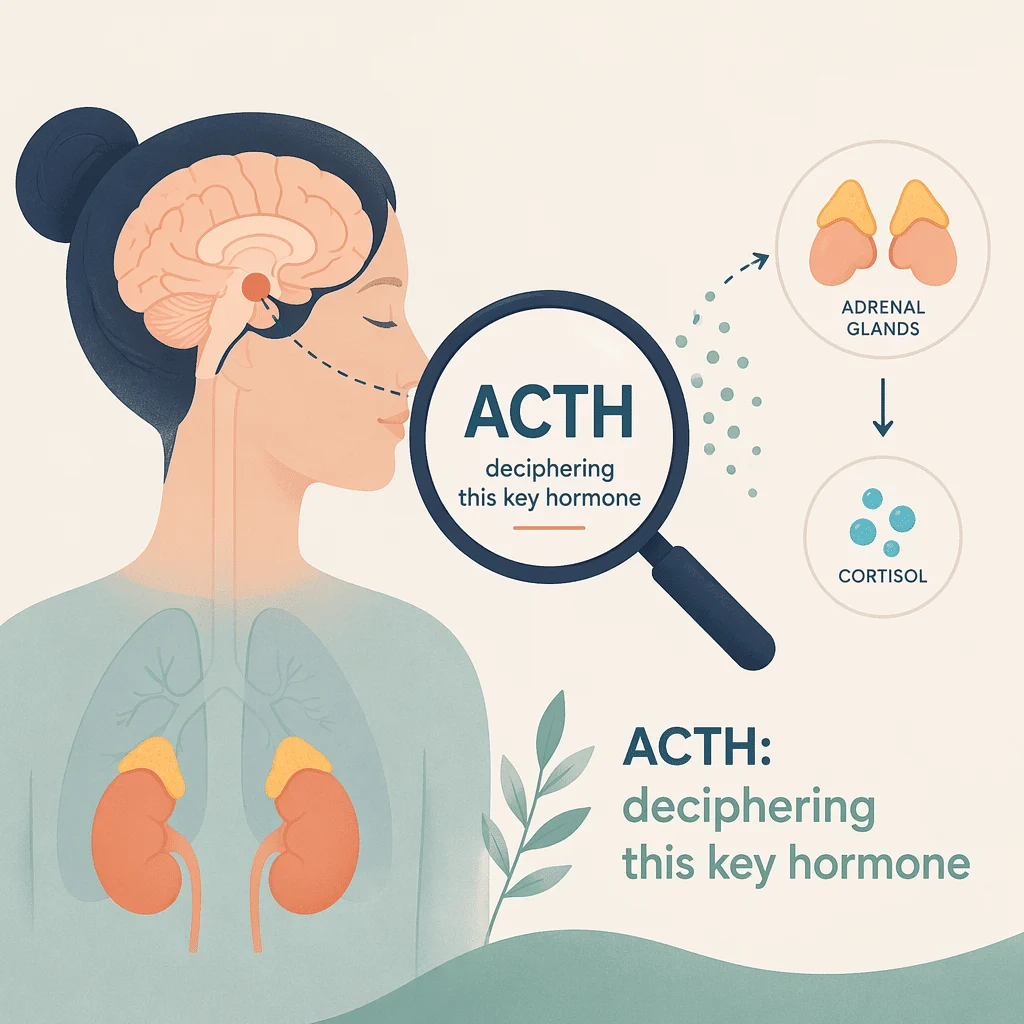
ACTH stands for adrenocorticotropic hormone. Your pituitary gland, a pea-sized structure at the base of the brain, releases it into the bloodstream in short bursts throughout the day. Its job is simple to describe: it travels to the adrenal glands, two small glands that sit on top of the kidneys, and signals them to produce cortisol. An ACTH blood test measures how much of this signalling hormone is circulating at the moment your blood is drawn.
The pituitary and adrenal connection
Doctors call this chain of command the hypothalamic-pituitary-adrenal axis, often shortened to the HPA axis. The hypothalamus starts the process by releasing a hormone called CRH, or corticotropin-releasing hormone. CRH prompts the pituitary to release ACTH, and ACTH prompts the adrenal glands to release cortisol. Each link depends on the one before it, which is why a problem in the pituitary, in the adrenal glands, or somewhere else entirely can change your ACTH level. Reading the result well means thinking about the whole chain, not just one gland.
The ACTH and cortisol feedback loop
The system is self-correcting. When cortisol rises, it signals the pituitary to make less ACTH; when cortisol falls, the pituitary makes more. This back-and-forth keeps cortisol within a healthy band. It also explains why ACTH is almost always interpreted together with cortisol rather than on its own. A single ACTH number means little until your doctor sees whether cortisol is high, low, or normal at the same time. To see the full picture, it helps to understand the cortisol blood test and what it reveals about your stress response.
Why doctors order an ACTH blood test
An ACTH blood test is rarely the first test ordered. It usually follows an abnormal cortisol result or symptoms that suggest the adrenal or pituitary glands are not working as they should. By comparing ACTH with cortisol, your doctor can tell whether a problem starts in the pituitary, which makes ACTH, or in the adrenal glands, which respond to it. That single distinction shapes every step that follows, from imaging to treatment.
Symptoms that may prompt testing
- Weight gain around the trunk, a rounder face, or new purple stretch marks, which can point to too much cortisol
- Long-lasting fatigue, weight loss, low blood pressure, or a craving for salt, which can point to too little cortisol
- Darkening of the skin over scars, knuckles, or gums
- High blood pressure or high blood sugar that does not fit the usual explanations
- Muscle weakness, mood changes, or irregular periods that appear alongside other hormone symptoms
Tests often done alongside ACTH
ACTH is most useful in context. Because cortisol and other adrenal hormones tell the rest of the story, doctors often show how ACTH fits within a broader adrenal panel blood test. The adrenal glands also balance salt and blood pressure, so your care team may explain what the aldosterone blood test reveals. And when symptoms hint at a wider hormone problem, the same pituitary-control logic drives other markers, so our guide explains how to read the TSH thyroid hormone test.
How to read your ACTH blood test results
ACTH is measured in picograms per millilitre, written pg/mL. Laboratories commonly report a morning reference range of roughly 7 to 63 pg/mL, though the exact figures vary from one lab to another and from one testing method to another. Always compare your value with the range printed on your own report rather than a number you found elsewhere.
Why the morning timing matters
ACTH follows a daily rhythm. Levels peak in the early morning, around 8 a.m., and fall to their lowest late at night. Because of this pattern, blood is usually drawn in the morning so results can be compared against a consistent baseline. A sample taken at a different time of day can look very different even in the same healthy person, which is why the collection time is noted on the request.
Reading ACTH together with cortisol
The single most important step is to read ACTH and cortisol side by side. The pattern between the two hormones is what points your doctor towards a cause. The table below shows the four combinations clinicians look for and what each one often suggests.
| ACTH and cortisol pattern | What it often points to |
|---|---|
| High ACTH with high cortisol | The pituitary or another tumour is making too much ACTH, driving cortisol up (for example, Cushing’s disease or ectopic ACTH) |
| Low ACTH with high cortisol | Cortisol is coming from the adrenal glands themselves or from steroid medicine, so the pituitary lowers ACTH (ACTH-independent Cushing’s syndrome) |
| High ACTH with low cortisol | The adrenal glands cannot respond, so the pituitary keeps sending more signal (primary adrenal insufficiency, or Addison’s disease) |
| Low ACTH with low cortisol | The pituitary is not sending enough signal, so the adrenal glands make little cortisol (secondary adrenal insufficiency or hypopituitarism) |
This framework, used by clinicians and reference laboratories, explains why neither hormone is very informative alone. If your report leaves you uncertain, our guide explains how to read blood test results.
What high ACTH can mean
A high ACTH result is not a diagnosis by itself. Its meaning depends on the matching cortisol value and on your symptoms, so the same number can lead in very different directions.
Cushing’s disease
When a benign tumour on the pituitary gland makes too much ACTH, the adrenal glands are pushed to overproduce cortisol. This specific cause is called Cushing’s disease, and it is the most common reason for endogenous Cushing’s syndrome, meaning cortisol excess produced inside the body. In this pattern, both ACTH and cortisol are typically high, and imaging of the pituitary usually follows.
Ectopic ACTH
Sometimes a tumour outside the pituitary, often in the lungs and less commonly in the pancreas, produces ACTH on its own. Doctors call this ectopic ACTH secretion. As with Cushing’s disease, ACTH and cortisol both rise, and additional testing is needed to locate the source before any treatment is planned.
Primary adrenal insufficiency (Addison’s disease)
High ACTH can also appear with low cortisol. Here the adrenal glands are damaged and cannot make enough cortisol, so the pituitary responds by pumping out more ACTH in an effort to stimulate them. This pattern suggests primary adrenal insufficiency, known as Addison’s disease. Because damaged adrenal glands can also disturb salt balance, your doctor may check the sodium and potassium in an electrolyte panel blood test.
What low ACTH can mean
A low ACTH result also takes its meaning from the cortisol value beside it, and again the two must be read together.
Adrenal tumours and steroid medicine
When cortisol is high but ACTH is low, the extra cortisol is usually not being driven by the pituitary. It may come from a tumour in one adrenal gland or from taking steroid, or glucocorticoid, medication such as prednisolone. In both situations the pituitary senses plenty of cortisol and turns ACTH down. This is called ACTH-independent Cushing’s syndrome. If you want to understand cortisol excess more fully, our article covers the symptoms and causes of high cortisol levels.
Secondary adrenal insufficiency and hypopituitarism
When both ACTH and cortisol are low, the problem often lies in the pituitary itself. If the gland is damaged by a tumour, surgery, radiation, or injury, it may not send enough ACTH, and the adrenal glands make too little cortisol as a result. This is secondary adrenal insufficiency, sometimes part of a broader condition called hypopituitarism, in which several pituitary hormones fall together. Because the pituitary controls more than the adrenal glands, related problems can affect other hormones too, and our article explains what high prolactin levels mean.
When to see a doctor
An ACTH result should always be reviewed by a clinician, but certain symptoms deserve prompt attention on their own. Contact your doctor if you notice:
- Severe, ongoing fatigue with weight loss, dizziness when standing, or strong salt cravings
- Darkening of the skin, especially over scars, knuckles, elbows, or gums
- Rapid weight gain in the trunk with a rounder face, easy bruising, or new purple stretch marks
- Muscle weakness, high blood pressure, or high blood sugar without a clear cause
Seek urgent care for sudden severe weakness, vomiting, confusion, or fainting, which can signal an adrenal crisis, a rare but serious drop in cortisol that needs immediate treatment. Acting early gives your care team the best chance to find and address the cause.
Preparing for your ACTH blood test and what can affect results
A few practical factors influence an ACTH measurement, which is one reason the same person’s results can differ over time.
Timing and fasting
Because ACTH peaks in the morning, the sample is usually collected early, often around 8 a.m. You may be asked to fast for several hours beforehand and to avoid intense exercise or stress just before the draw, since both can nudge the result upward. Follow the specific instructions your lab or doctor gives you, as protocols differ.
Medications and everyday influences
Steroid medicines have the largest effect, because the body reads them as cortisol and lowers ACTH in response. Oestrogen-containing medicines, some anti-seizure drugs, and recent physical or emotional stress can also shift the number. Tell your provider about every medication and supplement you take before the test so your result can be judged fairly.
Why one result can differ from another
ACTH is released in pulses, so two samples taken hours apart can differ even without any disease. The hormone is also fragile: samples must be kept cold and processed quickly, or the reading can fall. On top of this, different laboratory machines can produce different ACTH numbers for the same blood. For all these reasons, doctors often repeat an unexpected result rather than act on a single value.
Latest scientific advances in ACTH testing
Research continues to refine how ACTH is measured and interpreted. Here is what recent work adds, explained in plain terms.
Simple blood ratios may speed up the diagnosis
Distinguishing between the different causes of cortisol excess sometimes requires complex, multi-step hospital tests. A 2026 study asked whether a straightforward morning blood draw could help instead. Researchers measured ACTH together with cortisol and a related adrenal hormone called DHEA-S and combined them into simple ratios. What they found: these baseline measurements separated pituitary-driven from adrenal-driven Cushing’s syndrome with high accuracy. What this means for you: in the future, an ordinary set of blood results may help doctors pinpoint the cause more quickly and, in some cases, avoid more demanding tests. The work is still at an early stage and comes from a single centre, so it needs confirmation before it changes everyday care.
The lab machine can change the number
A 2025 study compared two common laboratory systems for measuring ACTH in people with low cortisol. One platform tended to report higher ACTH values than the other, and in a few cases the gap could have pointed towards the wrong diagnosis. What this means for you: if your ACTH looks surprisingly high or low, your doctor may repeat it, sometimes on a different machine, before drawing conclusions. It is a practical reason why results are read carefully and often more than once.
New medicines aimed at the ACTH pathway
Because ACTH is the switch that turns on cortisol production, researchers are testing medicines that block its action. One experimental oral drug, atumelnant, is designed to bind to the ACTH receptor of the adrenal glands and reduce excess cortisol; it is being studied in an early clinical trial in people with ACTH-dependent Cushing’s syndrome. What this means for you: these treatments are still experimental and not yet available, but they show how a clearer understanding of ACTH is opening up new options for hard-to-treat cortisol excess. A recent expert overview of Cushing syndrome reinforces the same point: cortisol excess is easier to manage when its cause is found early, and ACTH is central to finding it.
Glossary
| Term | Definition |
|---|---|
| ACTH (adrenocorticotropic hormone) | A pituitary hormone that signals the adrenal glands to make cortisol. |
| Pituitary gland | A pea-sized gland at the base of the brain that releases ACTH and several other hormones. |
| Adrenal glands | Two small glands situated on top of the kidneys that produce cortisol and other hormones. |
| Cortisol | A steroid hormone that helps manage stress, blood sugar, blood pressure, and inflammation. |
| HPA axis | The hypothalamic-pituitary-adrenal axis, the feedback chain that controls cortisol production. |
| Cushing’s syndrome | A condition caused by too much cortisol from any source, inside or outside the body. |
| Cushing’s disease | Cushing’s syndrome caused specifically by an ACTH-producing tumour in the pituitary gland. |
| Addison’s disease | Primary adrenal insufficiency, in which damaged adrenal glands produce too little cortisol. |
| Ectopic ACTH | ACTH produced by a tumour located outside the pituitary gland, such as in the lungs. |
| DHEA-S | Dehydroepiandrosterone sulphate, an adrenal hormone sometimes measured alongside ACTH. |
Frequently asked questions
Do I need to fast for an ACTH blood test?
Fasting is not always required, but many labs ask you to fast for several hours and to have the sample taken in the morning, when ACTH is naturally highest. This keeps results consistent from one test to the next. Because intense exercise and stress can also raise the reading, you may be asked to rest beforehand. Always follow the exact instructions from your own lab or doctor, since protocols differ between facilities.
What does high ACTH with normal cortisol mean?
A high ACTH with a cortisol level still in range can be an early or borderline finding. It sometimes appears before cortisol shifts, and it may prompt your doctor to repeat the test or add others to see whether an adrenal or pituitary problem is developing. On its own it is not a diagnosis. The timing of the draw, your medications, and the laboratory method all influence the number, so the full context matters.
Why do my ACTH results change from one test to the next?
ACTH is released in short pulses, so its level naturally rises and falls throughout the day and even within the same hour. Two samples taken at different times can therefore differ in a perfectly healthy person. The hormone is also fragile and must be kept cold and processed quickly, and different laboratory machines can report different values. These are common reasons doctors repeat an unexpected result before acting on it.
Can medications affect my ACTH level?
Yes. Steroid, or glucocorticoid, medicines such as prednisone have the biggest effect, because the body reads them as cortisol and lowers ACTH. Oestrogen-containing medicines and certain anti-seizure drugs can also change the result. Recent stress, surgery, or illness may shift it as well. Give your provider a complete list of your medicines and supplements so your result can be interpreted correctly.
Is an ACTH blood test the same as a cortisol test?
No, but they are closely linked. ACTH is the pituitary signal, and cortisol is the adrenal response to that signal. Measuring only one gives half the story, which is why the two are usually tested together. The pattern between them — which is high and which is low — is what helps your doctor tell a pituitary problem from an adrenal one.
Does age affect normal ACTH values?
Age and life stage can influence ACTH. Newborns often show higher levels, and the morning peak tends to be less pronounced in older adults. Pregnancy and the natural day-night rhythm also play a role. This is one reason laboratories provide their own reference ranges, and why your result should be compared with the range on your report rather than a general figure.
Sources
- MedlinePlus, National Library of Medicine — Adrenocorticotropic Hormone (ACTH) — medlineplus.gov
- Cleveland Clinic — Adrenocorticotropic Hormone (ACTH): What It Is and Function — my.clevelandclinic.org
- Mayo Clinic — Cushing syndrome: Symptoms and causes — mayoclinic.org
- Nieman LK, Castinetti F, Newell-Price J, et al. — Cushing syndrome — Nature Reviews Disease Primers, 2025 — doi.org/10.1038/s41572-024-00588-w
- Koroglu EY, Tam AA, Faki S, et al. — Diagnostic Utility of ACTH, Cortisol, DHEAS, and Their Derived Ratios in Cushing’s Syndrome Subtypes — Journal of Clinical Medicine, 2026 — doi.org/10.3390/jcm15072772
- Singha A, Mukhopadhyay P, Ghosh S — Adrenocorticotropic Hormone Measured by Immulite 1000 and Elecsys Assay Platforms in Suspected Cases of Hypocortisolism: A Word of Caution — Endocrine Practice, 2025 — doi.org/10.1016/j.eprac.2025.02.018
- ClinicalTrials.gov — A Phase 1b/2a Study of CRN04894 (atumelnant) in ACTH-dependent Cushing’s Syndrome — NCT05804669, 2023 — clinicaltrials.gov/study/NCT05804669
Further reading
- How blood test reference ranges work
- What abnormal blood test results really mean
- A guide to the 17-OH progesterone blood test
- Parathyroid hormone (PTH) blood test explained
- Understanding the luteinising hormone (LH) test
Understand your lab results with AI DiagMe
An ACTH result rarely stands alone: it makes the most sense next to cortisol, and sometimes DHEA-S or an electrolyte panel that checks sodium and potassium. Reading these numbers together is exactly where many people feel lost. AI DiagMe helps you understand what your lab values mean in plain language, so you can walk into your next appointment better informed. It is a tool to help you understand your results, not to diagnose you or replace your doctor.
Get your results interpreted in minutes