






































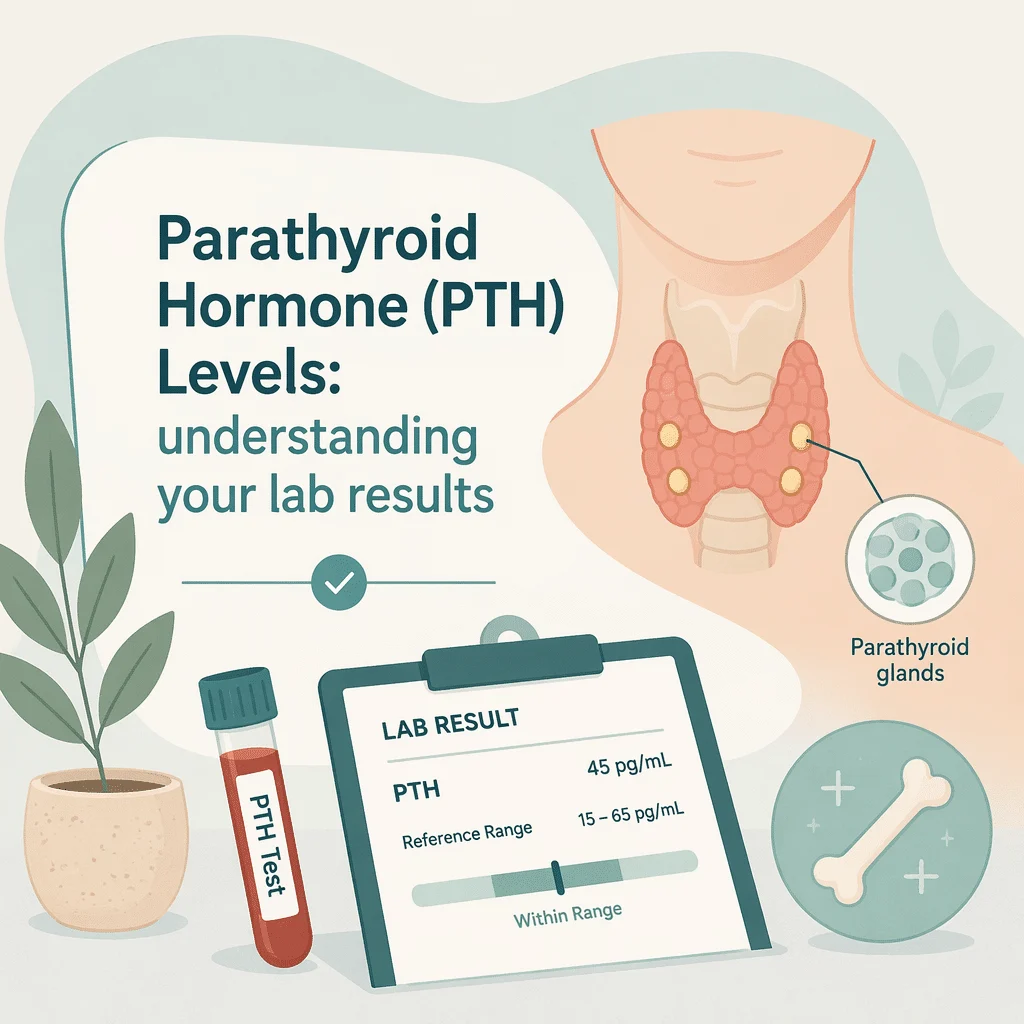
A PTH blood test measures parathyroid hormone, the hormone that acts as your body’s thermostat for calcium. Here is the most important thing to know about it: a PTH result on its own tells you almost nothing. The same PTH number can be entirely normal in one person and a clear warning sign in another, and the difference is what the calcium result says next to it. Your parathyroid glands are not meant to hold PTH at a fixed value — they are meant to react to calcium. So the question is never “is this number high?” but “is this number the right response to this calcium?”
In this article you’ll learn what parathyroid hormone does, why PTH and calcium must be read as a pair, what each combination points to, how vitamin D and your kidneys fit in, and when a result should prompt a call to your doctor.
What parathyroid hormone does in your body
Parathyroid hormone is made by four tiny glands in your neck, each about the size of a grain of rice. They sit behind the thyroid gland but have nothing to do with thyroid function. The parathyroids are neighbours of the thyroid, not part of it, and a thyroid problem and a parathyroid problem are entirely different things.
The job of these glands is narrow and vital. They monitor the calcium level in your blood and adjust PTH output to keep it steady. Calcium does far more than build bone: it lets your muscles contract, your nerves fire, your heart beat in rhythm, and your blood clot. If blood calcium drifts too far in either direction, those systems start to misbehave, so your body defends the level aggressively.
How calcium is kept in a narrow range
When blood calcium starts to fall, the parathyroid glands release more PTH. That extra PTH does three things at once: it releases calcium held in your skeleton, which acts as a calcium bank; it tells your kidneys to hold on to calcium instead of losing it in urine; and it activates vitamin D into its usable form, which helps your gut absorb more calcium from food.
When blood calcium rises, the glands switch PTH off and calcium settles back down. PTH also pushes phosphate out through the kidneys, which is why calcium and phosphate often move in opposite directions. Our guide explains what a phosphorus blood test result means.
This feedback loop is the whole reason PTH is measured. A working system produces a PTH value that makes sense given the calcium. A broken system produces a mismatch.
Why a PTH blood test is never read alone
Because PTH exists to respond to calcium, a PTH number without a calcium number is genuinely uninterpretable. Consider a PTH of 90 pg/mL, above most reference ranges. If your calcium is also high, that is a serious mismatch: PTH should have shut off and didn’t. If your calcium is low, that same PTH of 90 is your glands doing exactly their job. Identical value, opposite meaning.
This is why clinicians read the two together, alongside vitamin D and kidney function. Recent French endocrine consensus guidance states the principle plainly: diagnosis rests on a parathyroid hormone value that is inappropriate to the calcium value, not on PTH crossing a threshold by itself.
The grid below shows the main combinations and what they typically suggest. It is a map of the territory, not a diagnosis — only your doctor can say which box you are actually in.
| PTH result | Calcium result | What this pattern usually suggests |
|---|---|---|
| High | High | Primary hyperparathyroidism — a parathyroid gland acting on its own. The commonest cause of raised calcium found in outpatients, and often picked up by accident on a routine panel. |
| High | Low or normal | Secondary hyperparathyroidism — healthy glands compensating for something else, most often vitamin D deficiency, chronic kidney disease, or low calcium intake or absorption. |
| Very high | High | In someone with long-standing kidney disease, this may reflect tertiary hyperparathyroidism — glands that have been driven hard for years and no longer switch off. |
| Low | Low | Hypoparathyroidism — not enough PTH is being made. Most often follows surgery on the neck or thyroid. |
| Low | High | PTH is behaving correctly by switching off, so the calcium is arriving from another source. Your doctor will look outside the parathyroid glands for the cause. |
| Normal | High | Still a mismatch, even though both numbers sit inside their ranges. With high calcium, PTH should have fallen to the bottom of the range. A “normal” PTH here deserves review. |
That last row is the one most easily missed. A number inside the reference range is not automatically a normal number — it has to be appropriate. This is also why your report may show a corrected calcium value alongside the total calcium: roughly half your calcium travels bound to a protein called albumin, so if albumin is low, total calcium reads falsely low. Our guide explains how to read an albumin blood test.
Why your doctor ordered a PTH blood test
PTH is not part of a standard check-up. It is usually added for a reason, and most often that reason is an unexplained calcium result on an earlier panel: routine bloods show unexpected calcium, so PTH is added to work out whether the parathyroid glands are the source or the victim.
Other common reasons include:
- Osteoporosis or thinning bones, especially when the pattern doesn’t fit your age or risk profile.
- Recurrent kidney stones, since long-standing high calcium encourages stones to form. Our guide covers what causes kidney stones and how they are managed.
- Known chronic kidney disease, where PTH is tracked as part of routine mineral monitoring.
- Symptoms suggesting low calcium, such as tingling around the mouth or fingers, or muscle cramps.
- Follow-up after thyroid or parathyroid surgery.
- A vitamin D deficiency that isn’t behaving as expected.
In many cases, particularly with primary hyperparathyroidism, there are no symptoms at all: routine testing means the condition is now usually found incidentally, in people who feel well.
High PTH with high calcium: primary hyperparathyroidism
When PTH is high and calcium is high at the same time, the leading explanation is primary hyperparathyroidism. In most cases, one of the four glands has grown a small benign lump called an adenoma. That gland stops responding to the calcium feedback signal and keeps producing PTH regardless. The remaining glands usually behave normally — they are simply outvoted.
The word “benign” matters here. An adenoma is not cancer, and parathyroid cancer is genuinely rare. What primary hyperparathyroidism does instead is apply slow pressure over years: calcium is steadily drawn from bone, and the kidneys handle a heavier calcium load. That is why it is taken seriously even in people who feel fine.
Symptoms, when present, are famously vague — tiredness, low mood, poor concentration, aches, constipation, increased thirst. Because these are easy to attribute to ageing or stress, the blood test often does the talking.
Normocalcaemic primary hyperparathyroidism
There is a variant where PTH is raised but calcium stays persistently normal. It is a diagnosis of exclusion: every other reason for a high PTH — vitamin D deficiency above all, plus reduced kidney function and low calcium intake — must be ruled out first. This is why your doctor will often check vitamin D and repeat the tests rather than acting on a single elevated PTH.
How decisions about treatment are made
Treatment decisions are not made on PTH alone, and published guidance from named bodies sets out the criteria. The Italian guidelines from the Associazione Medici Endocrinologi and SIOMMMS, for example, recommend that surgery be considered in adults with sporadic primary hyperparathyroidism who have symptoms, or who meet criteria including calcium more than 1 mg/dL above the upper limit of normal, osteoporosis or a fragility fracture, reduced kidney function, kidney stones, high urinary calcium, or age 50 or under. Those who don’t meet the criteria are typically monitored instead. Your own care is a conversation with your doctor, who will weigh your results, your bones, your kidneys and your preferences.
High PTH with low or normal calcium: when the glands are compensating
This is the far more common pattern, and its origin is usually reassuring: your parathyroid glands are working properly, responding to a problem elsewhere. This is called secondary hyperparathyroidism.
Vitamin D deficiency
Vitamin D is what allows your gut to absorb calcium efficiently. When vitamin D is low, less calcium gets in, blood calcium edges down, and the parathyroid glands raise PTH to defend the level — pulling calcium from bone to do it. Your calcium may look perfectly normal on paper precisely because PTH is working hard to keep it there. The raised PTH is the visible cost of that effort.
This is the most frequent reason for an isolated high PTH with normal calcium, and it is why vitamin D is almost always checked alongside. Correcting the deficiency often brings PTH back down. You can also read our guide to the vitamin D 25-OH blood test.
Chronic kidney disease
Your kidneys activate vitamin D and clear phosphate. As kidney function declines, phosphate builds up and active vitamin D falls — both of which drive PTH up. Sustained over years, this affects bone strength and blood vessels, a cluster clinicians call CKD-MBD (chronic kidney disease–mineral and bone disorder). In kidney disease, PTH is monitored deliberately rather than as a one-off, and international bodies such as KDIGO set out how targets and monitoring should be approached. Our guide explains how to read a kidney function panel, and another covers what creatinine says about kidney function.
Tertiary hyperparathyroidism
If glands are driven hard for long enough, typically in advanced kidney disease, they can become autonomous — they stop switching off even when they no longer need to work. Calcium then rises alongside an already high PTH. This is tertiary hyperparathyroidism, uncommon outside long-standing kidney disease.
Other causes worth knowing
Low dietary calcium, poor absorption from conditions such as coeliac disease, and low magnesium can all raise PTH. The parathyroid glands need magnesium to release PTH properly, so low magnesium can produce odd, hard-to-explain results. Our guide covers how to interpret a magnesium blood test.
Low PTH with low calcium: hypoparathyroidism
When both PTH and calcium are low, the glands aren’t producing enough hormone. Calcium falls because the signal to defend it is missing.
The most common cause is surgical. Thyroid surgery can bruise, disturb the blood supply to, or remove the parathyroid glands, which sit right beside the thyroid — which is why calcium is checked closely after thyroid operations. It is often temporary, with the glands recovering over weeks, but it can be permanent. Less common causes include autoimmune conditions, low magnesium, and rare genetic conditions present from birth.
Low calcium causes recognisable symptoms: tingling around the mouth, fingers or toes, muscle cramps, and twitching or spasms. Severe cases can affect heart rhythm. Anyone who has had neck surgery and develops these symptoms should seek medical advice promptly.
One rare pattern is worth knowing: in pseudohypoparathyroidism, PTH is normal or high but the body cannot respond because the receptors don’t work, so calcium stays low despite plenty of hormone.
What can affect your PTH result
PTH is a demanding measurement, and several things shift it before anyone interprets anything.
- Sample handling. PTH is a fragile molecule that degrades if a sample sits too long or isn’t kept cool, which can lower the reading. This is why labs have strict handling rules.
- Time of day. PTH follows a daily rhythm, generally peaking overnight, so consistent timing makes results easier to compare.
- Which assay was used. Second-generation “intact PTH” and third-generation assays measure slightly different things and do not always agree, so results from different labs may not be directly comparable.
- Vitamin D status, one of the biggest drivers of PTH.
- Kidney function.
- Medicines. Lithium, some diuretics, and calcium or vitamin D supplements can all influence calcium and PTH. Tell your doctor everything you take, including supplements.
- Natural variation. PTH fluctuates from day to day even in healthy people — far more than calcium, which is held remarkably steady.
Most PTH tests don’t require fasting, but calcium is often drawn at the same time and some panels do, so follow whatever instruction your lab gives you.
When to see a doctor about your PTH results
Most abnormal PTH results are not emergencies and are worked out calmly over weeks with repeat testing. A few situations need faster attention.
- Seek urgent care for symptoms of severe high calcium: confusion or drowsiness, persistent vomiting, severe weakness, or intense thirst with heavy urination. Severe hypercalcaemia is a medical emergency.
- Seek prompt care for symptoms of low calcium: tingling around the mouth or in the hands and feet, muscle spasms, cramps or twitching — particularly after neck or thyroid surgery.
- Book an appointment to discuss any PTH result outside the reference range, so it can be read together with your calcium and vitamin D.
- Book an appointment if you have raised calcium with a PTH that is normal or high.
- Book an appointment for recurrent kidney stones, unexplained bone thinning, or fractures from minor knocks.
Bring your previous results if you have them. A trend across several tests is worth far more than any single value.
Latest scientific advances in PTH testing
Research from the last few years has reinforced the message that PTH must be read in context — and has begun to show how that could be built into the lab report itself.
A 2026 study in Clinical Chemistry and Laboratory Medicine sampled thirty healthy volunteers weekly for ten weeks to measure how much calcium-related markers naturally fluctuate. What was found: PTH varied within the same healthy person by roughly ten times as much as calcium did. A model predicting what someone’s PTH should be given their calcium flagged more potentially non-physiological results than conventional reference ranges did, and adding phosphate or vitamin D didn’t improve it — calcium alone carried the information. What this means for you: it is normal for your PTH to move around between tests more than your calcium, so one borderline PTH is weak evidence on its own.
A 2024 review in Current Opinion in Nephrology and Hypertension examined rare inherited conditions affecting PTH to understand what different PTH tests actually detect. What was found: assays — the laboratory methods used to measure a substance — can differ in which forms of the hormone they pick up, so the same blood can yield different numbers depending on the method. What this means for you: if results from two labs disagree, that may be the test, not your body. It is a good reason to stay with one laboratory for monitoring.
A 2026 analysis in BMC Endocrine Disorders used a national health survey to define what a normal PTH range should be. What was found: once people with vitamin D insufficiency, reduced kidney function or other mineral abnormalities were excluded, too few “clean” reference participants often remained to define a range reliably. What this means for you: the reference range printed beside your PTH is an approximation, drawn from populations that include people with unrecognised vitamin D deficiency. Sitting slightly outside it is not automatically alarming, and sitting inside it is not automatically reassuring.
A 2025 review in the Journal of Clinical Endocrinology and Metabolism looked at normocalcaemic primary hyperparathyroidism — raised PTH with persistently normal calcium. What was found: the natural history remains unsettled, evidence on complications is inconsistent, and there is no consensus on treatment. What this means for you: if you’re told you may have this pattern, uncertainty and watchful monitoring are the honest, evidence-based response rather than a sign of hesitancy.
Finally, 2025 French consensus guidance on diagnosing primary hyperparathyroidism restated the core rule: diagnosis rests on a PTH value inappropriate for the calcium value, and atypical patterns — high calcium with normal PTH, or normal calcium with high PTH — need careful evaluation rather than dismissal. What this means for you: your PTH result is a relationship, not a number.
Glossary
| Term | Definition |
|---|---|
| Parathyroid glands | Four rice-sized glands in the neck, behind the thyroid, that produce parathyroid hormone. They are separate from the thyroid and do a completely different job. |
| Parathyroid hormone (PTH) | The hormone that raises blood calcium by acting on bone, the kidneys and vitamin D activation. It rises when calcium falls and switches off when calcium rises. |
| Intact PTH | The most widely used type of PTH test, measuring the whole hormone molecule. Often written as “PTH, intact” on a lab report. |
| Assay | The laboratory method used to measure a substance. Different PTH assays can give slightly different numbers from the same sample. |
| Hypercalcaemia | A blood calcium level above the reference range. Mild forms often cause no symptoms; severe hypercalcaemia is a medical emergency. |
| Hypocalcaemia | A blood calcium level below the reference range. It can cause tingling, cramps and muscle spasms. |
| Primary hyperparathyroidism | A parathyroid gland producing PTH on its own, regardless of calcium. Typically shows as high PTH with high calcium, and is the commonest cause of raised calcium in outpatients. |
| Secondary hyperparathyroidism | Healthy glands raising PTH in response to a problem elsewhere, most often vitamin D deficiency or chronic kidney disease. Calcium is usually low or normal. |
| Hypoparathyroidism | Too little PTH being produced, most often after neck or thyroid surgery. Typically shows as low PTH with low calcium. |
| Corrected calcium | A calculation that adjusts total calcium for your albumin level, since about half of blood calcium travels bound to that protein. |
Frequently asked questions
Do I need to fast for a PTH blood test?
Usually not. A PTH test on its own does not generally require fasting. However, PTH is very often taken together with calcium, vitamin D, or a wider metabolic panel, and some of those tests do have fasting instructions. Because PTH follows a daily rhythm and can be affected by a recent calcium-rich meal, some laboratories prefer a morning sample for consistency. The practical answer: follow whatever instruction your laboratory or doctor gives you for the whole set of tests being taken, not just the PTH. If you were given no instruction at all, it is worth a quick call to confirm rather than guessing.
What is a normal PTH level?
Most laboratories report a normal intact PTH somewhere in the region of 15 to 65 pg/mL, but this varies by laboratory and by the assay used, so always read your result against the range printed on your own report. More importantly, “normal” for PTH is conditional. A PTH sitting comfortably inside the range can still be inappropriate if your calcium is high, because in that situation PTH should have dropped to the low end. Research has also shown that published reference ranges are drawn from populations that include people with undetected vitamin D deficiency, which nudges the range upward. The range is a guide, not a verdict.
What does “PTH, intact” mean on my report?
It refers to the type of test used. PTH circulates as a whole molecule plus various fragments, and different generations of assay detect different mixtures of these. “Intact PTH”, a second-generation assay, is the most common and measures the whole hormone plus some fragments. Third-generation assays are more selective. The practical consequence is that PTH results from two different laboratories may not be directly comparable, even if both look normal or both look high. If you are being monitored over time, staying with the same laboratory makes your trend far more meaningful than switching between them.
Can PTH be tested without calcium?
It can be ordered that way, but it is rarely useful. PTH exists to respond to calcium, so a PTH number without a matching calcium is missing the information needed to interpret it. The same PTH value can indicate a parathyroid gland misbehaving, glands working correctly to compensate for vitamin D deficiency, or nothing much at all — and only the calcium distinguishes those. If you have a PTH result and no calcium was drawn at the same time, it is entirely reasonable to ask your doctor whether calcium, and usually vitamin D, should be added.
Is PTH-related peptide the same as PTH?
No, they are different substances and different tests, though the names are confusingly similar. PTH-related peptide (PTHrP) is a protein that can act on some of the same receptors as PTH and raise blood calcium, but it is not made by the parathyroid glands. It is measured in specific situations when a doctor is investigating a cause of high calcium that sits outside the parathyroid glands. If your report says PTH or “PTH, intact”, that is the standard parathyroid hormone test discussed throughout this article, not PTHrP.
Can a high PTH level affect mood or concentration?
Symptoms such as low mood, anxiety, fatigue and difficulty concentrating have been described in people with hyperparathyroidism, and they are generally attributed to the effects of raised calcium rather than to PTH itself. These symptoms are non-specific, meaning many other conditions cause them too, so they cannot point to a parathyroid problem on their own. Recent guidance also notes that unlike bone and kidney effects, these non-classical symptoms are not reliably known to improve after treatment. If you have a raised PTH along with symptoms like these, mention them to your doctor so they form part of the overall picture.
Sources
- MedlinePlus, National Library of Medicine — Parathyroid Hormone (PTH) Test — medlineplus.gov
- National Institute of Diabetes and Digestive and Kidney Diseases (NIDDK) — Primary Hyperparathyroidism — niddk.nih.gov
- Physiology, Parathyroid Hormone — StatPearls, NCBI Bookshelf — ncbi.nlm.nih.gov
- Guldhaug NA et al. — Biological variation and inter-relation between key calcium homeostasis biomarkers — Clinical Chemistry and Laboratory Medicine (CCLM), 2026 — consensus.app
- Höppner J et al. — Rare genetic disorders that impair parathyroid hormone synthesis, secretion, or bioactivity provide insights into the diagnostic utility of different parathyroid hormone assays — Current Opinion in Nephrology and Hypertension, 2024 — consensus.app
- Choi R et al. — Reference interval of parathyroid hormone based on the Korea National Health and Nutrition Examination Survey 2024 — BMC Endocrine Disorders, 2026 — consensus.app
- Liu Y, Sinha Gregory N, Andreopoulou P, Kashyap S, Cusano N — Approach to the Patient: Normocalcemic Primary Hyperparathyroidism — The Journal of Clinical Endocrinology and Metabolism, 2025 — doi.org
- Bouillet B, Bertocchio JP, Nominé-Criqui C, Kerlan V — Chapter 2: Primary Hyperparathyroidism: diagnosis — Annales d’Endocrinologie, 2025 — doi.org
- Vescini F et al. — Italian Guidelines for the Management of Sporadic Primary Hyperparathyroidism — Endocrine, Metabolic & Immune Disorders Drug Targets, 2024 — doi.org
Further reading
- Vitamin D blood test (25-OH): read your results
- Calcium blood test: what your levels mean
- Kidney function panel: how to read it
- Alkaline phosphatase (ALP) test explained
- Calcium blood test: bone and mineral panel
Understand your lab results with AI DiagMe
A PTH result rarely travels alone. Alongside it you will usually find calcium, vitamin D and phosphate, and it is the way those numbers sit together that carries the meaning. AI DiagMe reads your report and explains what each marker measures and how they relate, in plain language. It helps you understand your results and prepare better questions — it does not diagnose, and it does not replace your doctor.
Get your results interpreted in minutes