




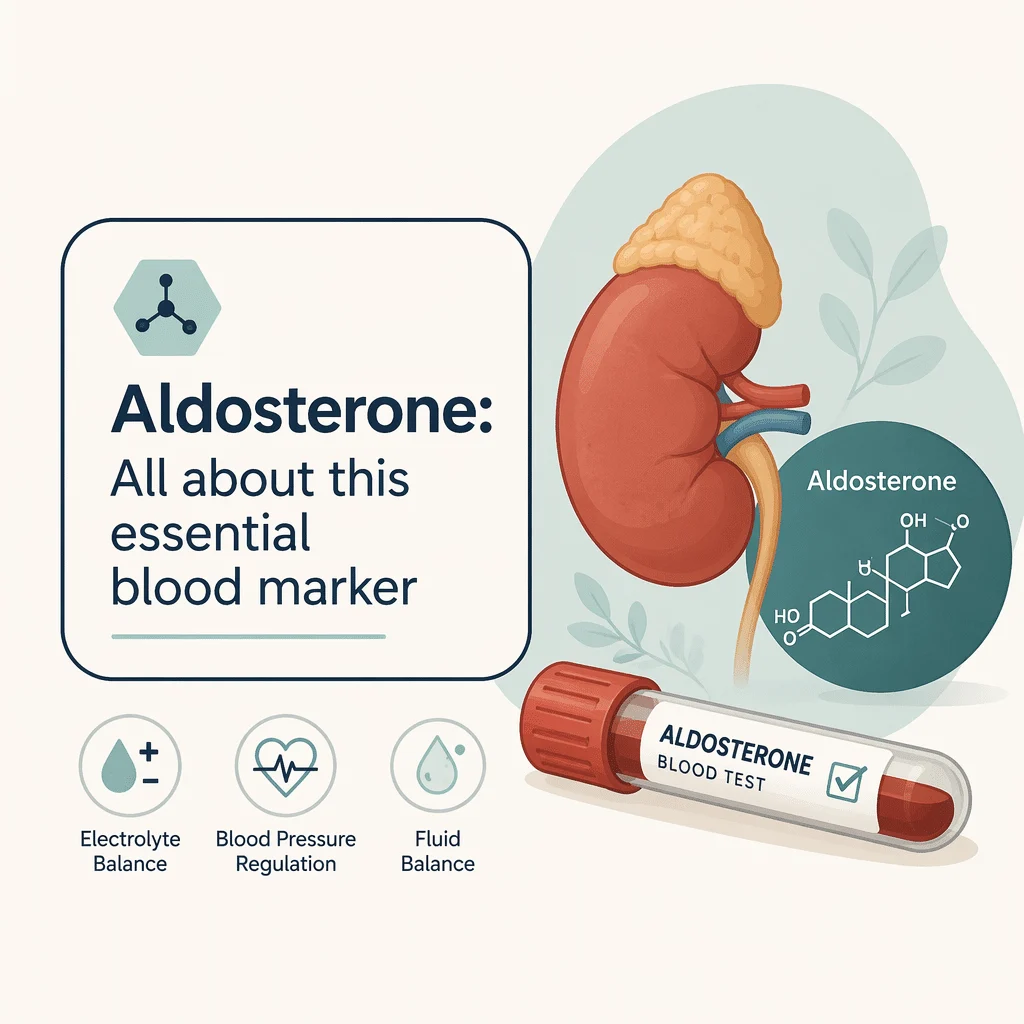
An aldosterone test measures the amount of aldosterone, a hormone made by your adrenal glands, in a sample of your blood. Aldosterone helps control blood pressure by balancing sodium and potassium, so the result offers a useful window into how your body manages fluid and minerals. Doctors most often order this test to look for a treatable cause of high blood pressure or to explain an unexpected change in potassium. In this article you will learn what aldosterone does, why the test is requested, how posture, timing, and medicines shape the result, and what high or low numbers can mean. You will also see how the aldosterone-to-renin ratio guides interpretation and when a conversation with your doctor is worthwhile.
What aldosterone is and what it does
Aldosterone is a steroid hormone produced by the outer layer of your adrenal glands, the two small glands that sit on top of your kidneys. Its main job is to manage the balance of sodium and potassium, two minerals that keep your fluids, nerves, and muscles working properly.
How your body controls aldosterone
Aldosterone acts mostly on the kidneys. When levels rise, the kidneys hold on to more sodium and water and release more potassium into the urine. Holding water helps raise blood pressure, whilst releasing potassium lowers the amount in your blood. This keeps blood pressure and mineral levels within a healthy range.
Production is guided by a feedback loop called the renin-angiotensin-aldosterone system. When blood pressure or sodium drops, the kidneys release an enzyme called renin, which sets off a chain that tells the adrenal glands to make more aldosterone. When balance returns, the signal fades. Because renin and aldosterone move together, doctors usually measure them as a pair.
Why your doctor may order an aldosterone test
An aldosterone test is mainly used to find out whether too much or too little of this hormone is affecting your blood pressure or your mineral balance. It is often requested when blood pressure stays high despite treatment, when a routine panel shows low potassium, or when symptoms point to an adrenal problem.
Your doctor may suggest the test if you have:
- High blood pressure that does not settle with several medicines, sometimes called resistant hypertension; for background you can read our guide to high blood pressure.
- Low potassium found on a blood test, with or without muscle weakness or cramps.
- High blood pressure that begins at a young age, or a family history of early high blood pressure or stroke.
- Dizziness when you stand up, which can signal low blood pressure and low aldosterone.
- An adrenal lump found by chance on a scan done for another reason.
Because aldosterone rarely tells the whole story on its own, it is usually measured together with renin. Comparing the two helps show whether a high or low result comes from the adrenal glands themselves or from another system that controls them.
How the aldosterone test is done
The test uses a simple blood sample taken from a vein in your arm, and some situations also call for a 24-hour urine collection. The blood draw itself takes only a few minutes, but a few details around it matter a great deal for an accurate result.
Posture and timing
Aldosterone changes with body position. Levels are lower when you have been lying down and higher after you have been standing or sitting upright, because being upright gently activates the renin system. For this reason, the lab may ask you to rest lying down before the draw, or to stay upright for a set time, and the report often notes which position was used. Aldosterone also follows a daily rhythm and tends to be highest in the morning, so samples are frequently collected between about 8 a.m. and 10 a.m.
Medicines and food that can change the result
Several common medicines shift aldosterone or renin, including water tablets (diuretics), many blood pressure drugs, and anti-inflammatory painkillers. Your doctor may adjust or pause certain medicines before testing, always under supervision, and you should never stop a prescribed medicine on your own. A very high or very low salt intake also changes the numbers, and natural liquorice can mimic aldosterone and raise blood pressure, so labs often advise avoiding it before the test. Around the same time, your doctor may check an electrolyte panel. Reading sodium and potassium alongside your hormone levels makes the whole picture clearer.
The aldosterone-to-renin ratio explained
The aldosterone-to-renin ratio, often shortened to ARR, compares how much aldosterone you make with how active renin is. It is the standard first step, or screening test, for a condition called primary aldosteronism. The logic is simple: if the adrenal glands make aldosterone on their own, aldosterone stays high whilst renin is pushed down, so the ratio rises.
A raised ratio does not confirm a diagnosis by itself; it flags who should go on to confirmatory testing. Reading aldosterone and renin together is far more informative than either number alone, which is why the pattern matters more than a single value. The grid below shows how the two results are commonly interpreted.
| Pattern of results | What it may suggest | Typical next step |
|---|---|---|
| High aldosterone, low renin (high ratio) | Primary aldosteronism (Conn syndrome) | Confirmatory testing, then adrenal imaging |
| High aldosterone, high renin | Secondary hyperaldosteronism (for example dehydration, kidney artery narrowing, heart failure) | Find and treat the underlying cause |
| Low aldosterone, high renin | Adrenal insufficiency (Addison disease) | Cortisol and ACTH testing |
| Low aldosterone, low or normal renin | Hyporeninemic hypoaldosteronism (often with diabetes or kidney disease) | Check potassium and kidney function |
Because renin reflects how the kidneys sense blood pressure and salt, your doctor may also review your kidney function panel.
Reading a high aldosterone result
A high aldosterone level usually points to one of two situations, and renin is the clue that separates them.
Primary aldosteronism (Conn syndrome)
In primary aldosteronism, one or both adrenal glands make too much aldosterone on their own, so aldosterone is high and renin is low. It is a common and often overlooked cause of high blood pressure, and it can also lower potassium, which may bring on muscle weakness, cramps, fatigue, or frequent urination. The cause is often a small non-cancerous growth called an adrenal adenoma, or overactivity of both glands. When your doctor suspects this pattern, they may order a broader adrenal panel and, if screening stays positive, imaging of the adrenal glands. Identifying it matters, because targeted treatment, whether medicine or surgery, can improve blood pressure and lower long-term risk.
Secondary hyperaldosteronism
Here, high aldosterone is a normal response to something else, and both aldosterone and renin are high. It happens when less blood reaches the kidneys or when fluid balance is disturbed, for example through dehydration, narrowing of a kidney artery, cirrhosis, or the fluid overload that can accompany heart failure. Treatment focuses on the underlying cause rather than the aldosterone level itself.
Reading a low aldosterone result
A low aldosterone level means your body may not be holding on to enough sodium or clearing enough potassium, which can lower blood pressure and raise potassium.
Adrenal insufficiency (Addison disease)
When the adrenal glands are damaged, they may not make enough aldosterone or cortisol. Aldosterone is low whilst renin climbs as the body tries to compensate. Signs can include low blood pressure, marked fatigue, weight loss, salt cravings, and sometimes darkening of the skin. To look into this, your doctor may measure cortisol and request the ACTH blood test, since these help show how the adrenal glands and the pituitary are working. For more detail you can also read our guide to cortisol testing.
Hyporeninemic hypoaldosteronism
This less familiar pattern is more common in people with diabetes or long-standing kidney disease. Both renin and aldosterone are low, and the most important consequence is a high potassium level, which needs attention because it can affect the heart. Other symptoms are often mild. Your doctor will usually check potassium and kidney function to guide the next steps.
Related conditions and when to see a doctor
Because aldosterone sits at the crossroads of blood pressure and mineral balance, its results connect to several other tests and conditions. Sodium and potassium are often reported together, and you can read our guide to the comprehensive metabolic panel to see how these fit into a wider picture. If your numbers are only slightly outside the range, your doctor may simply recheck them in a few months whilst keeping an eye on your blood pressure.
| When to see a doctor promptly |
|---|
|
Most abnormal aldosterone results are manageable once the cause is clear, so try not to read a single value as a diagnosis. For a broader orientation, see our complete guide to reading blood test results.
Latest scientific advances in aldosterone testing
Aldosterone testing is an active area of research, and recent peer-reviewed studies indexed in PubMed and similar databases help explain why the test is being used more widely. Here is what some of the newest work found, in plain language.
Guidelines now suggest testing far more people
In 2025 the Endocrine Society published an updated clinical practice guideline on primary aldosteronism. Its central recommendation is that every person with high blood pressure be screened at least once by measuring aldosterone and renin and calculating the ratio. What this means for you: if you have hypertension, asking about an aldosterone test is reasonable, because the guideline now treats this as a common and treatable cause rather than a rare one.
How well the aldosterone-to-renin ratio performs
A 2024 systematic review and meta-analysis, which is a study that pools results from many earlier studies, combined 18 studies and more than 7,000 people with high blood pressure. It found that the aldosterone-to-renin ratio correctly flagged most people who truly had primary aldosteronism whilst keeping false alarms relatively low. What this means for you: the ratio is a dependable screening step, though a positive result still needs a confirmatory test before any diagnosis is made.
Screening works in everyday primary care
A 2025 study followed 1,181 primary care patients with high blood pressure in Sweden and screened them with the aldosterone-to-renin ratio. About 1 in 22 turned out to have primary aldosteronism, and screening was practical even while people continued most of their usual medicines. What this means for you: this testing is not limited to specialist centres and can begin with the doctor who already manages your blood pressure.
Even milder imbalances may matter for the heart
A 2025 population study published in the journal Circulation followed about 2,000 adults for roughly a decade. People with a higher aldosterone-to-renin ratio and lower renin had a greater risk of serious heart and blood-vessel events, even when their blood pressure looked normal. What this means for you: the balance between aldosterone and renin may carry information beyond the blood pressure reading alone, which is one reason doctors pay attention to the pattern. Researchers note that this kind of study shows an association and cannot prove cause on its own, so it is best read as a reason for awareness rather than alarm.
Glossary of key terms
| Term | Definition |
|---|---|
| Aldosterone | A hormone from the adrenal glands that helps control blood pressure by balancing sodium and potassium. |
| Adrenal glands | Two small glands that sit on top of the kidneys and make several hormones, including aldosterone and cortisol. |
| Renin | An enzyme released by the kidneys when blood pressure or sodium falls; it triggers the production of aldosterone. |
| Aldosterone-to-renin ratio (ARR) | A screening calculation that compares aldosterone with renin to check for primary aldosteronism. |
| Renin-angiotensin-aldosterone system | The hormone loop that adjusts blood pressure and salt balance and controls how much aldosterone is made. |
| Primary aldosteronism (Conn syndrome) | A condition in which the adrenal glands make too much aldosterone on their own, often causing high blood pressure. |
| Hypokalaemia | A lower-than-normal level of potassium in the blood, which can cause muscle weakness or an irregular heartbeat. |
| Adrenal adenoma | A non-cancerous growth on an adrenal gland that can sometimes produce extra aldosterone. |
Frequently asked questions about the aldosterone test
What is a normal aldosterone blood test range?
Reference ranges vary between laboratories and depend on whether the sample was taken lying down or standing, so always read your result against the range printed on your own report. As a rough guide, values are lower after resting flat and higher after being upright, because standing activates the renin system. Units may appear as nanograms per decilitre or picomoles per litre. Rather than focusing on a single figure, your doctor interprets aldosterone together with renin, potassium, and sodium, which is why the aldosterone-to-renin ratio matters more than the aldosterone number alone.
What is the difference between a serum and a plasma aldosterone test?
Both a serum aldosterone test and a plasma aldosterone test measure the same hormone; the difference lies in how the blood sample is prepared in the laboratory. In practice the two are used interchangeably for screening, and the value is interpreted the same way. What influences your result far more than serum versus plasma is your posture and the time of day, along with any medicines that affect aldosterone or renin. Your laboratory chooses the method it has validated, so follow the preparation instructions you are given and let your result be read against that lab’s own reference range.
Do I need to stop my medications before an aldosterone test?
Sometimes, but only if your doctor tells you to. Several medicines change aldosterone or renin, including water tablets, some blood pressure drugs, and certain painkillers, and a group called mineralocorticoid receptor antagonists (such as spironolactone) can affect the result the most. Your doctor may pause or swap these for a short period before testing, always under supervision, and may suggest alternatives that interfere less. Never stop a prescribed medicine on your own, because doing so can raise your blood pressure or cause other problems. Bring a full list of everything you take, including over-the-counter products and supplements.
What is an aldosterone suppression test?
An aldosterone suppression test, also called a confirmatory test, checks whether aldosterone can be lowered the way it should be in a healthy body. You are given extra salt, either by mouth or through a vein, over a set period, and aldosterone is then measured. In most people, the added salt tells the adrenal glands to make less aldosterone. If the level stays high despite the salt load, it suggests the adrenal glands are producing aldosterone on their own, which supports a diagnosis of primary aldosteronism. It is usually done after a positive aldosterone-to-renin ratio, not as a first step.
Does the time of day change aldosterone results?
Yes. Aldosterone follows a daily rhythm and is usually highest in the morning, which is why samples are often taken between about 8 a.m. and 10 a.m. Collecting at a consistent time makes it easier to compare results from one test to another. Your recent posture matters too: lying down lowers aldosterone, whilst sitting or standing raises it. Because both timing and position shift the number, your report may note when and how the sample was taken so your doctor can interpret it correctly.
Can diet or liquorice affect my aldosterone levels?
Yes. How much salt you eat has a direct effect: a high-salt diet tends to lower aldosterone, whilst a low-salt diet raises it, which is why labs may ask you to keep salt intake steady before testing. Natural liquorice is a special case, because it can mimic aldosterone, raise blood pressure, and lower potassium; most liquorice-flavoured sweets in the United Kingdom do not contain the natural extract, but it is worth checking the label. Potassium-rich foods also play a supporting role in mineral balance. Share your usual diet with your doctor so results can be read in context.
Sources
- MedlinePlus, National Library of Medicine — Aldosterone Test — medlineplus.gov
- Cleveland Clinic — Hyperaldosteronism: What It Is, Causes, Symptoms and Treatment — my.clevelandclinic.org
- Johns Hopkins Medicine — Primary Aldosteronism — hopkinsmedicine.org
- Adler GK, Stowasser M, Correa RR, et al. — Primary Aldosteronism: An Endocrine Society Clinical Practice Guideline — The Journal of Clinical Endocrinology & Metabolism, 2025 — doi.org/10.1210/clinem/dgaf284
- Kao TW, Chen JY, Liu JH, et al. — Diagnostic efficacy of aldosterone-to-renin ratio to screen primary aldosteronism in hypertension: a systematic review and meta-analysis — Therapeutic Advances in Endocrinology and Metabolism, 2024 — doi.org/10.1177/20420188241303429
- Makhnov N, et al. — Screening for primary aldosteronism in 1,181 Swedish primary care patients with hypertension — Frontiers in Endocrinology, 2025 — consensus.app
- Goupil R, Desbiens LC, Merabtine A, et al. — Subclinical Primary Aldosteronism and Major Adverse Cardiovascular Events: A Longitudinal Population-Based Cohort Study — Circulation, 2025 — doi.org/10.1161/CIRCULATIONAHA.124.073507
Further reading
- Adrenal panel: cortisol, ACTH, aldosterone, and DHEA
- Cortisol blood test: a guide to your result
- ACTH hormone blood test explained
- Electrolyte panel: sodium, potassium, and chloride
- Kidney function panel: reading your renal blood tests
Making sense of hormone results can feel overwhelming, especially when several markers appear on the same report. AI DiagMe can help you understand tests such as aldosterone, renin, potassium, and sodium by turning them into clear, everyday language. It is designed to help you understand your results and prepare better questions for your appointment, not to diagnose a condition or replace your doctor.
Understand your lab results with AI DiagMe
Get your results interpreted in minutes