


HPV Self-Collection Test: What’s New in Cervical Cancer Screening

目录

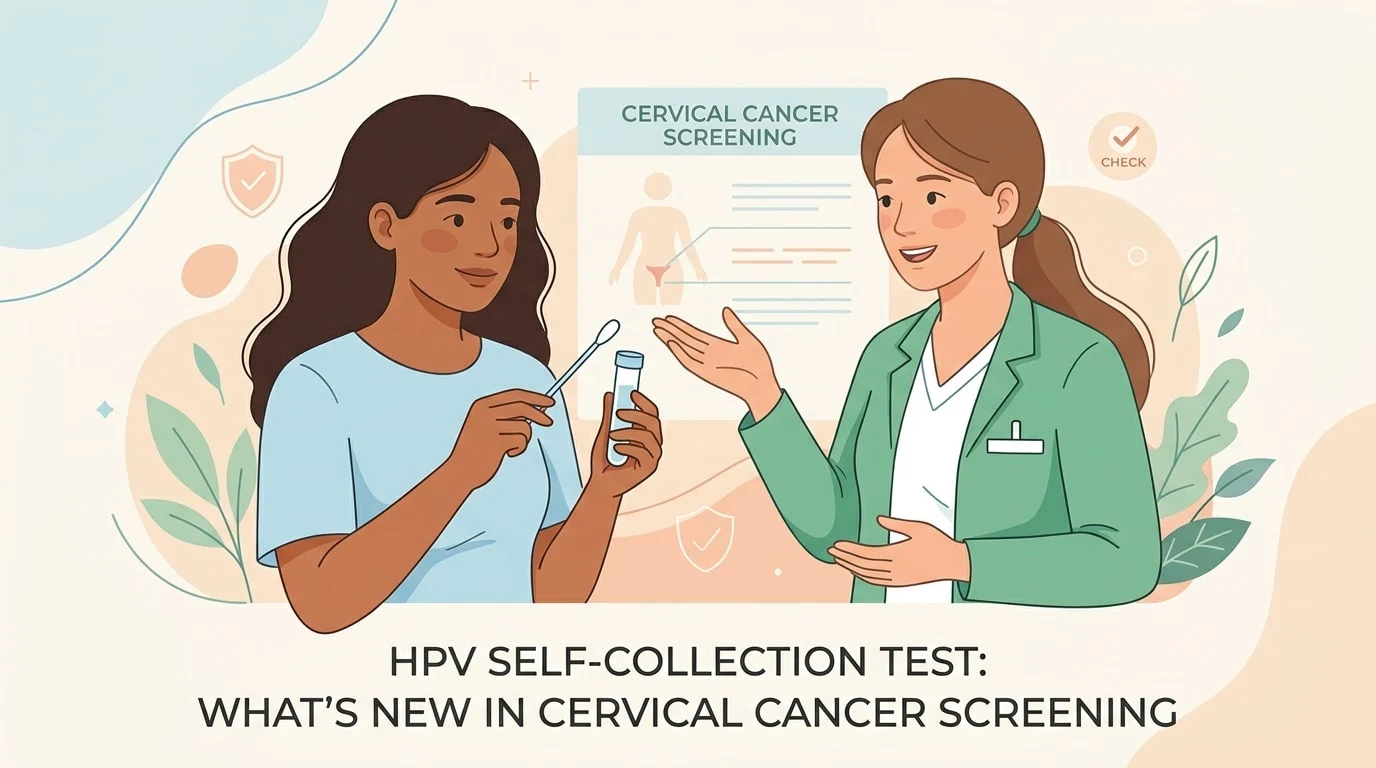
Woman using an FDA-cleared HPV self-collection test kit for at-home cervical cancer screening
经医学审核: Julien Priour

⚕️ 本文仅供参考,不能替代医疗建议。请务必咨询医生以解读您的检查结果。.

An HPV self-collection test lets you provide your own vaginal sample for cervical cancer screening, either in a clinic or, as of 2026, from home. This option has expanded quickly: federal guidelines updated in January 2026 now list self-collection as a preferred screening method for average-risk women ages 30 to 65, and two FDA-cleared kits can now be mailed directly to your door. In this article you’ll learn what changed in 2026, how the at-home test works, how it compares with a standard clinic visit, and what recent research says about its accuracy. You’ll also find answers to common questions and a short glossary of terms.

What is an HPV self-collection test?

An HPV self-collection test involves gathering cells from the vagina yourself, using a soft swab or brush, instead of having a clinician perform the sampling during a pelvic exam. The sample is then tested for high-risk strains of human papillomavirus, the virus responsible for nearly all cervical cancers. Self-collection is not new: clinics have offered it as an in-office alternative to a traditional Pap smear for a couple of years. What changed in 2026 is where you can do it.

For background on how HPV causes cervical cell changes, a separate guide from our team covers human papillomavirus, its symptoms, and its treatment options. A related guide explains a normal Pap result paired with a positive HPV test. This combination confuses many patients, since HPV testing and Pap testing look for different things.

What changed in 2026

Two developments moved HPV self-collection from a clinic-only option to something you can now do at home.

On January 5, 2026, the Health Resources and Services Administration updated its Women’s Preventive Services Guidelines. The update lists high-risk HPV testing, whether collected by a clinician or by the patient, as the preferred screening method for average-risk women ages 30 to 65, while cervical cytology remains an option for younger women. The guidelines also require most insurance plans to cover follow-up testing needed to complete screening, starting January 1, 2027. HRSA Administrator Tom Engels said the change is meant to expand options and remove cost barriers to screening.

Second, two device makers received FDA clearance to sell self-collection kits for home use rather than only inside a healthcare setting. In May 2025, the FDA approved the Teal Wand, a prescription device that ships to your home; you collect a sample without a speculum and mail it to a certified lab, where it is processed with the same test used in clinics. In April 2026, Waters Corporation announced FDA clearance of the Onclarity HPV Self-Collection Kit, paired with the BD Onclarity HPV Assay, expected to become available by prescription and to be covered by private insurance, Medicaid, and Medicare.

Before these approvals, self-collection was authorized only inside a doctor’s office, a distinction reflected in guidance published by Mayo Clinic as recently as February 2025, which described at-home use as something anticipated for future years rather than already available.

How the at-home test works

Both at-home kits follow a similar path, though exact steps vary by brand and by your clinician’s instructions.

  1. A clinician reviews your eligibility and writes a prescription, since both kits require one.
  2. The kit ships to your home in discreet packaging.
  3. You collect a vaginal sample yourself using the swab or wand included in the kit, following the printed instructions.
  4. You seal the sample and mail it back to the manufacturer’s certified laboratory, usually the same day.
  5. The lab runs the same HPV test used in clinics and sends results to your prescribing clinician.
  6. Your clinician contacts you with the result and next steps, which may include a follow-up visit if the test is positive.

A positive result does not mean you have cancer. It means the test found a high-risk HPV strain, and your clinician will typically recommend follow-up, such as a colposcopy, to check for cell changes.

Comparing your cervical cancer screening options

Self-collection is one of several ways to complete HPV testing. The table below compares the main options available in 2026.

OptionWho collects the sampleWhereAvailability in 2026
Standard Pap or HPV testClinicianDoctor’s office or clinicWidely available
In-clinic self-collectionYou, with staff nearbyDoctor’s office or clinicAvailable at many clinics since 2024
Teal Wand at-home kitYouYour home, mailed to a labPrescription-based, expanding since June 2025
Onclarity Self-Collection KitYouYour home, mailed to a labCleared April 2026, rolling out by prescription

What the research says

Independent research supports this shift toward self-collection, and the evidence has grown quickly.

A 2025 systematic review and meta-analysis in the International Journal of Gynecology & Obstetrics pooled 15 studies covering more than 3,600 women and found that self-collected vaginal samples detect high-risk HPV about as reliably as clinician-collected samples, with even higher accuracy for flagging more advanced cell changes. A pooled analysis like this one, which combines results from many smaller studies, is considered one of the stronger forms of evidence, and it consistently favors self-collection as a valid alternative.

A 2026 study from Belgium, part of a research framework called VALHUDES, compared two self-collection devices with clinician-collected samples in more than 500 women and found comparable, and in some measures higher, accuracy for detecting precancerous changes. What this means for you: newer self-collection devices continue to perform at least as well as a clinician-administered swab when processed with the same PCR-based lab test already used in clinics.

A 2025 US study conducted in Washington, D.C. and Florida compared paired self- and clinician-collected samples from 294 women and found strong agreement between the two methods. What this means for you: this kind of same-patient, head-to-head comparison is exactly what regulators look for before clearing a device for wider use.

Also in 2025, a national committee of cervical cancer screening experts published the first detailed US clinical recommendations for using self-collected samples in routine practice, including how to follow up on results by HPV type. What this means for you: your clinician now has clear, agreed-upon guidance for what to do next after your specific result, which reduces guesswork on both sides.

A pilot study now being organized through Mayo Clinic plans to offer self-collection to women visiting a hospital emergency department in Florida who may not otherwise have a regular doctor, with enrollment expected to begin in September 2026. Since the study has not yet started, its findings are still to come, but it points to how self-collection may reach people who have historically faced barriers to screening.

Who should still see a doctor promptly

Self-collection works well for routine screening in people without symptoms. See a clinician promptly, rather than waiting to order a routine screening kit, if you notice unusual vaginal bleeding, including after sex or after menopause, unusual discharge, or pelvic pain. These symptoms need direct evaluation and are not something a screening test alone should be used to investigate.

Self-collection kits are also intended for average-risk women in the recommended age range. If you have a history of abnormal results, a weakened immune system, or other risk factors, ask your clinician whether self-collection or an in-office visit fits your situation better. It’s also worth remembering that a Pap test and an HPV test check different things than other screenings. Our guide covers ovarian cancer symptoms and the tests that actually help. It explains why a normal Pap result doesn’t rule out other gynecologic conditions.

How self-collection fits into broader screening trends

HPV self-collection is part of a wider move toward tests you can complete outside a traditional office visit. Our team has covered the multi-cancer early detection test and its 2026 trial results, a single blood draw studied as a way to flag several cancers at once. A separate guide addresses pregnancy test accuracy and how to read a home result, another example of self-testing that a clinical pathway later confirms. Our overview explains the blood test process from collection to laboratory results, useful background even though HPV self-collection uses a swab rather than a needle.

HPV infection isn’t limited to the cervix. A related guide describes HPV symptoms affecting the mouth and throat. This is a reminder that the virus family behind cervical changes can appear in other parts of the body as well.

词汇表

学期定义
HPV (human papillomavirus)A common virus spread through sexual contact; certain types can cause cell changes that lead to cervical cancer over time.
High-risk HPVThe group of HPV types most strongly linked to cervical cancer, distinct from the types that cause genital warts.
Self-collectionGathering your own vaginal sample with a swab or wand for HPV testing, either in a clinic or at home.
Cervical cytology (Pap test)A test that examines cervical cells under a microscope for abnormal changes, distinct from an HPV test.
ColposcopyA follow-up exam using a magnifying instrument to look closely at the cervix after an abnormal screening result.
PCR-based testA laboratory method that detects genetic material from a virus, used to identify HPV in a collected sample.
Positive percent agreementA measure of how often two testing methods reach the same result when a true positive is present.
FDA clearanceA U.S. regulatory pathway showing a device is safe and effective, often based on similarity to an existing approved device.
HRSAThe Health Resources and Services Administration, the federal agency that sets U.S. preventive services guidelines.
Preventive services guidelinesFederal recommendations that determine which screenings insurance plans must cover without extra cost to the patient.

常见问题解答

Is an at-home HPV self-collection test as accurate as a test done in a clinic?

Research comparing self-collected and clinician-collected samples, including recent validation studies, has found strong agreement between the two methods when samples are processed with an FDA-cleared PCR-based test. Accuracy depends on following the kit instructions closely, including collecting enough cells and returning the sample promptly. If you’re ever unsure whether your sample was collected correctly, contact your prescribing clinician rather than assuming the result either way.

Do I need a prescription for an at-home HPV self-collection kit?

Yes. Both FDA-cleared at-home kits available in 2026, the Teal Wand and the Onclarity HPV Self-Collection Kit, require a prescription. A clinician typically reviews a short questionnaire about your age, screening history, and symptoms before approving the kit, which is then mailed directly to your home.

What happens if my self-collection test result is positive?

A positive result means the test found high-risk HPV, not that you have cervical cancer. Your prescribing clinician will typically recommend a follow-up appointment, which may include a colposcopy to examine the cervix more closely and, if needed, a small tissue sample. Most HPV infections, even high-risk types, clear on their own, but follow-up testing is how clinicians rule out or catch early cell changes.

Is HPV self-collection covered by insurance?

Coverage is expanding. The January 2026 update to federal preventive services guidelines requires most insurance plans to cover follow-up testing needed to complete cervical cancer screening starting January 1, 2027. The Onclarity HPV Self-Collection Kit is expected to be covered by private insurance, Medicaid, and Medicare once broadly available. Check with your insurer and prescribing clinician about your specific plan before ordering a kit.

Can I use a self-collection kit if I’ve never been screened before?

Self-collection may be a good option if you have delayed or skipped screening, since research suggests that removing the clinic visit itself helps some people complete a test they might otherwise avoid. That said, eligibility depends on your age, risk factors, and screening history, so a clinician should confirm the kit is appropriate before you order one.

What’s the difference between HPV self-collection and a Pap smear?

A Pap smear, or cervical cytology, examines cervical cells under a microscope for abnormal changes. An HPV test, whether self-collected or clinician-collected, instead looks for the virus itself using a PCR-based method. Current federal guidelines list HPV testing, including self-collection, as the preferred option for most women ages 30 to 65, while Pap testing remains recommended for younger women and stays available as an alternative at any age.

来源

  • Centers for Disease Control and Prevention — Cervical Cancer Screening — cdc.gov
  • U.S. Food and Drug Administration, Office of Women’s Health — Cervical Cancer 101, 2025 — fda.gov
  • Health Resources and Services Administration — New Cervical Cancer Screening Guidelines Strengthen Women’s Preventive Health, January 5, 2026 — hrsa.gov
  • Mayo Clinic Comprehensive Cancer Center Blog — Improving Cervical Cancer Screening with HPV Self-Collection Tests, February 2025 — mayoclinic.org
  • Dong-mei Li et al., 2025, International Journal of Gynecology & Obstetrics — Accuracy analysis of cervical cancer screening using urine and vaginal self-sampling versus clinician-collected samples: a systematic review and meta-analysis — consensus.app
  • Latsuzbaia et al., 2026, Journal of Medical Virology — Accuracy of Allplex HPV HR Detection Full Genotyping Assay on cervical samples compared to vaginal self-samples (VALHUDES) — consensus.app
  • Tsegaye et al., 2025, Journal of Clinical Virology — Performance of the Alinity m HR HPV assay on self-collected vaginal samples compared to clinician-collected cervical samples — consensus.app
  • Wentzensen et al., 2025, Journal of Lower Genital Tract Disease — Self-Collected Vaginal Specimens for HPV Testing: Recommendations From the Enduring Consensus Cervical Cancer Screening and Management Guidelines Committee — consensus.app
  • ClinicalTrials.gov, NCT06607874 — Self-Collection for Cervical Cancer Screening and HPV Vaccination for Cancer Prevention Among Women in Emergency Care in Northeast Florida (Mayo Clinic) — clinicaltrials.gov
  • Teal Health (PR Newswire) — FDA Approves Teal Health’s Teal Wand, the First and Only At-Home Self-Collection Device for Cervical Cancer Screening, May 2025 — prnewswire.com
  • Waters Corporation (PR Newswire) — Waters Announces FDA Clearance of the Onclarity HPV Self-Collection Kit and FDA-Approved HPV Assay, April 2026 — prnewswire.com

延伸阅读

利用 AI DiagMe 了解您的实验室结果

Screening results, whether from a Pap test, an HPV test, or routine bloodwork, can raise questions that are hard to research on your own. AI DiagMe helps you understand common lab values, from hormone panels to tumor markers, in plain language, so you arrive at your next appointment with clearer questions. It is built to help you understand your results, not to diagnose you or replace your clinician’s judgment.

几分钟内即可获得结果解读

作者

  • AI DiagMe

    AI DiagMe团队汇聚了医生、临床专家和医学编辑。我们的文章由健康传播专业人士撰写,并由我们科学委员会的医生进行审核和验证。该委员会由在血液科、内分泌科和全科等专科领域执业的医院医生组成。负责编辑工作的Julien Priour拥有巴黎高等商学院(HEC Paris)的MBA学位,并曾在法国国家可持续发展研究所(IRD,FUN-MOOC,2026)接受过科学写作和出版方面的培训。每篇文章都基于最新的临床指南和同行评审的医学出版物。.

相关文章