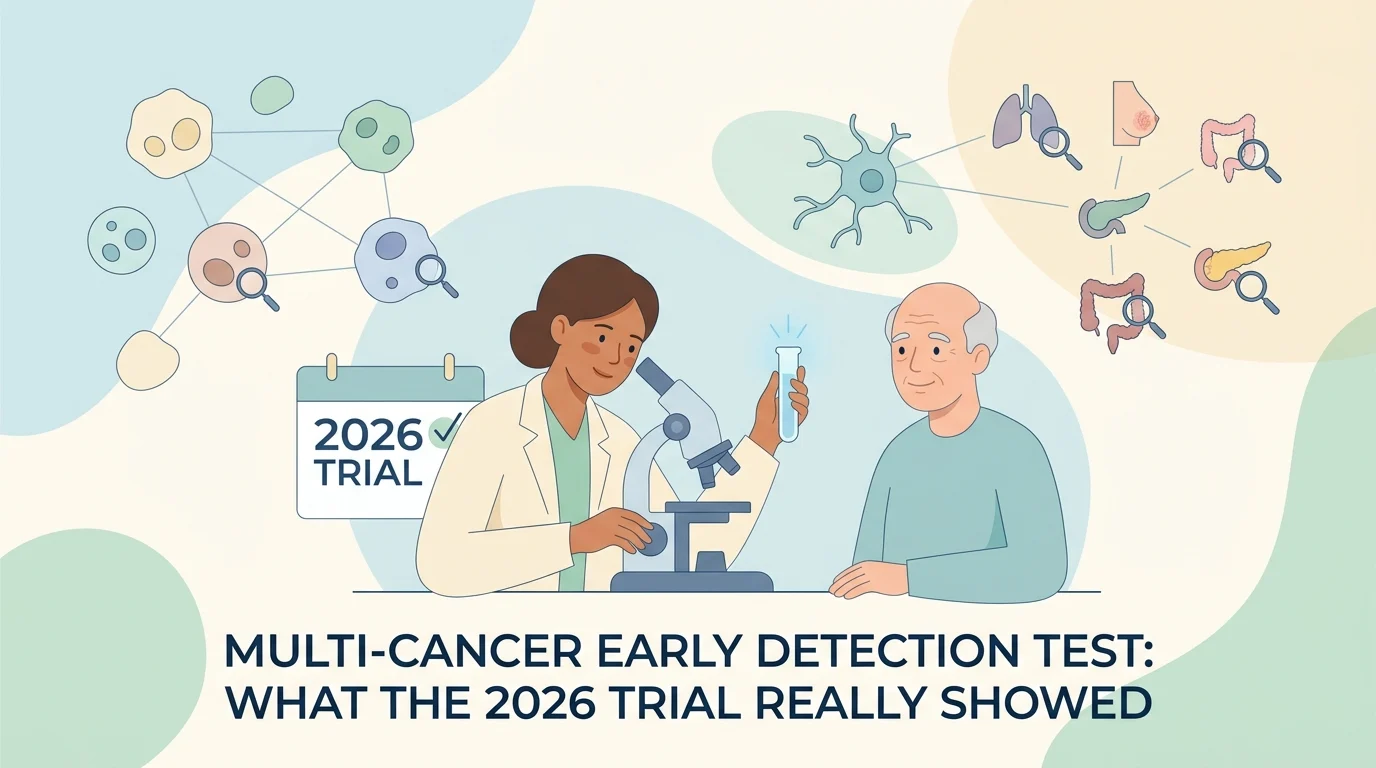
Multi-cancer early detection test: what the 2026 trial really showed

目录

经医学审核: 朱利安·普里乌尔

⚕️ 本文仅供参考,不能替代医疗建议。请务必咨询医生以解读您的检查结果。.

A multi-cancer early detection test is a single blood draw meant to look for several cancers at once, sometimes before any symptoms appear. In 2026 the idea reached a turning point: the largest trial ever run on one of these tests, the NHS-Galleri trial, reported its full results. The verdict is mixed, neither a triumph nor a failure. This article explains what a multi-cancer early detection test actually is, what the trial did and did not show, what the most recent research says, and what it changes, or does not change, for you today. The goal is clear, calm guidance, with no hype and no alarm, about a technology that is still being evaluated.

What is a multi-cancer early detection test?

A multi-cancer early detection test (often shortened to MCED) looks in the blood for tiny fragments of circulating tumor DNA, the DNA shed by possible cancer cells. Instead of measuring a single substance, it analyzes the methylation patterns of that DNA (small chemical tags) to flag a “cancer signal” and, in many cases, to suggest the organ it came from.

This approach, known as a liquid biopsy, is different from a routine blood panel: it does not measure your blood cells or cholesterol (for that, see our guide to 解读血液检测结果). It also differs from familiar 肿瘤标志物 such as 中央原子能机构, CA 125, , 或者 前列腺特异性抗原, which each track a single cancer. One multi-cancer test aims at dozens of cancers at once, including some that have no organized screening today.

The NHS-Galleri trial: a missed goal, but cancers caught earlier

The NHS-Galleri trial, presented at the 2026 ASCO Annual Meeting, followed more than 140,000 people aged 50 to 77 in England over three years. Half received the Galleri test each year on top of usual screening; the other half received usual screening alone.

Its main goal, a statistically significant drop in cancers found at a late stage (stages III and IV combined) across twelve serious cancers, was not met. That is the “miss” behind the headlines. But the picture is more subtle: according to the data presented, stage IV diagnoses fell by about 14% across the three rounds, early-stage (I-II) cancers rose by 16%, the detection rate quadrupled, and cancers found through emergency presentation dropped by 25%.

Why was the main goal missed despite these encouraging signals? Because stage III cancers turned out to be more common than expected: the drop in stage IV was partly offset by a rise in stage III, so the combined III plus IV total did not change in a statistically clear way. Follow-up will be extended to clarify the trend.

What the NHS-Galleri trial showed它的含义Strength of evidence
Main goal (stages III + IV) not metNo proof, so far, of a clear drop in advanced cancersHigh (randomized trial, 3 years)
Stage IV down by about 14%Fewer cancers found at the most serious stageModerate (secondary measure)
Early-stage (I-II) up by 16%More cancers caught earlyModerate (secondary measure)
Emergency diagnoses down 25%Fewer late, abrupt discoveries缓和

ASCO summed it up cautiously: encouraging trends toward earlier diagnosis, but a primary endpoint that was not met, and genuine hope for cancers that currently lack screening, such as ovarian and 胰腺癌. Other studies, including the US REACH trial, are awaited before any firm conclusion.

Why catching cancer earlier is not the whole story

One point is essential: a positive test is not a diagnosis. It is only a signal that calls for more tests (imaging, and sometimes a biopsy) to confirm or rule out cancer. That is exactly what the US National Cancer Institute (NCI) stresses for any test of this kind.

These tests are highly specific (few false alarms, around 99%), but none is perfect. A false positive triggers anxiety and sometimes invasive workups; a false negative can be falsely reassuring, because a quiet tumor sheds little DNA. Above all, the decisive question is still open: does earlier detection actually save lives? Moving the date of diagnosis forward does not help if it does not prevent deaths, a well-known statistical trap in which a cancer is simply “seen” for longer without the person living longer. To date, no blood test has proven reliable enough to serve as a universal screening tool.

最新科学进展

According to research indexed in PubMed, the multi-cancer early detection test is advancing quickly, but its place in care is still being defined.

A real-world analysis of more than 100,000 tests (Nature Communications, 2025) found a cancer signal in 0.91% of people tested, correctly predicted the organ of origin in 87% of cases, and reached a diagnosis in a median of 39.5 days (DOI). A prospective study in more than 9,000 adults without symptoms (BMC Medicine, 2025) shows the false-positive limit, however: a positive predictive value of about 40%, meaning many positive tests did not correspond to a true cancer (DOI).

A review article (Digestive Diseases and Sciences, 2025) tempers the enthusiasm: for most early-stage cancers, sensitivity remains modest and often below that of screening tests already recommended, and clinical usefulness has not been proven (DOI). On the practical side, a survey of major US cancer centers (Cureus, 2025) shows adoption is still limited: only 15 of 74 leading centers mentioned these tests publicly, very few used them in routine care, and some explicitly cautioned their patients (DOI).

Should you get a multi-cancer test now?

As of today, no multi-cancer test is approved by health authorities as a general screening tool. In the United States, none has FDA authorization (they are offered as laboratory-developed tests), no professional society or the US Preventive Services Task Force recommends them, and they are not reimbursed (around $900 paid out of pocket). They are not part of any organized screening program.

The experts’ message is consistent: these tests may one day complement proven screening, not replace it. So keep up the screenings recommended for your age and risk factors, including for 结直肠癌, 肺癌, , 和 乳腺癌. And if a multi-cancer test is offered to you, talk to your doctor first: they can help you weigh the benefits, the limits, and the consequences of a result.

词汇表

学期意义
Multi-cancer early detection (MCED) testA blood test that looks for a signal shared by several cancers at once, before symptoms appear
Circulating tumor DNADNA fragments released into the blood by possible cancer cells
Liquid biopsyAnalysis of traces left by a tumor, taken from blood or another body fluid
DNA甲基化Small chemical tags on DNA whose patterns can reveal a cancer
SensitivityA test’s ability to catch people who truly have the disease (few false negatives)
SpecificityA test’s ability to avoid alarming healthy people (few false positives)
Positive predictive valueAmong positive tests, the share that truly corresponds to a cancer
随机对照试验A study that compares two groups by random assignment, the most reliable way to judge screening

常见问题解答

Can a blood test really detect cancer?

Sometimes, but with important limits. No blood test detects every cancer, and a reassuring result never fully rules out disease. Classic 肿瘤标志物 are mainly used for monitoring, not screening, while multi-cancer tests are still being evaluated. To understand what your panel already measures, see our guide to 解读血液检测结果.

Is the multi-cancer early detection test available in the US?

Some companies offer it as a laboratory-developed test, but it is not FDA-authorized as a screening tool, no major guideline recommends it, and insurance generally does not cover it. Most people pay out of pocket, often around $900, and confirmatory tests may add to that cost. It is best discussed with a doctor before ordering one.

Does it replace mammograms, colonoscopies, or other screening?

No. Experts are clear that these tests could at best complement proven screening, never replace it. Mammography, colonoscopy, and cervical screening remain the standards for the cancers they cover. Dropping a recommended screening in favor of an unvalidated multi-cancer test would risk missing cancers those exams are designed to find.

What happens if my test is positive?

A positive result is not a diagnosis; it is a signal that needs confirmation. Your doctor will order further tests, such as imaging and sometimes a biopsy, often guided toward the organ the test suggests. This workup can take several weeks, and in some cases no cancer is found at all, which is a false positive.

Do the 2026 results change my care right now?

Not yet. The NHS-Galleri trial offers encouraging signals, but its main goal was not met, and it is still unknown whether these tests actually reduce deaths. Until that evidence exists and an authority recommends them, they do not change current guidance. The most useful step is to keep up validated screening.

How much does a multi-cancer test cost?

In the United States, the cost is around $900, paid by the individual, because these tests are not reimbursed; any confirmatory tests may add to that. They are not covered as part of an organized screening program.

来源

延伸阅读

利用 AI DiagMe 了解您的实验室结果

Between tumor markers, routine blood panels, and new tests, lab results are not always easy to make sense of. AI DiagMe helps you decode your blood or urine test in plain language: what each line means, what an out-of-range value might suggest, and when to raise it with your doctor. The tool helps you understand, not diagnose, and never replaces the advice of a healthcare professional.

➡️ Get a plain-language reading in minutes

作者

  • AI DiagMe团队汇聚了医生、临床专家和医学编辑。我们的文章由健康传播专业人士撰写,并由我们科学委员会的医生进行审核和验证。该委员会由在血液科、内分泌科和全科等专科领域执业的医院医生组成。负责编辑工作的Julien Priour拥有巴黎高等商学院(HEC Paris)的MBA学位,并曾在法国国家可持续发展研究所(IRD,FUN-MOOC,2026)接受过科学写作和出版方面的培训。每篇文章都基于最新的临床指南和同行评审的医学出版物。.

相关文章