
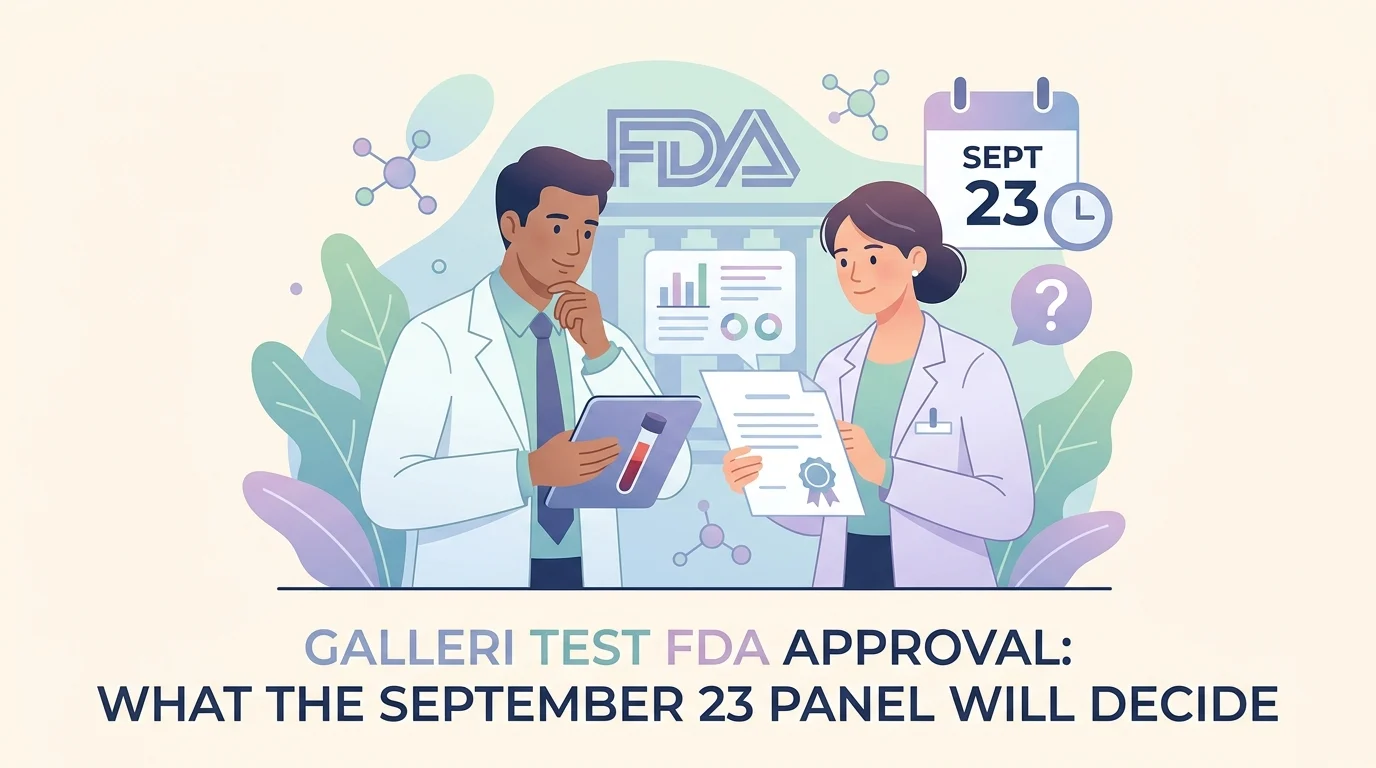
A US Food and Drug Administration advisory panel meets on September 23, 2026 to vote on the Galleri test, a blood test designed to look for more than 50 cancers at once. It is the first time an American expert committee has formally reviewed a multi-cancer screening blood test as part of a premarket approval application. Until now, tests of this kind have reached patients without that step, and the National Cancer Institute still states plainly that no multi-cancer detection test has been authorized by the FDA. This article explains what the committee is actually being asked, why a vote is not an approval, and what a yes or a no would mean for someone weighing whether to pay for a cancer screening blood test today.
What the FDA panel is voting on
The Molecular and Clinical Genetics Panel of the Medical Devices Advisory Committee meets at the FDA White Oak campus in Silver Spring, Maryland, from 9 a.m. to 6 p.m. Eastern Time. Its task is narrow and specific: to discuss, make recommendations, and vote on the premarket approval application filed by GRAIL for the Galleri test.
The FDA describes the product as a prescription-only, next-generation sequencing based in vitro diagnostic test that looks for cancer-specific methylation patterns in cell-free DNA taken from a routine blood draw. It is intended for adults aged 50 and over, and it is meant to be added to recommended screening rather than to replace it. When a signal is detected, the test also predicts where in the body that signal may have originated, which is supposed to point the diagnostic workup in the right direction.
The agency opened a public docket, numbered FDA-2026-N-8004, which closed on September 16, 2026. The meeting is open to the public and is being webcast.
Why an advisory panel vote is not an approval
This is where most headlines blur. An advisory committee provides independent expert advice, and its recommendations are not binding. The FDA generally follows them, but it is not legally required to, and the agency can take weeks or months to issue its own decision afterwards. A panel vote on September 23 is therefore a signal, not a verdict.
There is a second distinction worth holding onto. Galleri has been sold in the United States as a laboratory-developed test, a category regulated under rules that do not require evidence of clinical benefit to patients. The breakthrough device designation the test received in 2018 is not a premarket review either. So this meeting is the first time the underlying evidence faces this particular kind of public scrutiny, whatever the outcome.
The evidence on the table
The application rests mainly on two datasets. The first is PATHFINDER 2, a US study of 25,490 participants with one year of follow-up. The second is the intervention arm of the first screening round of the NHS-Galleri trial in England, which involved more than 70,000 participants and remains the only randomized controlled trial of a multi-cancer test in the population it is meant to serve.
Our earlier article sets out the full multi-cancer early detection test results, including why the NHS-Galleri primary endpoint was not met. The table below summarizes the tension the committee has to resolve.
| Question before the panel | The case for | The case against |
|---|---|---|
| Cancers with no screening today | One blood draw can flag ovarian or pancreatic signals | Detecting a cancer is not the same as saving a life |
| Quality of the evidence | NHS-Galleri is the largest randomized trial of its kind | Its main endpoint on late-stage cancers was not met |
| Predicting the organ involved | A predicted site shortens the diagnostic search | A wrong prediction lengthens it instead |
| False positives | Specificity is high, close to 99% | More than half of positive results end with no cancer found |
| Access and cost | A blood draw is easier to accept than a colonoscopy | Around $900 out of pocket, with no routine insurance cover |
最新科學進展
According to research indexed in PubMed, 2026 has been a year of fast technical progress and unresolved clinical questions, and that mix is exactly what the panel inherits.
A September 2026 commentary in Public Health Challenges looks past the PATHFINDER 2 headline and asks what the test would really contribute to routine care and to cancer as a public health problem (DOI). Put plainly: finding more cancers is not automatically the same as helping more people, and the authors argue that gap has to be closed with outcome data rather than detection rates.
A methodological article in Cancer Epidemiology, Biomarkers and Prevention makes the same point from the statistics side, noting that the benefit of any screening test depends on the natural history of the disease, meaning how fast a given cancer grows and whether finding it earlier changes the outcome at all (DOI). What this changes for you: a test can be technically excellent and still not extend a single life, which is precisely what a randomized trial is built to reveal.
A 2026 review of blood-based colorectal screening in Gastrointestinal Endoscopy Clinics of North America adds a practical warning that applies to this whole family of tests: sensitivity for advanced precancerous lesions is low, and follow-up colonoscopy rates after an abnormal result are disappointing (DOI). A screening test only works if the person acts on the result. Another article details the colon cancer blood test cleared by the FDA, which is a single-cancer test and a different regulatory story.
Finally, a July 2026 review in Critical Reviews in Oncology and Hematology examined liquid biopsy in people with inherited cancer risk, the group where the case for extra screening is strongest, and still concluded that no randomized trial has confirmed clinical benefit (DOI).
What a yes would change for you
If the panel votes in favor and the FDA follows, several things shift at once, and none of them is instant.
- Oversight. The test would move from the laboratory-developed test category into a framework where the FDA has reviewed the evidence for the stated intended use.
- Prescription. It would remain prescription-only for adults aged 50 and over, so a clinician would still have to order it and interpret the result with you.
- Coverage. FDA authorization does not create insurance coverage. Medicare and private insurers decide separately, and that process takes its own time.
- Guidelines. No professional society and no US Preventive Services Task Force recommendation currently covers multi-cancer tests. Authorization does not change a guideline by itself.
- Your existing screening. Nothing about a yes would justify skipping a mammogram, a colonoscopy, or cervical screening. The test is designed as an addition.
If the panel votes against, the practical situation stays close to what it is today: the test remains available, unreviewed by this route, and paid for out of pocket.
在決定懸而未決期間該怎麼做
本週最實用的一步,也是最不引人注目的一步:持續進行已被證實對您的年齡與風險狀況有效的篩檢。無論任何多癌症檢測結果如何,這都是美國國家癌症研究所一再重申的建議。.
如果您正在考慮現在自費進行多癌症檢測,在下單之前,有三個問題值得先詢問您的醫師:若結果呈陽性,我們會怎麼處理,可能需要做多少後續檢查?若結果呈陰性,是否會改變我其他的篩檢計畫(答案應該是不會)?以及,如果後續檢查什麼都沒發現,費用由誰負擔?
無論任何篩檢結果如何,若您發現不明原因的體重減輕、糞便或尿液中有血、持續存在的腫塊、久咳不癒,或異常出血,請立即就醫。症狀本身就需要獨立評估。本指南說明 腫瘤標記及其局限性, ,這是一種不同的工具,主要用於監測而非篩檢。.
詞彙表
| 術語 | 意義 |
|---|---|
| 上市前核准(PMA) | 美國食品藥物管理局(FDA)對醫療器材或檢測最嚴格的審查程序 |
| 諮詢委員會 | 由外部專家組成的小組,其投票結果可供 FDA 參考,但不具約束力 |
| 實驗室自行研發檢測 | 由單一實驗室自行設計並執行的檢測,所適用的規範不要求提供對患者有益的證明 |
| 游離 DNA | 漂浮於血液中的 DNA 片段,其中部分由腫瘤細胞釋出 |
| DNA甲基化 | DNA 上的微小化學標記,其模式可能指向癌症 |
| 癌症訊號來源 | 檢測預測所偵測到的訊號來自哪個器官 |
| 特異度 | 檢測避免對未罹癌者發出警報的能力 |
| 自然病程 | 若無任何介入,疾病隨時間發展的方式 |
常見問題
Galleri 檢測有獲得 FDA 核准嗎?
截至 2026 年 9 月為止,尚未獲得核准。它一直以實驗室自行研發檢測的形式提供,美國國家癌症研究所也表示,目前尚無任何多癌症偵測檢測獲得 FDA 授權。9 月 23 日的諮詢委員會會議是審查程序中的一個步驟,並非最終結果。.
Galleri 檢測可以偵測哪些癌症?
它的設計目的是偵測超過 50 種癌症類型的共同癌症訊號,包括幾種目前沒有系統性篩檢計畫的癌症,例如卵巢癌和胰臟癌。它並不涵蓋所有癌症,也無法取代乳房攝影、大腸鏡檢查或子宮頸篩檢。.
它的準確度如何?
特異性高,接近99%,因此假陽性警報相對少見。敏感性則低得多,尤其對早期疾病而言,這意味著正常結果無法排除癌症。根據已發表的研究,超過一半結果呈陽性的人在後續檢查後並未發現癌症。.
費用多少?保險有給付嗎?
此檢測在美國費用約為900美元,通常需自費支付。目前沒有任何多癌症檢測獲得美國聯邦醫療保險和醫療補助服務中心建議納入給付,後續診斷程序所產生的費用也不確定是否會獲得保險理賠。.
如果FDA核准了,我應該去做嗎?
這個問題應與您的醫師討論,而非自動回答「是」。核准代表該證據通過了針對特定用途的正式審查,但並不代表此檢測適合所有人、會獲保險給付,或可取代您目前已在進行的篩檢。.
如果結果呈陽性,接下來會怎樣?
陽性結果是一個訊號,而非診斷。它會觸發進一步的檢查,通常是影像學檢查,有時還需要切片,往往會針對檢測所預測的器官進行。整個後續檢查過程可能需要數週,且有相當比例的案例最終並未發現癌症。.
參考資料
- 美國食品藥物管理局——2026年9月23日分子與臨床遺傳學小組會議公告
- 美國國家癌症研究所——多癌症檢測相關問答
- 美國國家癌症研究所——腫瘤標記說明資料
- PubMed:Sium 與 Lucero-Prisno,《公共衛生挑戰》,2026年(DOI);Lange 與 Etzioni,《癌症流行病學、生物標記與預防》,2026年(DOI);Xue、Daruwalla 與 Liang,《北美胃腸內視鏡診所》,2026年(DOI);Kuhlen 等人,《腫瘤學與血液學重要評論》,2026年(DOI).
延伸閱讀
- 我們先前的文章介紹了 the full multi-cancer early detection test results
- 本指南說明 腫瘤標記及其局限性
- 另一篇文章詳細說明了 the colon cancer blood test cleared by the FDA
- 我們的指南涵蓋 解讀血液檢查結果的完整方法
用 AI DiagMe 讀懂您的檢驗報告
無論FDA本週做出何種決定,您的檢驗報告上大多數數值都是常見的項目:血球計數、肝腎功能數值、血糖、鐵質。AI DiagMe 以淺顯易懂的語言解讀您的血液、尿液或糞便報告,告訴您每個項目所代表的意義、數值異常可能代表什麼,以及哪些項目值得向醫師提出。它幫助您理解報告,而非進行診斷,也無法取代醫療專業人員。.