
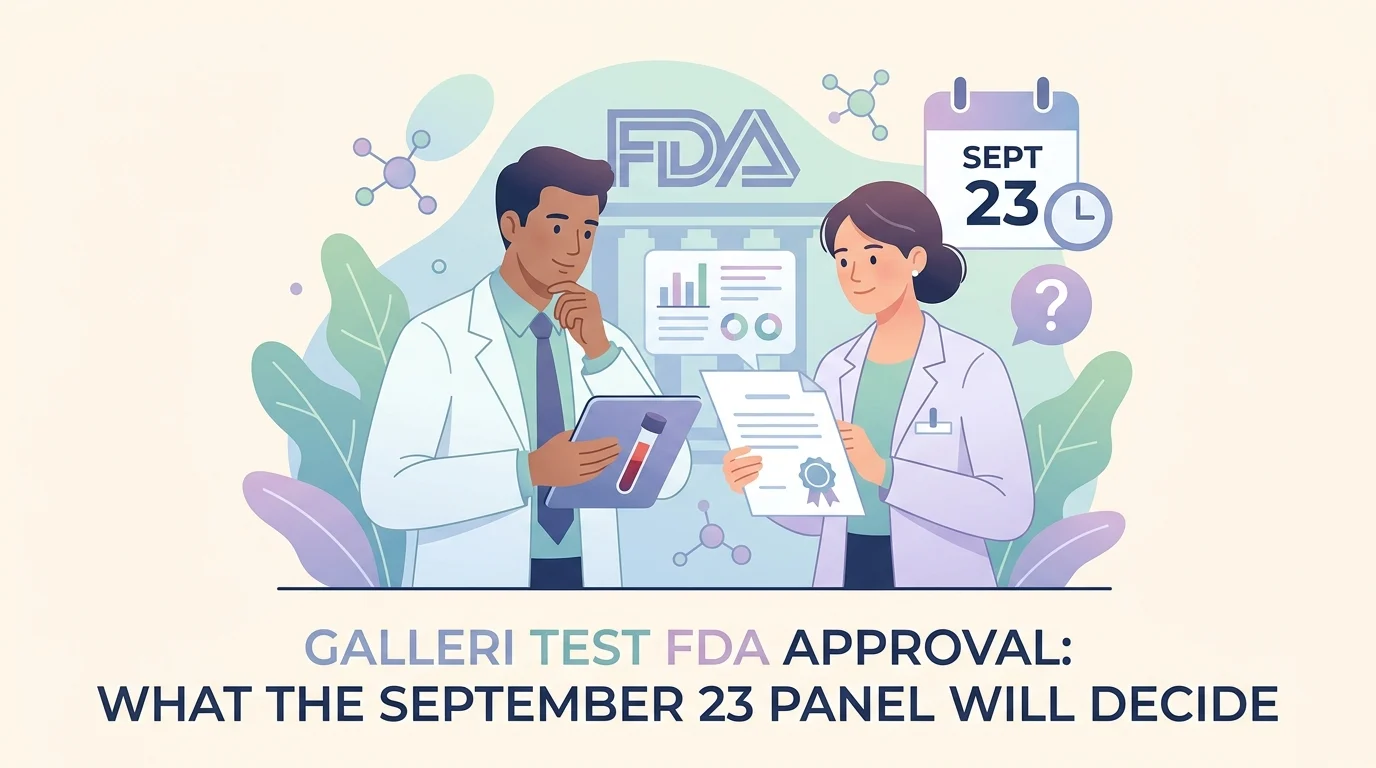
A US Food and Drug Administration advisory panel meets on September 23, 2026 to vote on the Galleri test, a blood test designed to look for more than 50 cancers at once. It is the first time an American expert committee has formally reviewed a multi-cancer screening blood test as part of a premarket approval application. Until now, tests of this kind have reached patients without that step, and the National Cancer Institute still states plainly that no multi-cancer detection test has been authorized by the FDA. This article explains what the committee is actually being asked, why a vote is not an approval, and what a yes or a no would mean for someone weighing whether to pay for a cancer screening blood test today.
What the FDA panel is voting on
The Molecular and Clinical Genetics Panel of the Medical Devices Advisory Committee meets at the FDA White Oak campus in Silver Spring, Maryland, from 9 a.m. to 6 p.m. Eastern Time. Its task is narrow and specific: to discuss, make recommendations, and vote on the premarket approval application filed by GRAIL for the Galleri test.
The FDA describes the product as a prescription-only, next-generation sequencing based in vitro diagnostic test that looks for cancer-specific methylation patterns in cell-free DNA taken from a routine blood draw. It is intended for adults aged 50 and over, and it is meant to be added to recommended screening rather than to replace it. When a signal is detected, the test also predicts where in the body that signal may have originated, which is supposed to point the diagnostic workup in the right direction.
The agency opened a public docket, numbered FDA-2026-N-8004, which closed on September 16, 2026. The meeting is open to the public and is being webcast.
Why an advisory panel vote is not an approval
This is where most headlines blur. An advisory committee provides independent expert advice, and its recommendations are not binding. The FDA generally follows them, but it is not legally required to, and the agency can take weeks or months to issue its own decision afterwards. A panel vote on September 23 is therefore a signal, not a verdict.
There is a second distinction worth holding onto. Galleri has been sold in the United States as a laboratory-developed test, a category regulated under rules that do not require evidence of clinical benefit to patients. The breakthrough device designation the test received in 2018 is not a premarket review either. So this meeting is the first time the underlying evidence faces this particular kind of public scrutiny, whatever the outcome.
The evidence on the table
The application rests mainly on two datasets. The first is PATHFINDER 2, a US study of 25,490 participants with one year of follow-up. The second is the intervention arm of the first screening round of the NHS-Galleri trial in England, which involved more than 70,000 participants and remains the only randomized controlled trial of a multi-cancer test in the population it is meant to serve.
Our earlier article sets out the full multi-cancer early detection test results, including why the NHS-Galleri primary endpoint was not met. The table below summarizes the tension the committee has to resolve.
| Question before the panel | The case for | The case against |
|---|---|---|
| Cancers with no screening today | One blood draw can flag ovarian or pancreatic signals | Detecting a cancer is not the same as saving a life |
| Quality of the evidence | NHS-Galleri is the largest randomized trial of its kind | Its main endpoint on late-stage cancers was not met |
| Predicting the organ involved | A predicted site shortens the diagnostic search | A wrong prediction lengthens it instead |
| False positives | Specificity is high, close to 99% | More than half of positive results end with no cancer found |
| Access and cost | A blood draw is easier to accept than a colonoscopy | Around $900 out of pocket, with no routine insurance cover |
Recente wetenschappelijke ontwikkelingen
According to research indexed in PubMed, 2026 has been a year of fast technical progress and unresolved clinical questions, and that mix is exactly what the panel inherits.
A September 2026 commentary in Public Health Challenges looks past the PATHFINDER 2 headline and asks what the test would really contribute to routine care and to cancer as a public health problem (DOI). Put plainly: finding more cancers is not automatically the same as helping more people, and the authors argue that gap has to be closed with outcome data rather than detection rates.
A methodological article in Cancer Epidemiology, Biomarkers and Prevention makes the same point from the statistics side, noting that the benefit of any screening test depends on the natural history of the disease, meaning how fast a given cancer grows and whether finding it earlier changes the outcome at all (DOI). What this changes for you: a test can be technically excellent and still not extend a single life, which is precisely what a randomized trial is built to reveal.
A 2026 review of blood-based colorectal screening in Gastrointestinal Endoscopy Clinics of North America adds a practical warning that applies to this whole family of tests: sensitivity for advanced precancerous lesions is low, and follow-up colonoscopy rates after an abnormal result are disappointing (DOI). A screening test only works if the person acts on the result. Another article details the colon cancer blood test cleared by the FDA, which is a single-cancer test and a different regulatory story.
Finally, a July 2026 review in Critical Reviews in Oncology and Hematology examined liquid biopsy in people with inherited cancer risk, the group where the case for extra screening is strongest, and still concluded that no randomized trial has confirmed clinical benefit (DOI).
What a yes would change for you
If the panel votes in favor and the FDA follows, several things shift at once, and none of them is instant.
- Oversight. The test would move from the laboratory-developed test category into a framework where the FDA has reviewed the evidence for the stated intended use.
- Prescription. It would remain prescription-only for adults aged 50 and over, so a clinician would still have to order it and interpret the result with you.
- Coverage. FDA authorization does not create insurance coverage. Medicare and private insurers decide separately, and that process takes its own time.
- Guidelines. No professional society and no US Preventive Services Task Force recommendation currently covers multi-cancer tests. Authorization does not change a guideline by itself.
- Your existing screening. Nothing about a yes would justify skipping a mammogram, a colonoscopy, or cervical screening. The test is designed as an addition.
If the panel votes against, the practical situation stays close to what it is today: the test remains available, unreviewed by this route, and paid for out of pocket.
What to do while the decision is pending
The most useful step this week is also the least dramatic one: keep up the screening already proven to work for your age and risk profile. That is the recommendation the National Cancer Institute repeats regardless of what any multi-cancer test shows.
If you are considering paying for a multi-cancer test now, three questions are worth asking your doctor before you order it. What would we do with a positive result, and how many follow-up exams might that mean? Would a negative result change anything about my other screening, and the answer should be no. And who pays if the workup finds nothing?
Talk to a clinician promptly, whatever any screening test says, if you notice unexplained weight loss, blood in the stool or urine, a lump that persists, a cough that will not settle, or unusual bleeding. Symptoms are evaluated on their own merit. This guide explains tumormarkers en hun beperkingen, which are a different tool used mostly for monitoring rather than screening.
Glossarium
| Termijn | Betekenis |
|---|---|
| Premarket approval (PMA) | The FDA’s most demanding review pathway for a medical device or test |
| Advisory committee | A panel of outside experts whose vote advises the FDA without binding it |
| Laboratory-developed test | A test designed and run inside a single lab, under rules that do not require proof of patient benefit |
| Cell-free DNA | DNA fragments floating in the blood, some of them shed by tumor cells |
| DNA-methylering | Small chemical tags on DNA whose pattern can point to a cancer |
| Cancer signal origin | The organ the test predicts a detected signal came from |
| Specificiteit | A test’s ability to avoid alarming people who do not have cancer |
| Natural history | How a disease behaves over time if nobody intervenes |
Veelgestelde vragen
Is the Galleri test FDA approved?
Not as of September 2026. It has been offered as a laboratory-developed test, and the National Cancer Institute states that no multi-cancer detection test has been authorized by the FDA. The September 23 advisory committee meeting is a step in that review, not the end of it.
What cancers does the Galleri test look for?
It is designed to detect a shared cancer signal across more than 50 cancer types, including several with no organized screening program, such as ovarian and pancreatic cancer. It does not cover every cancer, and it is not a substitute for mammography, colonoscopy, or cervical screening.
How accurate is it?
Specificity is high, close to 99%, so false alarms are relatively rare. Sensitivity is much lower, especially for early-stage disease, which means a normal result cannot rule cancer out. In published work, more than half of people with a positive result had no cancer found after workup.
How much does it cost, and does insurance pay?
The test costs around $900 in the United States, generally paid out of pocket. No multi-cancer test is currently recommended for reimbursement by the Centers for Medicare and Medicaid Services, and follow-up diagnostic procedures may add cost that is also uncertain to be covered.
If the FDA approves it, should I get one?
That is a conversation with your doctor rather than an automatic yes. Authorization would mean the evidence passed a formal review for a stated use. It would not mean the test is recommended for everyone, covered by insurance, or a replacement for screening you already do.
What happens if my result is positive?
A positive result is a signal, not a diagnosis. It triggers further tests, usually imaging and sometimes a biopsy, often guided toward the organ the test predicted. That workup can take weeks, and in a substantial share of cases no cancer is found.
Bronnen
- US Food and Drug Administration – September 23, 2026 Molecular and Clinical Genetics Panel meeting announcement
- US National Cancer Institute – Questions and answers about multi-cancer detection tests
- US National Cancer Institute – Tumor markers fact sheet
- PubMed: Sium and Lucero-Prisno, Public Health Challenges, 2026 (DOI); Lange and Etzioni, Cancer Epidemiology, Biomarkers and Prevention, 2026 (DOI); Xue, Daruwalla and Liang, Gastrointestinal Endoscopy Clinics of North America, 2026 (DOI); Kuhlen et al., Critical Reviews in Oncology and Hematology, 2026 (DOI).
Verder lezen
- Our earlier article covers the full multi-cancer early detection test results
- Deze gids legt uit tumormarkers en hun beperkingen
- Another article details the colon cancer blood test cleared by the FDA
- Onze gids behandelt a complete method for reading blood test results
Begrijp uw laboratoriumresultaten met AI DiagMe.
Whatever the FDA decides this week, most of the numbers on your lab report are the ordinary ones: blood counts, liver and kidney values, glucose, iron. AI DiagMe reads your blood, urine, or stool report in plain language and tells you what each line measures, what an out-of-range value can suggest, and what is worth raising with your doctor. It helps you understand, never to diagnose, and it does not replace a healthcare professional.
➡️ Ontvang binnen enkele minuten een uitleg in begrijpelijke taal