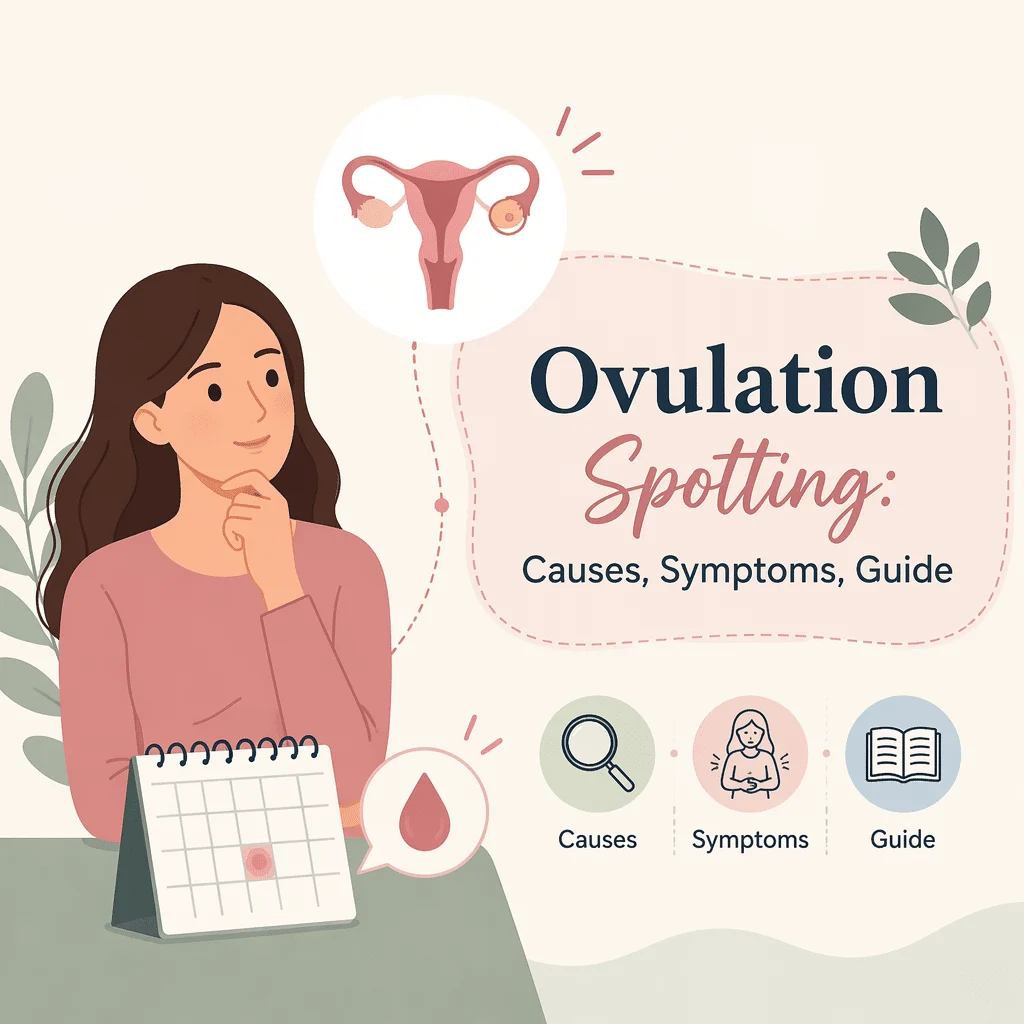
Ägglossningsblödning är lätt vaginal blödning som uppträder ungefär mitt i menscykeln, nära den tidpunkt då ett äggstock frigör ett ägg. Den är vanligtvis mycket lätt, ofta brun eller rosa snarare än klarröd, och den upphör normalt inom en dag eller två. För de flesta är det ett ofarligt inslag i hormonernas timing snarare än ett varningstecken, och i sig självt tyder det inte på graviditet. Det är inte den enda anledningen till att blod kan uppträda mitt i cykeln, vilket är varför det är viktigt att veta vad som är normalt. I den här artikeln får du lära dig när ägglossningsblödning brukar inträffa, vad som orsakar den, hur den skiljer sig från implantationsblödning och lätt mens, hur ägglossning faktiskt bekräftas, och vilka mönster av blödning mitt i cykeln som bör bedömas av läkare.
Vad ägglossningsblödning är
Ägglossningsblödning tillhör en bredare kategori som kliniker kallar intermenstruell blödning: all blödning mellan två normala menstruationer. Det utmärkande draget är mängden. Spotting innebär några droppar eller ett lätt märke på underkläder eller toalettpapper – inte tillräckligt för att behöva ett binda eller en tampong. Om du genomblöder skyddet är det en blödning på mensnivå, orsakad av något annat än en enkel ägglossningsrelaterad förändring.
Tidpunkten är det andra utmärkande draget: ägglossningsblödning uppträder kring mitten av cykeln snarare än slumpmässigt. Blödning vid oförutsägbara tillfällen, månad efter månad, pekar på något annat.
Varifrån blodet kommer
Två mekanismer brukar nämnas, och de utesluter inte varandra. Den första är hormonell. Östrogen stiger under cykelns första hälft och bygger upp endometriet, livmoderslemhinnan. Strax innan ägget frigörs sjunker östrogenet kortvarigt innan progesteron tar över från corpus luteum, den lilla struktur som lämnas kvar i äggstocken. Det korta fallet kan lämna slemhinnan tillfälligt utan stöd, och en liten del av den stöts bort. Du kan läsa om vad östrogennivåer betyder i vår guide till blodprovet för östradiol.
Den andra mekanismen är mekanisk. När follikeln brister läcker lite vätska och ibland ett spår av blod ut i bäckenet. Det känns oftare som en ensidig molande smärta, känd som mittelschmerz, än att det syns som blödning, och en del märker illamående vid samma tidpunkt, vilket beskrivs i vår guide om illamående vid ägglossning.
När ägglossningsblödning uppstår i din cykel
Ägglossning sker ungefär 12 till 16 dagar före nästa mens, inte 14 dagar efter den senaste. Den skillnaden är viktigare än de flesta cykelappars antaganden, eftersom cykelns andra hälft är relativt konstant i längd medan den första hälften varierar.
Räknat från första dagen av din mens
Dag ett är den första dagen med ordentlig blödning, inte dagen du först såg en fläck. I en 28-dagarscykel sker ägglossningen runt dag 14, så ägglossningsblödning uppträder ungefär dag 12 till 16. I en 35-dagarscykel sker ägglossningen närmare dag 21 och blödningen förskjuts med den. Office on Women’s Health betraktar alla cykler från 24 till 38 dagar som regelbundna, så det finns ingen enda korrekt dag.
Varför cykelns längd påverkar tidpunkten
Eftersom ägglossningen varierar leder ett fast kalenderantagande ständigt folk vilse. Någon med 33-dagarscykler som förväntar sig ägglossning på dag 14 kommer att tolka blödning på dag 20 som onormal, när den är helt normal för henne. Den praktiska lösningen: notera datumet du såg blödningen och datumet din nästa mens började, under några cykler. Ett mellanrum på ungefär två veckor betyder att blödningen inträffar när ägglossningsblödning bör göra det.
Hur länge det varar
Ägglossningsblödning är kortvarig: de flesta beskriver några timmar upp till två dagar. Allt som pågår längre än tre dagar, eller blödning som börjar lätt och sedan tilltar, avviker från det typiska mönstret och bör undersökas.
Hur ägglossningsblödning ser ut
Varför brunt flöde är så vanligt
Brunt är den färg folk söker mest på, och det är lugnande snarare än oroande. Blod blir brunt när det utsätts för syre, vilket sker när en mycket liten mängd lämnar livmodern långsamt. Färsk, snabb blödning är röd; långsam, sparsam blödning anländer brun eller rostfärgad. Rosa är mellantinget – ett spår av blod blandat med livmoderhalsslem, som kring ägglossningen är klart, töjbart och rikligt. Rosa-tonad flytning mitt i cykeln är en mycket typisk bild.
Mängd och konsistens
Den förväntade mängden är minimal. Ett trosskydd räcker mer än väl, och många märker det bara när de torkar sig. Koagler hör inte till bilden. Att passera koagler, särskilt sådana som är större än ett mynt, tyder på kraftigare blödning och är ett av de mönster Mayo Clinic listar som skäl att kontakta en sjukvårdspersonal.
Vad som brukar följa med det
- Klar, hal livmoderhalslemma som liknar rå äggvita
- En dov värk eller en stickande känsla på ena sidan av nedre buken
- Mild ömhet i brösten som börjar dagarna efteråt
- En liten höjning av vilokroppstemperaturen under de följande dagarna
Hur du skiljer ovulationsblödning från annan blödning
Fyra olika saker kan orsaka lätt blödning, och de skiljs åt främst utifrån tidpunkt. Tabellen nedan ställer dem sida vid sida.
| Typ av blödning | När i cykeln | Typisk färg | Varaktighet | Volym |
|---|---|---|---|---|
| Ovulationsblödning | Mitt i cykeln, ungefär 12 till 16 dagar före nästa mens | Brun, rostfärgad eller ljust rosa | Några timmar till 2 dagar | Bara enstaka droppar, ett trosskydd räcker |
| Implantationsblödning | Sent i cykeln, ungefär 6 till 12 dagar efter ägglossning | Rosa eller ljusbrun | Några timmar till 2 dagar | Mycket lätt, inga koagler |
| En lätt mens | Vid den förväntade tidpunkten för mens | Röd till en början, brunare senare | 2 till 7 dagar | Kräver binda eller tampong |
| Genombrottsblödning | När som helst, ofta under de första månaderna med hormonellt preventivmedel | Röd eller brun | Dagar, ibland återkommande | Lätt till måttlig |
Implantationsblödning är den som folk mest vill utesluta eller bekräfta
Den absolut vanligaste frågan om blödning mitt i cykeln är om det kan betyda graviditet. Tidpunkten ger svaret. Implantation kan inte ske vid ägglossningen: befruktning har precis blivit möjlig, och embryot behöver ungefär en vecka för att nå livmodern och fästa. Blödning den dag du ägglossnar är alltså inte implantationsblödning. Blödning en vecka till tio dagar senare, nära när mensen väntas, är det mönster som väcker frågan. Bara ett graviditetstest taget efter en utebliven mens ger ett säkert svar, och du kan läsa om hur känsliga dessa tester verkligen är i vår guide om graviditetstestets tillförlitlighet.
En lätt mens i förklädnad
Om blödningen kräver en binda, kommer när mensen var väntad och varar i flera dagar är det mens, om än sparsam. Ihållande lätt eller oförutsägbar mens är värt att ta upp, särskilt i kombination med akne, oönskad hårväxt eller svårigheter att bli gravid – ett mönster som beskrivs i vår guide om PCOS-symtom och diagnos.
Genombrottsblödning vid preventivmedelsanvändning
P-piller, implantat, injektioner och hormonspiraler orsakar alla ofta oplanerade blödningar, särskilt under de första tre till sex månaderna, och glömda p-piller är en vanlig utlösande faktor. Det här är inte ovulationsblödning: de flesta av dessa metoder hämmar ägglossningen helt.
Andra orsaker till blödning mellan menserna
Att anta att varje blödning mitt i cykeln beror på ägglossning är den största risken med en artikel som den här. Det finns flera andra förklaringar, de flesta behandlingsbara.
Orsaker i livmoderhalsen och livmodern
- Polyper i livmoderhalsen eller livmoderslemhinnan – små godartade utväxter som blöder när de störs
- Myom, som är icke-cancerartade muskelutväxter i livmoderväggen
- En inflammerad, känslig livmoderhals som blöder efter sex eller ett cellprov – ett mönster som beskrivs i vår guide om en skör livmoderhals
- Endometrios och adenomyos, där vävnad som liknar livmoderslemhinnan växer där den inte ska, vilket behandlas i vår guide om endometrios
- I sällsynta fall livmoderhalscancer eller livmodercancer – det är därför ihållande oförklarlig blödning alltid utreds
Hormonella, infektiösa och andra orsaker
Sköldkörtelsjukdom är en underskattad orsak till rubbningar i menscykeln och är lätt att kontrollera med ett blodprov för TSH. Sexuellt överförbara infektioner som klamydia kan inflammera livmoderhalsen och orsaka blödning efter sex. MedlinePlus listar hormonella förändringar, infektioner, läkemedel, graviditetskomplikationer och strukturella problem bland orsakerna till blödning mellan mensperioderna, och National Institute of Child Health and Human Development lägger till hormonella obalanser, sjukdomar och trauma till den listan. Akut-p-piller samt att börja eller sluta med hormonell behandling kan också orsaka en blödning.
Hur ägglossning faktiskt bekräftas
Ägglossningsblödning är ett tecken, inte ett bevis. Många ägglossningar sker utan minsta blödning, och en del som blöder mitt i cykeln ägglossnar inte alls. Om du behöver veta om ägglossning faktiskt sker finns det tre metoder – var och en besvarar en annan fråga.
LH-tester i urinen förutsäger – de bekräftar inte
Receptfria ägglossningstest mäter den ökning av luteiniserande hormon (LH) som föregår ägglossningen med ungefär 24 till 36 timmar. De talar om att ägglossning troligen är på väg att ske. Ett positivt resultat bevisar inte att ägget faktiskt löstes ut, och att tolka strecket rätt är viktigare än de flesta tror – det förklarar vi i vår guide till att tolka ett positivt ägglossningstest. Hormonet i sig förklaras i vår guide till LH-blodprovet.
Temperaturen bekräftar i efterhand
Basaltemperaturen stiger något när progesteron börjar utsöndras, så en ihållande temperaturhöjning bekräftar att ägglossning redan har skett. Det är som en backspegel: värdelöst för att tajma samlag den här cykeln, men användbart för att ta reda på om du ägglossnar överhuvudtaget.
Blodprov ger det tydligaste svaret
Ett progesteronprov taget ungefär sju dagar före förväntad mens är standardmetoden för att bekräfta ägglossning, eftersom progesteron stiger märkbart först efter att follikeln har frigjort sitt ägg. Det beställs ofta tillsammans med andra hormoner i ett hormonpanel för kvinnor. Om blödningen har varit kraftig eller långvarig kan din läkare beställa ett stort blodstatus för att kontrollera om du har blivit järnbrist, och vi förklarar varningstecknen i vår guide till anemi och dess blodprov.
När du bör söka läkare vid blödning mitt i cykeln
Enstaka lätt ägglossningsblödning i en i övrigt regelbunden cykel behöver sällan utredas. Följande mönster däremot. Boka tid om du märker något av dessa.
- Blödning som är så kraftig att du behöver binda eller tampong mellan mens
- Blödning mitt i cykeln som varar mer än tre dagar, eller som återkommer varje cykel
- Blödning efter sex vid mer än ett tillfälle
- Blödning med feber, illaluktande flytningar eller bäckensmärta, vilket kan tyda på infektion
- Blödning med yrsel, andnöd eller ovanlig trötthet, vilket kan vara tecken på anemi
- All blödning efter klimakteriet, som alltid behöver utredas
- Blödning mitt i cykeln som är ny för dig och fortsätter under flera cykler
- Blödning under graviditet eller när graviditet är möjlig, särskilt i kombination med ensidig smärta
Svår ensidig bäckensmärta med blödning, svimningskänsla eller smärta i axelspetsen kräver akut vård snarare än ett vanligt läkarbesök, eftersom utomkvedshavandeskap eller en bristande äggstockscysta måste uteslutas snabbt.
Det här hjälper ditt läkarbesök att gå snabbare
Ta med datum. Anteckna första dagen i dina tre senaste menstruationer, dagarna du hade mellanblödningar, färgen och mängden, om du hade sex innan, och vilket preventivmedel du använder. Det korta anteckningarna brukar snabba på utredningen mer än ett enskilt test.
Senaste vetenskapliga framstegen
Forskning publicerad sedan 2023 har inte förändrat vad ägglossningsblödning är, men den har skärpt hur blödningar klassificeras och hur tillförlitligt ägglossning kan följas hemma. Här är vad den forskningen säger, i enkla ord.
Blödningar mellan mens har nu en gemensam checklista
En internationell genomgång tog fram två strukturerade system för onormal livmoderblödning: ett som beskriver själva blödningsmönstret och ett som sorterar möjliga orsaker i strukturella sådana, som polyper och myom, och icke-strukturella sådana, som problem med ägglossning eller koagulation. Genomgången noterade också att onormal livmoderblödning kan drabba mer än hälften av alla kvinnor och flickor i fertil ålder, och att det är ett kraftigt underrapporterat problem. Vad det betyder för dig: att beskriva din blödning noggrant – hur ofta, hur länge, hur regelbundet och hur riklig den är – är inte petig. Det är precis den information de här systemen bygger på, och det styr vilka tester du erbjuds.
En andra expertgenomgång tittade specifikt på blödningar orsakade av ägglossningsproblem. Den kom fram till att sådana blödningar visserligen är en vanlig orsak till onormal livmoderblödning, men att nuvarande riktlinjer inte ger tydliga behandlingsrekommendationer, vilket gör att praxis varierar mellan länder. Vad det betyder för dig: om din blödning hänger ihop med hur du ägglossnar kan det finnas flera rimliga alternativ snarare än ett självklart svar, och det är helt legitimt att fråga om alternativen.
Ägglossningstest hemifrån är tillförlitliga – men bara för vissa cykler
En prospektiv studie jämförde fem populära ägglossningstest för hemmabruk mot dagliga blodprover för luteiniserande hormon i övervakade fertilitetsbehandlingar. Alla fem stämde väl överens med blodprovsresultaten, och dyra test presterade inte bättre än billiga, även om några missade en verklig LH-topp oftare. Vad detta betyder för dig: priset är en dålig kvalitetsindikator, och ett negativt testresultat är inte bevis på att ägglossning inte skett. Att testa under flera dagar är bättre än att testa en enda gång.
En separat genomförbarhetsstudie tydliggör begränsningarna. Författarna konstaterar att de flesta receptfria tester är utformade för regelbundna cykler med en förutsägbar topp mitt i cykeln, och att alternativ håller på att tas fram för personer med oregelbundna cykler eller polycystiskt ovariesyndrom (PCOS). Det arbetet är i ett tidigt skede och har ännu inte resulterat i någon validerad produkt. Vad det betyder för dig: om dina cykler är oregelbundna kan tester faktiskt vilseleda dig, och ett blodprov är ett mer tillförlitligt alternativ.
Temperaturmätning och appar: användbara, men inte för att förutsäga
En studie från 2026 jämförde flera sätt att mäta basaltemperatur mot en kontinuerlig intern sensor som användes som referens. Sensorn identifierade varje ägglossning, inklusive en cykel där inget ägg frigjordes. Mätningar i örat och ändtarmen visade sig vara för opålitliga att förlita sig på, medan en noggrann mätning under tungan vid en fast tid varje morgon var ett acceptabelt lågkostnadsalternativ. Vad detta betyder för dig: temperaturen bekräftar ägglossning i efterhand, tekniken spelar större roll än mätinstrumentet, och den kan inte förutsäga att ägglossning är på väg.
Forskning om appar för cykelspårning visade en tydlig klyfta i förtroende. Användare var ofta entusiastiska över de ägglossningsdatum som appen förutsåg, medan vårdpersonal var märkbart skeptisk till samma förutsägelser. Båda grupperna var överens om att kalender- och symtomloggen var den verkligt värdefulla delen. Vad det innebär för dig: använd appen för att registrera när du faktiskt hade fläckar och blödde, och betrakta det förutsagda ägglossningsdatumet som en uppskattning, inte ett faktum.
Hur ägglossning bekräftas på bästa sätt
En systematisk genomgång av menstruationscykelstörningar nådde en praktisk slutsats om metod. I stället för att lita på en enda signal rekommenderades att kombinera kalenderspårning, urinbaserade ägglossningstest och ett progesteronblodprov taget under cykelns andra hälft. Vad det innebär för dig: två samstämmiga signaler är mycket mer informativa än en, och ett progesterontest mitt i lutealfasen är det mest avgörande av de tre.
Slutligen erkänner en genomgång av livmoderblödningar att blödning vid ägglossning är en distinkt händelse, skild från mens och från graviditetsrelaterad blödning, samtidigt som det konstateras att mycket om hur livmodern reglerar blödning fortfarande är okänt. Vad det innebär för dig: ett ärligt svar om att inget oroande hittades, efter en ordentlig undersökning, är ett legitimt resultat – inte ett tecken på att din oro avfärdades.
Ordlista
| Kalla | Definition |
|---|---|
| Ägglossning | Frisättningen av ett moget ägg från en äggstock. Det sker ungefär 12 till 16 dagar före nästa mens börjar. |
| Intermenstruell blödning | Den medicinska termen för all blödning som sker mellan två normala mensperioder. Ägglossningsfläckar är en form av det. |
| Endometrium | Livmoderslemhinnan. Den tjocknar under cykeln och stöts bort under mensen. |
| Luteiniserande hormon (LH) | Ett hypofyshormon som stiger kraftigt strax före ägglossning. Ägglossningstest för hemmabruk mäter denna topp i urinen. |
| Östradiol | Den viktigaste formen av östrogen under de reproduktiva åren. Den bygger upp livmoderslemhinnan och når sin topp strax före ägglossningen. |
| Progesteron | Det hormon som produceras efter ägglossningen och som stabiliserar livmoderslemhinnan. En blodnivå under cykelns andra hälft bekräftar att ägglossning har skett. |
| Corpus luteum | Den tillfälliga struktur som lämnas kvar i äggstocken efter att ägget har frigjorts. Den producerar progesteron i ungefär två veckor. |
| Mittelschmerz | En tysk term för ensidig smärta i nedre buken som upplevs runt ägglossningen. Den är vanligtvis kortvarig och ofarlig. |
| Implantationsblödning | Lätt blödning som kan uppstå när ett embryo fäster sig i livmoderslemhinnan, vanligtvis 6 till 12 dagar efter ägglossningen. |
| Genombrottsblödning | Oplanerad blödning vid användning av hormonell preventivmetod. Det är vanligt under de första månaderna med en ny metod. |
Vanliga frågor
Är ägglossningsfläckar ett gott tecken för fertiliteten?
Det är ett rimligt tecken på att en cykel är ovulatorisk, men det är ingen garanti och säger ingenting om äggkvalitet eller chansen att bli gravid. Många som ägglossning normalt varje månad ser aldrig någon fläckning alls, så att den uteblir är lika oinformativt. Betrakta det som en signal bland flera snarare än ett fertilitetsbetyg. Om du försöker bli gravid och vill ha ett säkrare svar bekräftar ett progesteronblodprov under cykelns andra hälft att ägglossning faktiskt har ägt rum – något som fläckning ensam inte kan göra.
Kan man bli gravid om man blöder under ägglossningen?
Ja. Lätt blödning mitt i cykeln sker vid eller nära den mest fertila punkten, så befruktning är fullt möjlig under det fönstret. Blödningen i sig varken ökar eller minskar chansen. Spermier kan överleva flera dagar i fortplantningskanalen, så samlag dagarna före fläckblödningen faller också inom det fertila fönstret. Om du inte försöker bli gravid ska du inte se blödning mitt i cykeln som en säker period.
Vad betyder brun fläckning vid ägglossning?
Brunt betyder helt enkelt att blodet är äldre. När en mycket liten mängd blod lämnar livmodern långsamt utsätts det för syre längs vägen och mörknar från rött till brunt eller rostfärgat. Det har ingen separat betydelse och är inte ett tecken på infektion eller på att gammalt blod fastnat. Brun fläckning vid ägglossning som är lätt, varar en dag eller två och uppträder mitt i cykeln passar in i det vanliga mönstret. Brun flytning som håller i sig i många dagar, luktar illa eller åtföljs av bäckensmärta är en annan situation och bör undersökas.
Varför blöder jag under ägglossningen för första gången?
Ett första tillfälle förklaras vanligtvis av något som nyligen rubbat din hormonbalans: att sluta med eller börja med hormonella preventivmedel, kraftig stress, markant viktförändring, sjukdom, resor som stör sömnen, eller helt enkelt en ovanligt oregelbunden cykel. Ett enstaka nytt tillfälle i en annars normal cykel är inte ett varningstecken. Det som spelar roll är vad som händer härnäst. Om det lugnar sig och inte återkommer behöver du inte göra något. Om blödning mitt i cykeln däremot upprepas under flera på varandra följande cykler, eller blir kraftigare, bör du boka en läkartid i stället för att vänta.
Ska jag ta ett ägglossningstest om jag har fläckning?
Det kan du, men tajma det rätt. Ägglossningstest mäter en hormonstegring som kommer ungefär en dag innan ägget frigörs, så om du bara testar när fläckblödningen redan har börjat kan du fånga slutet av stegringen eller missa den helt. Att testa dagligen under de förväntade fertila dagarna ger en mycket mer användbar bild än ett enstaka test. Tänk på att ett positivt test förutsäger ägglossning snarare än bevisar att den har skett, och att testen är minst tillförlitliga när cyklerna är oregelbundna.
Hur länge är för länge för fläckning mitt i cykeln?
Mer än tre dagar faller utanför det typiska mönstret, och blödning som återkommer mitt i cykeln varje månad är värd att utreda även när varje episod är kort. Mängden spelar lika stor roll som varaktigheten: allt som kräver ett binda eller tampong är inte längre fläckning. Blödning som börjar lätt och stadigt blir kraftigare, eller som uppträder med smärta, feber eller ovanlig flytning, bör leda till ett läkarbesök utan att man väntar och ser hur nästa cykel beter sig.
Källor
- MedlinePlus, National Library of Medicine — Vaginal bleeding between periods — Medical Encyclopedia. MedlinePlus
- Office on Women’s Health, U.S. Department of Health and Human Services — Your menstrual cycle. womenshealth.gov
- Mayo Clinic — Menstrual cycle: What’s typical, what’s not. Mayo-kliniken
- Eunice Kennedy Shriver National Institute of Child Health and Human Development — What causes menstrual irregularities? NICHD
- Jain V, Munro MG, Critchley HOD — Contemporary evaluation of women and girls with abnormal uterine bleeding: FIGO Systems 1 and 2 — International Journal of Gynaecology and Obstetrics, 2023. DOI
- Simoncini T, Arab H, Pedachenko N, et al. — Unmet needs in abnormal uterine bleeding due to ovulatory dysfunction — Gynecological Endocrinology, 2024. DOI
- Vanderhoff AC, Lanes A, Waldman I, Ginsburg E — Similar accuracy and patient experience with different one-step ovulation predictor kits — Fertility and Sterility, 2024. DOI
- Peebles E, Finlay W, Nguyen TM, et al. — Digitally Enabled AI-Interpreted Salivary Ferning-Based Ovulation Prediction: Feasibility Study — Journal of Medical Internet Research, 2025. DOI
- Nolte J, Pilz M, Legerlotz K, Platen P — Optimizing basal body temperature measurement for cycle diagnostics: a comparison of different methods in female recreational athletes — Frontiers in Sports and Active Living, 2026. DOI
- Hohmann-Marriott B, Williams T, Girling J — Fertility and infertility uses of menstrual apps from the perspectives of healthcare providers and patients — Australian and New Zealand Journal of Obstetrics and Gynaecology, 2023. DOI
- Taim BC, Ó Catháin C, Renard M, et al. — The Prevalence of Menstrual Cycle Disorders and Menstrual Cycle-Related Symptoms in Female Athletes: A Systematic Literature Review — Sports Medicine, 2023. DOI
- James AH, James PD — What do we know about why women bleed and what do we not know? — Journal of Thrombosis and Haemostasis, 2023. DOI
Vidare läsning
- Blodprov för fertilitet: hormoner att kontrollera
- FSH-blodprov: höga och låga värden förklarade
- Mens 5 dagar försenad: orsaker och nästa steg
- Livmoderhalscancer och livmodercancer förklarade
- Täta trängningar att kissa innan mensen – vad beror det på?
Förstå dina labresultat med AI DiagMe
Mellanblödning mitt i cykeln är ett symtom du kan se, men hormonerna bakom det syns bara i ett blodprov. Om din läkare redan har beställt progesteron för att bekräfta ägglossning, LH och FSH för att se hur cykeln styrs, östradiol, sköldkörtelns TSH eller ett blodstatus på grund av kraftiga blödningar, är siffrorna i provsvaret sällan självförklarande. AI DiagMe omvandlar resultaten till ett enkelt språk så att du kommer till ditt nästa läkarbesök med rätt frågor. Det hjälper dig att förstå dina provsvar – det ställer ingen diagnos och ersätter inte din läkare.
Få dina resultat tolkade på några minuter