
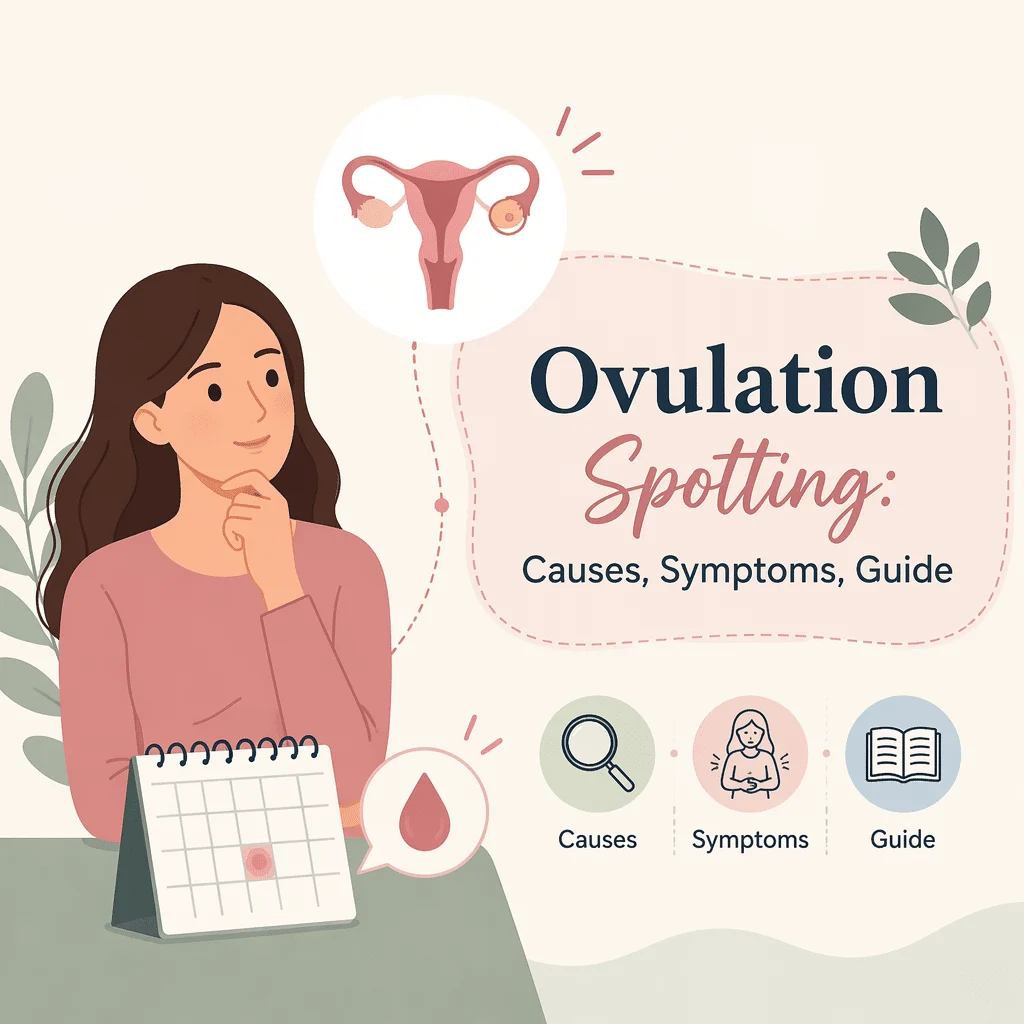
Ovulation spotting is light vaginal bleeding that appears around the middle of a menstrual cycle, close to the time an ovary releases an egg. It is usually very light, often brown or pink rather than bright red, and it normally stops within a day or two. For most people it is a harmless quirk of hormone timing rather than a warning sign, and on its own it does not indicate pregnancy. It is not the only reason blood appears mid-cycle, which is why knowing what is typical matters. In this article you’ll learn when ovulation spotting tends to happen, what causes it, how it differs from implantation bleeding and a light period, how ovulation is genuinely confirmed, and which patterns of mid-cycle bleeding deserve a medical opinion.
What ovulation spotting is
Ovulation spotting belongs to a broader category clinicians call intermenstrual bleeding: any bleeding between two normal periods. The defining feature is volume. Spotting means a few spots or a light smear on underwear or toilet paper, not enough to need a pad or a tampon. If you are soaking through protection, that is menstrual-level bleeding, caused by something other than a simple ovulatory shift.
Timing is the second defining feature: ovulatory bleeding clusters around the midpoint of the cycle rather than appearing randomly. Bleeding at unpredictable moments, month after month, points somewhere else.
Where the blood comes from
Two mechanisms are usually offered, and they are not mutually exclusive. The first is hormonal. Estrogen climbs through the first half of the cycle and builds the endometrium, the lining of the uterus. Just before the egg is released, estrogen dips briefly before progesterone takes over from the corpus luteum, the small structure left behind in the ovary. That short dip can leave the lining momentarily unsupported, and a little of it sheds. You can read what estrogen levels mean in our guide to the estradiol blood test.
The second mechanism is mechanical. When the follicle ruptures, a little fluid and sometimes a trace of blood escapes into the pelvis. This is more often felt as a one-sided ache, known as mittelschmerz, than seen as bleeding, and some people notice queasiness at the same point, described in our guide to ovulation nausea.
When ovulation spotting happens in your cycle
Ovulation happens roughly 12 to 16 days before your next period starts, not 14 days after your last one. That distinction matters more than most cycle apps suggest, because the second half of the cycle is relatively fixed in length while the first half stretches and shrinks.
Counting from the first day of your period
Day one is the first day of full bleeding, not the day you first saw a smudge. In a 28-day cycle, ovulation lands near day 14, so ovulation spotting shows up around days 12 to 16. In a 35-day cycle, ovulation is closer to day 21 and the spotting shifts with it. The Office on Women’s Health considers any cycle from 24 to 38 days regular, so there is no single correct day.
Why cycle length changes the timing
Because ovulation moves, a fixed calendar assumption misleads people constantly. Someone with 33-day cycles who expects to ovulate on day 14 will read day-20 spotting as abnormal when it is entirely ordinary for her. The practical fix: record the date you spotted and the date your next period began, for a few cycles. A gap of about two weeks means the spotting is landing where ovulatory bleeding should.
How long it lasts
Ovulation spotting is short: most people describe a few hours to two days. Anything running beyond three days, or bleeding that starts light and then builds, has left the typical pattern and deserves a look.
What ovulation spotting looks like
Why brown spotting is so common
Brown is the color people search for most, and it is reassuring rather than worrying. Blood turns brown once exposed to oxygen, which happens when a very small volume leaves the uterus slowly. Fresh, fast bleeding is red; slow, scant bleeding arrives brown or rust-colored. Pink is the in-between case, a trace of blood mixed with cervical mucus, which around ovulation is clear, stretchy and abundant. Pink-tinged discharge at mid-cycle is a very typical presentation.
Volume and texture
The expected volume is minimal. A liner is more than enough, and many people notice it only when wiping. Clots are not part of the picture. Passing clots, especially any larger than a coin, signals a heavier bleed and is one of the patterns Mayo Clinic lists as a reason to contact a healthcare professional.
What usually comes with it
- Clear, slippery cervical mucus resembling raw egg white
- A dull ache or twinge on one side of the lower abdomen
- Mild breast tenderness beginning in the days afterwards
- A small rise in resting body temperature over the following days
How to tell ovulation spotting from other bleeding
Four different things can produce light bleeding, and they are separated mainly by timing. The table below sets them side by side.
| Type of bleeding | When in the cycle | Typical color | Duration | Volume |
|---|---|---|---|---|
| Ovulation spotting | Mid-cycle, about 12 to 16 days before the next period | Brown, rust or pale pink | A few hours to 2 days | Spots only, a liner suffices |
| Implantation bleeding | Late in the cycle, roughly 6 to 12 days after ovulation | Pink or light brown | A few hours to 2 days | Very light, no clots |
| A light period | At the expected time for a period | Red at first, browner later | 2 to 7 days | Needs a pad or tampon |
| Breakthrough bleeding | Any point, often in the first months on hormonal contraception | Red or brown | Days, sometimes recurring | Light to moderate |
Implantation bleeding is the one people most want to rule in
The single most searched question about mid-cycle bleeding is whether it means pregnancy. Timing answers it. Implantation cannot occur at ovulation: fertilization has only just become possible, and the embryo needs roughly a week to reach the uterus and attach. Bleeding on the day you ovulate is therefore not implantation bleeding. Bleeding a week to ten days later, close to when a period is due, is the pattern that raises the question. Only a pregnancy test taken after a missed period settles it, and you can read how sensitive those tests really are in our guide to pregnancy test accuracy.
A light period in disguise
If the bleeding needs a pad, arrives when a period was due and lasts several days, it is a period, even a scant one. Persistently light or unpredictable periods are worth raising, especially alongside acne, unwanted hair growth or difficulty conceiving, a pattern described in our guide to PCOS symptoms and diagnosis.
Breakthrough bleeding on contraception
Pills, implants, injections and hormonal coils all commonly cause unscheduled bleeding, especially in the first three to six months, and missed pills are a frequent trigger. This is not ovulatory bleeding: most of these methods suppress ovulation altogether.
Other causes of bleeding between periods
Assuming every mid-cycle bleed is ovulatory is the main risk of an article like this one. Several other explanations exist, most treatable.
Causes in the cervix and uterus
- Cervical or endometrial polyps, small benign growths that bleed when disturbed
- Fibroids, which are non-cancerous muscular growths in the uterine wall
- An inflamed, fragile cervix that bleeds after sex or a smear, a pattern set out in our guide to a friable cervix
- Endometriosis and adenomyosis, where tissue resembling the uterine lining grows where it should not, covered in our guide to endometriosis
- Rarely, cervical or endometrial cancer, which is why persistent unexplained bleeding is always assessed
Hormonal, infectious and other causes
Thyroid disease is an underappreciated cause of cycle disruption and is easy to check with a TSH blood test. Sexually transmitted infections such as chlamydia can inflame the cervix and cause bleeding after sex. MedlinePlus lists hormonal changes, infections, medications, pregnancy complications and structural problems among the causes of bleeding between periods, and the National Institute of Child Health and Human Development adds hormonal imbalances, diseases and trauma to that list. Emergency contraception, and starting or stopping hormonal treatment, can also produce a bleed.
How ovulation is actually confirmed
Ovulation spotting is a clue, not proof. Plenty of people ovulate every cycle and never spot, and some who spot are not ovulating at all. If you need to know whether ovulation is happening, three approaches exist, each answering a different question.
Urinary LH tests predict, they do not confirm
Over-the-counter ovulation strips detect the surge in luteinizing hormone that precedes egg release by roughly 24 to 36 hours. They tell you ovulation is probably about to happen. A positive result does not prove the egg was released, and reading the line correctly matters more than people expect, which we set out in our guide to reading a positive ovulation test result. The hormone itself is explained in our guide to the LH blood test.
Temperature confirms after the fact
Basal body temperature rises slightly once progesterone appears, so a sustained rise confirms ovulation has already occurred. It is a rear-view mirror: useless for timing intercourse this cycle, useful for establishing whether you ovulate at all.
Blood tests give the clearest answer
A progesterone level drawn about seven days before the expected period is the standard way to confirm ovulation, because progesterone rises meaningfully only after the follicle releases its egg. It is often ordered alongside other hormones in a female hormone panel. If bleeding has been heavy or prolonged, your doctor may order a complete blood count to check whether you have lost iron, and we explain the warning signs in our guide to anemia and its blood tests.
When to see a doctor about mid-cycle bleeding
Occasional light ovulation spotting in an otherwise regular cycle rarely needs investigation. The following patterns do. Book an appointment if you notice any.
- Bleeding heavy enough to need a pad or tampon between periods
- Mid-cycle bleeding that lasts more than three days, or that recurs every cycle
- Any bleeding after sex, on more than one occasion
- Bleeding with fever, foul-smelling discharge or pelvic pain, which suggests infection
- Bleeding with dizziness, breathlessness or unusual fatigue, which can indicate anemia
- Any bleeding after the menopause, which always needs assessment
- Mid-cycle bleeding that is new for you and persists over several cycles
- Bleeding while pregnant or when pregnancy is possible, especially with one-sided pain
Severe one-sided pelvic pain with bleeding, faintness or a shoulder-tip ache needs urgent care rather than a routine appointment, because an ectopic pregnancy or a ruptured ovarian cyst has to be excluded quickly.
What helps your appointment go faster
Bring dates. Note the first day of your last three periods, the days you spotted, the color and volume, whether sex preceded it, and any contraception you use. That short record often narrows the possibilities faster than any single test.
Latest scientific advances
Research published since 2023 has not overturned what ovulation spotting is, but it has sharpened how bleeding is classified and how reliably ovulation can be tracked at home. Here is what that work says, in plain terms.
Bleeding between periods now has a shared checklist
An international review set out two structured systems for abnormal uterine bleeding: one describing the bleeding pattern itself, one sorting its possible causes into structural ones such as polyps and fibroids and non-structural ones such as ovulatory or clotting problems. The review also noted that abnormal uterine bleeding may affect more than half of women and girls of reproductive age, and stays widely underreported. What this means for you: describing your bleeding precisely, by frequency, duration, regularity and volume, is not fussiness. It is the exact information those systems are built on, and it steers which tests you are offered.
A second expert review looked specifically at bleeding caused by ovulation problems. It concluded that although these are a common source of abnormal bleeding, current guidelines stop short of clear treatment recommendations, so practice varies between countries. What this means for you: if your bleeding is linked to how you ovulate, there may be several reasonable options rather than one obvious answer, and asking about alternatives is legitimate.
Home ovulation strips are accurate, but only for some cycles
A prospective study compared five widely sold at-home ovulation predictor kits against daily blood tests for luteinizing hormone in monitored fertility cycles. All five agreed closely with the blood result, and expensive kits did not outperform cheap ones, though a few missed a genuine surge more often. What this means for you: price is a poor guide to quality, and one negative strip is not proof that ovulation did not happen. Testing across several days beats testing once.
A separate feasibility study makes the limits explicit. Its authors note that most over-the-counter kits were built around regular cycles with a predictable mid-cycle surge, and they are developing alternatives for people with irregular cycles or polycystic ovary syndrome. That work is early and has produced no validated product yet. What this means for you: if your cycles are irregular, strips can genuinely mislead you, and a blood test is the more dependable route.
Temperature and apps: useful, but not for prediction
A 2026 study compared several ways of taking basal body temperature against a continuous internal sensor used as the reference. The sensor identified every ovulation, including one cycle in which no egg was released. Ear and rectal readings proved too variable to rely on, while a careful under-the-tongue reading at a fixed time each morning was an acceptable low-cost substitute. What this means for you: temperature confirms ovulation afterwards, technique matters more than the device, and it will not tell you ovulation is coming.
Research into cycle-tracking apps found a clear split in confidence. Users were often enthusiastic about the ovulation dates their app predicted, while healthcare providers were markedly skeptical of those same predictions. Both groups agreed the calendar and symptom log was the genuinely valuable part. What this means for you: use the app to record when you actually spotted and bled, and treat its predicted ovulation day as an estimate, not a fact.
How ovulation is best confirmed
A systematic review of menstrual cycle disorders reached a practical conclusion about method. Rather than trusting any single signal, it recommended combining calendar tracking, urinary ovulation tests and a progesterone blood test taken in the second half of the cycle. What this means for you: two agreeing signals are far more informative than one, and a mid-luteal progesterone test remains the most decisive of the three.
Finally, a review of uterine bleeding recognizes bleeding at ovulation as a distinct event, separate from periods and from pregnancy-related bleeding, while stating plainly that much about how the uterus controls bleeding is still unknown. What this means for you: an honest answer of nothing worrying found, after a proper assessment, is a legitimate result, not a sign your concern was dismissed.
Glossary
| Term | Definition |
|---|---|
| Ovulation | The release of a mature egg from an ovary. It happens roughly 12 to 16 days before the next period begins. |
| Intermenstrual bleeding | The medical term for any bleeding that occurs between two normal periods. Ovulation spotting is one form of it. |
| Endometrium | The lining of the uterus. It thickens through the cycle and is shed during a period. |
| Luteinizing hormone (LH) | A pituitary hormone that surges shortly before ovulation. Home ovulation strips detect this surge in urine. |
| Estradiol | The main form of estrogen in the reproductive years. It builds the uterine lining and peaks just before ovulation. |
| Progesterone | The hormone produced after ovulation that stabilizes the uterine lining. A blood level in the second half of the cycle confirms ovulation occurred. |
| Corpus luteum | The temporary structure left in the ovary after the egg is released. It produces progesterone for about two weeks. |
| Mittelschmerz | A German term for one-sided lower abdominal pain felt around ovulation. It is usually brief and harmless. |
| Implantation bleeding | Light bleeding that can occur when an embryo attaches to the uterine lining, typically 6 to 12 days after ovulation. |
| Breakthrough bleeding | Unscheduled bleeding while using hormonal contraception. It is common in the first few months of a new method. |
Frequently asked questions
Is ovulation spotting a good sign for fertility?
It is a reasonable clue that a cycle is ovulatory, but it is not a guarantee and it says nothing about egg quality or the chance of conceiving. Many people who ovulate normally every single month never spot at all, so its absence is equally uninformative. Treat it as one signal among several rather than a fertility score. If you are trying to conceive and want a firmer answer, a progesterone blood test in the second half of the cycle confirms that ovulation actually took place, which spotting alone cannot do.
Can you get pregnant if you bleed during ovulation?
Yes. Light bleeding at mid-cycle happens at or near the most fertile point of the cycle, so conception is entirely possible in that window. The bleeding itself neither improves nor reduces the chance. Sperm can survive several days in the reproductive tract, so intercourse in the days before the spotting also falls inside the fertile window. If you are not trying to conceive, do not read mid-cycle bleeding as a safe period.
What does brown ovulation spotting mean?
Brown simply means the blood is older. When a very small amount of blood leaves the uterus slowly, it is exposed to oxygen along the way and darkens from red to brown or rust. It carries no separate meaning and is not a sign of infection or of old blood being trapped. Brown ovulation spotting that is light, lasts a day or two and sits mid-cycle fits the ordinary pattern. Brown discharge that persists for many days, smells unpleasant or comes with pelvic pain is a different situation and should be checked.
Why am I bleeding during ovulation for the first time?
A first episode is usually explained by something that shifted your hormone balance recently: coming off or starting hormonal contraception, considerable stress, marked weight change, illness, travel disrupting sleep, or simply an unusually variable cycle. A single new episode in an otherwise normal cycle is not a red flag. What matters is what happens next. If it settles and does not return, it needs no action. If mid-cycle bleeding then repeats over several consecutive cycles, or becomes heavier, arrange a review rather than waiting.
Should I take an ovulation test if I am spotting?
You can, but time it properly. Ovulation strips detect a hormone surge that arrives roughly a day before the egg is released, so testing only once the spotting has appeared may catch the end of the surge or miss it entirely. Testing daily across the expected fertile days gives a far more useful picture than a single strip. Bear in mind that a positive strip predicts ovulation rather than proving it occurred, and that strips are least reliable when cycles are irregular.
How long is too long for mid-cycle spotting?
More than three days moves outside the typical pattern, and bleeding that recurs at mid-cycle every month is worth investigating even when each episode is short. Volume matters as much as duration: anything requiring a pad or tampon is no longer spotting. Bleeding that starts light and steadily becomes heavier, or that arrives with pain, fever or unusual discharge, should prompt an appointment without waiting to see whether the next cycle behaves.
Sources
- MedlinePlus, National Library of Medicine — Vaginal bleeding between periods — Medical Encyclopedia. MedlinePlus
- Office on Women’s Health, U.S. Department of Health and Human Services — Your menstrual cycle. womenshealth.gov
- Mayo Clinic — Menstrual cycle: What’s typical, what’s not. Mayo Clinic
- Eunice Kennedy Shriver National Institute of Child Health and Human Development — What causes menstrual irregularities? NICHD
- Jain V, Munro MG, Critchley HOD — Contemporary evaluation of women and girls with abnormal uterine bleeding: FIGO Systems 1 and 2 — International Journal of Gynaecology and Obstetrics, 2023. DOI
- Simoncini T, Arab H, Pedachenko N, et al. — Unmet needs in abnormal uterine bleeding due to ovulatory dysfunction — Gynecological Endocrinology, 2024. DOI
- Vanderhoff AC, Lanes A, Waldman I, Ginsburg E — Similar accuracy and patient experience with different one-step ovulation predictor kits — Fertility and Sterility, 2024. DOI
- Peebles E, Finlay W, Nguyen TM, et al. — Digitally Enabled AI-Interpreted Salivary Ferning-Based Ovulation Prediction: Feasibility Study — Journal of Medical Internet Research, 2025. DOI
- Nolte J, Pilz M, Legerlotz K, Platen P — Optimizing basal body temperature measurement for cycle diagnostics: a comparison of different methods in female recreational athletes — Frontiers in Sports and Active Living, 2026. DOI
- Hohmann-Marriott B, Williams T, Girling J — Fertility and infertility uses of menstrual apps from the perspectives of healthcare providers and patients — Australian and New Zealand Journal of Obstetrics and Gynaecology, 2023. DOI
- Taim BC, Ó Catháin C, Renard M, et al. — The Prevalence of Menstrual Cycle Disorders and Menstrual Cycle-Related Symptoms in Female Athletes: A Systematic Literature Review — Sports Medicine, 2023. DOI
- James AH, James PD — What do we know about why women bleed and what do we not know? — Journal of Thrombosis and Haemostasis, 2023. DOI
Further reading
- Fertility blood test: hormones to check
- FSH blood test: high and low levels explained
- Period 5 days late: causes and next steps
- Cervical cancer and uterine cancer explained
- Frequent urination before your period explained
Understand your lab results with AI DiagMe
Mid-cycle spotting is a symptom you can see, but the hormones behind it are only visible in a blood test. If your doctor has already ordered progesterone to confirm ovulation, LH and FSH to look at how the cycle is being driven, estradiol, a thyroid TSH, or a blood count because bleeding has been heavy, the numbers on the report are rarely self-explanatory. AI DiagMe turns those results into plain language so you arrive at your next appointment knowing what to ask. It helps you understand your results; it does not diagnose you and it does not replace your doctor.
Get your results interpreted in minutes