






































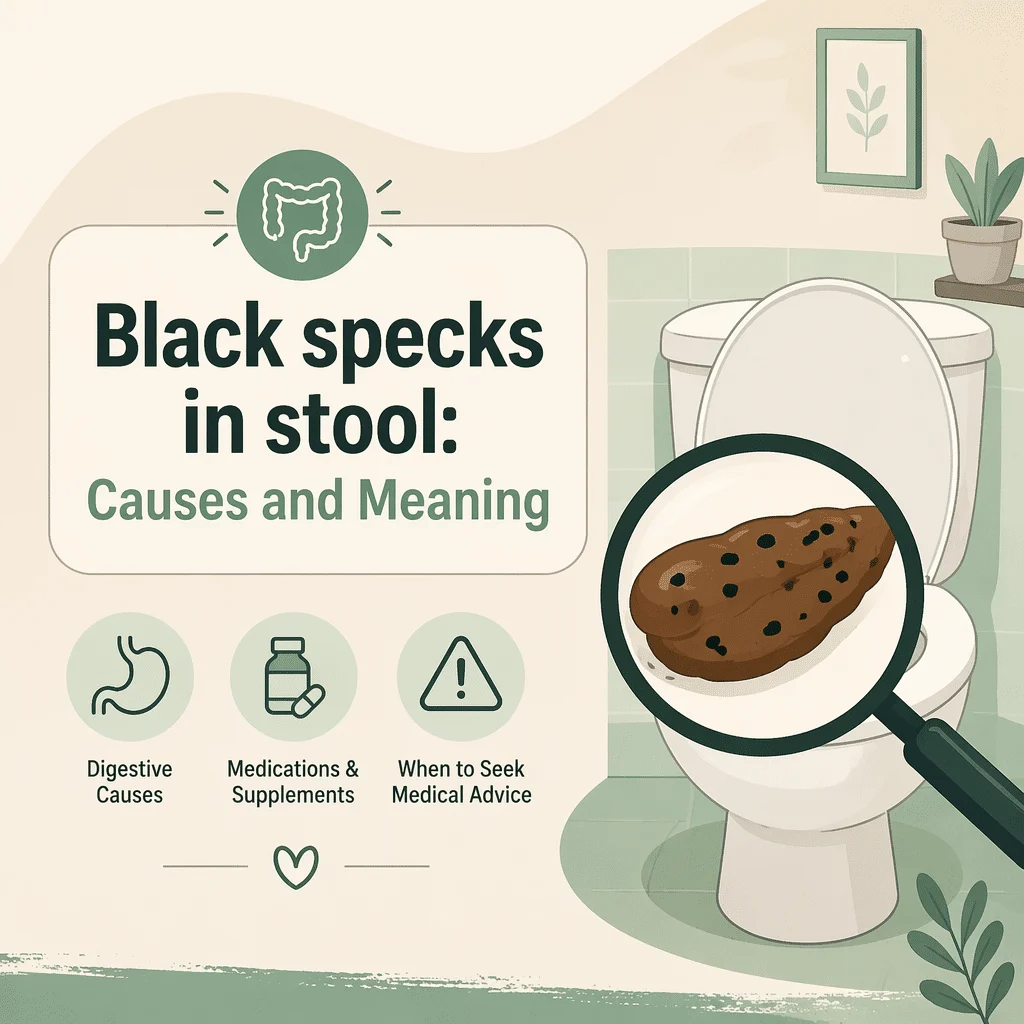
Zwarte vlekjes in de ontlasting kunnen verontrustend zijn, maar in de meeste gevallen is de oorzaak volkomen onschuldig — meestal iets wat u gegeten heeft of een supplement dat u gebruikt. Kleine donkere vlekjes komen vaak van zaden, bessenschilletjes, ijzerpillen of stukjes vezels die uw lichaam niet volledig heeft verteerd. Minder vaak kunnen donkere vlekjes of zwarte, teerachtige ontlasting wijzen op bloeding hoger in het spijsverteringskanaal, wat het waard is om te laten controleren. Dit artikel legt uit wat zwarte vlekjes in de ontlasting doorgaans betekenen, welke oorzaken geruststellend zijn, hoe u een onschuldig patroon van een zorgwekkend onderscheidt, hoe artsen de verandering beoordelen en welke waarschuwingssignalen aanleiding zijn om uw arts te bellen.
Wat zwarte vlekjes in de ontlasting doorgaans betekenen
Bij gezonde volwassenen zijn zwarte vlekjes in de ontlasting meestal klein, verspreid en gemakkelijk te herleiden tot iets wat u onlangs gegeten of geslikt heeft. Ontlasting krijgt zijn normale bruine kleur van gal, een spijsverteringsvloeistof die door de lever wordt aangemaakt. Donkere vlekjes die opvallen tegen een verder bruine ontlasting zijn dan ook meestal losse deeltjes en geen gezondheidsprobleem. Het patroon is belangrijker dan de kleur alleen: een paar donkere stipjes in een normale, gevormde, bruine ontlasting is heel anders dan een volledige stoelgang die zwart en teerachtig eruitziet.
Wat de vlekjes eigenlijk zijn
De donkere vlekjes die mensen opmerken zijn vaak zaden en schilletjes van fruit, stukjes bladgroenten, koffiedik of resten van een ijzertablet. Het kunnen ook kleine stukjes vezels zijn die uw darmen niet hebben verteerd. Het belangrijkste is de context: uw recente maaltijden, eventuele nieuwe medicijnen en of u zich verder goed voelt.
Veelvoorkomende, onschuldige oorzaken van zwarte vlekjes in de ontlasting
De meeste alledaagse gevallen vallen in een paar bekende categorieën. Als je de zwarte vlekjes in je ontlasting kunt koppelen aan een van de onderstaande oorzaken en je je goed voelt, is er doorgaans weinig reden tot bezorgdheid.
Voedingsmiddelen, zaden en voedselkleurstoffen
Donkere of sterk gepigmenteerde voedingsmiddelen zijn de meest voorkomende verklaring. Bosbessen, bramen, vijgen, kersen en de kleine zaadjes in bananen of kiwi's kunnen allemaal als donkere vlekjes zichtbaar zijn. Maanzaad, bladgroenten zoals spinazie en boerenkool, zwart drop en voedingsmiddelen met donkerblauwe, paarse of zwarte kleurstof kunnen hetzelfde effect hebben. Deze deeltjes behouden hun kleur terwijl ze door het spijsverteringskanaal passeren.
IJzersupplementen en bismutmedicijnen
IJzersupplementen zijn een bekende oorzaak van donkere ontlasting. Overtollig ijzer dat het lichaam niet opneemt, kan de ontlasting donkergroen tot bijna zwart kleuren en kan zichtbaar zijn als zwarte vlekjes. Medicijnen die bismutsubsalicylaat bevatten, zoals Pepto-Bismol en sommige andere middelen tegen maagklachten of diarree, reageren met kleine hoeveelheden zwavel in de darmen en kunnen de hele ontlasting of de tong donker kleuren. Beide effecten zijn onschadelijk en verdwijnen binnen een dag of twee nadat je het product hebt gestopt.
Onverteerde vezels en normale galpigmenten
Vezelrijk eten is gezond, maar sommige vezels zijn simpelweg niet verteerbaar. Maïsschillen, zaadhuiden en taaie plantenvezels kunnen als donkere of zwarte stukjes zichtbaar zijn. Normale variaties in galpigment kunnen de ontlasting ook op sommige dagen donkerder maken dan op andere. Andere veranderingen in de ontlasting, zoals bleke en vettige stoelgang, kunnen juist wijzen op vettige ontlasting, wat op een ander proces duidt; je kunt meer lezen over vettige, moeilijk door te spoelen ontlasting in onze gids over vette ontlasting.
Wanneer zwarte vlekjes of zwarte ontlasting kunnen wijzen op bloeding
De oorzaak die aandacht vereist, is bloed uit het bovenste deel van het spijsverteringskanaal — de slokdarm, de maag of het eerste deel van de dunne darm. Wanneer bloed tijdens de passage door het spijsverteringskanaal wordt verteerd, wordt het donker. Het resultaat is meestal niet een paar kleine puntjes, maar een kenmerkende ontlasting die artsen melena noemen: zwart, plakkerig, teerachtig en met een ongewoon sterke geur. De Amerikaanse National Library of Medicine beschrijft zwarte of teerachtige ontlasting als een mogelijk teken van bloeding in het bovenste deel van het spijsverteringskanaal.
Veelvoorkomende oorzaken van dit soort bloeding zijn maagzweren, ontsteking van het maagslijmvlies (gastritis) en irritatie van de slokdarm. Regelmatig gebruik van ontstekingsremmende pijnstillers kan bijdragen door de maag te irriteren. Helderrood bloed daarentegen komt meestal van lager in het maagdarmkanaal — bijvoorbeeld van aambeien — en ziet er anders uit dan verteerd, teerachtig bloed. Aanhoudend verborgen bloedverlies is ook een van de patronen die artsen ertoe aanzet te controleren op darmkanker, hoewel bij de meeste mensen donkere ontlasting een veel alledaagsere verklaring heeft.
Onschuldig of zorgwekkend: hoe het verschil te herkennen
Je hoeft jezelf niet te diagnosticeren, maar een paar eenvoudige checks helpen je te bepalen of zwarte vlekjes in de ontlasting waarschijnlijk onschuldig zijn of een reden om binnen dezelfde week contact op te nemen met een arts. De onderstaande tabel vergelijkt het geruststellende patroon met het patroon dat medische aandacht verdient.
| Wat u moet controleren | Meestal onschuldig (voeding of supplementen) | Mogelijke bloeding — laat het nakijken |
|---|---|---|
| Kleurpatroon | Kleine, verspreide zwarte vlekjes in verder bruine ontlasting | De hele ontlasting ziet er zwart uit |
| Textuur en geur | Normale gevormde ontlasting met de gebruikelijke geur | Kleverig, teerachtig en ongewoon sterk ruikend (melaena) |
| Recente voeding of medicatie | Bessen, zaden, ijzerpillen of bismut in de afgelopen dag of twee | Geen voeding of medicatie die het verklaart |
| Hoe lang het aanhoudt | Verdwijnt binnen een dag of twee nadat je de voeding of pil hebt gestopt | Houdt meerdere dagen aan |
| Overige symptomen | Je voelt je verder goed | Vermoeidheid, duizeligheid, buikpijn of donker braaksel |
| Verstandige volgende stap | Heroverweeg na aanpassing van voeding of supplementen | Neem contact op met een arts; zoek spoedhulp als je je niet goed voelt |
Waarschuwingssignalen en wanneer naar de dokter
De context bepaalt de urgentie. Als donkere vlekjes eenmalig verschijnen, je je gezond voelt en een recente maaltijd of supplement ze verklaart, is afwachten redelijk. In sommige situaties is het echter verstandig snel medisch advies te zoeken.
Bel binnenkort je dokter als
- Donkere vlekjes of donkere ontlasting langer dan een paar dagen aanhouden zonder verklaring vanuit voeding of medicatie.
- Je je ook vermoeider voelt dan normaal, kortademig bent of licht in het hoofd.
- Je regelmatig ontstekingsremmende pijnstillers of bloedverdunners gebruikt en een kleurverandering opmerkt.
- Je aanhoudende maagpijn, brandend maagzuur of onverklaard gewichtsverlies hebt.
Bel direct een ambulance of ga naar de spoedeisende hulp als
- Je ontlasting zwart, kleverig en teerachtig is, vooral in combinatie met duizeligheid, flauwvallen of een snelle hartslag.
- Je bloed of materiaal dat eruitziet als koffiedik opgeeft.
- Je ernstige buikpijn hebt of een grote hoeveelheid bloed verliest.
Hoe artsen zwarte vlekjes in de ontlasting onderzoeken
Wanneer u zwarte vlekjes in de ontlasting beschrijft, begint een arts met uw voorgeschiedenis: recente voeding, supplementen, medicijnen en eventuele andere klachten. Dat gesprek lost onschuldige gevallen vaak snel op. Als bloeding moet worden uitgesloten, zijn er een aantal gangbare en eenvoudige onderzoeken.
Ontlastingstests
Een ontlastingstest kan verborgen bloed opsporen dat met het blote oog niet zichtbaar is — vaak een fecale immunochemische test, die reageert op menselijk bloed. Als een infectie of een ander darmprobleem wordt vermoed, kan het laboratorium een ontlastingskweekuitvoeren, en uw arts kan een ontlastingstest op eieren en parasietenaanvragen. Om darmontsteking te meten, kan het laboratorium een fecale calprotectinetest.
Bloedonderzoek
Als langzaam bloedverlies een zorg is, laten artsen vaak een volledig bloedbeelduitvoeren, omdat aanhoudend bloeden ijzergebreksanemiekan aantonen. Voor een gedetailleerder beeld van de ijzervoorraden kan uw arts een panel voor ijzeronderzoekaanvragen; een bloedtest kan ook lage ferritinewaardenmeten, wat kan optreden bij langzaam bloedverlies. Als u hulp wilt bij het begrijpen van een uitslag, kunt u meer leren over Hoe lees je de resultaten van je bloedtest?.
Van binnen kijken
Wanneer uitslagen of klachten op bloeding wijzen, kan een arts een endoscopie of colonoscopie aanbevelen — een dunne camera die het spijsverteringskanaal rechtstreeks bekijkt en de oorzaak kan opsporen. De meeste mensen met onschuldige donkere vlekjes hebben deze stap nooit nodig.
Recente wetenschappelijke ontwikkelingen
Onderzoek blijft de manier waarop artsen denken over donkere ontlasting, verborgen bloed en bloedingsrisico verder verfijnen. De onderstaande bevindingen zijn afkomstig uit recente studies die zijn geïndexeerd in PubMed, hier vertaald naar begrijpelijke taal; elke studie verwijst naar de gepubliceerde bron.
Niet alle pijnstillers dragen hetzelfde bloedingsrisico
Een systematische review uit 2025 toonde aan dat het risico op maagdarmbloeding sterk verschilt tussen veelgebruikte ontstekingsremmende pijnstillers — de groep die bekendstaat als NSAID's, niet-steroïde ontstekingsremmers zoals ibuprofen. Sommige middelen werden in verband gebracht met een aanzienlijk hoger bloedingsrisico dan andere. Wat dit voor u betekent: als u vaak ontstekingsremmende pijnstillers gebruikt en zwarte of teerachtige ontlasting opmerkt, bespreek beide met uw arts, die het specifieke middel kan beoordelen en veiligere alternatieven kan voorstellen. U kunt de studie lezen via het gepubliceerde record.
Ontlastingstests werken het beste in de juiste context
Een review uit 2025 over fecaal occult bloedonderzoek — ontlastingstesten die verborgen bloed opsporen, waaronder de fecale immunochemische test — bevestigde opnieuw dat deze tests het beste werken als screeningstest voor mensen zonder klachten met een gemiddeld risico. Gebruik in de verkeerde situatie kan misleidende resultaten opleveren. Wat dit voor u betekent: een ontlastingstest op bloed is zeker nuttig, maar het is slechts één stukje van het geheel, en uw arts beoordeelt de uitslag samen met uw klachten en voorgeschiedenis, niet op zichzelf. De volledige review is beschikbaar via gepubliceerde record.
Een normale uitslag sluit het probleem niet altijd uit
Een bijgewerkte review uit 2024 toonde aan dat de fecale immunochemische test de meeste colorectale kankers opspoort bij mensen die al darmklachten hebben, maar toch kan hij sommige gevallen missen — een enkele negatieve uitslag sluit een probleem dus niet volledig uit wanneer de klachten aanhouden. Wat dit voor u betekent: als zwarte vlekjes of andere spijsverteringsklachten aanhouden na een normale ontlastingstest, is het de moeite waard om dit verder te laten onderzoeken in plaats van aan te nemen dat alles in orde is. De analyse is te raadplegen via gepubliceerde record.
Woordenlijst met belangrijke termen
| Termijn | Definitie |
|---|---|
| Melaena | Zwarte, teerachtige, sterk ruikende ontlasting veroorzaakt door verteerd bloed uit het bovenste deel van het spijsverteringskanaal. |
| Occult bloed | Bloed in de ontlasting in hoeveelheden die te klein zijn om te zien, en alleen door een laboratoriumtest worden aangetoond. |
| Fecale immunochemische test (FIT) | Een ontlastingstest die verborgen menselijk bloed opspoort, veel gebruikt bij darmkankerscreening. |
| Fecaal occult bloedtest | Een algemene term voor ontlastingstesten die zoeken naar verborgen bloed. |
| Bismutsubsalicylaat | Een bestanddeel in sommige maag- en antidiarreemiddelen dat de ontlasting zwart kan kleuren. |
| Gal | Een groengele spijsverteringsvloeistof van de lever die de ontlasting zijn normale bruine kleur geeft. |
| Ferritine | Een bloedproteïne dat de ijzervoorraad weerspiegelt; lage waarden kunnen het gevolg zijn van aanhoudend bloedverlies. |
| Endoscopie | Een procedure waarbij een dunne camera wordt gebruikt om de binnenkant van het spijsverteringskanaal te bekijken. |
| Hematochezie | Het verlies van helder rood bloed bij de ontlasting, meestal afkomstig uit het onderste deel van het spijsverteringskanaal. |
| NSAID | Een niet-steroïdaal ontstekingsremmend middel, zoals ibuprofen, dat het maagslijmvlies kan irriteren. |
Veelgestelde vragen
Is het normaal om zwarte vlekjes in de ontlasting te hebben?
Af en toe zwarte vlekjes in de ontlasting zijn gewoon en meestal normaal, zeker als u ze kunt koppelen aan donkere voedingsmiddelen, zaden, een ijzersupplement of een bismutmedicijn. Het geruststellende patroon is een paar verspreide vlekjes in een verder bruine, goed gevormde ontlasting terwijl u zich goed voelt. Het is de moeite waard om het te laten controleren wanneer de hele ontlasting zwart en teerachtig wordt, wanneer donkere ontlasting meerdere dagen aanhoudt zonder een voedingsverklaring, of wanneer er andere klachten optreden.
Kunnen zwarte vlekjes in de ontlasting iets anders zijn dan bloed?
Ja. Verreweg het vaakst zijn donkere vlekjes onverteerd voedsel, zaadschilletjes, vezels, koffiedik of resten van een ijzertablet. Verteerd bloed maakt de ontlasting doorgaans volledig zwart en plakkerig, in plaats van een paar kleine stipjes te veroorzaken. Het algemene patroon — verspreide vlekjes versus een egaal zwarte, teerachtige ontlasting — is de nuttigste aanwijzing.
Betekenen zwarte vlekjes in de ontlasting darmkanker?
In de meeste gevallen niet. Donkere vlekjes zijn meestal voedingsgerelateerd, en een enkele bevinding bij iemand die zich goed voelt is zelden een teken van kanker. Dat gezegd hebbende, kan aanhoudend verborgen bloedverlies een signaal zijn dat artsen serieus nemen, vooral in combinatie met andere veranderingen zoals onverklaarbaar gewichtsverlies, aanhoudende buikpijn of een verandering in de stoelgang. Als donkere ontlasting zonder verklaring aanhoudt, kan een arts eenvoudige tests laten uitvoeren om dit te controleren.
Kunnen ijzersupplementen zwarte vlekjes in de ontlasting veroorzaken?
Ja, en dit is een van de meest voorkomende verklaringen. IJzer dat uw lichaam niet opneemt, kan de ontlasting donkergroen of bijna zwart kleuren en kan eruitzien als zwarte vlekjes. Dit effect is onschadelijk en omkeerbaar; de kleur van de ontlasting keert doorgaans binnen een dag of twee na het stoppen met het supplement terug naar normaal. Als u niet zeker weet of ijzer of bloeding de oorzaak is, kan een bloedtest in de ontlasting de vraag beantwoorden.
Zijn zwarte vlekjes bij een baby of borstgevoede zuigeling een reden tot bezorgdheid?
Donkere vlekjes in de luier van een baby komen vaak van ingeslikt materiaal of, bij borstgevoede baby's, van kleine hoeveelheden bloed van de moeder door een gebarsten tepel, wat niet gevaarlijk is voor de baby. IJzerverrijkte flesvoeding kan de ontlasting ook donkerder maken. Toch wordt het spijsverteringsstelsel van een baby het best beoordeeld door een kinderarts, dus het is verstandig om contact op te nemen met de arts van uw kind als u zich zorgen maakt of als het patroon aanhoudt.
Kan een parasiet zwarte vlekjes in de ontlasting veroorzaken?
Darmparasieten veroorzaken vaker diarree, krampen of zichtbare wormfragmenten dan echte zwarte vlekjes, en de donkere vlekjes die mensen zien zijn meestal voedsel- of supplementresten. Als u aanhoudende diarree heeft gehad, onlangs gereisd heeft of andere spijsverteringsklachten heeft, kan een arts een ontlastingsonderzoek aanvragen om op parasieten te controleren, in plaats van te gissen.
Bronnen
- MedlinePlus (U.S. National Library of Medicine) — Zwarte of teerachtige ontlasting — MedlinePlus Medische Encyclopedie, 2024 — medlineplus.gov
- National Institute of Diabetes and Digestive and Kidney Diseases (NIDDK) — Maagdarmbloeding (GI-bloeding) — NIDDK, 2024 — niddk.nih.gov
- Cleveland Clinic — Bloed in de ontlasting (rectaal bloedverlies): oorzaken en hoe het eruitziet — Cleveland Clinic, 2024 — my.clevelandclinic.org
- Tawfik AG, et al. — Nonsteroidal Anti-Inflammatory Drugs and Risk of Gastrointestinal Bleeding: A Systematic Review and Meta-Analysis — Clinical Pharmacology & Therapeutics, 2025 — doi.org/10.1002/cpt.70054
- Méndez G, et al. — Faecal occult blood testing: a review of its use and common misutilisation — BMJ Open Gastroenterology, 2025 — doi.org/10.1136/bmjgast-2025-001876
- Harnan S, et al. — Faecal immunochemical tests for patients with symptoms suggestive of colorectal cancer: an updated systematic review and meta-analysis — Colorectal Disease, 2024 — doi.org/10.1111/codi.17255
Verder lezen
- Laag MCV: oorzaken, symptomen en behandelingen
- Fecale lactoferrine test: positieve uitslag begrijpen
- Abnormale bloedtestresultaten: wat betekenen ze?
- C. diff toxinetest: hoe lees je je uitslag
- Normale waarden bij bloedonderzoek: een uitleg van de referentiewaarden
Begrijp uw laboratoriumresultaten met AI DiagMe.
Donkere vlekjes in je ontlasting zijn meestal onschuldig, maar als een arts op bloedverlies controleert, komen de antwoorden vaak uit laboratoriumuitslagen — een fecaal occult bloedtest die zoekt naar verborgen bloed, een volledig bloedbeeld dat bloedarmoede kan aantonen, en ferritine- of ijzeronderzoek dat laat zien of je ijzervoorraden laag zijn. AI DiagMe helpt je begrijpen wat die waarden betekenen in begrijpelijke taal, zodat je een beter geïnformeerd gesprek kunt voeren met je arts. Het is bedoeld om je uitslagen te helpen begrijpen, niet om een diagnose te stellen, en het vervangt je arts niet.
Ontvang binnen enkele minuten een interpretatie van uw resultaten.