








































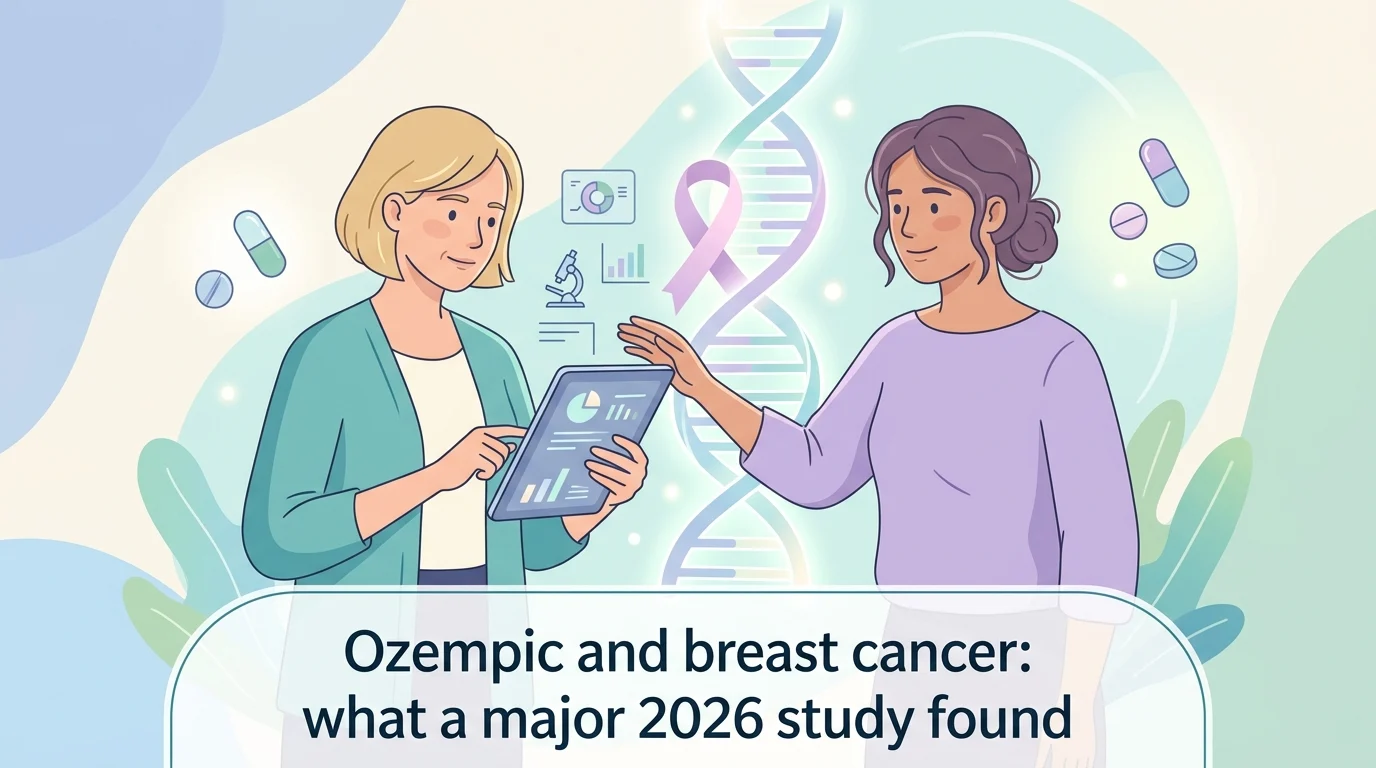
Ozempic and breast cancer landed in the headlines in June 2026, after a large U.S. study found that women taking GLP-1 medications such as Ozempic or Wegovy were about 30% less likely to develop breast cancer. The finding is striking, but it is not the whole story. In this article you will learn what the study actually showed, why these weight-loss drugs might affect cancer risk, what other recent research adds, and what it means for you. The goal is not to alarm you or promise a miracle, but to help you understand an early, evolving piece of science and how it connects to your own lab results.
Ozempic and breast cancer: what the 2026 study found
The research that put Ozempic and breast cancer in the news came from Penn Medicine (University of Pennsylvania). It was presented at the 2026 American Society of Clinical Oncology (ASCO) Annual Meeting and published in JCO Oncology Practice.
Researchers reviewed the health records of 111,646 women aged 45 to 80 who were overweight or had obesity (a body mass index of 25 or higher) and had breast imaging between January 2022 and June 2025. Of these, 15,264 had prescriptions for GLP-1 medications.
Women using GLP-1 drugs had 30% to 35% lower odds of developing breast cancer. The lower rate held up in a matched analysis that accounted for age, race, ethnicity, BMI, breast density, and diabetes status.
One caveat matters most: this was an observational study. It shows an association, not proof that Ozempic prevents breast cancer. The authors are now planning a clinical trial to test the idea directly. For the fundamentals of the disease, including risk factors and screening, see our complete guide to breast cancer.
Why a diabetes drug might protect the breast
GLP-1 drugs such as semaglutide (the active ingredient in Ozempic and Wegovy) mimic a gut hormone that regulates appetite and blood sugar. Originally developed for type 2 diabetes, they have become some of the most widely used weight-loss medications in the United States.
Excess weight, especially after menopause, is a well-established risk factor for breast cancer. Fat tissue produces extra estrogen, raises insulin levels, and fuels low-grade inflammation, all of which can encourage hormone-driven tumors to grow.
Because GLP-1 drugs cause significant weight loss, some of the benefit may simply come from a healthier weight. But researchers suspect the drugs also act on their own, by lowering inflammation and improving insulin sensitivity. That is why markers such as blood glucose, insulin, and the HOMA-IR insulin resistance score sit at the center of this research.
Latest scientific advances: what recent research shows
The Penn study did not appear in a vacuum. Several recent papers indexed in PubMed paint a more nuanced picture of GLP-1 drugs and cancer.
A quick vocabulary note helps here. An observational study follows people without randomly assigning treatment, so it can spot associations but not prove cause. A meta-analysis pools many studies to find an overall trend. A randomized controlled trial, which assigns treatment or placebo by chance, remains the strongest level of evidence.
Several large real-world databases point toward a protective effect. The most rigorous synthesis, however, urges caution: when randomized trials are pooled together, GLP-1 drugs have so far shown little or no clear effect on obesity-related cancers. In other words, the encouraging real-world signal has not yet been confirmed at the highest level of evidence.
| Study (year, journal) | Type of study | What it adds | Level of evidence |
|---|---|---|---|
| Penn / ASCO (2026, JCO Oncology Practice) | Observational, 111,646 women | About 30% fewer breast cancers in GLP-1 users | Low to moderate |
| JAMA Network Open (2024) | Cohort, 1.65 million people with diabetes | Lower risk of several obesity-related cancers vs insulin | Moderate |
| JAMA Oncology (2025) | Cohort (target-trial emulation), adults with obesity | Compares the risk of 14 cancers on GLP-1 drugs | Moderate |
| Annals of Internal Medicine (2026) | Meta-analysis, 48 randomized trials (94,245 people) | Little or no clear effect in trials: not yet confirmed | High |
The takeaway: a promising research lead is not a validated medical recommendation. A 2025 review focused on the breast notes that GLP-1 drugs are still under investigation in oncology, with no signal that they raise the risk of recurrence, but no proof of a preventive benefit either.
Should you take Ozempic to prevent breast cancer?
No. As of today, no health authority recommends Ozempic or Wegovy to prevent breast cancer. These drugs carry side effects and contraindications, and they are prescribed only for diabetes or obesity. The clinical trial announced by the researchers will, in a few years, show whether they offer any real preventive value.
To lower your risk now, the proven steps are unchanged: maintain a healthy weight, stay physically active, limit alcohol, and keep up with mammography screening. Any lasting change in a breast, such as a lump, skin change, or nipple discharge, is a reason to see a doctor promptly.
If you already take a GLP-1 drug, follow-up relies on simple lab work. Our guide to the diabetes blood test and the HbA1c normal range explains the sugar markers to watch, while a comprehensive metabolic panel reviews your kidneys, liver, and electrolytes in one test.
Glossary
| Term | Definition |
|---|---|
| BMI (body mass index) | A weight-to-height ratio used to define overweight (25 or higher) and obesity (30 or higher). |
| GLP-1 receptor agonist | A class of drugs that mimic a hormone regulating appetite and blood sugar, used for diabetes and obesity. |
| Hormone-receptor-positive breast cancer | Breast cancer that grows in response to hormones such as estrogen; common after menopause. |
| Insulin resistance | A state in which cells respond poorly to insulin, so the body makes more of it. |
| Meta-analysis | A statistical synthesis that combines many studies on one question to find an overall trend. |
| Observational study | A study that observes outcomes without randomly assigning treatment; it shows associations, not cause. |
| Randomized controlled trial | A study that assigns treatment or placebo by chance; the most reliable level of evidence. |
| Semaglutide | The active ingredient in Ozempic and Wegovy, part of the GLP-1 drug class. |
Frequently asked questions
Does Ozempic really lower breast cancer risk?
The 2026 study found an association: women with overweight or obesity who took GLP-1 drugs developed about 30% fewer breast cancers. An association is not proof of cause and effect. Other factors, such as lifestyle or closer medical follow-up, may play a role, and randomized trials have not yet confirmed a protective effect. It is a serious lead, not a settled fact.
Should I take Ozempic to prevent breast cancer?
No. No GLP-1 medication is approved to prevent cancer. These drugs are intended for diabetes and obesity, carry side effects, and require a prescription. To lower your risk, the better path is the proven one: a healthy weight, regular activity, limited alcohol, and screening. Talk with your doctor about what fits your situation.
Do these findings also apply to Wegovy and Mounjaro?
The study grouped different GLP-1 drugs together, including semaglutide (Ozempic, Wegovy) and tirzepatide (Mounjaro, Zepbound), without separating each medication or the length of use. So it cannot tell us whether one product is better than another. That is one of the questions future trials will need to answer.
Which lab tests should I watch if I take a GLP-1 drug?
It depends on your situation, but follow-up often includes fasting glucose, glycated hemoglobin (HbA1c), and sometimes a lipid panel or kidney function. These markers help track blood sugar control and how well you tolerate the drug. Your doctor sets the schedule, and no single result should be read in isolation.
Does the study prove cause and effect?
No. As the authors note, it is a retrospective analysis of medical records. It does not control for every factor and cannot show that Ozempic caused the lower rate observed. Only a randomized controlled trial, now being planned, can answer that question.
Does excess weight raise breast cancer risk?
Yes, especially after menopause. Fat tissue produces estrogen and promotes inflammation and insulin resistance, which can drive some tumors. That is one reason weight loss is being studied as a prevention strategy. Still, it explains only part of the picture, since many breast cancers occur with no identifiable risk factor.
Sources
- Obesity and Cancer Fact Sheet — National Cancer Institute (NCI)
- Breast Cancer Risk Factors — Centers for Disease Control and Prevention (CDC)
- GLP-1 use linked to lower breast cancer incidence (Penn Medicine, 2026)
- Cancer risk with GLP-1 receptor agonists: a systematic review and meta-analysis — Annals of Internal Medicine, 2026 (PubMed)
- GLP-1 receptor agonists and cancer risk in adults with obesity — JAMA Oncology, 2025 (PubMed)
- GLP-1 receptor agonists and 13 obesity-associated cancers in type 2 diabetes — JAMA Network Open, 2024 (PubMed)
- The impact and safety of GLP-1 agents and breast cancer (review) — Cancer Medicine, 2025 (PubMed)
Further reading
- Breast cancer: understanding, living better, and prevention
- Diabetes blood tests: glucose, HbA1c, and insulin explained
- Glucose levels: causes, symptoms, and treatments
- HOMA-IR test: understanding your insulin resistance score
- Comprehensive metabolic panel: how to read your results
Understand your lab results with AI DiagMe
This news matters most if you take a GLP-1 drug or keep an eye on your weight and blood sugar. AI DiagMe helps you understand your lab results, including fasting glucose, long-term sugar control (HbA1c), and how your body handles insulin (the HOMA-IR score). It does not diagnose you and never replaces your doctor; it puts your numbers in plain-language context so you can prepare better questions for your next appointment.
➡️ Get your results interpreted in minutes