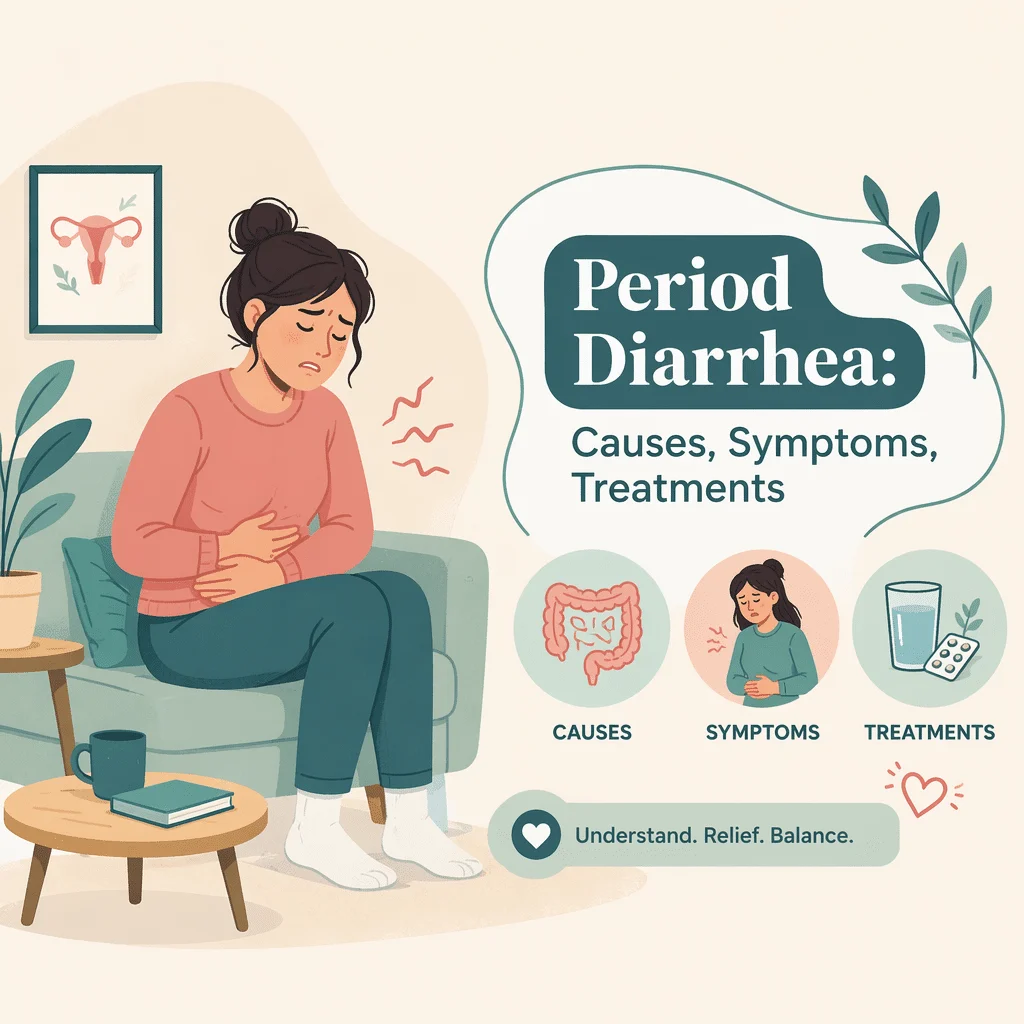
Period diarrhea sends many people to the bathroom far more often during the first day or two of bleeding, and that timing is no coincidence. As the uterine lining breaks down it releases prostaglandins, and those same chemical messengers reach the bowel sitting directly behind the uterus. Transit speeds up, the colon absorbs less water, and stools turn loose just as cramps peak. In this article you will learn why the pattern is so predictable, what separates an ordinary cycle symptom from one that needs attention, which warning signs call for prompt care, and which laboratory tests clinicians reach for when the picture does not add up.
What period diarrhea is and when it usually starts
Period diarrhea means looser, more frequent bowel movements that track the menstrual cycle rather than a meal, a bug, or a travel upset. Stools are soft to watery, come with urgency, and arrive alongside cramping. What makes them recognizable is not their appearance but their schedule.
A narrow and repeatable window
Most people find that period diarrhea begins between the day before bleeding starts and the second day of the period, then fades as the heaviest flow eases. Some notice a shift earlier, when premenstrual constipation gives way abruptly to loose stools. That handover is one of the clearest clues that hormones, rather than something eaten, are driving the change.
The narrowness of the window matters. Diarrhea confined to cycle days one to three behaves very differently from diarrhea that comes and goes all month and merely feels worse during a period. The first reflects normal cycle physiology; the second points to an underlying gut condition that the cycle is amplifying.
How common the symptom is
Digestive symptoms around menstruation are widespread rather than unusual: bloating, nausea, cramping, and changes in bowel habit are reported by a large share of people who menstruate. Mayo Clinic lists loose stools and nausea among the symptoms that commonly accompany menstrual cramps, which places period diarrhea in the category of expected physiology rather than disease.
| Point in the cycle | Common bowel pattern | What usually explains it |
|---|---|---|
| Week after ovulation | Slower transit, firmer stools, bloating | Progesterone relaxes smooth muscle, including the gut wall |
| Last two or three days before bleeding | Constipation easing, first loose movements | Progesterone falls and the brake on the bowel lifts |
| Day one and day two of bleeding | Loose or watery stools, urgency, cramping | Prostaglandin release peaks as the lining sheds |
| Day three onward | Gradual return to a normal pattern | Prostaglandin levels drop as shedding slows |
Why prostaglandins turn a period into loose stools
What the uterine lining releases as it breaks down
The uterine lining thickens through the second half of the cycle. When no pregnancy occurs it breaks down, generating prostaglandins: hormone-like compounds made locally in tissue rather than delivered from a distant gland. Their job is to make the uterine muscle contract so the lining can be expelled, and they also drive local inflammation, which is why cramping and prostaglandin levels rise and fall together. A 2024 review of treatment options for painful periods describes prostaglandins as the central driver of those contractions, which is why anti-inflammatory medicines that block their production work so reliably.
Why the bowel next door reacts
Prostaglandins made in the uterus do not stay there. The rectum and lower colon sit immediately behind it, separated by a thin layer of tissue, and these compounds diffuse into the surrounding area and enter local circulation. Bowel muscle responds to the same signals as uterine muscle: it contracts more forcefully and more often, pushing intestinal contents along faster.
Speed is the whole story. The colon’s main job is to reclaim water from digested material, so when contents move through quickly there is less time for absorption and stools arrive softer. Prostaglandins also prompt the intestinal lining to secrete more fluid into the bowel, compounding the effect. Strong cramps and period diarrhea therefore arrive together, because both come from the same surge.
The progesterone withdrawal effect
A second mechanism runs alongside the first. Progesterone rises after ovulation and relaxes smooth muscle, including the intestinal wall, which is why many people feel constipated and bloated in the week before a period. As progesterone falls sharply just before bleeding begins, that relaxing influence disappears and the bowel returns to baseline just as prostaglandins surge. The swing from a slowed gut to an accelerated one within a couple of days explains the abrupt change many people describe.
What counts as normal and what does not
Ordinary period diarrhea has a recognizable shape, and recognizing it helps you decide whether to manage symptoms at home or raise them at your next appointment.
Features of ordinary cycle-linked diarrhea
Cycle-linked diarrhea starts within a day either side of bleeding, lasts one to three days, and resolves as flow lightens. Between periods, bowel habits return to baseline. Stools are loose but not black, bloody, or greasy. You sleep through the night without being woken by the need to go. Cramping is manageable, and there is no fever, no unexplained weight loss, and no vomiting. To compare forms precisely, see our guide to stool consistency.
Patterns that deserve a closer look
Several patterns suggest something beyond ordinary physiology. Diarrhea that lasts well beyond the end of bleeding, or occurs throughout the month and merely intensifies during a period, points toward a gut condition with a cyclical overlay. Symptoms appearing for the first time after age forty, or clearly worsening over recent cycles, deserve evaluation rather than watchful waiting. So does diarrhea severe enough to keep you home from work.
Research supports this distinction. A 2023 study of just over six hundred young women found digestive symptom scores varied little across cycle phases in otherwise healthy participants, although lower abdominal pain was clearly higher during menstruation. The same measures picked up worse symptoms in participants who already carried a diagnosed gut disorder. A mild, predictable shift is ordinary; symptoms severe enough to dominate your cycle point elsewhere.
Warning signs that call for prompt medical attention
A small set of features should prompt a call to a clinician rather than another cycle of waiting. None are typical of hormone-driven period diarrhea.
- Blood in the stool, or stools that look black and tarry. Menstrual blood on toilet paper is expected; blood mixed into the stool is not.
- Diarrhea that wakes you from sleep. Cycle-related symptoms generally follow your waking day, and night-time diarrhea suggests an inflammatory or infectious cause.
- Unintended weight loss over recent months without a change in diet or activity.
- Fever or chills accompanying the diarrhea.
- Signs of dehydration. The National Institute of Diabetes and Digestive and Kidney Diseases lists extreme thirst, dry mouth, dark urine, and passing urine less often than usual.
- Diarrhea lasting more than two days, whatever the point in your cycle.
- Severe abdominal pain different in character from your usual cramps.
None confirms a serious problem alone, but each moves the situation outside the range hormones explain and warrants a same-week conversation.
Conditions that can sit behind severe or year-round symptoms
When period diarrhea is severe, lasts beyond the period, or occurs all month, several conditions become worth ruling out. Each has a recognized relationship with the menstrual cycle, which is why they are so easily mistaken for ordinary period symptoms.
Endometriosis
Endometriosis occurs when tissue resembling the uterine lining grows outside the uterus, sometimes on or near the bowel. That tissue responds to cycle hormones and inflames the surrounding area, producing cyclical diarrhea, painful bowel movements during a period, and pronounced bloating. A 2023 review of the distension often called endo belly noted that people with endometriosis tolerate stretching of the bowel wall less well, which explains why the bloating feels disproportionate. For the diagnostic pathway, read our full guide to endometriosis.
Irritable bowel syndrome
Irritable bowel syndrome frequently flares in step with the cycle, which makes it easy to misread as a purely menstrual problem. The distinguishing feature is that symptoms exist between periods too, even if milder. A 2023 survey of nearly five thousand young women found moderate and heavy menstrual pain roughly twice as common among those meeting criteria for the condition. If your gut is unsettled most weeks and becomes unbearable during bleeding, review our page on irritable bowel syndrome.
Celiac disease
Celiac disease is an immune reaction to gluten that damages the small intestine lining, causing chronic diarrhea, bloating, fatigue, and poor iron absorption. It is often diagnosed late in women because symptoms get attributed to periods or stress, and because it blocks iron absorption while heavy periods drain iron, the two together produce stubborn anemia. Antibody testing must be done while you are still eating gluten. For the testing sequence, consult our article on celiac disease and gluten intolerance.
Inflammatory bowel disease
Crohn’s disease and ulcerative colitis involve genuine inflammation of the bowel wall rather than altered function. They produce persistent diarrhea, blood in the stool, weight loss, and fatigue, and often worsen premenstrually. To compare symptom profiles, read our overview of Crohn’s disease.
Thyroid disorders
An overactive thyroid speeds up gut transit and causes loose stools, alongside heat intolerance, palpitations, anxiety, and weight loss. An underactive thyroid tends toward constipation but also disrupts cycles and worsens heavy bleeding. Because thyroid disease commonly affects women of reproductive age and changes both bowel habit and cycle, it is checked when both are disturbed. For the marker, see our guide to the TSH blood test.
Laboratory tests that help sort out the cause
There is no single test for period diarrhea itself. Testing exists to confirm or exclude the conditions above, and a clinician chooses based on your pattern rather than ordering everything at once.
| Test | What it looks at | Why it matters here |
|---|---|---|
| Complete blood count | Red cells, white cells, platelets | Detects anemia from heavy bleeding or chronic gut inflammation |
| Ferritin | Stored iron | Falls before anemia appears, so it flags iron loss early |
| TSH | Thyroid function | Screens for thyroid disease affecting both gut and cycle |
| Celiac antibodies | Immune reaction to gluten | Identifies a treatable cause of chronic diarrhea and low iron |
| Fecal calprotectin | Inflammation inside the bowel | Separates inflammatory bowel disease from functional symptoms |
| CRP | Body-wide inflammation | Adds context, though it is not specific to the gut |
How the results fit together
Individual numbers are rarely decisive; the pattern across several markers carries the meaning. Low iron stores alongside a normal blood count suggest iron loss that has not yet produced anemia, a common finding with heavy periods. To see how that marker behaves, read our guide to the ferritin blood test. A normal calprotectin result in someone with cyclical symptoms argues against active bowel inflammation, which is why many clinicians order a fecal calprotectin test.
Conversely, a raised inflammatory marker alongside night-time diarrhea and weight loss shifts the picture considerably. To see how the individual values are read, open our explainer on the complete blood count, then consult our article about the CRP blood test. Where heavy bleeding is part of the picture, read our overview of anemia.
What actually helps during the first days
Because period diarrhea is triggered by a short prostaglandin surge, most useful measures work by blunting that surge or supporting the body through it.
Anti-inflammatory relief, timed well
Nonsteroidal anti-inflammatory drugs reduce prostaglandin production rather than simply masking pain, which is why they often ease cramps and loose stools at once. The 2024 treatment review named them a first-line option for painful periods. Timing matters: starting them as symptoms begin, or shortly before a predictable period, works better than waiting until pain peaks. Anyone with a history of stomach ulcers, kidney disease, or asthma should confirm suitability with a clinician.
Fluids and food
Loose stools lose water and salts, and dehydration deepens fatigue and headache. Drinking steadily through the day helps more than large amounts at once, and an oral rehydration solution is worth considering when episodes are frequent. Plainer, lower-fat meals tend to sit better, while very fatty or heavily spiced food, caffeine, and alcohol aggravate symptoms. Rather than eliminating foods permanently, adjust for the two or three days that matter.
Heat, movement, and tracking
A heating pad on the lower abdomen has reasonable evidence behind it for menstrual pain and costs nothing to try. Regular physical activity across the month is also supported. Logging cycle day, stool consistency, and pain level across three consecutive cycles gives a clinician far more to work with than recollection, and it often shortens the path to the right test.
Latest scientific advances
Research published over the last three years has sharpened the picture of how the cycle and the gut interact. According to PubMed, the following findings are the most relevant for anyone tracking period diarrhea.
Gut symptoms cluster in the second half of the cycle
Researchers analyzed more than thirty-three thousand cycles logged in a tracking app and found digestive symptoms reported far more often in the luteal phase, the stretch between ovulation and bleeding. What this means for you: if your gut feels unsettled in the week or two before bleeding as well as during it, that is a documented pattern rather than something unusual.
Existing gut conditions flare with menstruation
An international survey of over fourteen thousand people with disorders of gut-brain interaction, an umbrella term for conditions such as irritable bowel syndrome where gut and nervous system communicate abnormally without visible damage, found the strongest links to menstruation for irritable bowel syndrome and indigestion. What this means for you: if you already carry one of these diagnoses, expecting a monthly flare is realistic, and planning around it beats treating each episode as new.
Pelvic sensitivity may connect period pain and gut pain
In a study following around one hundred and ninety women for a year, those whose pelvic organs were more sensitive to pressure at the start were more likely to develop new bowel pain. What this means for you: treating severe period pain properly may matter beyond comfort alone, though the finding is preliminary and needs confirmation in larger groups.
Exercise showed measurable effects on period pain
A randomized trial, meaning participants were assigned to groups by chance so the comparison is fair, tested ten weeks of high-intensity interval training in women with painful periods. The exercise group reported less pain and distress, alongside lower levels of the inflammatory compounds behind cramping. Probiotics eased premenstrual distress but did not change pain. What this means for you: consistent exercise between periods is a reasonable addition, while probiotics should not be expected to relieve cramps.
The gut microbiome shifts across the cycle
A 2025 study of sixty-five women examined the gut microbiome, the community of bacteria living in the intestine, at two points in the cycle. Bacterial variety differed by cycle day among those taking oral contraceptives. What this means for you: an early hint at why bloating and gas fluctuate through the month, though the group was small and the findings are exploratory.
Frequently asked questions
How long does period diarrhea usually last?
Most people find it lasts one to three days, beginning around the day before bleeding starts or on the first day, and settling as flow becomes lighter. The timing follows the prostaglandin surge that accompanies the shedding of the uterine lining, and that surge is short-lived. Diarrhea that continues well beyond the end of bleeding, or that persists more than two days at any point, is worth discussing with a clinician rather than attributing to the cycle.
When does period diarrhea typically start?
The most common onset is in the twenty-four hours before bleeding begins or on the first day itself. Some people notice a distinct switch from premenstrual constipation to loose stools over a single day, which reflects progesterone falling away at the same time prostaglandin levels climb. An onset in the middle of the cycle, or one that has no consistent relationship to bleeding at all, suggests a different explanation.
What should I eat when period diarrhea hits?
Simple, lower-fat foods are generally easier to tolerate for the two or three days symptoms last. Plain rice, oats, bananas, toast, potatoes, and cooked vegetables suit most people, and steady fluid intake throughout the day matters more than any specific food. Very fatty or heavily spiced meals, large amounts of caffeine, and alcohol commonly aggravate symptoms. There is no need to restrict your diet for the rest of the month unless a clinician has advised it.
Can period diarrhea cause weight loss?
A temporary drop of one or two pounds around a period usually reflects fluid shifts rather than fat loss, and it typically reverses within days. Sustained weight loss across months, without a change in eating or activity, is a different matter entirely and is not explained by cycle-related diarrhea. That pattern warrants medical evaluation, since it appears in conditions such as inflammatory bowel disease, celiac disease, and an overactive thyroid.
Does hormonal birth control reduce these symptoms?
It can. Methods that thin the uterine lining generally reduce the amount of tissue that breaks down each month, which lowers prostaglandin release and often eases both cramping and loose stools. The effect varies considerably between individuals and between methods, and hormonal contraception has its own considerations, so it is a decision to make with a clinician who knows your history rather than a guaranteed fix.
Is period diarrhea contagious?
No. It results from your own hormonal signals acting on your bowel, not from a virus, bacterium, or parasite, so there is nothing to pass to anyone else. If several people in a household develop diarrhea at the same time, or if it arrives with fever and vomiting, an infection is the more likely explanation and the timing with your period is probably coincidental.
Glossary
| Term | Definition |
|---|---|
| Prostaglandins | Hormone-like compounds made locally in tissue. During a period they make the uterus contract and also speed up the nearby bowel. |
| Luteal phase | The part of the cycle between ovulation and the start of bleeding, when progesterone is high. |
| Progesterone | A cycle hormone that relaxes smooth muscle, including the intestinal wall, which tends to slow digestion. |
| Transit time | How long food takes to travel through the digestive tract. Faster transit leaves less time for water to be absorbed, producing looser stools. |
| Ferritin | A protein that stores iron. Its level in blood reflects iron reserves and falls before anemia becomes visible. |
| TSH | Thyroid stimulating hormone, a blood marker used as the first check of thyroid function. |
| Fecal calprotectin | A protein measured in stool that rises when the bowel wall is genuinely inflamed. |
| Celiac serology | Blood antibody tests that screen for celiac disease. They require you to still be eating gluten. |
| Bristol stool scale | A seven-point chart describing stool form, from hard lumps through to entirely liquid. |
| Disorders of gut-brain interaction | Conditions such as irritable bowel syndrome where gut and nervous system signaling is disturbed without visible damage to the bowel. |
Sources
- Office on Women’s Health, US Department of Health and Human Services — Period problems. womenshealth.gov
- National Institute of Diabetes and Digestive and Kidney Diseases — Symptoms and Causes of Diarrhea. niddk.nih.gov
- National Institute of Diabetes and Digestive and Kidney Diseases — Symptoms and Causes of Irritable Bowel Syndrome. niddk.nih.gov
- Mayo Clinic — Menstrual cramps: symptoms and causes. mayoclinic.org
- Kirsch E, Rahman S, Kerolus K, et al. — Dysmenorrhea, a Narrative Review of Therapeutic Options — Journal of Pain Research, 2024. PubMed
- Hannan K, Li X, Mehta A, et al. — Mood symptoms and gut function across the menstrual cycle in individuals with premenstrual syndrome — Hormones and Behavior, 2024. PubMed
- Sarnoff RP, Hreinsson JP, Kim J, et al. — Sex Differences, Menses-Related Symptoms and Menopause in Disorders of Gut-Brain Interaction — Neurogastroenterology and Motility, 2025. PubMed
- Velho RV, Werner F, Mechsner S — Endo Belly: What Is It and Why Does It Happen? A Narrative Review — Journal of Clinical Medicine, 2023. PubMed
- Furukawa S, Yamamoto Y, Miyake T, et al. — Menstrual Status Is Associated with the Prevalence of Irritable Bowel Syndrome in a Japanese Young Population — Digestive Diseases, 2023. PubMed
- Shlobin AE, Tu FF, Sain CR, et al. — Bladder Pain Sensitivity Is a Potential Risk Factor for Irritable Bowel Syndrome — Digestive Diseases and Sciences, 2023. PubMed
- Mendelson S, Anbukkarasu P, Cassisi JE, Zaman W — Gastrointestinal functioning and menstrual cycle phase in emerging young adult women: a cross-sectional study — BMC Gastroenterology, 2023. PubMed
- Yang MY, Chen HY, Ho CH, Huang WC — Impact of Probiotic Supplementation and High-Intensity Interval Training on Primary Dysmenorrhea — Nutrients, 2025. PubMed
- Terrazas F, Kelley ST, DeMasi T, et al. — Influence of menstrual cycle and oral contraception on taxonomic composition and gas production in the gut microbiome — Journal of Medical Microbiology, 2025. PubMed
Further reading
- Period weight gain: causes and management
- Night sweats before a period: causes and tests
- Frequent urination before a period
- Hip pain during a period: causes and relief
- Female hormone panel: what your results mean
Understand your lab results with AI DiagMe
When digestive symptoms follow your cycle month after month, the answer often lies in a handful of routine results read together rather than one number in isolation. A complete blood count and ferritin show whether heavy bleeding is draining your iron, TSH checks whether the thyroid is driving both bowel and cycle changes, and celiac antibodies look for a treatable cause of long-standing diarrhea. AI DiagMe turns those results into clear, plain-language explanations so you arrive at your appointment knowing what to ask. It helps you understand your results; it does not diagnose, and it does not replace your doctor.
Get your results interpreted in minutes