Urobilinogen in urine is one of the small chemical readings on a urine dipstick, and it is one of the least understood. Unlike almost everything else on that strip, a small amount is normal and expected in healthy people. It is one pad among several on a standard urine panel, and our guide to urinalysis results and how to interpret them covers the rest of the test.
In this article you’ll learn where urobilinogen actually comes from, why a small amount belongs in your urine, what a raised result and an absent result can each point to, why this particular pad is unreliable, and which tests genuinely answer the question. The short version: an isolated abnormal urobilinogen reading, in someone with no symptoms and normal blood tests, very often means nothing at all.
What urobilinogen is and where it comes from
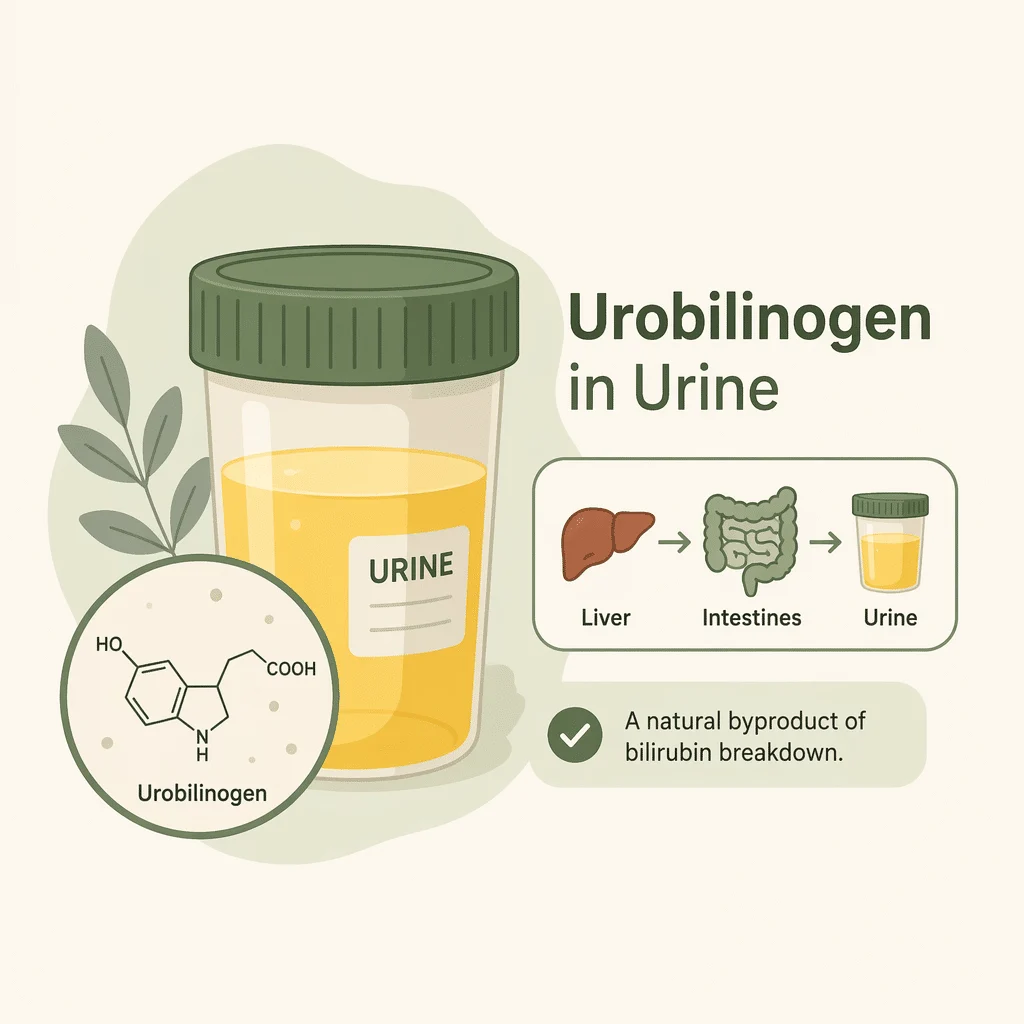
Urobilinogen is not made by your liver or your kidneys. It is made by the bacteria in your gut. Following the chain from start to finish makes the rest of this article much easier to read.
Red blood cells last around four months. When they wear out, your body dismantles them and recovers the iron. What is left of the red pigment inside them becomes bilirubin, a yellow-orange waste pigment.
That bilirubin travels through the blood to the liver. The liver attaches a sugar molecule to it, which makes it water-soluble, and then pushes it out into bile. Bile drains down the bile ducts, past the gallbladder, and into the small intestine.
Once bilirubin reaches the large intestine, gut bacteria go to work on it. They strip the sugar back off and reduce the pigment, and the product of that reaction is urobilinogen. Nothing else in the body makes it.
Why stool is brown and urine is yellow
Most of the urobilinogen made in the gut never leaves the gut. It is converted further into stercobilin and leaves in the stool, and that is what gives normal stool its brown color. This is why the color of your stool matters so much later in this article: when bile stops arriving, the brown pigment stops being made.
A small share of urobilinogen is absorbed back through the gut wall into the bloodstream. Most of that returns to the liver and is sent out in bile again, a loop known as the enterohepatic circulation. A small remainder slips past the liver, reaches the kidneys, and is filtered into the urine. In contact with air and light it oxidizes to urobilin, one of the pigments that gives urine its yellow color.
So a trace of urobilinogen in urine is not a leak or a fault. It is the expected tail end of a long, normal chain, and part of the reason urine has a color at all.
Why a small amount is normal, and how it differs from bilirubin in urine
Most reagent strips report urobilinogen in milligrams per deciliter, using a fixed set of color blocks: typically 0.2, 1, 2, 4 and 8 mg/dL. Many strips label the lowest block “normal” rather than zero, because the chemistry cannot reliably distinguish a healthy trace from nothing at all.
This matters, because a great many people search for what a urobilinogen of 0.2 means. On most strips, 0.2 mg/dL is the normal block. It is the expected result in a healthy person, not a mildly abnormal one. A result of 1.0 mg/dL is still within the range many laboratories treat as normal, and reference ranges differ between strip manufacturers, so the range printed on your own report is the one that applies to you.
The bilirubin pad next to it is the more informative one
Right beside urobilinogen on the same strip sits the bilirubin pad, and the two behave in opposite ways. Bilirubin should not be detectable in urine at all. Any detectable urine bilirubin is abnormal and points towards the liver or bile ducts, which makes it a far more useful finding than an odd urobilinogen reading.
If both pads are flagged, or if bilirubin alone is positive, the follow-up usually runs through blood tests such as total and direct bilirubin rather than through the strip.
What a high urobilinogen result can mean
A raised urobilinogen reading has two plausible mechanisms behind it, plus one very ordinary explanation that has nothing to do with disease.
More bilirubin being produced
If red blood cells are breaking down faster than usual, more bilirubin is made, more of it reaches the gut, more urobilinogen is produced and more shows up in urine. Faster red cell breakdown is called hemolysis. It can be inherited, as in hereditary spherocytosis or G6PD deficiency, or acquired, as when the immune system attacks red cells or a mechanical heart valve damages them.
Hemolysis rarely announces itself through a dipstick alone. It usually comes with symptoms of anemia: tiredness, pallor, breathlessness on exertion, sometimes a yellow tinge to the eyes and darker urine. Red cell size, reported as low MCV or high MCV, is one of the first things a doctor looks at when sorting out why.
A liver that is not clearing what comes back to it
The other mechanism is a liver that cannot re-process the urobilinogen returning to it through the enterohepatic loop. What escapes goes to the kidneys instead. Hepatitis, whether viral, autoimmune or alcohol-related, and cirrhosis can both do this, as can injury from a medicine or a supplement, and so can iron overload in hemochromatosis.
Again, a strip reading is not how any of this gets diagnosed. Liver questions are answered by blood tests such as ALT, AST and the wider liver function panel, and where relevant by hepatitis testing such as anti-HCV and HBs antigen.
A concentrated sample
The most common explanation of all is the least interesting one. A dehydrated, concentrated sample raises the apparent level of almost everything measured on the strip, urobilinogen included. Slow bowel transit can also nudge it up, by giving gut bacteria more time to work. Neither is a disease.
What an absent or low urobilinogen result can mean
Counter-intuitively, the finding that carries more specific information is the low one, because there is really only one way to stop urobilinogen being made.
When bile cannot reach the gut
If bile cannot get from the liver into the intestine, bilirubin never arrives, gut bacteria have nothing to work on, and no urobilinogen is produced. That blockage is called cholestasis or biliary obstruction. It can be caused by a gallstone lodged in the bile duct, by scarring that has narrowed the duct, or by a tumor of the pancreas or bile duct pressing on it.
The picture that goes with it is worth naming plainly, because it is what actually leads to a diagnosis: pale, clay-colored stools together with dark urine and yellowing of the whites of the eyes or the skin. The stool loses its brown pigment because none is being made, and the urine darkens because bilirubin that cannot leave through the gut is leaving through the kidneys instead. If you notice that combination, it needs assessment promptly rather than at your next routine appointment.
Recent antibiotics, and stale samples
There is a much more common and entirely benign reason for a low or absent reading. Broad-spectrum antibiotics reduce the gut bacteria that make urobilinogen in the first place. After a recent course, a low reading is expected and means nothing about your liver.
The other frequent explanation is the sample itself. Urobilinogen breaks down on exposure to light and at room temperature, so a specimen that sat in a warm car or on a windowsill can read low simply because the substance degraded before the strip touched it. This is the one collection detail that genuinely matters for this pad: get the sample to the laboratory quickly and keep it out of direct light.
Why the urobilinogen pad is not a reliable test
This is the part that is usually left out, and it is the most useful thing to know if a single arrow on a report has alarmed you.
The urobilinogen pad has limited sensitivity and limited specificity. It is a color match against printed blocks, not a measurement. It degrades on exposure to light and at room temperature and gives unreliable readings in a sample that has been standing. It is affected by how acidic or alkaline the sample is, which is why urine pH is read alongside it, and nitrite in the sample can suppress the reaction and produce a falsely low result. Visible blood in the specimen interferes badly with several pads on the strip, urobilinogen among them.
Medicines add another layer. Phenazopyridine, used for urinary discomfort, dyes urine a deep orange and can swamp the color reading altogether. Sulfonamide antibiotics and certain other drugs can push the reading falsely high. Strongly colored urine from any cause makes the block harder to read. If you take a medicine that might affect the result, tell whoever ordered the test; do not stop taking it on your own.
Because of all this, several laboratory bodies and method reviewers have questioned whether urobilinogen earns its place on the strip at all, and some laboratories have stopped reporting it. The practical consequence for you is simple: an isolated abnormal urobilinogen, with no symptoms and normal blood tests, very often means nothing.
What your result usually means, and which tests answer the question
The table below sets out the situations that come up most often. It is a guide to proportion, not a diagnosis.
| What the result shows | What it usually means | What to do |
|---|---|---|
| A small amount detected, such as 0.2 mg/dL | The expected normal finding | Nothing. This is what a healthy result looks like |
| Slightly raised, no symptoms, normal blood tests | Most often a concentrated sample or the limits of the pad itself | Mention it at your next appointment; a repeat on a fresh sample usually settles it |
| Raised with tiredness, pallor or breathlessness | Raises the question of faster red cell breakdown | See a doctor. A full blood count and hemolysis markers give the answer |
| Raised in someone with known liver disease | May reflect reduced clearance by the liver | Report it to the team already following you rather than acting on it alone |
| Absent or low with pale stools, dark urine and yellow eyes | Suggests bile is not reaching the gut | Seek medical assessment promptly, without waiting for a routine appointment |
| Absent or low after recent antibiotics, or in a sample that stood around | Common, benign and expected | Say so when the result is reviewed; a repeat on a fresh sample is usually enough |
The tests that actually answer the question
Urobilinogen is not used on its own to diagnose anything. When a liver question is genuinely on the table, the answers come from blood: total and direct bilirubin, ALT, AST, alkaline phosphatase and GGT, read together rather than one at a time.
When the question is faster red cell breakdown, the panel is a full blood count with reticulocytes, LDH and haptoglobin, plus a look at the blood film. Where obstruction is suspected, imaging takes over: an ultrasound of the liver and bile ducts first, then more detailed scanning if needed.
One caution while you wait for answers. Products marketed as liver cleanses or detoxes are dietary supplements, not medicines, and are far less tightly regulated. Some herbal and dietary supplements are themselves a recognized cause of liver injury. If a supplement is on your list, mention it to your doctor rather than adding another one.
When to seek medical care
Most abnormal urobilinogen readings are noise. These are the situations that are not, and none of them should be dismissed on the grounds that the pad is unreliable.
Seek medical care without delay if you have any of the following.
- Yellowing of the whites of the eyes or the skin
- Pale, clay-colored stools together with dark urine
- Severe abdominal pain, especially in the upper right side, with fever
- Vomiting blood, or black tarry stools
- Confusion or unusual drowsiness in someone with known liver disease
- Breathlessness with pallor and dark urine, which can indicate rapid red cell breakdown
Outside those situations, a urobilinogen result that sits outside the reference range still deserves a mention to your doctor, particularly if you feel unwell, if it persists on a repeat sample, or if other markers on the same report are also flagged. Reassurance and dismissal are not the same thing.
Latest scientific advances in urobilinogen testing
Research published since 2023, identified through PubMed, has moved in two directions at once: a much better understanding of how urobilinogen is made, and a sharper look at how the dipstick pad behaves.
Gut bacteria were shown to hold the key enzyme
What was found: researchers described bilirubin reductase, the bacterial enzyme in the gut that converts bilirubin into urobilinogen, and identified which gut species carry it.
What this means for you: it explains at a mechanical level why anything that disturbs your gut bacteria, a recent course of antibiotics above all, can lower your urobilinogen reading with nothing at all wrong with your liver or bile ducts.
The bilirubin route was mapped end to end
What was found: a 2025 review traced bilirubin from red cell breakdown through the liver, into bile, into the intestine and back into the circulation, including the point at which the microbiome converts it to urobilinogen and urobilin.
What this means for you: urobilinogen in urine is the far end of a long chain. Many ordinary things along that chain nudge the reading, which is a large part of why it works poorly as a stand-alone test.
Blood in the sample disrupts the urobilinogen pad
What was found: a laboratory evaluation of a standard ten-parameter strip showed that visibly bloody urine caused profound interference across several pads, urobilinogen included, and that spinning the sample did not remove the problem.
What this means for you: if your sample contained visible blood, including menstrual blood, the urobilinogen result should not be taken at face value. It is worth telling whoever collected it.
Delay changes some parts of a sample more than others
What was found: a small study tested urine repeatedly over six hours at room temperature. Cells and casts changed noticeably over that window, while most chemical pad readings, urobilinogen among them, held steadier than expected.
What this means for you: a short delay is not automatically fatal to the result. Urobilinogen still degrades with longer standing and light exposure, so a fresh sample tested promptly remains the most reliable way to get a reading worth acting on.
Precise measurement is being explored in liver disease
What was found: a metabolomics study comparing blood and urine from people with cirrhosis and healthy volunteers found urobilinogen and urobilin among the small group of substances that differed in both fluids.
What this means for you: urobilinogen does carry real information about liver and bile function. But research measures it with laboratory instruments, not with a color block on a strip. That gap is exactly why a dipstick result is a prompt to look further rather than an answer in itself.
Frequently asked questions
Is urobilinogen in urine normal?
Yes. A small amount of urobilinogen in urine is normal and expected in healthy people, because gut bacteria produce it every day and a fraction of it is reabsorbed and filtered out by the kidneys. This is what separates it from the bilirubin pad next to it, where any detectable result is abnormal. Most strips label their lowest block as normal rather than zero. So seeing a urobilinogen value on your report is not, in itself, a sign that anything is wrong.
What does urobilinogen 0.2 in urine mean?
On most reagent strips, 0.2 mg/dL is the lowest printed block and represents the normal result. It does not mean a small amount has been detected where none should be; it means the reading sits where a healthy reading is expected to sit. Some manufacturers use 1.0 mg/dL as the upper limit of normal instead. Because the blocks and the cut-offs differ between strips, the reference range printed on your own report is the one to compare against, not a figure found online.
What does high urobilinogen in urine mean?
It can mean more bilirubin is being produced, usually because red cells are breaking down faster than usual, or that the liver is not clearing the urobilinogen returning to it. It can also simply reflect a concentrated sample from mild dehydration, or a quirk of the pad itself. On its own, a raised reading diagnoses nothing. What decides whether it matters is the rest of the picture: whether you have symptoms, and what your blood tests show.
Should I worry about a single abnormal urobilinogen reading?
Usually not. The urobilinogen pad has limited sensitivity and specificity, degrades with light and warmth, reacts to sample acidity, and can be thrown off by medicines and by blood in the specimen. An isolated abnormal reading in someone who feels well and has normal blood tests very often reflects the test rather than the person. Mention it to your doctor and ask whether a repeat on a fresh sample is worthwhile, but a single arrow on a report is rarely the start of a serious story.
What does a negative or absent urobilinogen result mean?
Most often it means the sample sat around or was exposed to light, or that you have recently taken broad-spectrum antibiotics that reduced the gut bacteria which make urobilinogen. Both are benign. The finding that matters is an absent result accompanied by pale, clay-colored stools, dark urine and yellowing of the eyes or skin, because that combination suggests bile is not reaching the gut and needs prompt medical assessment.
Can medicines or food change my urobilinogen result?
Yes. Phenazopyridine colors urine deep orange and can make the pad unreadable. Sulfonamide antibiotics and some other drugs can push the reading falsely high, while nitrite in the sample can push it falsely low. Broad-spectrum antibiotics lower it by acting on gut bacteria. Heavy fluid intake dilutes the sample and dehydration concentrates it. Tell whoever ordered the test what you are taking, and never stop a prescribed medicine on your own because of a dipstick result.
Glossary of key terms
| Term | Definition |
|---|---|
| Urobilinogen | A colorless substance made by gut bacteria from bilirubin; a small amount reaches the urine normally |
| Urobilin | What urobilinogen turns into when exposed to air and light; one of the pigments that makes urine yellow |
| Bilirubin | The yellow-orange pigment produced when worn-out red blood cells are broken down |
| Bile | The fluid made by the liver that carries bilirubin and bile salts into the intestine |
| Enterohepatic circulation | The loop in which substances absorbed from the gut return to the liver and are sent out in bile again |
| Hemolysis | Faster than normal breakdown of red blood cells |
| Cholestasis | Reduced or blocked flow of bile from the liver into the intestine |
| Jaundice | Yellowing of the skin and the whites of the eyes caused by a build-up of bilirubin |
| Reagent strip | The plastic dipstick carrying chemical pads that change color when dipped in urine |
Sources
- National Institute of Diabetes and Digestive and Kidney Diseases. Liver Disease.
- National Institute of Diabetes and Digestive and Kidney Diseases. Gallstones.
- MedlinePlus Medical Encyclopedia, National Library of Medicine. Urine – abnormal color.
- LiverTox: Clinical and Research Information on Drug-Induced Liver Injury. National Institute of Diabetes and Digestive and Kidney Diseases, NCBI Bookshelf.
- National Center for Complementary and Integrative Health. Milk Thistle: Usefulness and Safety.
- Vitek L, Tiribelli C. Gut microbiota and bilirubin metabolism: unveiling new pathways in health and disease. Trends in Molecular Medicine, 2025.
- Kipp ZA, Pauss SN, Martinez GJ, Hinds TD, Lee WH. Bilirubin Hepatic and Intestinal Transport and Catabolism: Physiology, Pathophysiology, and Benefits. Antioxidants, 2025.
- Robinson JL, Bharti V. Evaluation of hemoglobin interference thresholds for chemical urinalysis panels. Clinical Biochemistry, 2026.
- Parikh PC, Souza SD, Obeid W. Changes in the composition of urine over six hours using urine dipstick analysis and automated microscopy. BMC Nephrology, 2025.
- Li X, Wang R, Zhou H, Li R, Chang H, Shi S. Serum-urine metabolic integration via UPLC-QTOF/MS uncovers shared pathway biomarkers for cirrhosis diagnosis. Frontiers in Medicine, 2026.
Further reading
- Urinalysis results: interpretation guide
- Direct bilirubin test: understanding your results
- Reticulocytes: the complete guide to your blood test
- Understanding urine crystals: causes and risks
- Urine creatinine levels: guide and interpretation
A urobilinogen reading only makes sense next to the results that surround it: bilirubin, ALT, AST, alkaline phosphatase and a full blood count. AI DiagMe reads your report back to you in plain language and shows how those numbers fit together, so you can arrive at your appointment with better questions. It helps you understand your results; it does not diagnose you, and it does not replace your doctor.
Understand your lab results with AI DiagMe
Get your results interpreted in minutes