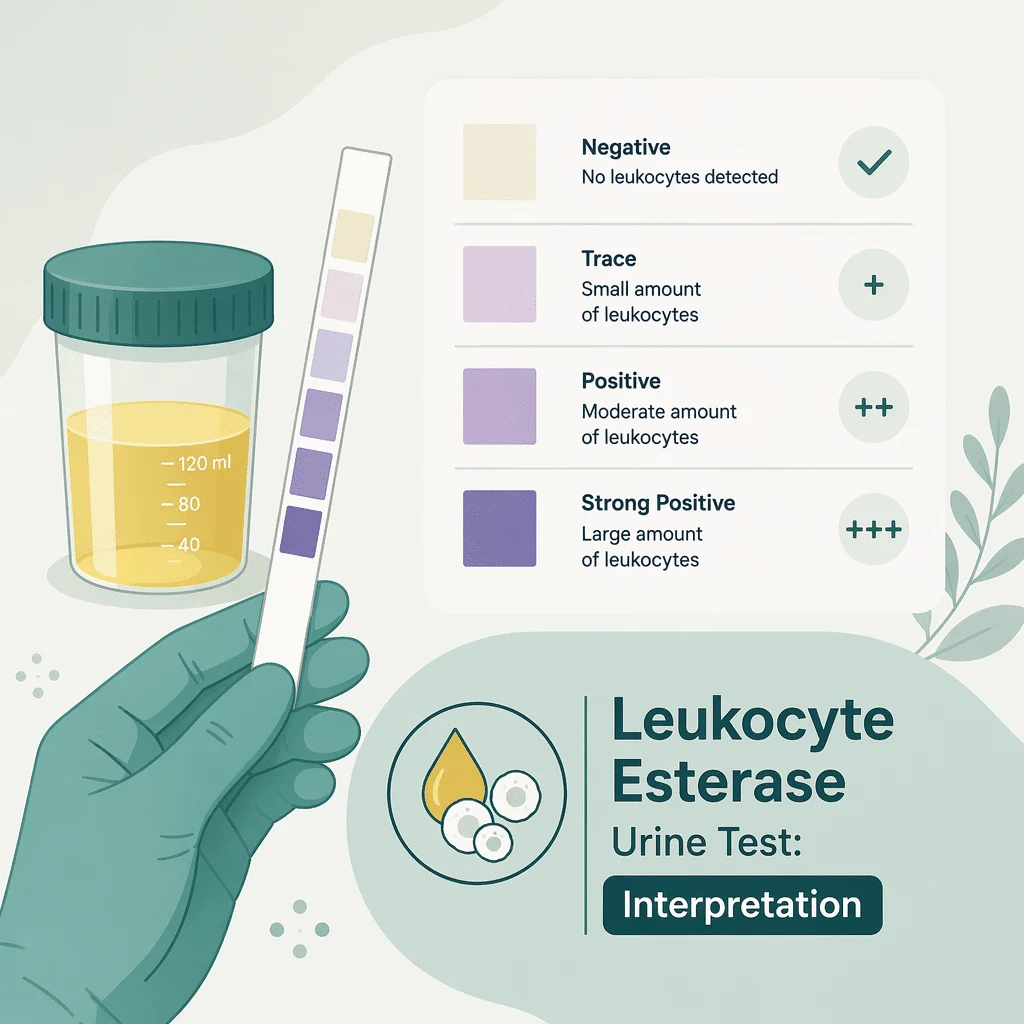
A line on a urine report reading “leukocyte esterase: positive” is one of the most misread results in routine medicine. The pad does not detect bacteria. Leukocyte esterase in urine is an enzyme carried by neutrophils, the white blood cells that arrive first wherever tissue is irritated, so a colour change there means white cells are present and something in the urinary tract is inflamed. It does not name a cause, and by itself it does not say “infection”. In this article you’ll learn what the enzyme is and what the pad can and cannot tell you, how the answer changes once it is read next to nitrite, why your symptoms decide what it means, what makes the pad wrong in both directions, and what sterile pyuria is: white cells in the urine with a culture that grows nothing at all.
What leukocyte esterase is, and what the pad detects
Neutrophils store leukocyte esterase inside their granules. When they break down, which they do readily once they are floating in urine, the enzyme is released. The dipstick pad carries a chemical that this enzyme splits apart, and the product of that reaction turns the pad from cream to purple. The depth of colour is reported as negative, trace, or one to three pluses.
Two consequences follow, and they underpin everything else on this page. The first is that the pad measures an enzyme rather than an intact cell, so it can read positive even when the white cells themselves have fallen apart between the toilet and the laboratory bench. The second matters more: nothing in that chemical reaction involves bacteria at any point.
A positive pad therefore tells you that white cells have passed through the urine. It places inflammation somewhere between the kidney and the opening of the urethra. It does not tell you what caused that inflammation, and it cannot separate an infection from an irritation, a stone, an inflamed kidney, or cells that never came from the urinary tract at all.
Positive is not the same as infected
People are told the urine test came back positive and reasonably hear “you have an infection”. The pad is not capable of that statement. It is screening chemistry: quick, cheap and deliberately sensitive, designed to point at samples worth examining rather than to settle anything. How dilute the sample was shifts the reading too, which is why the concentration of your urine, covered in the guide to specific gravity, changes how every pad on the strip reads.
Reading leukocyte esterase alongside nitrite
The nitrite pad sits beside leukocyte esterase for a reason. Neither is much use alone, and the pair is how the strip is actually read.
Nitrite is not something your body makes. Urine normally contains nitrate from food, and many gram-negative bacteria, Escherichia coli above all, carry an enzyme that converts that nitrate into nitrite. The pad detects the nitrite, so it is an indirect fingerprint of certain bacteria rather than a measure of white cells.
Two conditions have to be met before it turns. The bacteria present must belong to a species that reduces nitrate, and the urine must have sat in the bladder long enough, several hours, for enough nitrite to accumulate. That second condition is why a first-morning sample is more informative than one produced twenty minutes after the last trip to the toilet.
Several organisms that genuinely cause urinary infections make no nitrite at all. Enterococcus species, Staphylococcus saprophyticus, a frequent cause of cystitis in younger women, and Pseudomonas all leave that pad blank. The practical result is that nitrite is a specific test but an insensitive one: a positive nitrite carries real weight, while a negative nitrite proves very little. It follows that leukocyte esterase positive with nitrite negative, much the commonest of the combinations, is far less conclusive than most people assume; the detail behind that second pad sits in the guide to nitrites in urine.
| Result and symptoms | What it usually suggests | Usual next step |
|---|---|---|
| Leukocyte esterase positive, nitrite positive, with burning or urgency | The picture most consistent with a bacterial urinary infection | Clinical assessment; a culture is commonly sent and a decision often made before it returns |
| Leukocyte esterase positive, nitrite negative, with symptoms | Very common and much less specific; fits infection with an organism that makes no nitrite, and equally fits sterile pyuria | Culture is usually the deciding test; testing for a sexually transmitted infection may be considered |
| Leukocyte esterase negative, nitrite positive, no symptoms | Uncommon; often a sample that stood too long, or bacteria present without inflammation | A fresh clean-catch sample rather than action on the first one |
| Leukocyte esterase positive, no urinary symptoms whatsoever | A different situation entirely, and not a diagnosis of infection | Discussion in context rather than a decision based on the pad alone |
| Both pads negative, but clear urinary symptoms | A negative strip does not exclude infection, particularly with vitamin C, very dilute urine or early illness | Be assessed on the symptoms; a culture is still worth sending |
| Either pad positive with fever and pain in the back or side | Possible kidney infection, which behaves differently from a bladder infection | Urgent same-day assessment |
What the neighbouring pads add
The rest of the strip is read in the same breath. A positive blood pad alongside white cells is common in infection but carries its own long list of explanations, set out in the guide to blood in the urine. A trace of protein often accompanies inflammation and rarely means much on its own; glucose in the urine raises questions about blood sugar or a medicine rather than about infection; and ketones usually reflect not eating rather than anything happening in the bladder.
Why your symptoms change what the result means
The pad is a colour. What turns it into information is what you are feeling. Burning or stinging when passing urine, needing to go far more often or more urgently than usual, and a dull ache low in the abdomen are the symptoms that make a positive leukocyte esterase result worth acting on. In someone describing those, the pad supports what the story already suggests, and the next steps follow quickly.
A positive pad in someone with no urinary symptoms at all is a different situation with a different answer, and that case is handled in the guide to reading a full urinalysis report.
The opposite mistake deserves naming just as clearly. If you do have urinary symptoms, a negative or trace strip is not a reason to stay at home. An infection that travels from the bladder up to the kidney, called pyelonephritis, can become serious within a day, and the strip is not sensitive enough to be treated as permission to wait.
Sterile pyuria: white cells with a negative culture
Pyuria means white cells in the urine. Sterile pyuria means they are there, confirmed under the microscope, but the urine culture grew nothing. It is common, badly explained, and the single most useful thing to understand about a stubbornly positive leukocyte esterase pad.
A urine culture is not a general search for life. It is a specific test: a measured drop of urine spread on media chosen to grow the usual urinary bacteria, read after a set time against a threshold count. Anything that grows slowly, needs different conditions, lives inside cells, or has already been knocked back by an antibiotic will simply not appear on the plate.
Causes worth knowing
- A recently or partially treated urinary infection. A day or two of antibiotics can stop bacteria growing on a plate while the inflammation they provoked is still running.
- A sexually transmitted infection, particularly chlamydia and gonorrhoea causing urethritis, meaning inflammation of the urethra. This is the cause most often missed, especially in younger adults, because it produces burning and frequency that feel exactly like cystitis while the culture comes back clean. A urine culture does not detect it; that needs a specific test, usually a nucleic acid amplification test on a urine sample. Our guides to chlamydia and gonorrhoea testing explain what is involved, and testing for one sexually transmitted infection is often offered alongside HIV screening and an RPR test for syphilis.
- Kidney stones. A stone working its way down scrapes the lining and draws white cells with no bacteria involved at all; the wider picture is in the guide to kidney stones.
- Interstitial cystitis, also called bladder pain syndrome, a long-term bladder pain condition that is diagnosed largely by ruling other things out.
- A urinary catheter, or a recent procedure such as a cystoscopy. Instrumentation irritates the lining mechanically, and white cells follow.
- Glomerular disease, meaning inflammation of the filtering units inside the kidney, which usually shows protein or blood on the strip as well.
- Tuberculosis of the urinary tract. This is the classic textbook answer, uncommon in most settings but genuinely real, and it will never grow on a routine culture because it requires its own testing.
- Contamination from the genital area. This is the commonest explanation of the lot: vaginal cells, discharge or skin cells collected with the sample bring white cells that were never in the bladder.
What a negative culture does not mean
It does not mean nothing is wrong, and it does not mean you imagined the symptoms. That reframing matters, because a great many people leave an appointment holding a negative culture and a vague sense of having been disbelieved.
A negative culture removes one explanation from a list of eight. It is genuinely useful information, since it makes ordinary bacterial cystitis unlikely, but on its own it closes nothing. If you have symptoms and white cells with a culture that grew nothing, the productive question is not whether the test was wrong but which of the other causes has been looked for, and in a sexually active adult the possibility of an untested sexually transmitted infection deserves to be raised out loud.
What causes a false positive or a false negative
The biggest false positive by far is contamination. Vaginal cells and discharge carry white cells with them, and a sample collected without discarding the first part of the stream will pick them up. A report showing white cells beside a large number of squamous epithelial cells is usually describing the collection rather than the bladder.
A sample left standing is the other common one. White cells break apart, any bacteria present multiply, and the chemistry drifts. A pot that sat on a counter for several hours describes the pot.
False negatives are discussed less and matter more when you have symptoms. High-dose vitamin C interferes with several dipstick reactions. A high glucose concentration, a high protein concentration and very concentrated urine can each suppress the leukocyte esterase reaction. So can some antibiotics, including nitrofurantoin and the tetracyclines, which is one reason a strip taken after treatment has started is hard to read. Very dilute urine works the other way, thinning a real finding below the threshold. If you take supplements, say so before the sample is collected rather than after the result is discussed.
What confirms the picture: microscopy and urine culture
Two tests do the confirming. Microscopy spins the sample and counts what is actually present: white cells, red cells, bacteria, casts and epithelial cells. It converts an enzyme reading into a cell count and flags contamination in the same glance.
A urine culture identifies the organism and tests which antibiotics it responds to. It takes roughly a day or two, sometimes longer when extra testing is needed. In someone with clear symptoms a decision is often made before the result returns and then revised when it arrives, and that sequence is normal practice rather than a corner cut.
Two points are worth stating plainly. A urine culture will not find chlamydia or gonorrhoea, so if those are possible the test has to be requested by name. And antibiotics left over from a previous course are a bad idea on every count: the wrong drug for the wrong organism, an unknown amount remaining, a culture rendered uninterpretable, and the risk of a reaction such as a penicillin allergy occurring without anyone knowing what was taken.
Cranberry products and D-mannose come up constantly at this point. The evidence that exists concerns preventing repeat infections in particular groups and is modest even there; neither has been shown to treat an infection already under way, and neither changes what your dipstick says.
When to seek care
Most positive leukocyte esterase results are handled at an ordinary appointment. A few should not wait for one.
Red flags: seek urgent medical care
- Fever, chills or shaking together with pain in the back or the side, which can mean a kidney infection
- Vomiting, or being unable to keep fluids down
- New confusion in an older adult who is also unwell
- Blood you can see in the urine
- Pregnancy with any urinary symptom at all
- Being unable to pass urine
- Symptoms that do not settle after a course of treatment
Short of those, burning, urgency or frequency that is not settling on its own is a reason to arrange an appointment rather than to wait it out. Symptoms persisting after treatment are worth reporting too: that is one of the main routes by which sterile pyuria is finally recognised.
Latest scientific advances in urine white cell testing
Recent work has moved away from improving the pad itself and towards a harder question: what should be done when the strip and the culture disagree? Five studies indexed in PubMed map where the field now stands.
A diagnostic accuracy study in Archives of Academic Emergency Medicine compared dipstick pads and a Gram stain against urine culture in adults having urine cultured at a hospital laboratory. What was found: leukocyte esterase on its own missed a meaningful share of confirmed infections and also flagged people who had none, and no single test performed as well as the pads and the Gram stain read together. What this means for you: one pad is not a diagnosis, and the reason your clinician looks at several results at once is that the combination is what carries information.
A four-year prospective study in the Indian Journal of Medical Microbiology screened hospital patients with sterile pyuria, defined as white cells on microscopy with no bacterial growth. What was found: a substantial minority carried an atypical organism that a standard culture cannot grow, with Chlamydia trachomatis the most frequent, and having multiple sexual partners or previous pelvic surgery raised the odds. Genitourinary tuberculosis appeared, but was rare in that population. What this means for you: culture-negative white cells are a prompt to widen the search rather than to close the file.
A fifteen-month service evaluation in Enfermedades Infecciosas y Microbiologia Clinica applied pooled urine PCR screening to samples from people with urinary symptoms, white cells and a negative culture. What was found: about one in ten of those patients had an undiagnosed sexually transmitted infection, most often chlamydia, then Trichomonas vaginalis, Mycoplasma genitalium and gonorrhoea. What this means for you: if you have cystitis-like symptoms and a clean culture, asking whether a sexually transmitted infection has been tested for is a reasonable and clinically sensible question.
A study in World Journal of Urology sequenced the genetic material in urine from patients whose culture had grown nothing, comparing those with and without pyuria. What was found: a range of bacteria and even viruses appeared in culture-negative samples, and particular organisms were associated with the presence of white cells. What this means for you: a negative culture means the routine plate grew nothing, not that your urine was sterile.
Finally, a twelve-month observational study in Topics in Spinal Cord Injury Rehabilitation followed long-term indwelling catheter users who tested their own urine weekly. What was found: positive leukocyte esterase and nitrite results were the norm nearly every week and did not track with how people actually felt, while a negative strip in someone without symptoms was the more informative combination. What this means for you: with a catheter in place, a positive pad on its own says almost nothing, and symptoms carry the weight.
Frequently asked questions
Does leukocyte esterase mean I have a UTI?
Not by itself. The pad detects an enzyme released by white blood cells, so a positive result means white cells are in the urine and something is inflamed. Infection is the most frequent reason, but it is not the only one, and the pad cannot tell them apart. What tips the balance is the rest of the picture: whether you have burning, urgency, frequency or lower abdominal pain, whether the nitrite pad is also positive, and what a culture eventually grows. A positive pad in someone with no urinary symptoms is a different situation entirely. Only a clinician who knows your symptoms can decide what the result should lead to.
What is the difference between leukocyte esterase and white blood cells in urine?
They are two ways of measuring the same thing at different levels of precision. Leukocyte esterase is a chemical screen on the dipstick: it detects an enzyme that white cells release, including when the cells themselves have already fallen apart. The white blood cell count comes from microscopy, where a laboratory scientist looks at the spun sediment and counts intact cells per field of view. The dipstick is faster and cheaper; the microscope is more accurate and reports other useful things at the same time, such as epithelial cells that reveal contamination. Reports often carry both, and they occasionally disagree.
What does a trace of leukocyte esterase in urine mean?
Trace is the weakest colour change the pad registers, and on its own it is a weak signal. In someone with no symptoms it frequently reflects a small amount of contamination, a concentrated sample, or nothing identifiable at all. In someone with clear urinary symptoms the same trace reading can be part of a genuine picture, because the strip is not precise enough to rule anything out. The useful response is not to grade the trace but to look at the rest of the report and at how you feel, and to repeat the test on a properly collected sample if there is any doubt.
What if my urine culture was negative but I still have symptoms?
That combination has a name, sterile pyuria, and it is recognised rather than dismissed. A standard culture is designed to grow common urinary bacteria at a threshold; it will not detect chlamydia or gonorrhoea, it may miss an infection already partly treated, and it says nothing about stones, bladder pain syndrome, catheter irritation or inflammation inside the kidney. A negative culture removes one explanation from a list; it does not mean nothing is wrong and it does not mean you imagined it. If symptoms continue, ask which of the other causes have been considered and whether testing for a sexually transmitted infection is appropriate.
Can vitamin C affect the result?
Yes, and in the direction people least expect. Ascorbic acid interferes with several of the chemical reactions on a dipstick and can push a genuinely positive result down to negative. That is a false negative: it hides findings rather than inventing them. High-dose supplements are the usual culprit, though effervescent tablets and some drinks contain enough to matter. Very concentrated urine, a high glucose level, a high protein level and certain antibiotics can suppress the reaction in the same way. Mention any supplement before you give the sample, so a negative result can be read with that in mind and repeated if needed.
Why does my report say leukocyte esterase is abnormal?
Laboratories flag anything other than negative as abnormal, because negative is the expected result in urine from a healthy urinary tract. The flag is a formatting convention, not a severity grade, and it appears whether the reading is trace or three pluses. It is worth reading alongside the nitrite pad, the microscopy count if one was done, and your symptoms. An abnormal flag with no symptoms and no confirming microscopy is a long way from a diagnosis, while the same flag in someone with burning and fever is a reason to be seen the same day.
Glossary of key terms
| Term | Definition |
|---|---|
| Leukocyte esterase | An enzyme released by white blood cells, detected by a dipstick pad and indicating inflammation in the urinary tract rather than infection specifically |
| Neutrophil | The type of white blood cell that arrives first at inflamed or infected tissue and that carries leukocyte esterase in its granules |
| Pyuria | White blood cells present in the urine, usually confirmed by counting them under a microscope |
| Sterile pyuria | White cells in the urine together with a urine culture that grew no bacteria, which has its own list of possible causes |
| Nitrite | A chemical produced when certain bacteria convert dietary nitrate in urine that has sat in the bladder for several hours |
| Urine culture | A laboratory test that grows bacteria from a urine sample to identify the organism and test which antibiotics it responds to |
| Urethritis | Inflammation of the urethra, the tube carrying urine out of the body, often caused by a sexually transmitted infection |
| Nucleic acid amplification test | A test that detects the genetic material of an organism such as chlamydia, which a routine urine culture cannot grow |
| Clean-catch midstream sample | A collection method in which the first part of the stream is passed into the toilet to reduce contamination from skin and genital cells |
| Pyelonephritis | Infection that has reached the kidney, typically causing fever and pain in the back or side, and needing prompt assessment |
Sources
- Centers for Disease Control and Prevention. About Chlamydia
- National Institute of Diabetes and Digestive and Kidney Diseases. Bladder Infection (Urinary Tract Infection) in Adults
- National Institute of Diabetes and Digestive and Kidney Diseases. Diagnosis of Interstitial Cystitis
- MedlinePlus, US National Library of Medicine. Urinary tract infection in adults
- Solorzano C, Camila Rubio M, Licht-Ardila M, et al. Performance of Gram Stain, Leukocyte Esterase, and Nitrite in Predicting the Presence of Urinary Tract Infections: A Diagnostic Accuracy Study. Archives of Academic Emergency Medicine. 2025. Indexed in PubMed. https://doi.org/10.22037/aaemj.v13i1.2619
- Aggarwal A, Biswal D, Rawre J, et al. Prevalence of Chlamydia trachomatis, Ureaplasma spp., Mycoplasma hominis and Mycoplasma genitalium in patients with sterile pyuria. Indian Journal of Medical Microbiology. 2025. Indexed in PubMed. https://doi.org/10.1016/j.ijmmb.2025.101030
- Gil P, Villarruel K, Guillem J, et al. Detection of undiagnosed STIs in patients with suspected UTI using pooled urine PCR screening. Enfermedades Infecciosas y Microbiologia Clinica (English Edition). 2026. Indexed in PubMed. https://doi.org/10.1016/j.eimce.2026.503161
- Li J, et al. The role of urine microbiota in culture-negative patients with pyuria. World Journal of Urology. 2025. Indexed in PubMed. https://doi.org/10.1007/s00345-025-05620-6
- Rounds AK, Tractenberg RE, Groah SL, et al. Urinary Symptoms Are Unrelated to Leukocyte Esterase and Nitrite Among Indwelling Catheter Users. Topics in Spinal Cord Injury Rehabilitation. 2023. Indexed in PubMed. https://doi.org/10.46292/sci22-00095
Further reading
- Urine crystals: causes and risks
- Normal urine pH levels and what changes them
- High CRP levels: causes, symptoms and treatments
- High lymphocytes: causes, symptoms and treatments
- Urinary tract infection: symptoms, causes and testing
A urinalysis report puts leukocyte esterase, nitrite and half a dozen other markers on one line each, without the context that decides what any of them mean. AI DiagMe reads your report back to you in plain language, including how a leukocyte esterase result sits alongside nitrite and what a urine culture can and cannot add. It helps you understand what you are looking at and what to ask. It does not diagnose infection and it does not replace your doctor.
Understand your lab results with AI DiagMe
Get your results interpreted in minutes