



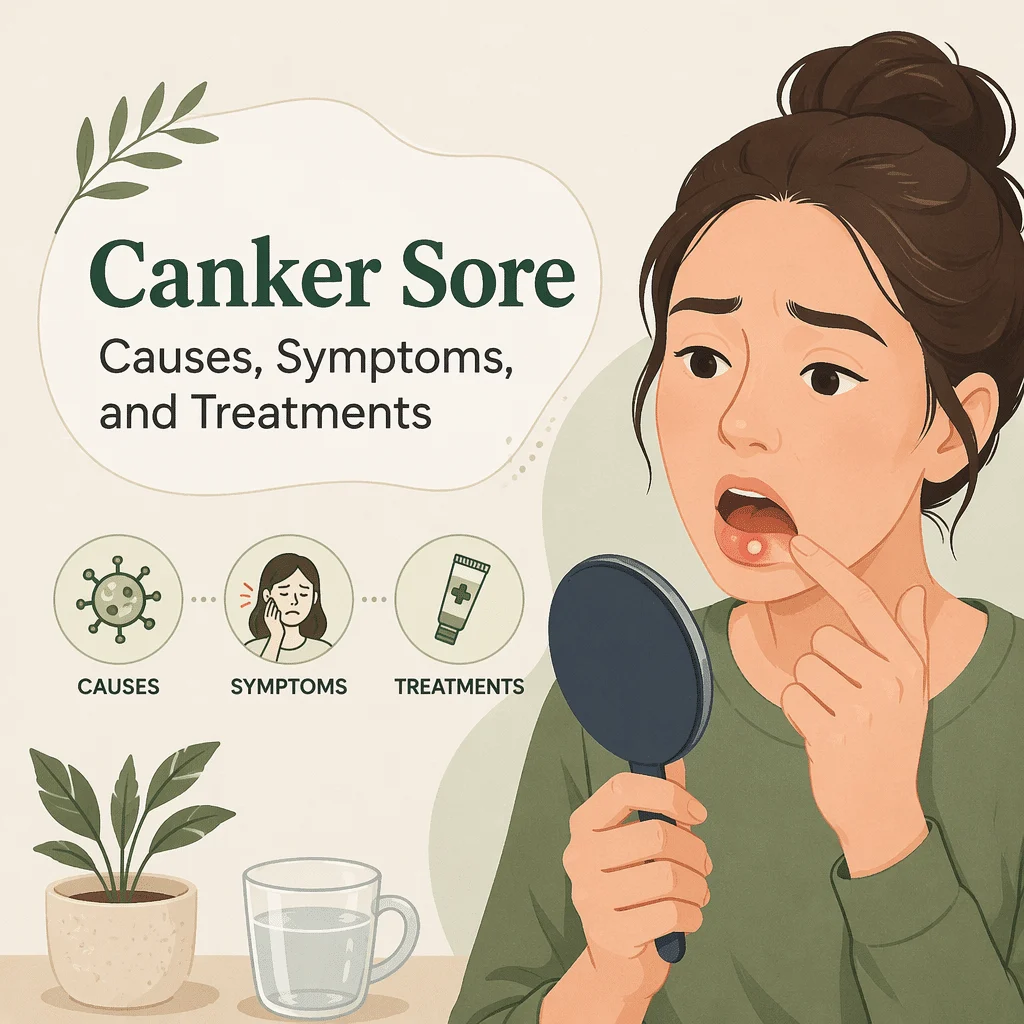
Canker sore causes are rarely a single thing. Most of these small mouth ulcers follow a pile-up of triggers that happen to line up at the same time: a bitten cheek, a stressful month, a shortfall in iron or vitamin B12. That is why one person gets a sore twice a year and someone else gets a fresh crop every few weeks.
In this article you will learn what a canker sore actually is, how to tell it apart from a cold sore, and which triggers carry the most weight. It also covers the three forms these ulcers take, the blood tests that matter when sores keep returning, the relief measures backed by evidence, and the warning signs worth an appointment.
What a canker sore is, and what it is not
A canker sore is a shallow open ulcer on the soft lining of the mouth. Doctors call it an aphthous ulcer, and the pattern of repeat episodes is recurrent aphthous stomatitis. These sores settle on tissue that moves and stretches: the inside of the lips and cheeks, the floor of the mouth, the sides of the tongue, and the soft palate. A typical sore is round or oval and hurts far more than its size suggests.
The single most useful fact is that a canker sore is not contagious. That separates it from a cold sore, which comes from herpes simplex virus type 1 and does spread through direct contact. The National Institute of Dental and Craniofacial Research notes that location alone settles the question most of the time: cold sores form outside the mouth around the lip border, while canker sores stay on the moist tissue inside.
| Feature | Canker sore (aphthous ulcer) | Cold sore (herpes labialis) |
|---|---|---|
| Where it appears | Inside the mouth: cheeks, lips, tongue, floor of mouth, soft palate | Outside the mouth: lip border, skin around the lips, sometimes the nostril |
| What it looks like | A single flat ulcer with a white or gray center and a red rim | A cluster of small fluid-filled blisters that later crust over |
| Cause | A local immune reaction, often on top of injury, stress or a nutrient shortfall | Herpes simplex virus type 1, reactivating after a first infection |
| Contagious | No | Yes, through direct contact and shared items |
| Warning sign before it appears | A day of burning or prickling at one spot | Tingling and itching on the lip |
| Usual healing time | One to two weeks for the common form | Seven to ten days |
| First-line care | Numbing gels, protective pastes, topical corticosteroids | Antiviral cream or tablets, started as early as possible |
Getting this right changes what you do next. A canker sore needs pain control, protection of the raw surface, and, if sores keep returning, a look at what feeds them.
Canker sore causes, trigger by trigger
No single mechanism explains every ulcer. The working model: a susceptible mouth lining meets a local insult, the immune system overreacts briefly, and the surface breaks down. What differs between people is how low that threshold sits, and several everyday factors push it lower.
Physical injury and toothpaste
Minor trauma is the most common starting point. Biting a cheek, scraping the gum with a hard toothbrush, catching the tongue on a chipped filling or an hour in a dental chair all qualify, and braces rub the same spot repeatedly. Sodium lauryl sulfate, the foaming agent in many toothpastes, is a recurring suspect because it strips the protective mucin layer from the mouth lining; switching to a formula without it is a cheap experiment.
Foods and drinks
Acidic and abrasive foods rarely create an ulcer out of nothing, but they reliably light one up and may tip a fragile spot over the edge. The usual list includes citrus fruit and juice, tomatoes, pineapple, vinegar, salty crackers, crusty bread, nuts, chocolate, coffee and spicy dishes. A few people react to a specific protein rather than to acidity, so a two-week food and ulcer diary beats guessing.
Stress, sleep and hormones
Poor sleep, exam weeks and emotionally demanding stretches show up in many ulcer diaries. Stress does not create an ulcer directly; it shifts immune signaling and increases unconscious cheek biting, so the local insult and the lowered threshold arrive together. Hormonal shifts across the menstrual cycle follow similar logic, and some women can predict a sore to within a few days.
Nutrient shortfalls
This is where a mouth ulcer stops being purely local. Low iron stores, low vitamin B12 and low folate all slow the turnover of the fast-dividing cells that line the mouth, and a lining that renews slowly breaks down more easily. A 2024 review in JAMA reported that people with recurrent aphthous stomatitis are markedly more likely to be low in B12, folic acid or ferritin, the protein that reflects iron stores. That does not mean supplements help everyone; it means a blood test is worth having first.
Family history and immune signals
Recurrent mouth ulcers cluster in families, and having one or both parents affected raises the odds noticeably. Researchers have also linked variations in inflammatory signaling genes to higher risk. None of this is testable in routine practice, but it explains why two people with identical habits can have very different experiences.
Minor, major and herpetiform: the three shapes canker sores take
Sorting an ulcer into one of three forms is the first thing a specialist does, because the form predicts healing time and how hard the workup should push.
| Form | What it looks like | Usual healing | What it means for you |
|---|---|---|---|
| Minor | One to five oval ulcers, each under about a third of an inch | One to two weeks, no scar | Around eight in ten cases; comfort care is usually enough |
| Major | Larger, deeper ulcers with irregular edges, often on the lip or soft palate | Up to six weeks, may scar | Deserves medical review, prescription treatment and a search for an underlying cause |
| Herpetiform | Dozens of pinpoint ulcers in clusters that can merge into one raw patch | One to two weeks, usually no scar | Despite the name, no herpes virus is involved; often needs prescription rinses |
Herpetiform means “resembling herpes” and refers only to the clustered appearance. These ulcers are still aphthous ulcers, still not contagious, and still confined to the mouth.
When recurrent canker sores signal something systemic
Most people with occasional ulcers have nothing else going on. The picture changes when sores are frequent, large, slow to heal or joined by symptoms elsewhere.
Celiac disease is the clearest example. A 2025 scoping review pooling more than 26,000 people with celiac disease found recurrent aphthous stomatitis among its most consistently reported oral features, alongside enamel defects and a sore, smooth tongue. The JAMA review put the link in plain terms: mouth ulcers are roughly three times more common in people with celiac disease. We detail celiac disease and gluten intolerance separately, including why antibody testing has to happen before you remove gluten from your diet.
Inflammatory bowel disease, mainly Crohn disease and ulcerative colitis, does the same. Persistent mouth ulcers alongside abdominal pain, chronic diarrhea, blood in the stool or unexplained weight loss belong in a doctor’s hands, not a pharmacy aisle. Iron, B12 and folate absorption all suffer in active bowel disease, linking this cause back to the nutrient pathway above.
Behçet disease is rarer but important. It is an inflammatory blood-vessel disorder in which recurrent mouth ulcers are the near-universal first sign, appearing at least three times in a year and joined over time by genital ulcers, skin lesions and eye inflammation. A 2024 clinical review describes it as a diagnosis made by recognizing that combination rather than by any single test, so relentless ulcers plus eye pain or genital sores need an evaluation, not reassurance.
Finally, a weakened immune system, from HIV infection, chemotherapy or long-term immune-suppressing medication, produces ulcers that behave differently: larger, more numerous and slower to close. We outline common autoimmune disease symptoms for readers checking whether a pattern fits.
The blood tests doctors order for recurrent canker sores
A single ulcer needs no laboratory work. A repeating pattern often does, and this is one of the few situations where a short blood panel changes management. Most clinicians test when sores return more than three or four times a year, last longer than two weeks, are unusually large, or come with symptoms pointing to the gut or immune system.
Iron status comes first, and ferritin is the marker that matters, because iron stores fall long before hemoglobin does. That is why someone can have a normal blood count and still be running the mouth lining on empty. Our guide explains the full iron studies panel, and a companion article covers low ferritin causes and symptoms.
Vitamin B12 and folate come next, both common shortfalls and both straightforward to correct. We break down the vitamin B12 blood test and its results and explain the folic acid blood test, including when a borderline B12 number needs a second marker. If either is low, symptoms often extend beyond the mouth, and we describe low vitamin B12 symptoms and treatments separately.
A complete blood count sits alongside these. It shows whether red cells are small, pointing toward iron, or unusually large, pointing toward B12 or folate, and it flags white cell abnormalities that would redirect the workup entirely. Our article explains the complete blood count, and a related piece covers anemia symptoms, causes and tests.
Celiac serology, usually the tissue transglutaminase IgA antibody with a total IgA level, is standard when ulcers recur, especially alongside digestive symptoms or unexplained anemia. Depending on the picture, a doctor may add zinc or vitamin D. We explain the zinc blood test and cover the vitamin D 25-OH blood test. None of these tests diagnoses a canker sore; they explain why the sores keep arriving.
Relief that has evidence behind it
Nothing on the shelf makes an ulcer vanish overnight. Good treatment shortens the painful phase and protects the raw surface while the body closes it.
Topical corticosteroids are the first-line prescription option in most guidance, including the 2024 JAMA review, because they calm the local inflammation that keeps the ulcer open. They come as pastes, gels and rinses, and work best applied at the first burning sensation rather than on day four. Over-the-counter benzocaine gels buy an hour of comfort before meals but do not speed healing.
Barrier products are underrated. A 2023 systematic review of aphthous ulcer treatments found that adhesive films and gels covering the ulcer produced some of the clearest pain reductions in the trials it examined, simply by keeping food, acid and the tongue off the exposed surface. Low-level laser treatment offered by some dental practices also reduced pain quickly in small trials, though availability and cost limit it.
Practical measures do more than their simplicity suggests. Warm salt-water rinses keep the area clean, a soft toothbrush and a toothpaste without sodium lauryl sulfate reduce fresh injury, and cool, bland foods with a straw for acidic drinks shorten the misery. Supplements deserve one rule: take them when a blood test shows a shortfall, not on the theory that they might help. Correcting a genuine deficiency can reduce how often sores return; taking iron you do not need is not harmless.
When to see a doctor about a mouth ulcer
Ordinary canker sores do not need an appointment. These situations do, and the first is the most important.
- Any mouth ulcer that has not healed after three weeks needs to be examined, whatever it looks like. A single non-healing ulcer, particularly on the side of the tongue or the floor of the mouth, is the classic presentation of oral cancer, and delay is what worsens the outcome.
- Sores that keep returning more than three or four times a year, or that never fully clear between episodes.
- Unusually large or deep ulcers, or ulcers that leave scars.
- Pain that stops you eating or drinking normally, or that over-the-counter products no longer touch.
- Fever, swollen neck glands or a general feeling of illness alongside the sores.
- Mouth ulcers plus symptoms elsewhere: genital sores, painful red eyes, joint pain, a rash, chronic diarrhea, blood in the stool or unexplained weight loss.
- Sores that started after a new medication, or in anyone taking immune-suppressing treatment or chemotherapy.
At the visit, expect a look inside the mouth, questions about how often sores appear and how long each lasts, and a review of medication and diet. Blood tests follow if the pattern justifies them. A biopsy, a small tissue sample taken under local anesthetic, is reserved for ulcers that fail to heal or look atypical.
Latest scientific advances
Research since 2023 has sharpened the picture. Everything below is observational or early-stage work, so read it as direction of travel rather than settled fact.
The nutrient link is now better quantified. A 2024 meta-analysis pooling blood results from people with recurrent mouth ulcers and healthy comparison groups found vitamin B12 and hemoglobin consistently lower in those with ulcers: roughly three times the risk with low B12, and about two and a half times with low ferritin. A separate 2024 meta-analysis on iron and zinc agreed for both minerals. What this means for you: if your sores keep coming back, asking about ferritin, B12 and folate is an evidence-backed request.
Vitamin D has moved from a fringe idea to a plausible contributor. A 2023 meta-analysis, which also checked whether enough people had been studied to trust the finding, reported clearly lower vitamin D levels in people with recurrent ulcers, and a second review that year agreed. What this means for you: worth measuring if you have other reasons to suspect low vitamin D, but no trial has shown that taking it prevents ulcers when levels are already normal.
The oral microbiome, the community of bacteria that lives in the mouth, is the newest thread. A 2025 meta-analysis found that saliva from people with recurrent ulcers held a less varied bacterial community than saliva from people without them. What this means for you: nothing actionable yet, and no probiotic is proven to change the pattern, but it may eventually explain why some people are susceptible.
A stomach bacterium has also drawn attention. A 2023 meta-analysis of fifteen studies found Helicobacter pylori infection somewhat more common in people with recurrent mouth ulcers, though the size of the link shifted with the detection method used. What this means for you: if you have persistent ulcers and ongoing stomach symptoms such as burning pain or reflux, mention them together at your appointment.
Treatment research has been more mixed. A 2024 meta-analysis of trials of thalidomide, an immune-modulating drug, showed real benefit for severe cases but a clear increase in side effects. What this means for you: it is a specialist option for major ulcers that resist everything else, not a treatment for ordinary canker sores, and it is unsuitable in pregnancy.
Frequently asked questions
How do I get rid of a canker sore in 24 hours?
You cannot make one disappear in a day, and any product claiming otherwise is marketing rather than medicine. What you can do in 24 hours is make it hurt much less. A topical corticosteroid paste applied at the first tingle, a protective adhesive gel over the ulcer, warm salt-water rinses, and a break from acidic and salty foods will usually take the edge off within a few hours. A minor canker sore then closes over one to two weeks on its own. If a sore is still painful after two weeks, that is the point to have it looked at rather than to keep trying new products.
Are canker sores contagious?
No. Canker sores are not caused by an infection you can pass on, so kissing, sharing a glass or using the same cutlery carries no risk. This is the clearest difference from cold sores, which are caused by herpes simplex virus type 1 and do spread through direct contact. If several people in a household develop mouth sores at the same time, that pattern points toward a viral cause or a shared trigger, and it is worth a medical opinion.
What is the white stuff in a canker sore?
The white or grayish film in the middle of the ulcer is fibrin, a protein the body lays down over any open wound, mixed with dead surface cells and immune cells. It is a normal part of healing, not pus and not an infection. It should not be scraped or picked off, because the layer underneath is raw and removing it restarts the pain. As the ulcer heals, the film gradually thins and the red rim fades.
Can canker sores be a sign of a vitamin deficiency?
They can be, and repeated sores are one of the recognized reasons to check. Low iron stores, vitamin B12 and folate are the three that come up most often, and low zinc and vitamin D appear in the research as well. A single sore after biting your cheek means nothing nutritional. Several episodes a year, or ulcers that heal slowly, justify a blood test. Supplements are only useful when a result is genuinely low, so testing before treating avoids both wasted money and unnecessary iron.
Why do I get canker sores on my tongue and gums specifically?
Aphthous ulcers form on loose, moving tissue rather than on tissue bound tightly to bone. The underside and sides of the tongue and the gum area near the lip qualify, which is why sores land there repeatedly. These spots also take the most mechanical punishment from teeth, brushing and food. A sore that appears in exactly the same place each time is worth showing to a dentist, because a sharp tooth edge, a rough filling or an ill-fitting appliance is often the culprit.
Do canker sores get worse with stress?
Many people notice a clear link, and it holds up in patient studies. Stress does not open an ulcer by itself; it appears to alter immune signaling while also increasing cheek biting, clenching and disturbed sleep, so the trigger and the vulnerability arrive together. Regular sleep, physical activity and any reliable relaxation routine will not make a current sore vanish, but people who manage stressful periods better often report fewer episodes over a year.
Glossary
| Term | Definition |
|---|---|
| Aphthous ulcer | The medical name for a canker sore: a shallow break in the lining of the mouth that is not caused by an infection. |
| Recurrent aphthous stomatitis | The pattern of canker sores returning again and again. Stomatitis simply means inflammation of the mouth. |
| Ferritin | A protein that stores iron. A blood ferritin test shows how much iron the body has in reserve, and it drops before anemia appears. |
| Folate | Vitamin B9, needed to build new cells. The supplement form is called folic acid. |
| Celiac serology | Blood tests that look for antibodies produced when someone with celiac disease eats gluten. Tissue transglutaminase IgA is the main one. |
| Complete blood count (CBC) | A standard blood test that counts red cells, white cells and platelets and describes their size and shape. |
| Herpes simplex virus type 1 (HSV-1) | The virus responsible for cold sores on and around the lips. It has no role in canker sores. |
| Topical corticosteroid | An anti-inflammatory medicine applied directly to the ulcer as a paste, gel or rinse rather than swallowed. |
| Sodium lauryl sulfate (SLS) | A foaming detergent used in many toothpastes. It can dry the protective layer of the mouth lining in sensitive people. |
| Biopsy | Removal of a small piece of tissue under local anesthetic so it can be examined under a microscope. |
Sources
- National Institute of Dental and Craniofacial Research (NIH) — Fever Blisters and Canker Sores. nidcr.nih.gov
- MedlinePlus, U.S. National Library of Medicine — Canker Sores. medlineplus.gov
- Mayo Clinic — Canker sore: symptoms and causes. mayoclinic.org
- National Institute of Arthritis and Musculoskeletal and Skin Diseases (NIH) — Behçet’s Disease. niams.nih.gov
- Stoopler ET, Villa A, Bindakhil M, Ojeda Díaz DL, Sollecito TP — Common Oral Conditions: A Review — JAMA, 2024. PubMed
- Mousavi T, Jalali H, Moosazadeh M — Hematological parameters in patients with recurrent aphthous stomatitis: a systematic review and meta-analysis — BMC Oral Health, 2024. PubMed
- Torabinia N, Asadi S, Tarrahi MJ — The relationship between iron and zinc deficiency and aphthous stomatitis: a systematic review and meta-analysis — Advances in Biomedical Research, 2024. PubMed
- Al-Maweri SA, Al-Qadhi G, Halboub E, Alaizari N, Almeslet A, Ali K, Osman SAA — Vitamin D deficiency and risk of recurrent aphthous stomatitis: updated meta-analysis with trial sequential analysis — Frontiers in Nutrition, 2023. PubMed
- Safari-Faramani R, Salehi M, Ghambari Haji Shore S, Omidpanah N — Serum level of vitamin D in patients with recurrent aphthous stomatitis: a systematic review and meta-analysis of case control studies — Clinical and Experimental Dental Research, 2023. PubMed
- Martín-Masot R, Ramos-García P, Torcuato-Rubio E, Pérez-Gaspar MI, Navas-López VM, González-Moles MÁ, Nestares T — State of knowledge of the relationship between celiac disease and oral pathology: a scoping review — Medicina Oral Patología Oral y Cirugía Bucal, 2025. PubMed
- Parra-Moreno FJ, Egido-Moreno S, Schemel-Suárez M, González-Navarro B, Estrugo-Devesa A, López-López J — Treatment of recurrent aphthous stomatitis: a systematic review — Medicina Oral Patología Oral y Cirugía Bucal, 2023. PubMed
- Zhao L, Xie H, Kang L, Liao G — Association between recurrent aphthous ulcers and oral biodiversity: a systematic review and meta-analysis — Journal of Evidence-Based Medicine, 2025. PubMed
- Shen J, Ye Z, Xie H, Ling D, Wu Y, Chen Y — The relationship between Helicobacter pylori infection and recurrent aphthous stomatitis: a systematic review and meta-analysis — Clinical Oral Investigations, 2023. PubMed
- Jian Y, Wang F, Zhao M, Han X, Wang X — Efficacy and safety of thalidomide for recurrent aphthous stomatitis: a systematic review and meta-analysis of randomized controlled trials — BMC Oral Health, 2024. PubMed
- Lavalle S, Caruso S, Foti R, Gagliano C, Cocuzza S, La Via L, Parisi FM, Calvo-Henriquez C, Maniaci A — Behçet’s disease, pathogenesis, clinical features, and treatment approaches: a comprehensive review — Medicina (Kaunas), 2024. PubMed
Further reading
- Folate deficiency symptoms, causes and treatments
- Vitamin and nutritional panel: vitamin D, B12 and folate
- Autoimmune panel: ANA, rheumatoid factor and anti-CCP
- Black spot on tongue: causes, symptoms and treatments
- HPV on the tongue: symptoms, risks and treatments
Understand your lab results with AI DiagMe
When canker sores keep coming back, the answer is often sitting in a blood test rather than in the medicine cabinet. Ferritin, vitamin B12, folate and celiac antibody results are the ones that most often explain a stubborn pattern, and they are also the ones patients find hardest to read on a laboratory printout. AI DiagMe turns those numbers into clear language so you can see what is low, what is normal and what deserves a question at your next appointment. It helps you understand your results; it does not diagnose you and it does not replace your doctor.
Get your results interpreted in minutes