



If you are holding a biopsy report that reads spongiotic dermatitis, start here: those two words do not name a disease. They describe a pattern — what your skin looked like when a pathologist put a slice of it under a microscope.
The second point is worth saying plainly, because it is what most people came to find out. Spongiotic dermatitis is not cancer. It is not precancerous, and it does not turn into cancer. It is a pattern of inflammation, and it is the microscopic signature of eczema.
In this article you’ll learn what spongiosis actually is, why a pathologist describes a pattern instead of naming a condition, which skin problems produce that pattern, how to translate the other words printed next to it, and what usually happens next — including the one test that is most often skipped.
What the pathologist actually saw
The outer layer of your skin, the epidermis, is built from cells called keratinocytes packed tightly together like bricks in a wall. In healthy skin they sit shoulder to shoulder.
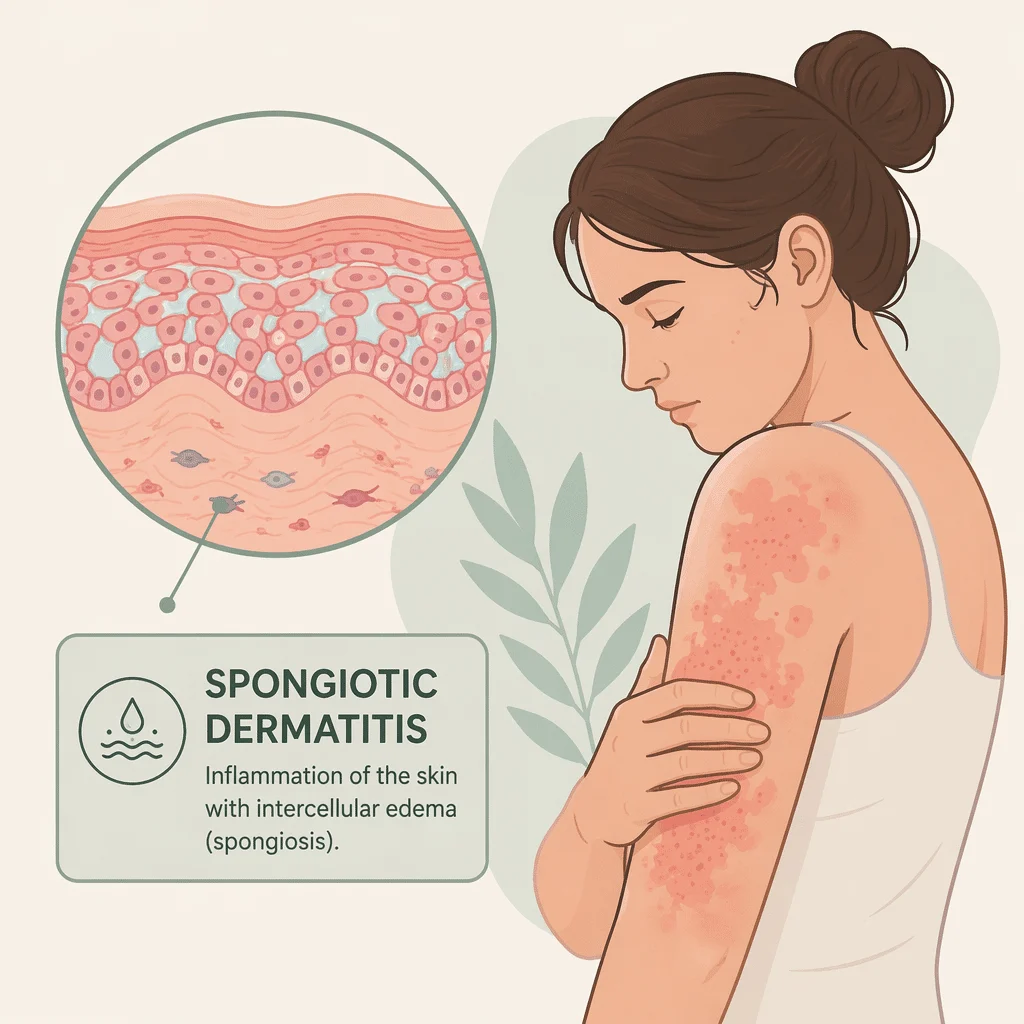
When that skin becomes inflamed in a particular way, fluid seeps between those cells and pushes them apart. Under the microscope the tight wall opens out into something that looks like a kitchen sponge, with clear spaces where fluid has gathered. That appearance is spongiosis, and it is where the word spongiotic comes from.
If enough fluid collects, the spaces join up and form tiny blisters inside the epidermis. That is why very active eczema weeps, and why some rashes show pinpoint blisters visible to the naked eye.
Spongiosis is the defining microscopic feature of eczematous inflammation. So when a report says spongiotic dermatitis, the pathologist is essentially saying: the pattern in this sample looks like eczema.
Why a pathologist describes rather than diagnoses
A pathologist usually receives a punch of skin a few millimeters across, in a pot of fixative, with a one-line clinical note. They can describe that fragment with great precision. What they cannot see is your job, your soap, or the six weeks the rash has been sitting there.
What spongiotic dermatitis does not mean
It does not mean cancer. Spongiosis is fluid between ordinary cells, not abnormal cells multiplying out of control. The US National Cancer Institute defines cancer as a disease in which cells grow uncontrollably and invade surrounding tissue. Inflammation does neither of those things.
It is not precancerous either. Precancerous change has its own vocabulary on a pathology report — words such as dysplasia or carcinoma in situ — and spongiotic dermatitis is not among them. Long-standing eczema does not convert into skin cancer.
There is one honest caveat. A biopsy is sometimes taken precisely to rule something out. If your doctor sampled the skin because a patch looked unusual, or because a rash had refused to settle, a spongiotic result is genuinely reassuring about the possibilities they had in mind. It is still not a reason to cancel the follow-up appointment.
A biopsy also has limits. It can confirm that a process is inflammatory rather than malignant or infectious. It usually cannot tell you which inflammatory condition you have, and it cannot tell you what set it off. Your report should always be interpreted by the doctor who requested it, alongside everything else they know about you.
Why your report doesn’t name a disease
Doctors call the missing step clinicopathological correlation. It is a long phrase for a simple idea: the microscope finding and the clinical picture have to be laid side by side before anything can be given a name.
Many different conditions produce the same spongiotic pattern. A pathologist looking only at the slide often cannot separate atopic eczema from a nickel allergy from a reaction to a new tablet, because at the level of cells they can look almost identical.
The clinician can. They know where the rash is, how long it has been there, whether it is symmetrical, what you handle at work, what you put on your skin, and what changed shortly before it appeared. Put those two views together and a diagnosis emerges. Remove either one and it does not.
So a report that feels frustratingly vague is often working exactly as intended. The pathologist has done their half of the job. The other half belongs to the person in the consulting room.
The conditions that produce a spongiotic pattern
The list is long, which is rather the point. All of the following can generate spongiosis on a biopsy.
- Atopic dermatitis, the long-term itchy eczema that often begins in childhood and runs in families with asthma and hay fever.
- Allergic contact dermatitis, a delayed immune reaction to something touching the skin — nickel, fragrance, hair dye, preservatives, rubber chemicals.
- Irritant contact dermatitis, direct damage from repeated wet work, detergents, solvents or friction, with no allergy involved at all.
- Nummular or discoid eczema, which forms coin-shaped plaques, often on the limbs.
- Dyshidrotic eczema, with deep-seated blisters on the palms, the sides of the fingers and the soles.
- Stasis dermatitis, inflammation of the lower legs driven by poor vein circulation.
- Id reaction, also called autoeczematization, a scattered eruption that appears at a distance from an active rash elsewhere on the body.
- Drug eruptions, rashes triggered by a medicine — a familiar story with antibiotics such as amoxicillin, and one reason a suspected penicillin allergy is worth confirming properly.
- Insect bite and mite reactions, including the bumpy, itchy eruption of carpet beetle dermatitis.
Itching is the symptom nearly all of them share, and for many people it is worst after dark. If night-time itch is your main complaint rather than the report itself, our guide to itchy feet at night covers those causes in depth. For rashes elsewhere on the body, our overview of skin rash causes is a better starting point.
Stasis dermatitis and the cellulitis mix-up
One entry on that list deserves a flag of its own. Stasis dermatitis on the lower legs is frequently mistaken for cellulitis, a bacterial skin infection — and cellulitis is sometimes mistaken for stasis dermatitis.
Both can leave a leg red, warm, swollen and sore. Stasis dermatitis usually affects both legs, builds up over months, and comes with the brown staining and varicose changes of long-standing vein trouble. Cellulitis is typically one leg, arrives over a day or two, and often brings fever and a feeling of being unwell. Our article on red feet works through the differences.
The distinction matters because the two point to opposite treatments. Getting it wrong means either antibiotics that were never needed or an infection that goes untreated.
The other words on your report, translated
Pathology reports rarely stop at two words. The table below covers the phrases that most often sit next to spongiotic dermatitis.
| Phrase on your report | What the pathologist meant | What it often points to |
|---|---|---|
| Acute spongiotic dermatitis | Plenty of fluid between the cells, sometimes forming tiny blisters; the process looks recent | A flare that began days rather than months ago — a contact reaction, a drug eruption or a sudden eczema flare |
| Subacute spongiotic dermatitis | Some fluid still present, with the outer layer beginning to thicken; a middle phase | A rash that has been there for a few weeks and is neither brand new nor long-standing |
| Chronic spongiotic dermatitis | Little fluid left, but a thickened epidermis and scaling; the skin has adapted to long-running inflammation | Long-standing eczema, usually with months of rubbing and scratching layered on top |
| Spongiotic dermatitis with eosinophils | Allergy-associated white blood cells are present in the tissue | Raises the possibility of a drug reaction, a contact allergy or an insect bite reaction — a hint, not a verdict |
| Spongiotic dermatitis with parakeratosis | The dead outer layer was built in a hurry and still contains cell nuclei | Skin that has been turning over quickly, typical of an active or repeatedly flaring rash |
| Superficial perivascular dermatitis | Inflammatory cells are clustered around the small blood vessels just beneath the surface | A very common and very non-specific finding that accompanies most inflammatory rashes |
A few other terms turn up on their own. Hyperkeratosis means the dead outer layer is thickened. Parakeratosis means that layer was built too fast, with cell nuclei still trapped in it. Acanthosis means the living epidermis itself has thickened. Lichenification is the clinical version of the same story: leathery, ridged skin produced by months of rubbing.
None of these words changes the headline. They describe how long the process has been running and how the skin has responded to it, not what caused it.
What actually happens next
Once a biopsy has confirmed an eczematous pattern, the useful question becomes: which eczema is this? Answering it is what changes outcomes, because several of the candidates disappear completely once the cause is removed.
Patch testing, the step that is most often missed
If allergic contact dermatitis is on the list, patch testing is the definitive next step. It is also badly under-used.
Patch testing is not the same thing as a skin prick test or the allergy blood test that measures specific IgE. Those look for immediate, antibody-driven allergy, the kind that produces hives or hay fever within minutes. Contact allergy is a delayed, cell-driven reaction that takes a day or two to declare itself, so it needs a completely different method.
In practice, small chambers holding standardized allergens are taped to your back and left in place for about two days. They are then removed and read, and read again a couple of days later to catch late reactions. That is why patch testing needs several appointments spread across a week and cannot be squeezed into one visit. Metals sometimes react later still.
Reviewing what your skin has been touching
Alongside testing, expect a careful inventory: what you handle at work, what you wash with, cosmetics, hair products, jewelry, footwear, gloves, and — importantly — the creams and ointments you have been putting on the rash itself.
Topical products can themselves become the allergen, so a rash that gets worse the more diligently you treat it is a clue worth raising. Do not stop a prescribed treatment on your own initiative; ask your doctor to go through the list with you.
How spongiotic dermatitis is treated, in general terms
There is no single treatment for spongiotic dermatitis, because it is not a single disease. What gets treated is the underlying condition, and how depends entirely on which one it is, where on the body it sits, how severe it is and who you are.
Broadly, care runs along three lines: removing whatever is driving the inflammation, restoring the skin barrier with regular emollients, and calming the inflammation with prescribed anti-inflammatory treatment. Stasis dermatitis adds a fourth line aimed at the veins and the swelling.
That third line is a prescriber’s decision. Which anti-inflammatory, at what strength, for how long and on which part of the body are choices that depend on an examination and cannot be made from an article. If infection has settled on top of the rash, the plan changes again.
When to go back to your doctor
A benign biopsy result is reassuring, but it describes one moment and one small piece of skin. Skin changes. A result from last month does not.
Seek medical help urgently if you have
- A rash with fever, spreading redness, warmth and pain — possible cellulitis, which needs same-day assessment.
- Blistering or peeling skin, particularly with sores in the mouth or eyes — treat this as an emergency.
- A rash spreading rapidly after starting a new medicine.
- A weeping, crusted rash with yellow or honey-colored crust, which suggests infection.
- Any single spot that bleeds, ulcerates or keeps growing — this needs reassessment regardless of a previous benign result.
- A rash that is simply not improving despite treatment.
Beyond those, book a review if the rash keeps returning to the same place, if the agreed treatment period has passed without progress, or if you simply do not understand what your report says. Asking the doctor who requested the biopsy to talk you through it is the single most useful thing you can do with the document in your hand.
Latest scientific advances in diagnosing spongiotic dermatitis
Eosinophils are a weaker clue than the textbooks suggested
What was found: a US team compared skin biopsies from people whose allergic contact dermatitis had been confirmed by patch testing with biopsies from other spongiotic rashes. Contrary to long-standing teaching, dermal eosinophils — the allergy-associated white cells often flagged on reports — did not point toward contact allergy, and heavy eosinophil infiltration was more common in the other diagnoses. Clusters of Langerhans cells, the immune sentinels living in the epidermis, were the one feature that leaned toward contact allergy.
What this means for you: if your report says with eosinophils, treat it as a hint that a drug, a contact allergen or an insect reaction deserves consideration, not as proof of any of them. The authors’ bottom line is blunt: allergic contact dermatitis cannot be reliably separated from other eczemas on the slide alone. Patch testing settles it, not the biopsy.
What patch testing actually finds in North America
What was found: the North American Contact Dermatitis Group tested several thousand patients across a dozen centers against a standardized screening series. Most had at least one positive reaction, and close to half were given a primary diagnosis of allergic contact dermatitis. Nickel led, followed by the preservative methylisothiazolinone, oxidized linalool from fragrance, and cobalt. More than a fifth reacted to something clinically relevant that was not in the standard panel at all.
What this means for you: metals, preservatives and fragrance are the everyday culprits rather than exotic ones. It also explains why a clinician will ask you to bring in your own products — the standard panel is a starting point, not the complete answer.
Red legs are misdiagnosed more often than most people realize
What was found: a systematic review and meta-analysis pooled studies in which people diagnosed with uncomplicated cellulitis were reassessed within two weeks. A large share turned out not to have an infection at all, and three conditions accounted for most of the alternative diagnoses: stasis dermatitis, eczematous dermatitis, and simple swelling or lymphedema.
What this means for you: if you have been treated repeatedly for cellulitis in the same leg without lasting improvement, a spongiotic biopsy result may be the piece that reframes the picture, and it is a reasonable thing to raise. Blood tests such as a complete blood count and CRP support the assessment but do not settle it on their own.
Some of what the microscope shows can now be read from the surface
What was found: an observational study of more than two hundred people with eczema compared what clinicians saw by eye, what dermoscopy showed — a handheld magnifier with polarized light — and what the biopsy showed. The dermoscopic patterns matched the microscopic stage closely, with distinctive vessel, scale and pigment features separating acute, subacute and chronic disease.
What this means for you: some of the information a biopsy provides can be obtained without cutting. If your rash is being monitored rather than investigated for the first time, a dermatologist may reach for a dermatoscope instead of a scalpel.
Spongiosis is not exclusive to eczema
What was found: in a hospital series of people with psoriasis of the palms and soles, biopsies were compared with the clinical diagnosis. Spongiosis appeared in a majority of these psoriasis samples, alongside features more typical of psoriasis. Clinical and microscopic diagnoses agreed in most cases, but only once both were considered together.
What this means for you: spongiosis can appear in conditions that are not eczema at all, including psoriasis. It is one more reason a report describing a pattern is not the same thing as a diagnosis, and why the clinical picture has the final word.
Frequently asked questions
Is spongiotic dermatitis cancer?
No. Spongiotic dermatitis is a pattern of inflammation, not a growth of abnormal cells. It is not cancer, it is not precancerous, and it does not turn into cancer over time. What the pathologist saw was fluid collecting between ordinary skin cells, the microscopic hallmark of eczema. That said, if the biopsy was taken because your doctor wanted to exclude something specific, discuss the result with them rather than assuming the matter is closed. And have any single spot that bleeds, ulcerates or keeps growing looked at again, whatever a previous report said.
Does spongiotic dermatitis go away?
The pattern goes away when the inflammation behind it settles, so the honest answer depends on the cause. Irritant and allergic contact dermatitis can clear completely and permanently once the trigger is identified and removed, which is why identifying it is worth the effort. Atopic dermatitis tends to come and go over years, with flares and quiet spells. Stasis dermatitis usually improves when the underlying vein problem and swelling are managed, but needs ongoing attention. Ask which of these applies to you, because the answer changes the outlook entirely.
Why didn’t my biopsy give me a diagnosis?
Because many different conditions look the same down a microscope. The pathologist can report faithfully that the tissue shows an eczematous pattern, but they cannot see where the rash sits, how long it has been there, what you were exposed to or what you do for a living. Supplying that context is the clinician’s job, and the two halves together are what produce a diagnosis. A descriptive report is not a failed report. It is one part of a two-part process, and the missing part is a conversation.
Is spongiotic dermatitis the same as atopic dermatitis?
Not quite. Atopic dermatitis is a named condition; spongiotic dermatitis is a description of what atopic dermatitis, and several other conditions, look like on a slide. So atopic dermatitis is spongiotic when biopsied, but not all spongiotic dermatitis is atopic. Allergic and irritant contact dermatitis, nummular eczema, dyshidrotic eczema, stasis dermatitis, drug eruptions and insect bite reactions can all produce the same appearance. Working out which one you have is a clinical decision rather than a microscope one.
Is there an autoimmune disease behind spongiotic dermatitis?
Usually not. Spongiotic dermatitis is an inflammatory pattern most often driven by allergy, irritation or a damaged skin barrier rather than by the body attacking its own tissue. Atopic dermatitis involves an overactive immune response, but it is not classed as an autoimmune disease. If your doctor suspects something systemic, they will say so and test for it directly. A spongiotic report on its own is not a reason to start searching for an autoimmune condition.
Are there foods to avoid with spongiotic dermatitis?
There is no list of foods that causes or cures spongiotic dermatitis, and no evidence-based diet for it. Food allergy occasionally contributes to eczema flares in young children, and a small number of people with contact allergy to particular substances, such as balsam of Peru or certain spices, do react to dietary sources as well. Both situations need proper assessment rather than guesswork. Cutting out whole food groups without medical advice risks nutritional problems and rarely helps the skin.
Glossary
| Term | Definition |
|---|---|
| Spongiosis | Fluid collecting between the cells of the outer skin layer and pushing them apart, giving a sponge-like look under the microscope |
| Epidermis | The thin outer layer of the skin, the part where spongiosis happens |
| Keratinocyte | The main cell type of the epidermis, stacked in layers like bricks in a wall |
| Hyperkeratosis | Thickening of the dead outer layer of the skin, often seen in long-standing rashes |
| Parakeratosis | Cell nuclei retained in the dead outer layer, a sign that skin has been renewing itself too quickly |
| Acanthosis | Thickening of the living part of the epidermis |
| Lichenification | Leathery, ridged, thickened skin caused by prolonged rubbing or scratching |
| Eosinophil | A white blood cell associated with allergy, parasites and some drug reactions, sometimes reported in the skin sample |
| Patch testing | A test for delayed contact allergy in which standardized substances are taped to the skin and read over several days |
| Clinicopathological correlation | Combining what the microscope shows with what the clinician observes in order to reach a diagnosis |
Sources
- Atopic Dermatitis: Basics, Symptoms and Causes — National Institute of Arthritis and Musculoskeletal and Skin Diseases (NIAMS), US National Institutes of Health.
- Contact dermatitis — MedlinePlus Medical Encyclopedia, US National Library of Medicine.
- Pathology Reports — National Cancer Institute, US National Institutes of Health.
- What Is Cancer? — National Cancer Institute, US National Institutes of Health.
- Wu PA, Wu J, Liu R, et al. Epidermal spongiotic Langerhans cell collections, but not eosinophils, are a clue to the diagnosis of allergic contact dermatitis: a series of 170 clinically- and patch test-confirmed cases. Journal of the American Academy of Dermatology. 2025;92(4):853-860 — record retrieved via PubMed.
- Houle MC, DeKoven JG, Atwater AR, et al. North American Contact Dermatitis Group Patch Test Results: 2021-2022. Dermatitis. 2025;36(5):464-476 — record retrieved via PubMed.
- Nightingale R, Yadav K, Hamill L, et al. Misdiagnosis of Uncomplicated Cellulitis: a Systematic Review and Meta-analysis. Journal of General Internal Medicine. 2023;38(10):2396-2404 — record retrieved via PubMed.
- Bhatt MM, Jamale V, Hussain AA, et al. An Observational Study of Dermoscopic and Histopathological Correlation in Spongiotic Disorders: A Hospital Based Cross Sectional Study. Indian Journal of Dermatology. 2024;68(6):634-641 — record retrieved via PubMed.
- Das G, Mathur M, Shrestha A, et al. Palmoplantar psoriasis: A clinicopathological correlation in a tertiary care hospital. Skin Research and Technology. 2024;30(8):e13882 — record retrieved via PubMed.
Further reading
- Eczema: understanding the skin condition
- Skin rash: causes, symptoms and treatments
- Painful skin rash: causes and treatments
- Itchy feet at night: causes and treatments
- Seborrheic keratosis vs melanoma: a guide to symptoms
Understand your lab results with AI DiagMe
A biopsy report is not a lab result that AI DiagMe interprets. AI DiagMe does not read pathology slides and does not diagnose skin conditions — that belongs to the doctor who requested the biopsy.
What often arrives alongside it are blood tests. A complete blood count, an eosinophil count, CRP or a specific IgE allergy test may all be ordered while your rash is being worked up.
Those are exactly the numbers AI DiagMe can help you make sense of, in plain language, before your next appointment.
Get your results interpreted in minutes