







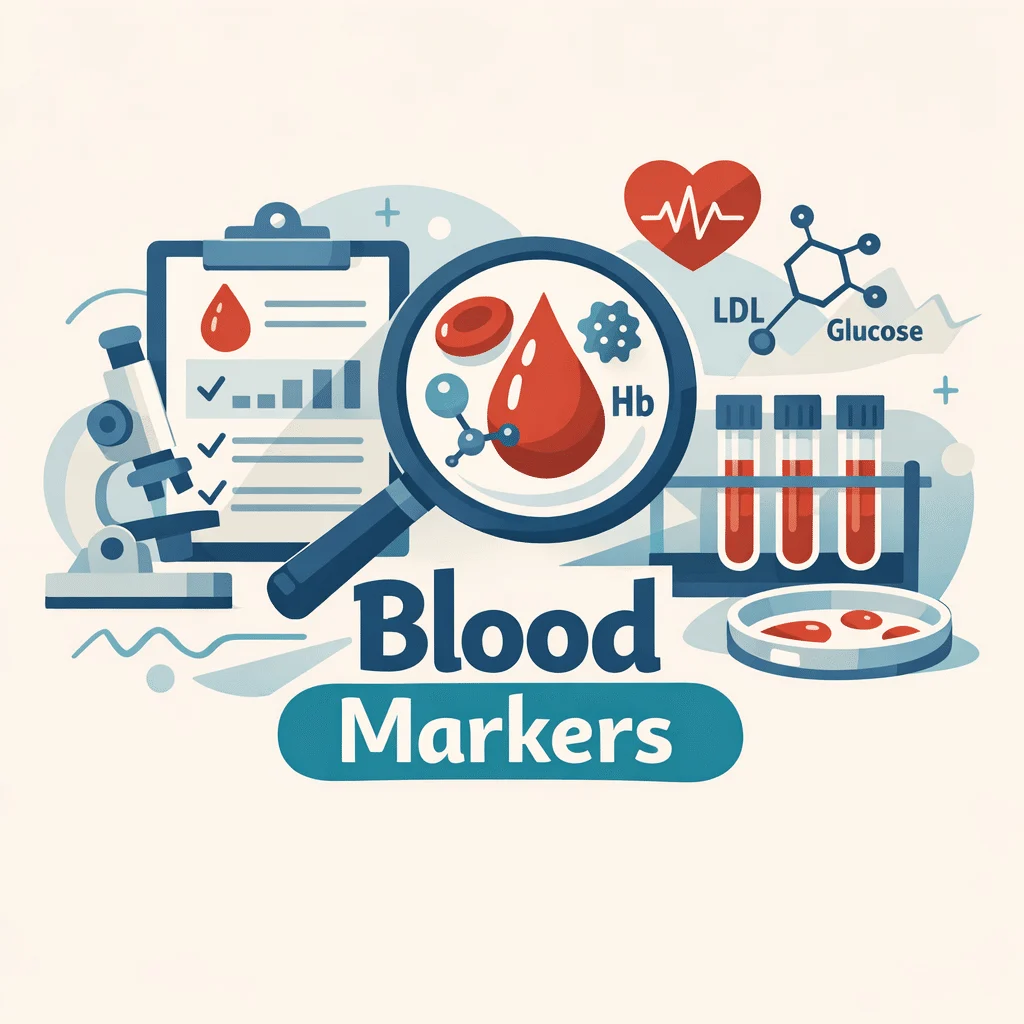
Un reporte de laboratorio puede parecer escrito en otro idioma. Este glosario de marcadores en sangre explica los términos que más probablemente verás en tus estudios de laboratorio, agrupados según el tipo de panel al que pertenecen, para que encuentres lo que necesitas rápidamente. Cada entrada ofrece una definición breve y en lenguaje cotidiano, sin tecnicismos, y cuando AI DiagMe tiene una guía completa sobre un marcador específico, el término enlaza directamente a ella para que puedas profundizar. Usa esta página como referencia a la que puedes volver cada vez que aparezca una nueva abreviatura en tus resultados, y lleva siempre tus dudas reales a tu médico, quien conoce tu historial clínico completo.
Marcadores de la biometría hemática (BH)
La biometría hemática analiza los tres tipos principales de células en tu sangre: glóbulos rojos, glóbulos blancos y plaquetas. Estos marcadores ayudan a detectar anemia, infecciones y riesgo de problemas de coagulación.
| Término | Definición |
|---|---|
| Biometría hemática (BH) | Un solo estudio que cuenta y describe los glóbulos rojos, glóbulos blancos y plaquetas, dando un panorama general del estado de la sangre. |
| Eritrocitos (glóbulos rojos, RBC) | Las células que transportan oxígeno desde tus pulmones al resto de tu cuerpo; un conteo bajo suele indicar anemia. |
| Hemoglobina (Hb) | La proteína rica en hierro que se encuentra dentro de los glóbulos rojos y que se encarga de captar y transportar el oxígeno. |
| Hematocrito (Hct) | El porcentaje de tu volumen total de sangre que está compuesto por glóbulos rojos. |
| VCM (volumen corpuscular medio) | El tamaño promedio de los glóbulos rojos; células más grandes pueden indicar deficiencia de vitamina B12 o ácido fólico, mientras que células más pequeñas sugieren falta de hierro. |
| Leucocitos (glóbulos blancos, WBC) | Células del sistema inmune que defienden al organismo contra infecciones; un conteo elevado suele ser señal de infección o inflamación. |
| Neutrófilos | El tipo más común de glóbulo blanco y la primera línea de defensa contra infecciones bacterianas. |
| Linfocitos | Glóbulos blancos fundamentales para combatir infecciones virales y para construir la memoria inmunológica a largo plazo. |
| Plaquetas | Pequeños fragmentos celulares que se agrupan para detener el sangrado cuando un vaso sanguíneo se lesiona. |
| VPM (volumen plaquetario medio) | El tamaño promedio de las plaquetas, que ofrece pistas sobre qué tan activamente se están produciendo. |
| Ferritina | Una proteína que almacena hierro dentro de las células; niveles bajos indican deficiencia, mientras que niveles altos niveles altos de ferritina pueden reflejar sobrecarga de hierro o inflamación. |
Panel metabólico y marcadores de glucosa
Los paneles metabólicos miden el azúcar en sangre, los electrolitos y cómo tu cuerpo maneja la energía. Estos marcadores son clave para diagnosticar y monitorear la diabetes y la prediabetes.
| Término | Definición |
|---|---|
| Glucosa en ayunas | Una medición del azúcar en sangre tomada después de al menos ocho horas sin comer, que se usa para detectar y diagnosticar diabetes o prediabetes. |
| HbA1c (hemoglobina glucosilada) | Un marcador que refleja tu nivel promedio de azúcar en sangre durante los últimos dos a tres meses, utilizado para diagnosticar y monitorear la diabetes. |
| Insulina | Una hormona producida por el páncreas que ayuda a las células a absorber glucosa de la sangre para obtener energía o almacenarla. |
| HOMA-IR | Un puntaje calculado a partir de la glucosa en ayuno y la insulina en ayuno, que estima qué tan bien responden tus células a la insulina. |
| Sodio | Un electrolito que ayuda a regular el equilibrio de líquidos y la transmisión nerviosa; los riñones controlan sus niveles de forma muy precisa. |
| Potasio | Un mineral esencial para el ritmo cardíaco normal y la función muscular; tanto niveles muy altos como muy bajos pueden ser graves. |
| Bicarbonato (CO2) | Un marcador del equilibrio ácido-base de tu sangre, que refleja qué tan bien regulan el pH tus pulmones y riñones. |
Marcadores hepáticos
Los marcadores hepáticos revelan si las células del hígado están bajo estrés y si la bilis fluye con normalidad. Los médicos los interpretan en conjunto como un patrón, no uno por uno.
| Término | Definición |
|---|---|
| ALT (alanina aminotransferasa / SGPT) | Una enzima que se encuentra principalmente dentro de las células del hígado; aumenta cuando las células hepáticas están inflamadas o dañadas, lo que la convierte en un marcador bastante específico del hígado. |
| AST (aspartato aminotransferasa) | Una enzima presente en el hígado, el corazón y los músculos; niveles elevados suelen indicar daño hepático, pero también pueden reflejar una lesión muscular. |
| ALP (fosfatasa alcalina) | Una enzima que se encuentra principalmente en el hígado y los huesos; niveles elevados pueden indicar problemas en los conductos biliares o afecciones óseas. |
| GGT (gamma-glutamil transferasa) | Una enzima del hígado y los conductos biliares muy sensible para detectar problemas en el flujo de bilis; también se ve afectada por el consumo de alcohol. |
| Bilirrubina (total) | Un pigmento amarillo que se forma cuando los glóbulos rojos se descomponen; niveles altos pueden causar ictericia y pueden ser señal de problemas en el hígado o los conductos biliares. |
| Albúmina | La principal proteína producida por el hígado, importante para el equilibrio de líquidos y para transportar hormonas y medicamentos a través de la sangre. |
| Prealbúmina | Una proteína producida por el hígado que cambia más rápido que la albúmina, lo que la hace útil para evaluar el estado nutricional reciente. |
| Proteínas totales | La cantidad total de todas las proteínas en la sangre, utilizada como herramienta general de detección de la salud del hígado y los riñones. |
Marcadores del panel de lípidos
Un panel de lípidos mide las grasas que circulan en tu sangre y ofrece una imagen de tu riesgo cardiovascular.
| Término | Definición |
|---|---|
| Colesterol total | La suma de todos los tipos de colesterol en tu sangre; un nivel alto puede aumentar el riesgo de enfermedades del corazón y los vasos sanguíneos. |
| Colesterol LDL | Conocido como el “colesterol malo,” el LDL puede depositarse en las paredes de las arterias y contribuir a la formación de placas cuando sus niveles son elevados. |
| Colesterol HDL | Conocido como el “colesterol bueno,” el HDL transporta el exceso de colesterol desde las arterias de regreso al hígado para que sea eliminado. |
| Triglicéridos | Un tipo de grasa en la sangre que se forma a partir de calorías no utilizadas; los niveles altos están relacionados con enfermedades del corazón y, cuando son muy elevados, con pancreatitis. |
| Apolipoproteína B (apoB) | Una proteína que se encuentra en las partículas de LDL y similares; cuenta el número de partículas que pueden obstruir las arterias y se usa cada vez más junto con el colesterol LDL. |
Marcadores de función renal
Los marcadores renales son productos de desecho que los riñones sanos filtran de la sangre. Medirlos es la principal forma de evaluar qué tan bien están funcionando tus riñones.
| Término | Definición |
|---|---|
| Creatinina | Un producto de desecho de la actividad muscular normal que los riñones sanos filtran de manera constante; niveles más altos pueden indicar una filtración más lenta. |
| TFGe (tasa de filtración glomerular estimada) | Un cálculo estimado, basado en la creatinina, la edad y el sexo, de cuánta sangre filtran tus riñones por minuto. |
| BUN (nitrógeno ureico en sangre) | Una medida de la urea, un producto de desecho de la degradación de proteínas; niveles altos pueden indicar una filtración renal reducida o deshidratación. |
| Creatinina en orina | La cantidad de creatinina excretada en la orina, que se usa para calcular índices como la relación albúmina-creatinina y evaluar la función renal. |
| Ácido úrico | Un producto de desecho que eliminan los riñones; los niveles elevados están relacionados con la gota y, en algunos casos, con una menor capacidad de filtración renal. |
Marcadores de coagulación y trombosis
Estos marcadores evalúan cómo tu cuerpo forma y disuelve los coágulos de sangre. Un equilibrio saludable previene tanto el sangrado excesivo como la formación peligrosa de coágulos.
| Término | Definición |
|---|---|
| Dímero D | Un fragmento de proteína que se libera cuando se disuelve un coágulo de sangre; un nivel alto puede indicar actividad reciente de coágulos importantes, como en la trombosis venosa profunda. |
| TTPa (tiempo de tromboplastina parcial activada) | Una prueba que mide cuánto tiempo tarda la sangre en coagularse a través de una parte de la cascada de coagulación, que se usa con frecuencia para monitorear el tratamiento con heparina. |
| Tiempo de protrombina (TP) | Una prueba que mide cuánto tiempo tarda el plasma sanguíneo en coagularse a través de una parte diferente de la cascada de coagulación, que generalmente se reporta junto con el INR. |
| INR (razón normalizada internacional) | Un cálculo estandarizado derivado de la prueba de TP, que se usa principalmente para monitorear anticoagulantes como la warfarina. |
| Antitrombina III | Una proteína anticoagulante natural que ayuda a prevenir la coagulación excesiva; los niveles bajos aumentan el riesgo de trombosis. |
| Proteína C | Una proteína anticoagulante natural que ayuda a limitar la formación de coágulos; una deficiencia aumenta el riesgo de coágulos sanguíneos anormales. |
| Proteína S | Una proteína que trabaja junto con la Proteína C para regular la coagulación; los niveles bajos aumentan el riesgo de trombosis. |
| Vitamina K | Una vitamina liposoluble necesaria para activar varios factores de coagulación en el hígado; su efecto generalmente se mide a través del TP y el INR. |
Marcadores hormonales y endocrinos
Los marcadores hormonales revelan cómo tus glándulas se comunican con el resto de tu cuerpo, desde el metabolismo hasta la respuesta al estrés.
| Término | Definición |
|---|---|
| TSH (hormona estimulante de la tiroides) | Una hormona pituitaria que le indica a la tiroides que produzca más o menos hormona; generalmente es la primera prueba que se usa para evaluar la función tiroidea. |
| T4 libre | La forma activa y libre de la tiroxina, una de las dos principales hormonas tiroideas; se usa para confirmar un resultado de TSH. |
| Cortisol | Una hormona del estrés producida por las glándulas suprarrenales que afecta el azúcar en sangre, la presión arterial y la respuesta inmune. |
| Testosterona | La principal hormona sexual masculina, también presente en menor cantidad en las mujeres; interviene en la masa muscular, la densidad ósea y el deseo sexual. |
Marcadores de inflamación e infección
Estos marcadores aumentan cuando el cuerpo detecta inflamación, lesión o infección en cualquier parte del organismo.
| Término | Definición |
|---|---|
| PCR (proteína C reactiva) | Una proteína producida por el hígado que sube rápidamente ante cualquier inflamación en el cuerpo; se usa para detectar infecciones o enfermedades inflamatorias. |
| PCR de alta sensibilidad (hs-CRP) | Una versión más sensible de la prueba de PCR, utilizada principalmente en cardiología para evaluar el riesgo cardiovascular a largo plazo causado por inflamación de bajo grado. |
| VSG (velocidad de sedimentación globular) | Una prueba que mide qué tan rápido se sedimentan los glóbulos rojos en un tubo; se usa como señal general e inespecífica de inflamación. |
| Troponina | Una proteína que se encuentra casi exclusivamente en las células del músculo cardíaco; su liberación en la sangre es una señal específica y sensible de daño al corazón. |
Vitaminas, minerales y marcadores tumorales
Este último grupo incluye marcadores nutricionales y las sustancias que se usan para ayudar a monitorear ciertos tipos de cáncer.
| Término | Definición |
|---|---|
| Vitamina B12 | Una vitamina esencial para el funcionamiento de los nervios y la producción de glóbulos rojos; su deficiencia puede causar fatiga y glóbulos rojos de mayor tamaño. |
| Vitamina D | Una vitamina que favorece la salud ósea y la absorción de calcio; los niveles bajos son frecuentes y muchas veces pasan desapercibidos sin hacerse estudios. |
| Calcio | Un mineral fundamental para los huesos, los nervios y la función muscular; está regulado de forma precisa por hormonas como la paratiroidea y la vitamina D. |
| Magnesio | Un mineral que participa en cientos de reacciones del organismo, incluyendo la función muscular y nerviosa, y el ritmo cardíaco. |
| Marcadores tumorales | Sustancias que se miden en sangre, orina o tejido y que pueden dar indicios sobre el cáncer; se usan principalmente para dar seguimiento a cánceres ya conocidos, más que para detectarlos en personas sanas. |
| PSA (antígeno prostático específico) | Una proteína que se usa para dar seguimiento, y a veces para detectar, condiciones de la próstata, incluyendo el cáncer; los niveles también pueden elevarse por causas inofensivas. |
| CEA (antígeno carcinoembrionario) | Un marcador que se usa frecuentemente para dar seguimiento al cáncer colorrectal y a algunos otros tipos de cáncer, en especial para detectar señales de recurrencia después del tratamiento. |
Avances científicos recientes
La medicina de laboratorio sigue perfeccionando la forma en que se miden e interpretan los marcadores existentes, muchas veces años antes de que esos cambios lleguen a los reportes de laboratorio del día a día. Algunos avances de los últimos dos años destacan en distintas categorías de este glosario.
En los estudios de lípidos, la Asociación Americana del Corazón publicó en 2024 una guía clínica que aclara cómo debe usarse la apolipoproteína B (apoB) junto con el colesterol LDL para evaluar el riesgo cardiovascular. La apoB puede superar al colesterol LDL en la predicción del riesgo aterosclerótico porque cuenta directamente las partículas que pueden dañar las arterias, en lugar de estimar su contenido de colesterol; además, la revisión propone umbrales de tratamiento más claros para los médicos (Circulation, 2024) (DOI).
En los estudios de marcadores cardiacos, una revisión de 2025 del Grupo Italiano de Estudio sobre Biomarcadores Cardiacos analizó los avances en los ensayos de troponina cardiaca de alta sensibilidad, incluyendo cómo pequeñas elevaciones progresivas por debajo del punto de corte diagnóstico pueden seguir aportando información sobre el riesgo cardiovascular (Clinical Chemistry and Laboratory Medicine, 2025) (DOI).
En los estudios de coagulación, un metaanálisis de 2023 que reunió 68 estudios y más de 140,000 pacientes evaluó estrategias para ajustar los niveles de corte del dímero D, incluidos los ajustes por edad, con el fin de reducir estudios de imagen innecesarios y descartar de forma segura la tromboembolia venosa. Los umbrales ajustados mejoraron de manera significativa la especificidad en comparación con un único punto de corte fijo, aunque el rendimiento varió según la estrategia (Journal of Internal Medicine, 2023) (DOI).
Más allá de los paneles que se abordan aquí, los biomarcadores en sangre para la enfermedad de Alzheimer han avanzado rápidamente. Un informe de 2024 de la Iniciativa Global de CEOs sobre la Enfermedad de Alzheimer describió rutas clínicas para usar análisis de sangre en la clasificación de pacientes y, eventualmente, confirmar la patología amiloide, un cambio que podría permitir un tamizaje más temprano y accesible a medida que se disponga de nuevos tratamientos (Alzheimer’s & Dementia, 2024) (DOI).
En conjunto, estos avances apuntan a una tendencia más amplia: los marcadores se interpretan cada vez más como parte de un patrón, se ajustan según factores individuales y se combinan con otros datos, en lugar de leerse como un número aislado.
Preguntas frecuentes
¿Cuál es el rango normal de un marcador en sangre?
El rango normal, también llamado rango de referencia, es el intervalo de valores que un laboratorio considera típico para una población sana. Los rangos varían entre laboratorios y con frecuencia dependen de tu edad y sexo. Un resultado fuera de este rango es un punto de partida para hablar con tu médico, no necesariamente una señal de enfermedad.
¿Con qué frecuencia debo hacerme análisis de sangre?
Depende de tu edad, tu historial de salud y cualquier condición que ya tengas. Muchos adultos sanos se realizan estudios de rutina como una biometría hemática (BH) o un panel metabólico una vez al año, mientras que las personas con una enfermedad crónica pueden necesitar estudios más frecuentes. Tu médico puede establecer el calendario adecuado para ti.
¿Por qué diferentes laboratorios muestran rangos de referencia distintos para el mismo marcador?
Los laboratorios utilizan equipos, reactivos y poblaciones de referencia diferentes para establecer sus rangos. Por eso es importante comparar siempre tu resultado con el rango impreso en tu propio reporte, no con un número de otra fuente o de un laboratorio anterior.
¿Un marcador sanguíneo alterado significa que tengo una enfermedad grave?
Por lo general, no. Un resultado anormal aislado suele explicarse por factores cotidianos como deshidratación, ejercicio reciente o una enfermedad leve. Los médicos normalmente analizan el panel completo y si el resultado se repite en un estudio de seguimiento antes de sacar conclusiones.
¿Necesito estar en ayuno antes de un análisis de sangre?
Depende de los marcadores que se estén midiendo. La glucosa en ayuno y el perfil de lípidos generalmente requieren entre 8 y 12 horas sin comer, mientras que muchos otros estudios, como la biometría hemática (BH) o el panel tiroideo, no requieren ayuno. Sigue siempre las indicaciones de tu médico o del laboratorio.
¿Cuál es la diferencia entre un marcador sanguíneo y un biomarcador?
Un biomarcador es cualquier señal biológica medible de salud o enfermedad, ya sea en sangre, orina, tejido u otras fuentes. Un marcador sanguíneo es simplemente un biomarcador medido en una muestra de sangre. Cada término de este glosario es un marcador sanguíneo, y la mayoría entra dentro de la categoría más amplia de biomarcadores.
Fuentes
- MedlinePlus (Biblioteca Nacional de Medicina, NIH) — Análisis de laboratorio
- Centros para el Control y la Prevención de Enfermedades (CDC) — Detección de enfermedad renal crónica
- Instituto Nacional del Cáncer (NCI) — Marcadores tumorales
- Joshi PH, et al. “Apolipoprotein B: Bridging the Gap Between Evidence and Clinical Practice.” Circulation, 2024 (DOI)
- Clerico A, et al. “Advancements and challenges in high-sensitivity cardiac troponin assays.” Clinical Chemistry and Laboratory Medicine, 2025 (DOI)
- Gerber JL, et al. “Utility and limitations of patient-adjusted D-dimer cut-off levels for diagnosis of venous thromboembolism.” Journal of Internal Medicine, 2023 (DOI)
- Mielke MM, et al. “Recommendations for clinical implementation of blood-based biomarkers for Alzheimer’s disease.” Alzheimer’s & Dementia, 2024 (DOI)
Lecturas recomendadas
- Biometría hemática (BH): cómo leer tus resultados
- Pruebas de función hepática: cómo leer tu panel hepático
- Panel de función renal: cómo leer tus estudios de sangre renales
- Abreviaturas comunes en análisis de laboratorio médico: una guía
- Cómo leer tus resultados de análisis de sangre: una guía completa
Entender tus resultados de laboratorio no debería requerir un título en medicina. AI DiagMe lee tu reporte de análisis de sangre y explica cada marcador en un lenguaje sencillo, ayudándote a preparar preguntas más claras para tu médico. Obtén la lectura de tus resultados en minutos.