




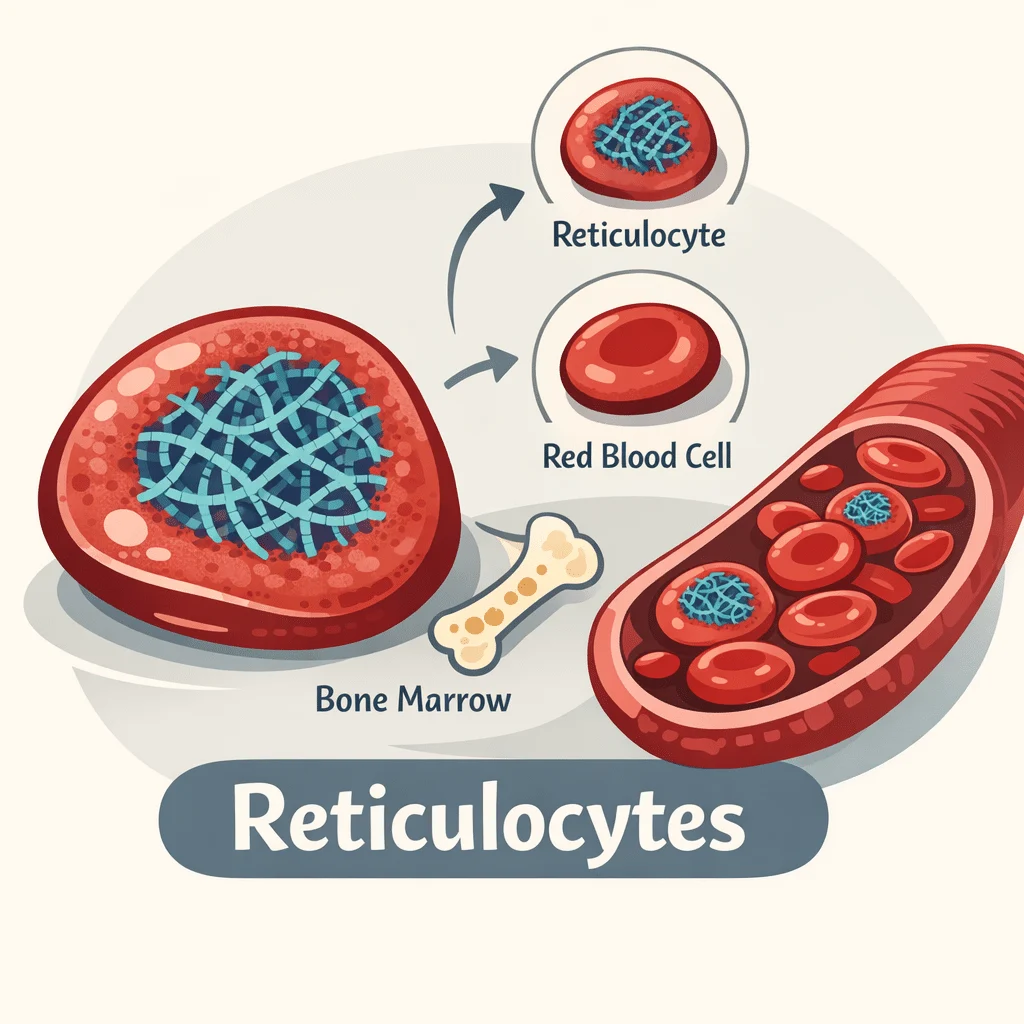
El conteo de reticulocitos mide cuántos glóbulos rojos jóvenes e inmaduros está liberando tu médula ósea hacia el torrente sanguíneo. Como esas células nuevas aparecen uno o dos días después de formarse, el número funciona como una fotografía en tiempo real de qué tan activamente trabaja tu médula para reponer glóbulos rojos. Los médicos lo solicitan con mayor frecuencia para encontrar la causa de una anemia, para verificar si un tratamiento está funcionando y para evaluar qué tan bien se está recuperando la médula después de quimioterapia. En este artículo aprenderás qué mide la prueba, cómo leer un porcentaje, un conteo absoluto y los índices corregidos, qué pueden significar los resultados altos y bajos, y qué otros análisis de sangre ayudan a completar el panorama. El objetivo es que tu resultado te resulte menos intimidante, no reemplazar la interpretación de tu médico.
¿Qué es el conteo de reticulocitos?
Los reticulocitos son glóbulos rojos que acaban de salir de la línea de producción en tu médula ósea. Ya expulsaron su núcleo, pero todavía conservan material genético residual llamado ARN, que es exactamente lo que detectan las tinciones de laboratorio y los analizadores automatizados. Estas células jóvenes generalmente circulan solo uno o dos días antes de madurar y convertirse en glóbulos rojos completamente formados, por lo que contarlas le muestra a tu médico qué tan activamente está produciendo reemplazos la médula en este momento.
Todo el proceso está regulado por una hormona llamada eritropoyetina (EPO), que los riñones liberan cuando los tejidos necesitan más oxígeno, por ejemplo durante una anemia, después de una pérdida de sangre o a gran altitud. Los niveles de EPO suelen subir tres o cuatro días antes de que el conteo de reticulocitos aumente, por lo que el estudio refleja una respuesta reciente y deliberada del organismo. Como la médula ósea es la fábrica y los reticulocitos son su producción más reciente, el conteo funciona como un indicador de producción: ayuda a distinguir entre una anemia causada por una médula que no puede seguir el ritmo y una anemia causada por la pérdida o destrucción acelerada de glóbulos rojos.
El conteo de reticulocitos se realiza con frecuencia junto con una biometría hemática (BH), o bien se solicita cuando los valores de glóbulos rojos se ven anormales. Para ver cómo encaja el panel completo, puedes revisar nuestra guía de biometría hemática. El resultado de reticulocitos aporta el dato que un conteo estándar no puede mostrar por sí solo: la velocidad de producción de nuevas células.
Cómo se mide y se reporta el conteo de reticulocitos
Los analizadores hematológicos modernos miden los reticulocitos de forma automática y pueden reportarlos de varias maneras complementarias. Cada formato responde una pregunta ligeramente distinta, y tu reporte puede mostrar uno o todos ellos. La tabla a continuación resume las medidas que es más probable que encuentres.
| Medida | Qué te indica | Punto de referencia típico | Por qué es importante |
|---|---|---|---|
| Porcentaje de reticulocitos | Proporción de glóbulos rojos que son reticulocitos | Aproximadamente 0.5% a 2.5% en adultos | Tamizaje rápido, pero puede ser engañoso cuando el número de glóbulos rojos es bajo |
| Conteo absoluto de reticulocitos | Número real de reticulocitos en un volumen determinado de sangre | Generalmente alrededor de 25,000 a 85,000 células/µL (varía según el laboratorio) | Menos distorsionado por la anemia que el porcentaje |
| Conteo corregido de reticulocitos | El porcentaje ajustado según el grado de anemia | Escalado respecto a un hematocrito normal | Evita un porcentaje falsamente tranquilizador en casos de anemia |
| Índice de producción de reticulocitos (IPR) | Si la producción de la médula ósea corresponde a la gravedad de la anemia | Un valor por encima de 2 aproximadamente sugiere una respuesta adecuada | Distingue una médula que responde de una que trabaja lentamente |
| Fracción de reticulocitos inmaduros (IRF) | Proporción que representan los reticulocitos más jóvenes de todos | Un valor más alto indica una respuesta temprana y activa | Señal temprana de recuperación o recaída de la médula ósea |
| Hemoglobina reticulocitaria (Ret-He / CHr) | Cuánto hierro se ha incorporado a los glóbulos rojos nuevos | Un valor por debajo de aproximadamente 28 a 30 pg sugiere células con deficiencia de hierro | Detecta la deficiencia de hierro antes que algunos otros estudios |
Porcentaje y conteo absoluto de reticulocitos
El porcentaje es la cifra más conocida, pero tiene una trampa. Describe los reticulocitos como una fracción de todos los glóbulos rojos, así que cuando el conteo total de glóbulos rojos baja por anemia, el porcentaje puede parecer alto aunque la médula ósea apenas esté produciendo. El conteo absoluto de reticulocitos evita ese problema al reportar el número real de células jóvenes, por eso muchos médicos lo revisan primero cuando hay anemia.
Conteo corregido de reticulocitos e índice de producción de reticulocitos (IPR)
Para corregir la trampa del porcentaje, los laboratorios calculan un conteo corregido de reticulocitos, que ajusta el porcentaje según tu hematocrito, es decir, la proporción de sangre compuesta por glóbulos rojos. El índice de producción de reticulocitos va un paso más allá al tomar en cuenta que las células jóvenes liberadas bajo estrés circulan un poco más tiempo. Como referencia general, un índice por encima de aproximadamente 2 a 3 sugiere que la médula ósea está respondiendo adecuadamente a la anemia, mientras que un valor por debajo de 2 indica que la médula está produciendo poco. Tu laboratorio o médico realiza estos cálculos por ti, así que no necesitas hacerlos tú mismo.
Fracción de reticulocitos inmaduros (IRF) y hemoglobina reticulocitaria (Ret-He)
Dos índices más recientes aportan información útil. La fracción de reticulocitos inmaduros (IRF) mide qué proporción de los reticulocitos son los más jóvenes de todos; una IRF en aumento es una de las primeras señales de que la médula ósea está recuperándose, lo que la hace muy valiosa después de quimioterapia o un trasplante de médula ósea. La hemoglobina reticulocitaria, conocida como Ret-He o CHr, estima cuánto hierro se ha incorporado realmente a las células nuevas, lo que ofrece una ventana temprana sobre la producción con deficiencia de hierro. Valores por debajo de aproximadamente 28 a 30 picogramos suelen indicar glóbulos rojos con falta de hierro. Para conocer con más detalle cómo se evalúa el estado del hierro, puedes consultar nuestra guía del panel de estudios de hierro.
Rangos normales del conteo de reticulocitos
Los rangos de referencia varían de un laboratorio a otro porque dependen del equipo utilizado y de la población que cada laboratorio estudia, por lo que los números impresos en tu propio reporte son los que importan. Como guía general, los adultos sanos suelen estar entre aproximadamente 0.5% y 2.5%, un rango utilizado por la Cleveland Clinic y por el material de referencia clínica de StatPearls. Los recién nacidos tienen valores naturalmente más altos, con frecuencia entre 2% y 6%, porque producen glóbulos rojos rápidamente después del nacimiento, y el nivel se acerca al rango adulto durante los primeros meses de vida. Cuando se reporta un conteo absoluto, muchos laboratorios utilizan un rango de aproximadamente 25,000 a 85,000 células por microlitro, aunque esto también varía según el método.
Un hábito práctico es leer el conteo de reticulocitos junto con tu hemoglobina, no de forma aislada. Si la hemoglobina está baja pero el conteo de reticulocitos es alto, la médula ósea está respondiendo al déficit como debe. Si la hemoglobina está baja y el conteo de reticulocitos también está bajo, es posible que la médula ósea en sí sea el problema. Para entender el valor de transporte de oxígeno con el que se relaciona, puedes consultar nuestra guía sobre hemoglobina.
Qué significa un conteo alto de reticulocitos
Un resultado más alto de lo normal, conocido como reticulocitosis, generalmente significa que la médula ósea está trabajando al máximo para reponer los glóbulos rojos que el cuerpo está perdiendo o destruyendo. Una médula ósea sana está haciendo su trabajo en este caso, por lo que un conteo alto suele ser señal de una respuesta adecuada y no de una enfermedad en sí misma. El patrón aún requiere contexto, porque la causa subyacente es lo que realmente importa.
Anemia hemolítica y pérdida de sangre
En la anemia hemolítica, los glóbulos rojos se destruyen más rápido de lo normal, antes de cumplir su vida útil de aproximadamente cuatro meses, y la médula ósea aumenta la producción de reticulocitos para compensarlo. Después de un sangrado, ya sea repentino o lento y oculto, la médula responde de la misma manera. Cuando se sospecha destrucción de glóbulos rojos, los médicos suelen revisar marcadores que cambian conforme las células se desintegran; consulta nuestra guía sobre haptoglobina y lee nuestra guía sobre la prueba de LDH en sangre, ya que la haptoglobina tiende a bajar y la LDH tiende a subir durante la hemólisis.
Recuperación al iniciar el tratamiento
Un conteo de reticulocitos en aumento también es una buena señal cuando ocurre después de un tratamiento. Cuando alguien con deficiencia de hierro, vitamina B12 o ácido fólico comienza a tomar el suplemento adecuado, el conteo suele subir en aproximadamente tres a cinco días, ya que la médula ósea retoma la producción. Los médicos llaman a esto la respuesta reticulocitaria, y es una de las formas más sencillas de confirmar que el tratamiento está funcionando. Aunque algunas personas buscan si un conteo alto de reticulocitos significa cáncer, las causas mucho más frecuentes son sangrado, hemólisis o una médula ósea que se está recuperando bien; el cáncer de sangre nunca se diagnostica a partir de este único valor.
Qué significa un conteo bajo de reticulocitos
Un resultado bajo significa que la médula ósea no está reponiendo los glóbulos rojos con la suficiente rapidez para cubrir las necesidades del cuerpo. Cuando esto ocurre junto con anemia, apunta a un problema de producción más que a una pérdida o destrucción de células, y el siguiente paso suele ser identificar qué nutriente o proceso está fallando.
La deficiencia de hierro es la causa más común en todo el mundo. Sin suficiente hierro, la médula ósea no puede producir hemoglobina, por lo que el conteo de reticulocitos se mantiene bajo o inapropiadamente normal aunque el cuerpo necesite más glóbulos rojos. Puedes leer nuestra guía sobre ferritina baja para ver cómo se detectan las reservas bajas de hierro. La falta de vitamina B12 o ácido fólico altera la producción de glóbulos rojos de una manera diferente; consulta nuestra guía sobre vitamina B12 baja y lee nuestra guía sobre deficiencia de ácido fólico.
Otras causas se encuentran más arriba en la cadena. En la anemia aplásica, la médula ósea no produce suficientes células de ningún tipo, mientras que la enfermedad renal crónica reduce la EPO, la hormona que le indica a la médula que produzca glóbulos rojos; puedes explorar nuestra guía sobre el panel de función renal para ver cómo se evalúa la salud de los riñones. La quimioterapia y algunos otros medicamentos también suprimen temporalmente la producción. Como los glóbulos rojos pequeños suelen acompañar los problemas de hierro, los médicos también pueden considerar el tamaño promedio de las células; puedes ver nuestra guía sobre VCM bajo para esa parte del panorama.
Cómo interpretar el conteo de reticulocitos junto con otros marcadores
Como el conteo de reticulocitos es un indicador de producción, resulta más útil cuando se combina con la hemoglobina y algunos marcadores de hierro. La guía rápida a continuación muestra patrones que los médicos observan con frecuencia. Es un punto de partida para entender tu situación, no un diagnóstico; solo tu médico puede confirmar qué significa tu combinación particular de resultados.
| Hemoglobina | Conteo de reticulocitos | Lo que suele indicar | Estudios que el médico puede agregar |
|---|---|---|---|
| Baja | Alta | Pérdida de sangre o hemólisis, con respuesta de la médula ósea | Haptoglobina, DHL, bilirrubina |
| Baja | Bajo o normal | Problema de producción: hierro, B12, ácido fólico, médula ósea o riñones | Ferritina, estudios de hierro, B12, ácido fólico, función renal |
| Normal | Alta | Sangrado reciente o una anemia en recuperación | Repetir biometría hemática (BH) y estudios de hierro |
| Normal | Normal | Por lo general, es una señal alentadora de producción de glóbulos rojos | Seguimiento de rutina si los síntomas continúan |
Vale la pena conocer un detalle más: el conteo de reticulocitos puede estar técnicamente dentro del rango normal y, aun así, ser demasiado bajo para la situación. Cuando la anemia es grave pero el conteo no ha subido para compensarla, los médicos hablan de una respuesta inapropiada, que es precisamente la razón por la que existen el conteo corregido y el índice de producción.
Avances científicos recientes
Con base en estudios recientes indexados en PubMed, una de las áreas más activas en torno al conteo de reticulocitos es la hemoglobina reticulocitaria (Ret-He), el índice que estima cuánto hierro hay dentro de los glóbulos rojos más nuevos. Los hallazgos que se presentan a continuación son prometedores, pero deben leerse con cuidado: un marcador que funciona bien en un grupo puede ser menos útil en otro, y nada de esto reemplaza la evaluación de un médico.
En un estudio multicéntrico con 2,760 pacientes sometidos a cirugía mayor, un Ret-He bajo (por debajo de 33.5 picogramos) ayudó a identificar la anemia por deficiencia de hierro con buena precisión y siguió siendo útil incluso cuando la ferritina estaba falsamente elevada por inflamación, una situación en la que los estudios de hierro estándar pueden dar resultados engañosos (Choorapoikayil S, et al., BMC Anesthesiology, 2025, DOI). Un amplio estudio pediátrico realizado en un hospital infantil de Estados Unidos llegó a una conclusión similar: un Ret-He igual o inferior a aproximadamente 30 picogramos ayudó a confirmar la deficiencia de hierro en niños (Poventud-Fuentes I, et al., International Journal of Laboratory Hematology, 2024, DOI).
Las limitaciones importan tanto como las ventajas. En una cohorte de pacientes embarazadas en Estados Unidos, el Ret-He mostró solo una precisión baja para detectar deficiencia leve de hierro, y los autores concluyeron que la ferritina seguía siendo el estudio preferible durante el embarazo (Haizler-Cohen L, et al., American Journal of Perinatology, 2024, DOI). En conjunto, la ventaja del Ret-He es que se obtiene de la misma muestra de sangre que una biometría hemática (BH) de rutina y no se ve afectado por la inflamación; sin embargo, la evidencia actual sugiere que complementa a la ferritina y los estudios de hierro en lugar de reemplazarlos. Como siempre, qué estudio es el más adecuado para cada persona es una decisión que le corresponde al médico.
Cuándo consultar a tu médico
El conteo de reticulocitos es una pista, no un diagnóstico definitivo, y un valor fuera de rango por sí solo rara vez es una urgencia. Aun así, hay situaciones que requieren atención médica pronta. Consulta a un profesional de la salud o busca atención urgente si notas:
- Un conteo de reticulocitos muy alto o muy bajo, especialmente junto con otros valores anormales en los estudios de sangre
- Cansancio intenso, dificultad para respirar, mareos, o latidos del corazón rápidos o fuertes
- Signos de sangrado, como heces negras o con aspecto alquitranado, o sangrado menstrual que empapa la protección en una o dos horas
- Un cambio rápido en tus valores entre dos estudios
- Síntomas nuevos, que empeoran o que no tienen explicación
Si el cambio es leve, aislado y te sientes bien, tu médico puede simplemente recomendarte repetir el estudio más adelante. Es recomendable evitar tomar hierro en dosis altas u otros suplementos sin hacerte estudios primero, porque el exceso de hierro es dañino y puede ocultar la causa real. Un análisis de sangre sencillo, interpretado en contexto, es la forma más segura de saber qué está pasando.
Glosario
| Término | Definición |
|---|---|
| Reticulocito | Un glóbulo rojo joven, recién liberado por la médula ósea, que todavía contiene trazas de ARN y madura en uno o dos días. |
| Conteo de reticulocitos | Un análisis de sangre que mide cuántos reticulocitos están presentes, lo que indica con qué intensidad está produciendo glóbulos rojos la médula. |
| Eritropoyetina (EPO) | Una hormona producida principalmente por los riñones que le indica a la médula ósea que produzca más glóbulos rojos. |
| Conteo absoluto de reticulocitos | El número real de reticulocitos en un volumen determinado de sangre, menos afectado por la anemia que el porcentaje. |
| Conteo corregido de reticulocitos | El porcentaje de reticulocitos ajustado según el grado de anemia, lo que da una imagen más precisa de la producción de la médula. |
| Índice de producción de reticulocitos (IPR) | Un cálculo que muestra si la respuesta de la médula es adecuada para la gravedad de la anemia. |
| Fracción de reticulocitos inmaduros (IRF) | La proporción de reticulocitos que son los más jóvenes, utilizada como señal temprana de recuperación de la médula. |
| Hemoglobina reticulocitaria (Ret-He / CHr) | Un índice de cuánto hierro se ha incorporado a los nuevos glóbulos rojos, usado para detectar de forma temprana una producción deficiente en hierro. |
| Reticulocitosis | Un conteo de reticulocitos más alto de lo normal, que suele ser una respuesta al sangrado o a la destrucción de glóbulos rojos. |
| Anemia hemolítica | Anemia causada porque los glóbulos rojos se destruyen más rápido de lo que la médula puede reponerlos. |
Preguntas frecuentes
¿El conteo de reticulocitos forma parte de la biometría hemática (BH)?
Está estrechamente relacionado, pero generalmente es una medición aparte. Una biometría hemática (BH) estándar reporta el número de glóbulos rojos, la hemoglobina y el tamaño de las células, mientras que el conteo de reticulocitos mide específicamente la producción de células nuevas. Muchos analizadores modernos pueden obtenerlo de la misma muestra de sangre, y los laboratorios suelen realizarlo de forma automática cuando los resultados de glóbulos rojos parecen anormales o cuando el médico lo solicita. Así que, aunque va de la mano con la BH, generalmente se reporta como un valor independiente y no se incluye en cada conteo de rutina.
¿Los reticulocitos tienen núcleo?
No. Para cuando un reticulocito es liberado al torrente sanguíneo, ya expulsó su núcleo, que es lo que lo diferencia de células aún más jóvenes llamadas glóbulos rojos nucleados. Lo que todavía conserva es ARN residual, el material que las tinciones y los analizadores detectan para identificar y contar estas células. Por eso los reticulocitos se describen como glóbulos rojos inmaduros y no como un tipo de célula completamente distinto: están a un paso de alcanzar su madurez total.
¿Qué significa tener el conteo de reticulocitos alto?
Un conteo elevado generalmente indica que la médula ósea está produciendo glóbulos rojos más rápido de lo habitual, la mayoría de las veces para reponer células perdidas por sangrado o destruidas en una hemólisis, o como respuesta saludable al tratamiento de la anemia. En ese sentido, suele reflejar una médula que está funcionando bien. El resultado debe interpretarse junto con tu hemoglobina y tus síntomas, porque la causa detrás del aumento es lo que orienta los siguientes pasos. Tu médico es quien está en mejor posición para interpretarlo.
¿Qué significa tener el conteo de reticulocitos bajo?
Un conteo bajo sugiere que la médula ósea no está produciendo suficientes glóbulos rojos nuevos. Las causas más comunes incluyen deficiencia de hierro, vitamina B12 o folato, enfermedad renal crónica, los efectos de la quimioterapia, o un trastorno de la médula como la anemia aplásica. Cuando un conteo bajo aparece junto con anemia, generalmente apunta a un problema de producción más que a pérdida de sangre. Identificar cuál es la causa responsable, frecuentemente con estudios de hierro o niveles de vitaminas, es importante porque los tratamientos son muy diferentes.
¿Puedes tener un conteo de reticulocitos normal con anemia?
Sí, y es un patrón importante. Un conteo que parece normal puede ser en realidad demasiado bajo para la situación cuando la anemia es significativa, porque una médula ósea sana debería estar produciendo células extra para compensar. Los médicos llaman a esto una respuesta reticulocitaria inapropiada. Para detectarlo, suelen calcular el conteo de reticulocitos corregido o el índice de producción de reticulocitos, que ajustan el número bruto según el grado de anemia y muestran si la médula realmente está respondiendo como debería.
¿Los reticulocitos están elevados en la anemia por deficiencia de hierro?
Por lo general, no. Como el hierro es un componente esencial que la médula necesita para producir glóbulos rojos, la deficiencia de hierro tiende a mantener el conteo de reticulocitos bajo o apenas normal, aunque el cuerpo necesite más células. Esto es lo contrario de lo que ocurre en la anemia hemolítica o después de un sangrado, donde el conteo sube. Esta diferencia es una de las razones por las que el conteo de reticulocitos es tan útil: ayuda a distinguir las anemias causadas por falta de suministro de las causadas por pérdida o destrucción.
Fuentes
- Conteo de reticulocitos (MedlinePlus, Biblioteca Nacional de Medicina, NIH)
- Conteo de reticulocitos: prueba, propósito y resultados (Cleveland Clinic)
- Histología, reticulocitos (StatPearls, NCBI Bookshelf, NIH)
- Choorapoikayil S, et al. Reticulocyte hemoglobin content: a new frontier in iron deficiency diagnostics for major surgical patients. BMC Anesthesiology, 2025. DOI
- Poventud-Fuentes I, et al. Reticulocyte hemoglobin equivalent as a marker to assess iron deficiency: a large pediatric tertiary care hospital study. International Journal of Laboratory Hematology, 2024. DOI
- Haizler-Cohen L, et al. Utility of Reticulocyte Hemoglobin Equivalent in Screening for Iron Deficiency in Pregnancy. American Journal of Perinatology, 2024. DOI
Lecturas recomendadas
- Anemia: síntomas, causas y los análisis de laboratorio para diagnosticarla
- Biometría hemática (BH): cómo leer tus resultados
- Ferritina baja: causas, síntomas y tratamiento
- Hemoglobina: cómo entender este marcador clave en tu sangre
- Cómo leer tus resultados de análisis de sangre
Entiende tus resultados de laboratorio con AI DiagMe
Un conteo de reticulocitos rara vez viene solo. Tiene más sentido cuando se analiza junto con valores como la hemoglobina, la ferritina y el resto de tu biometría hemática (BH), y es precisamente al leerlos todos juntos cuando suelen surgir las dudas. AI DiagMe te ayuda a entender qué significa cada uno de estos resultados en un lenguaje claro y sencillo, poniendo tu conteo de reticulocitos en contexto para que puedas hacerle preguntas más precisas a tu médico. Está diseñado para ayudarte a entender tus resultados, no para diagnosticar una enfermedad ni reemplazar la consulta médica. Si tienes un análisis de sangre reciente, puedes ver qué te está diciendo en tan solo unos minutos.
➡ Obtén la lectura de tus resultados en minutos